When Military Service Deserves Recognition: Understanding the MoD Medal Application Process
The Ministry of Defence Medal Office (MODMO) handles thousands of applications each year from veterans, serving personnel, and families seeking recognition for military service through official medals and decorations. Whether you're a veteran discovering you may be entitled to medals never claimed, a family member researching a deceased relative's service record, or someone with power of attorney acting on behalf of a living serviceperson, the Medal Application Form MODMO 0001 serves as your gateway to obtaining these important military honours.
The process extends far beyond simply requesting a medal. Each application triggers a comprehensive review of service records, verification of entitlement under current MoD policy, and careful authentication to prevent fraudulent claims. For many applicants, this represents the culmination of years of research into family military history or the resolution of administrative oversights that occurred decades ago during or after service.
Eligibility Boundaries: Who Can Apply and Under What Circumstances
The medal application system operates under strict eligibility criteria that reflect both legal frameworks and MoD policy decisions. Medals awarded prior to the Second World War can no longer be issued - a significant limitation that affects many families researching earlier conflicts including the Great War.
Three distinct categories of applicants can submit the MODMO 0001 form, each with specific requirements and documentation standards:
Direct Applications from Veterans and Serving Personnel
Current and former members of the Royal Navy, Royal Marines, Army, Royal Air Force, or recognised civilian services can apply directly for their own medals. This includes Home Guard personnel, provided they specify their county of enlistment, and civilian contractors who must supply their National Insurance number alongside service details.
The form accommodates complex service histories, including personnel who served in multiple regiments or corps, held different names during service, or had breaks in their military careers. Applicants must provide their service number, complete service dates, and details of any additional military or civil defence service that might affect their medal entitlement.
Applications Through Power of Attorney
Individuals holding legal power of attorney can apply on behalf of living veterans or servicepersons who cannot complete the process themselves due to incapacity, illness, or other circumstances. The MoD requires either a copy of the registered Power of Attorney document or the LPA online access code provided during registration with the Office of the Public Guardian.
This provision proves particularly valuable for elderly veterans in care facilities or those experiencing cognitive decline who retain entitlement to medals but lack the capacity to navigate the application process independently.
Next of Kin Applications for Deceased Personnel
The most complex category involves applications on behalf of deceased veterans or servicepersons, where entitlement follows strict next of kin rules based on intestacy law. The entitled next of kin represents the first person from a detailed hierarchy who remains alive, beginning with surviving spouses or civil partners and progressing through children, grandchildren, parents, siblings, and extended family members.
| Priority Order | Relationship | Additional Notes |
|---|---|---|
| 1 | Surviving Spouse or Civil Partner | Takes precedence over all other relationships |
| 2 | Eldest Surviving Child | Age determines priority among siblings |
| 3 | Eldest Surviving Grandchild | Only if no surviving children |
| 4 | Surviving Parents | Both parents have equal claim |
| 5 | Eldest Surviving Brother or Sister | Full siblings take precedence over half-siblings |
Applicants who do not qualify as entitled next of kin can still request information but will only receive a list of medal entitlement rather than the physical medals themselves.
Technical Requirements and Digital Form Management
The MODMO 0001 exists as a sophisticated PDF form that requires specific software and handling procedures to function correctly. Understanding these technical requirements prevents common submission problems and ensures your application reaches the Medal Office in the correct format.
Software Compatibility and Saving Procedures
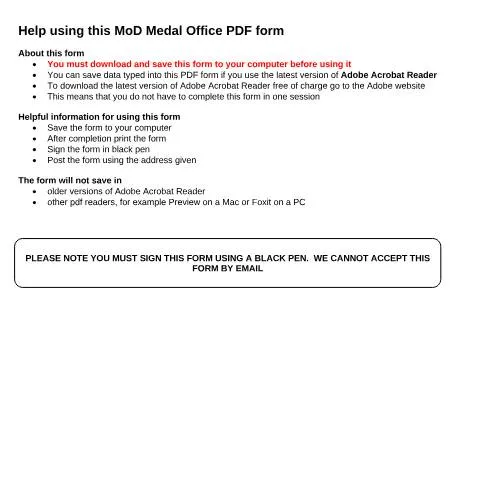
The form functions properly only with the latest version of Adobe Acrobat Reader, available free from Adobe's website. Other PDF readers, including Preview on Mac systems or Foxit on PC platforms, cannot save the entered data, potentially causing applicants to lose hours of work.
The recommended workflow involves downloading and saving the blank form to your computer before beginning completion. This allows you to work on the application across multiple sessions, saving your progress as you gather required documentation and verify service details.
Once completed, you must print the form and sign it using black pen - a specific requirement that reflects the MoD's need for clear, scannable signatures. The Medal Office cannot accept forms submitted by email, requiring postal submission to maintain security and authenticity standards.
Identity Verification and Anti-Fraud Measures
To combat fraudulent claims, every application must include identity verification documentation. Acceptable forms include a copy of your passport, photo driving licence, or recent utility bill. This requirement applies regardless of whether you're applying for yourself, through power of attorney, or as next of kin.
The MoD warns that falsely claiming to be entitled next of kin may result in your contact details being shared with the person they consider the correct recipient, allowing the parties to resolve the dispute directly.
Documentation Standards and Supporting Evidence
Successful medal applications depend heavily on providing complete, accurate documentation that supports your claim and verifies your identity or relationship to the serviceperson. The MoD has developed specific requirements for different types of supporting evidence, reflecting lessons learned from processing thousands of applications.
Service Documentation Requirements
The form demands comprehensive service details including service numbers, enlistment and discharge regiments or corps, complete service dates, and information about any additional military or civil defence service. For personnel who served under different names, perhaps due to marriage or legal name changes, you must provide all names used during service periods.
Home Guard applicants face additional requirements, needing to specify their county of enlistment - information that helps the Medal Office locate relevant records and verify service authenticity. Civilian contractors must provide their National Insurance number, creating a link between military service records and civilian employment documentation.
Death Certificates and Next of Kin Verification
Applications for deceased personnel require a copy of the death certificate or notification of death, except for those who died in service where MoD records already contain this information. The death certificate serves multiple purposes: confirming the person's death, establishing the date for medal entitlement calculations, and providing legal documentation supporting the next of kin application.
Next of kin applicants must complete a formal declaration confirming their status as the official next of kin, understanding that false claims may result in disclosure of their contact details to resolve disputes.
Communication Preferences and International Considerations
The Medal Office operates modern communication systems that can significantly speed up the application process, but these digital channels come with specific requirements and limitations that vary based on your location and circumstances.
Digital Communication Consent and Security
Applicants can authorise email and text message correspondence, accepting that these communications travel over unsecured networks and may be subject to interception or unauthorised use. The MoD explicitly states they will not be liable for any loss or compromise of information transmitted through these channels.
Email and text communications may include personal details and other information that could compromise your identity, requiring informed consent before the Medal Office can use these faster communication methods.
Overseas and Northern Ireland Delivery Requirements
Residents of Northern Ireland and overseas locations face mandatory requirements that differ from those applying within England, Scotland, and Wales. These applicants must provide both an email address and phone number on their application form, or delivery will not be possible.
For overseas applicants entitled to awards, the MoD may need to share contact details with local postal or customs services to ensure successful delivery. This requirement reflects the complex logistics of international medal distribution and the need to navigate various countries' customs and postal regulations.
Processing Timeline and Administrative Procedures
Understanding the Medal Office's internal processes helps set realistic expectations about application timelines and explains why certain documentation requirements exist. The MODMO processes applications systematically, but various factors can influence processing speed and outcomes.
Record Verification and Entitlement Assessment
Each application triggers a comprehensive review of military service records, cross-referencing provided information against official databases and archived documents. For older service records, this process can involve consulting physical archives and may require additional time to locate and verify service details.
The Medal Office assesses entitlement based on current MoD policy, which may differ from policies in place during the applicant's service period. Changes in medal criteria, service recognition standards, and eligibility requirements over decades mean that some personnel may discover they're entitled to medals they never knew existed, while others may find that medals they expected are no longer available.
Quality Control and Anti-Fraud Verification
Every application undergoes security screening designed to prevent fraudulent claims and ensure medals reach their rightful recipients. This process includes verifying identity documentation, confirming service records match provided details, and validating next of kin claims through cross-referencing with available records.
For applications involving deceased personnel, the Medal Office may conduct additional verification to ensure the applicant represents the legitimate entitled next of kin, particularly in cases where family relationships are complex or disputed.
Data Protection and Privacy Considerations
The Medal Office operates under strict data protection requirements that govern how personal information is collected, processed, and shared throughout the application process. Understanding these privacy provisions helps applicants make informed decisions about their applications and communication preferences.
The MoD's commitment to protecting privacy and security of personal data extends beyond basic compliance with UK data protection legislation. The organisation has developed specific protocols for handling sensitive military service information, family relationship data, and personal identification documents submitted with medal applications.
Applicants should review the MoD Privacy Notice and Personal Information Charter to understand their rights and the standards they can expect when the Ministry requests, holds, or shares personal information. These documents explain how long information will be retained, who may access it, and under what circumstances it might be shared with other organisations or individuals.
For international applicants, data sharing with local postal and customs services represents a necessary compromise between privacy protection and successful medal delivery, highlighting the complex balance between operational requirements and data protection principles.
Beyond the Application: What Happens Next
Submitting the MODMO 0001 form marks the beginning rather than the end of the medal application process. Understanding subsequent stages helps applicants prepare for potential queries, additional documentation requests, and the eventual outcome of their application.
The Medal Office assigns each application a unique MODMO reference number for tracking purposes and may contact applicants for clarification or additional information. Response times for these queries can affect overall processing duration, making prompt and complete responses essential for efficient application handling.
Successful applications result in medal dispatch, typically accompanied by documentation explaining the medals awarded and their significance. For next of kin applications, this represents not just the delivery of physical medals but often the completion of long-standing family research and the proper recognition of a loved one's military service.
Applications that cannot be processed successfully receive detailed explanations of the reasons, whether due to incomplete service records, eligibility limitations, or documentation deficiencies. In many cases, applicants can address these issues and resubmit their applications with additional information or corrected details.