Electoral Participation: The Gateway to Democratic Rights in England
Electoral registration represents the fundamental step that transforms residents into active participants in the UK's democratic process. The paper-based voter registration form ITR-E serves as the traditional pathway for individuals to secure their place on the electoral roll, enabling them to exercise their voting rights in local elections, general elections, and referendums. This process becomes particularly significant for those who prefer paper applications over digital alternatives or find themselves in circumstances where online registration proves unsuitable.
The registration system operates on the principle of individual electoral registration, introduced to enhance the accuracy and security of electoral rolls. Each eligible person must register independently, even within the same household, marking a departure from the previous household registration system. This change ensures that electoral registers reflect the genuine voting population and reduces opportunities for electoral fraud.
Eligibility Criteria and Citizenship Requirements
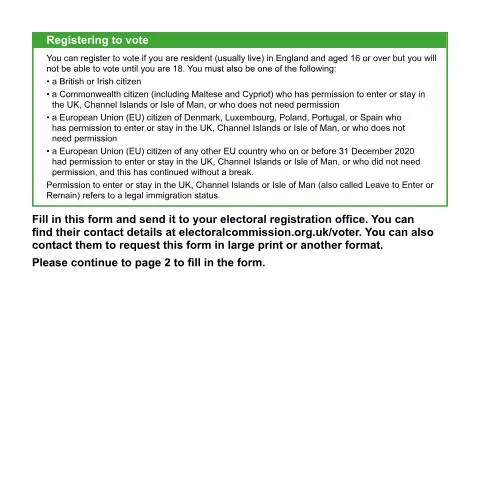
The voter registration framework in England establishes specific eligibility criteria that reflect both historical ties and contemporary immigration realities. Age requirements permit registration from 16 years onwards, though voting rights only commence at 18. This early registration system ensures young people can participate immediately upon reaching voting age without administrative delays.
Citizenship categories eligible for registration include British and Irish citizens, who enjoy automatic eligibility based on historical constitutional arrangements. Commonwealth citizens must demonstrate permission to enter or remain in the UK, Channel Islands, or Isle of Man, or show they don't require such permission. This encompasses citizens from countries including Malta and Cyprus, reflecting their Commonwealth status despite EU membership.
European Union citizens face more complex requirements following Brexit arrangements. Citizens of Denmark, Luxembourg, Poland, Portugal, and Spain retain registration rights if they possess appropriate immigration status. However, EU citizens from other member states must demonstrate continuous permission to remain since 31 December 2020, creating a two-tier system based on transitional arrangements.
| Citizenship Category | Registration Requirements | Additional Conditions |
|---|---|---|
| British/Irish | Automatic eligibility | Resident in England, aged 16+ |
| Commonwealth | Permission to enter/stay UK | Or no permission required |
| EU (Denmark, Luxembourg, Poland, Portugal, Spain) | Permission to enter/stay UK | Or no permission required |
| Other EU citizens | Continuous permission since 31/12/2020 | No breaks in legal status |
Immigration Status Documentation and Continuous Residence
The form's section on immigration status requires careful consideration of legal terminology and documentation. Permission to enter or stay encompasses various immigration statuses, including settled status under the EU Settlement Scheme, indefinite leave to remain, and limited leave arrangements. Applicants must understand that temporary absences don't automatically invalidate continuous residence if they fall within permitted parameters of their immigration status.
Pre-settled status holders under the EU Settlement Scheme qualify for registration, except those who obtained status as joining family members after the transition period. This distinction reflects the complex layering of Brexit-related immigration arrangements and their electoral consequences.
Individuals exempt from immigration controls, such as diplomats and certain international organisation employees, maintain registration eligibility provided they meet residency requirements. These exemptions acknowledge that legal residence doesn't always require formal immigration permissions.
Addressing Documentation Gaps
Section 10 of the form accommodates applicants who cannot provide standard identification details. Electoral registration officers possess discretionary powers to request alternative evidence when National Insurance numbers, birthdates, or nationality information remains unavailable. This flexibility ensures that vulnerable populations, including recent immigrants and individuals with complex personal histories, aren't automatically excluded from democratic participation.
Residential Address Requirements and Multiple Dwellings
Electoral registration operates on the principle of usual residence, recognising that individuals may maintain connections to multiple addresses. The form accommodates those living at several locations by requesting primary residence details while allowing disclosure of additional addresses when relevant.
Students often face particular challenges regarding address registration, as they may maintain both term-time and family home addresses. The electoral system permits registration at both locations, though voting in the same election from multiple constituencies constitutes an offence. Students must choose their preferred voting location for each electoral event.
Recent house moves require disclosure of previous addresses within the preceding twelve months, enabling electoral registration officers to maintain accurate records and prevent duplicate registrations. Overseas addresses during this period trigger additional questions about overseas voter registration, ensuring continuity of electoral rights for returning expatriates.
Overseas Connections and Returning Residents
Individuals returning from overseas periods must indicate whether they maintained UK electoral registration as overseas voters. This information helps electoral registration officers understand applicants' electoral history and ensures appropriate processing of their current applications. Returning expatriates may face varying requirements depending on their previous registration status and the duration of their overseas residence.
Personal Identification and Data Verification
The form requires multiple forms of personal identification to establish applicants' identities and prevent fraudulent registrations. National Insurance numbers serve as the primary identifier, linking electoral records to established government databases. These numbers appear on payslips, pension statements, and benefits correspondence, making them accessible to most eligible applicants.
Date of birth verification enables cross-referencing with existing government records while establishing voting age eligibility. The form accommodates individuals uncertain of their exact birthdate by providing age range options, though precise dates facilitate more effective verification processes.
Name change documentation becomes relevant for individuals who've altered their names through marriage, deed poll, or other legal processes. While providing previous names remains optional, this information assists electoral registration officers in linking current applications to existing records and maintaining registration continuity.
Verification Challenges and Alternative Evidence
Electoral registration officers may request additional documentation when standard verification methods prove insufficient. This discretionary power ensures that individuals with complex backgrounds or limited documentation can still access electoral rights, though processing times may extend while alternative verification occurs.
The Open Register and Privacy Considerations
Electoral registration creates two distinct versions of the electoral register: the full register used for elections and the edited register available for commercial purposes. The open register represents the commercially available version, purchased by businesses for direct marketing and other commercial activities.
Applicants possess the right to exclude themselves from the open register while maintaining their inclusion in the full electoral register. This opt-out mechanism balances democratic participation with privacy protection, acknowledging that electoral registration shouldn't automatically expose individuals to commercial exploitation.
Data protection considerations under the UK GDPR influence how electoral registration data is collected, processed, and shared. Electoral registration officers must balance democratic participation requirements with individuals' privacy rights, ensuring that registration processes comply with contemporary data protection standards.
Absent Voting Arrangements and Accessibility
The voter registration form connects to broader absent voting arrangements, acknowledging that not all registered voters can attend polling stations in person. Postal voting applications require separate forms but can be initiated through the registration process by indicating preferences on the ITR-E form.
Proxy voting arrangements enable registered voters to designate trusted individuals to vote on their behalf when personal attendance proves impossible. These arrangements require additional applications and verification processes, reflecting the sensitive nature of delegated voting rights.
The recent introduction of voter ID requirements adds complexity to electoral participation, necessitating photo identification at polling stations. The Voter Authority Certificate provides a free alternative for individuals lacking accepted photo ID, ensuring that identification requirements don't create barriers to democratic participation.
Format Accessibility and Support Services
Electoral registration offices must provide registration forms in accessible formats, including large print versions and alternative formats for individuals with disabilities. This requirement ensures that physical or sensory impairments don't prevent electoral registration and subsequent democratic participation.
Processing Procedures and Legal Obligations
Electoral registration operates under legal compulsion, with potential £80 fines for individuals who fail to register when required. This enforcement mechanism reflects the importance placed on maintaining accurate electoral registers, though prosecution remains relatively rare and typically focuses on deliberate non-compliance rather than innocent oversight.
The declaration section of the form establishes legal responsibilities for applicants, including potential criminal penalties for knowingly providing false information. These penalties can include imprisonment up to six months and unlimited fines, emphasising the seriousness of electoral registration fraud.
Processing timelines vary depending on application complexity and verification requirements. Straightforward applications typically process within days, while cases requiring additional documentation or verification may take several weeks. Electoral registration officers prioritise applications received close to electoral events to ensure eligible voters can participate.
The form submission process requires posting completed applications to local electoral registration offices, whose contact details are available through the Electoral Commission's website. This localised approach ensures that applications reach the appropriate authority for the applicant's residential area, facilitating efficient processing and accurate register maintenance.
Signature requirements establish additional verification layers while creating legal accountability for applicants. The combination of signature and date creates a formal record of application submission, supporting subsequent verification processes and potential legal proceedings if false information is discovered.
Special Circumstances and Alternative Registration Routes
While the standard paper registration process covers most situations, certain circumstances require additional documentation or alternative approaches. Understanding these special cases ensures your application proceeds smoothly without unnecessary delays.
Crown Servants and British Forces Personnel
British citizens serving abroad as Crown servants or members of the British Forces can register as overseas electors using paper forms. This includes diplomatic staff, British Council employees, and service personnel stationed internationally. You'll need to provide evidence of your Crown service or Forces status, typically through an official letter from your commanding officer or department head.
The registration covers your last UK address before overseas service, and you can vote by post or proxy in UK Parliamentary elections and European Parliament elections (where applicable). Your spouse or civil partner may also be eligible for overseas registration if they're British citizens who accompanied you abroad.
Students with Multiple Addresses
Students often face unique registration challenges when moving between term-time and home addresses. You can register at both your home address and university accommodation, but you can only vote once in any single election. The paper form allows you to specify which address you consider your main residence for electoral purposes.
When completing the form, indicate whether you're registering as a student, as this affects how long your registration remains valid. University halls of residence typically have established procedures for bulk registrations, but individual paper applications remain necessary if you miss these organised registration drives.
Individuals Without Fixed Address
People experiencing homelessness or those without a permanent address can still register to vote using paper forms. You can register using an address where you spend substantial time, such as a day centre, hostel, or friend's address. The form requires an explanation of your connection to the address and why you consider it your local connection for voting purposes.
Local authorities have a duty to assist homeless individuals with voter registration, and many work with support organisations to facilitate the process. Contact your local electoral registration office directly if you're unsure about address requirements in your specific situation.
Data Protection and Privacy Considerations in Paper Registration
Paper voter registration forms collect significant personal information, making data protection a crucial consideration. Understanding how your information is used, stored, and protected helps you make informed decisions about your registration details.
Information Collection and Legal Basis
Electoral registration officers collect personal data under their legal obligation to maintain accurate electoral registers. The Data Protection Act 2018 and UK GDPR govern this processing, with voter registration constituting a legal obligation rather than requiring your explicit consent. However, you retain certain rights over how your data is used beyond the core registration purpose.
The paper form collects your full name, address, date of birth, nationality, and National Insurance number. Additional information may be requested depending on your circumstances, such as previous addresses or evidence of eligibility. This information creates your electoral register entry and supports identity verification processes.
Electoral Register Versions and Opt-Out Rights
Your registration details appear on two versions of the electoral register: the full register and the open register. The full register is used for electoral purposes and is available only to specified persons and organisations, including political parties, candidates, and credit reference agencies for identity verification.
The open register, also called the edited register, can be purchased by any person, company, or organisation for commercial purposes such as marketing. On your paper registration form, you can opt out of the open register by ticking the relevant box. This prevents your details from being sold for commercial use while maintaining your voting rights.
Many people overlook this opt-out option, but it provides significant privacy protection. Consider your preferences carefully, as changing your open register status later requires submitting a new registration form or contacting your electoral registration office directly.
Data Retention and Accuracy
Electoral registration officers retain your paper registration forms and supporting documents for specified periods, typically several years after your registration expires or you move away. This retention supports audit requirements and potential legal challenges to registration decisions.
You have the right to request copies of personal data held about you, including your original registration form. If you identify errors in your register entry, contact your local electoral registration office promptly. Corrections may require additional documentation, particularly for significant changes like name corrections.
Troubleshooting Common Paper Form Issues
Paper registration forms occasionally encounter processing problems that can delay or prevent successful registration. Recognising potential issues early and understanding resolution processes helps ensure your voting rights remain protected.
Documentation and Evidence Problems
Insufficient or unclear supporting documentation represents the most common reason for paper registration delays. When providing identity documents, ensure photocopies are clear and complete. Dark or partial copies may be rejected, requiring resubmission and extending processing times.
Original documents should never be posted unless specifically requested. Certified copies from solicitors, banks, or other recognised professionals are acceptable alternatives when standard photocopies prove insufficient. Keep records of all documents submitted, including posting dates and any tracking references.
If you lack conventional identity documents, contact your electoral registration office before submitting your form. Alternative evidence arrangements may be possible, particularly for individuals who have recently arrived in the UK or those who have experienced document loss through circumstances beyond their control.
Address and Eligibility Verification Challenges
Electoral registration officers must verify your entitlement to register at your claimed address. This process sometimes reveals complications, particularly in shared accommodation or complex living arrangements. Be prepared to provide additional evidence of your residence, such as utility bills, tenancy agreements, or letters from landlords.
Eligibility verification can prove challenging for individuals with complex nationality situations or recent immigration status changes. Gather relevant documentation before submitting your form, including passports, visa documents, or naturalisation certificates. Contact the electoral registration office if you're uncertain about your eligibility status.
Processing Delays and Follow-Up Procedures
Standard processing times for paper registration forms vary between local authorities but typically range from several days to two weeks during normal periods. Processing may take longer during peak registration periods, particularly before major elections or following significant population movements.
If you haven't received confirmation within reasonable timescales, contact your electoral registration office directly. Provide your full name, address, and approximate submission date when enquiring. Keep copies of your completed form and supporting documents to facilitate any necessary resubmission.
Missing information or unclear handwriting can cause processing delays. Electoral registration officers may contact you for clarification, but this contact might be delayed if your contact details are unclear. Ensure your phone number and email address are legible and current when completing the form.
In urgent situations, such as impending election deadlines, contact your electoral registration office by phone rather than waiting for postal communications. Many offices can expedite processing for genuine urgent cases, particularly where delays result from administrative issues rather than incomplete applications.