When a Roof Over Your Head Shouldn't Stop You From Having a Voice
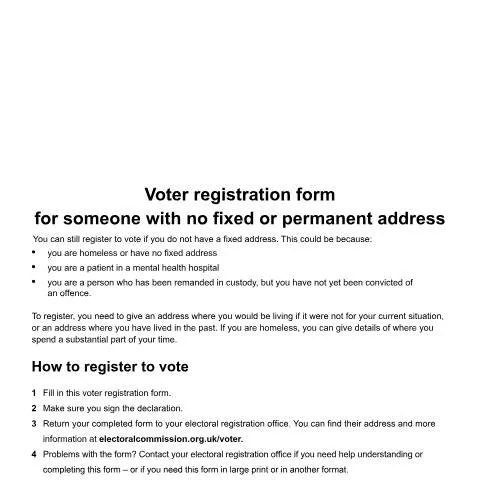
Homelessness, mental health treatment, or being remanded in custody might seem like barriers to democratic participation, but UK electoral law recognises that temporary circumstances shouldn't disenfranchise citizens. The voter registration form for someone with no fixed or permanent address (ITR-N-E) serves a crucial democratic purpose: ensuring that some of society's most vulnerable individuals retain their fundamental right to vote.
This specialised paper form addresses a gap that standard online voter registration cannot fill. When your living situation doesn't fit conventional address categories, or when you're temporarily detained or hospitalised, this form provides an alternative pathway to electoral participation. Unlike the mainstream digital registration process, it requires deeper consideration of where you would be living under normal circumstances, or where you spend substantial time.
The form's existence reflects a fundamental principle: democratic participation shouldn't depend on having a permanent postcode. Whether you're sleeping rough, receiving mental health treatment, or awaiting trial, your eligibility to vote remains intact, provided you meet the underlying citizenship and age requirements.
Who Qualifies for This Alternative Registration Route
The ITR-N-E form specifically targets three distinct groups whose living situations fall outside standard residential patterns. Each category has particular nuances that affect how the form should be completed.
Homeless Individuals and Those Without Fixed Address
This encompasses people sleeping rough, staying in temporary accommodation, moving between friends' homes, or living in vehicles. The key requirement is demonstrating where you spend a substantial part of your time within a particular electoral area. This might be a day centre, library, park, or neighbourhood where you regularly spend time, even if you don't sleep there consistently.
For homeless individuals, the form doesn't require a traditional residential address. Instead, it asks for locations that demonstrate your connection to a specific electoral constituency. This could be:
- A hostel or shelter where you stay periodically
- A public space where you spend significant time
- An area where you receive services or support
- A previous address where you lived before becoming homeless
Mental Health Hospital Patients
Patients in mental health hospitals face a more complex registration scenario. The form distinguishes between voluntary patients and those detained under the Mental Health Act. Voluntary patients retain their right to vote and must provide both their hospital details and where they would be living if not receiving treatment.
This dual-address requirement ensures you're registered in the constituency where you have genuine residential connection, not automatically in the hospital's electoral area. If you cannot identify where you'd be living otherwise, your last address before hospitalisation becomes the reference point.
Individuals Remanded in Custody
People remanded in custody who haven't yet been convicted retain their voting rights. The form requires details of the detention facility and your normal residential address. This distinction is crucial: remand status differs fundamentally from post-conviction detention in terms of electoral rights.
The form specifically states "you have not yet been convicted of an offence," emphasising that this applies only to those awaiting trial or sentencing, not to convicted prisoners serving sentences.
Citizenship and Immigration Requirements Under Post-Brexit Rules
The form's eligibility criteria reflect the complex post-Brexit landscape of voting rights. While basic citizenship requirements mirror standard voter registration, the immigration provisions reveal significant policy changes that affect EU nationals.
Straightforward Citizenship Categories
British and Irish citizens face no additional complications beyond proving their identity. Commonwealth citizens (including those from Malta and Cyprus) need permission to enter or stay in the UK, or must not require such permission due to their specific status.
EU Citizens: A Tale of Two Categories
The form creates a stark division among EU nationals based on their country of origin and timing of their UK residence:
| EU Citizen Category | Requirements | Key Considerations |
|---|---|---|
| Denmark, Luxembourg, Poland, Portugal, Spain | Must have permission to enter/stay, or not need permission | More straightforward path similar to Commonwealth citizens |
| All other EU countries | Must have had permission by 31 December 2020 and maintained it continuously | Strict continuity requirement; any break in status affects eligibility |
The continuity requirement for most EU citizens creates potential complications. Absences allowed under immigration status terms don't break continuity, but any lapse in legal status does. This particularly affects those who delayed applying for settled or pre-settled status under the EU Settlement Scheme.
Navigating the Form's Address Complexities
Section 8 of the form presents the most challenging aspect: determining appropriate addresses when your living situation doesn't fit standard categories. The form offers three distinct pathways, each with specific requirements.
The Homeless Declaration Route
Selecting the homeless option requires providing "the address or place where you spend a large part of your time." This deliberately broad language accommodates various circumstances, from rough sleeping to unstable housing arrangements. The address might be:
- A street or area where you regularly spend time
- A community centre or support service location
- A friend's address where you sometimes stay
- A previous address that still represents your community connection
Electoral registration offices understand that these addresses might not be conventional residential properties. The key is demonstrating genuine connection to a specific electoral constituency.
Hospital Patient Dual-Address Requirements
Mental health patients must provide two addresses: the hospital where they're receiving treatment and where they would otherwise be living. This second address determines their actual electoral registration location. If you cannot identify where you'd be living, your last address before hospitalisation serves this purpose.
This approach ensures that temporary medical treatment doesn't artificially shift your electoral participation to an area where you have no genuine residential connection.
Remanded in Custody: Maintaining Electoral Connection
The remand option similarly requires both detention facility details and your normal residential address. This maintains your electoral connection to your home constituency rather than the area where you're temporarily detained.
If you cannot provide your normal address—perhaps because you were homeless when arrested—your last known address before remand becomes the reference point.
Essential Documentation and Identity Verification
Unlike online registration, the paper form requires more extensive identity verification due to the complex circumstances it addresses. The National Insurance number serves as the primary identifier, linking your registration to existing government records.
When Standard Information Isn't Available
The form acknowledges that applicants might lack standard documentation. Section 14 (referenced but not detailed in the visible portions) apparently provides guidance for those without National Insurance numbers, uncertain birthdates, or unclear nationality status.
This flexibility recognises that people experiencing homelessness, mental health crises, or detention might not have ready access to standard identification documents. Electoral registration offices have procedures for verifying identity through alternative means when necessary.
Previous Address Requirements
Section 9 requires details of any addresses where you've lived in the past 12 months. This helps electoral registration offices verify your identity and ensure you're not registered elsewhere. For overseas addresses, additional questions about previous UK voter registration apply.
This requirement can be challenging for homeless individuals with complex housing histories, but electoral registration offices understand these circumstances and can work with incomplete information when necessary.
The Registration Process and Timeline Considerations
Submitting the ITR-N-E form initiates a more involved process than standard voter registration. Electoral registration offices must verify not only your identity and eligibility but also the appropriateness of your declared addresses given your circumstances.
Processing and Verification Steps
Electoral registration officers may contact you to discuss your address arrangements, particularly if you've declared homeless status. This isn't an interrogation but rather an attempt to ensure your registration accurately reflects your circumstances and places you in the correct constituency.
The form warns that applications may be delayed if previous addresses aren't provided, emphasising the importance of complete information even when your housing history is complicated.
Deadline Pressures and Strategic Timing
The form emphasises registering "as soon as possible" because processing takes longer than standard applications. While general voter registration deadlines apply, your complex circumstances might require additional verification time.
Given that people using this form often face unstable situations, early registration becomes particularly important. Your circumstances might change before an election, but maintaining registration provides continuity of electoral participation.
Electoral Registration Office Interactions and Support
The form explicitly directs applicants to contact their electoral registration office for assistance, recognising that people in complex housing situations might need additional support. These offices have experience working with vulnerable populations and understand the challenges faced by homeless individuals, hospital patients, and those in custody.
Accessibility and Format Options
Electoral registration offices can provide the form in large print or alternative formats, acknowledging that applicants might have additional needs beyond housing instability. This reflects broader accessibility requirements under disability legislation.
Staff can also provide assistance with form completion, which becomes particularly important when applicants have limited literacy, mental health challenges, or simply find the address requirements confusing.
Ongoing Communication and Updates
The form requests optional contact details—phone number and email—to facilitate communication about your application. For people in unstable housing, maintaining communication channels can be challenging, but electoral registration offices understand these difficulties.
If your circumstances change after registration—you find permanent housing, leave hospital, or are released from custody—you should update your registration through standard processes to ensure your electoral participation continues smoothly.
Beyond Registration: Practical Voting Considerations
Successfully registering through the ITR-N-E form is only the first step. Actually voting presents additional challenges for people without fixed addresses, but the electoral system provides mechanisms to address these difficulties.
Your polling station will be determined by the address you've provided on the form, which might not be where you're actually staying on polling day. Electoral registration offices can advise on proxy voting or postal voting arrangements that might better suit your circumstances.
For people whose situations remain unstable, postal voting offers particular advantages, allowing you to receive ballot papers at an address where you can reliably collect mail, even if it's not where you sleep. This might be a support service, friend's address, or other reliable postal location.
The ITR-N-E form represents more than bureaucratic accommodation—it embodies a commitment to inclusive democracy. By recognising that temporary housing instability, health treatment, or legal proceedings shouldn't eliminate electoral participation, it ensures that some of society's most vulnerable voices can still be heard in the democratic process. The form's complexity reflects the genuine challenges of maintaining electoral participation during difficult circumstances, but its existence guarantees that these challenges don't become barriers to democratic engagement.
Special Circumstances and Alternative Registration Routes
Beyond the standard homeless registration process, several specific circumstances require tailored approaches to voter registration. Understanding these nuances ensures you don't miss opportunities to exercise your democratic rights, even when your housing situation doesn't fit conventional categories.
If you're staying in a refuge or women's shelter, your registration needs particularly careful handling. Many refuges operate strict confidentiality policies to protect residents' safety. In such cases, you can register using the refuge address without your name appearing on the publicly available electoral register. Contact your local Electoral Registration Officer directly to discuss confidential registration options under the Representation of the People Act 2000. This process, known as anonymous registration, requires form 2A alongside supporting evidence from the refuge manager or your support worker.
Sofa-surfing presents another complex scenario. If you're staying temporarily with friends or family members without a formal tenancy agreement, you can still register at that address provided you have the householder's permission and genuinely consider it your residence for voting purposes. However, if you move frequently between different addresses, register at the location where you spend the majority of your time or where you receive correspondence. Remember that registering at an address where you don't actually stay could constitute electoral fraud under the Political Parties, Elections and Referendums Act 2000.
Students without permanent accommodation face particular challenges, especially during vacation periods when university halls close. If you're studying away from your family home and staying in temporary accommodation during breaks, you can maintain registration at either your term-time address (if halls remain open) or your family address. However, you cannot vote twice in the same election. For local elections, consider where you have the strongest community ties and where local issues most directly affect you.
Travellers and those living in mobile homes or caravans encounter specific registration procedures. If you have a permanent pitch with postal facilities, register using that address. For those without fixed pitches, many councils maintain special arrangements. Some areas designate specific polling stations for travelling communities, whilst others allow registration using a description of your general location (such as "caravan site off A34 near Newbury"). Contact your local authority's Traveller Liaison Officer if available, as they often facilitate registration drives and can guide you through the process.
Hospital patients in long-term care face registration complexities depending on their circumstances. If you're a voluntary patient who maintains a home address, you can remain registered there. However, if you're detained under the Mental Health Act 1983, your registration status depends on your specific section. Some detained patients retain voting rights, whilst others may be temporarily disenfranchised. Hospital social workers or patient advocates can clarify your position and assist with appropriate registration if you're eligible.
Documentation Requirements and Evidence Gathering
Successfully registering without a fixed address often hinges on providing appropriate supporting documentation. Unlike standard registrations where utility bills suffice, homeless registration requires more creative evidence gathering whilst maintaining legal compliance.
The Electoral Registration Officer will need to verify both your identity and your connection to the area where you wish to register. For identity, acceptable documents include your passport, driving licence, or National Insurance number confirmation letter. If you lack photo identification, combine multiple documents such as your birth certificate, NHS medical card, or correspondence from government departments like DWP or HMRC. Bank statements, even from basic accounts, carry significant weight as proof of identity and can demonstrate your connection to a local area.
Establishing your local connection requires demonstrating genuine ties to the registration area. This might include letters from local healthcare providers, correspondence with local council services, or documentation from charitable organisations operating in that area. If you receive Universal Credit or other benefits, ensure your claim reflects your current circumstances. DWP correspondence showing local job centre appointments can support your registration application.
For those using temporary accommodation addresses, obtain written confirmation from the service provider. This should state the nature of your stay, approximate duration, and confirm that you receive mail there. Many hostels and shelters have standard letters for this purpose, but ensure the document is recent and includes the organisation's official letterhead and contact details.
Religious or community organisation letters can provide valuable supporting evidence, particularly if you regularly attend services or activities in the area. These should come from recognised officials (priests, imams, community centre managers) and detail your involvement with the organisation. However, ensure any religious documentation doesn't compromise your privacy or safety if you're fleeing domestic violence or persecution.
Medical evidence carries particular weight in registration applications. If you're registered with a local GP practice, request a letter confirming your registration and approximate duration as a patient. Hospital discharge letters showing local treatment can also support your case. Mental health services, drug and alcohol support services, and sexual health clinics can all provide relevant documentation, though consider privacy implications carefully.
Employment documentation, even from casual or zero-hours work, demonstrates local connections. Payslips showing local employer addresses, P45 or P60 forms, or letters from employment agencies can all support your application. If you do voluntary work, obtain confirmation from the organisation detailing your role and commitment.
Legal aid documentation, probation service letters, or court correspondence showing local jurisdiction can provide evidence of your area connection, though consider whether revealing such information might affect other aspects of your life. Immigration documentation showing local Home Office reporting requirements can support applications from those with uncertain immigration status, provided they're eligible to vote.
Navigating Deadlines and Electoral Cycles
Electoral registration operates on strict deadlines that can catch unprepared applicants, particularly those dealing with unstable housing situations. Understanding these timeframes and planning accordingly ensures your registration succeeds when you need it most.
The standard registration deadline falls 12 working days before any election, but this calculation excludes bank holidays and can vary slightly between different types of elections. For general elections, this typically means mid-April registration closes for early May polling. Local elections follow similar patterns, but with dates varying across different council areas. European Parliament elections (when applicable) and Police and Crime Commissioner elections follow Westminster patterns, whilst mayoral elections may have different scheduling.
However, paper applications often require additional processing time compared to online submissions. Electoral Registration Officers recommend submitting paper forms at least three weeks before any deadline to account for postal delays and verification processes. If you're registering without a fixed address, allow even more time as your application may require additional scrutiny and evidence gathering.
Emergency registration provisions exist for specific circumstances, though these rarely apply to homeless situations. If you become eligible to vote through age (turning 18) or citizenship acquisition close to an election, contact your Electoral Registration Officer immediately. Some councils offer emergency counter services for such cases, but don't rely on these for address-related registration issues.
Annual canvass periods, typically running from August to November, present optimal registration opportunities. During this period, Electoral Registration Officers actively update their registers and may be more receptive to complex applications. They often have additional temporary staff trained in handling unusual circumstances, potentially speeding up your application processing.
If your registration application is refused, you have the right to appeal to the local Electoral Registration Officer within 21 days. The appeal must be in writing and should include any additional evidence supporting your case. If the local appeal fails, you can escalate to the Electoral Commission, though this process may take several months and likely won't resolve issues before immediate elections.
Consider registering proactively rather than reactively. If you anticipate housing instability, register as soon as you have any qualifying address rather than waiting for an election to be called. This approach gives you maximum flexibility and avoids last-minute complications when political campaigns intensify media attention around electoral processes.
Maintain awareness of electoral cycles beyond Westminster elections. Local council elections occur in different years across different areas, with some councils electing by thirds annually whilst others hold whole-council elections every four years. Parish council elections, mayoral contests, and potential referendums all create voting opportunities that require current registration.
If you move between local authority areas, your registration doesn't automatically transfer. You must re-register in each new area, even if moving between neighbouring councils. This becomes particularly complex for those in temporary accommodation spanning multiple authority boundaries or those whose circumstances change rapidly.