When Company Charges Need Updating: Understanding Property Release Statements
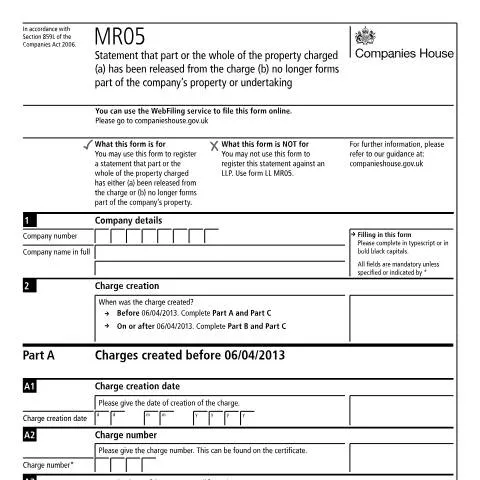
Property charges registered against companies aren't always permanent fixtures. When a business sells assets, pays off secured debts, or undergoes restructuring, the legal landscape of what's charged can shift dramatically. Form MR05 exists to capture these changes officially, ensuring the public record at Companies House accurately reflects which company assets remain subject to charges and which have been freed from such encumbrances.
This statement mechanism serves a dual purpose: it protects the company by clarifying that certain assets are no longer bound by previous charges, whilst simultaneously informing creditors and potential investors about the current state of the company's secured obligations. The form operates under Section 859L of the Companies Act 2006, making it a statutory requirement rather than an optional administrative courtesy.
Understanding when and how to deploy this form can mean the difference between maintaining clear title to assets and facing unnecessary complications during future transactions or refinancing arrangements.
Distinguishing Between Release Scenarios: What Triggers an MR05 Filing
The form handles two distinct legal scenarios, each with different implications for the company's asset position. Property released from the charge occurs when a creditor formally releases their security interest—typically following debt repayment, settlement negotiations, or as part of a broader commercial agreement. This release doesn't necessarily mean the asset has left the company's ownership.
Conversely, property no longer forming part of the company's undertaking captures situations where assets have been sold, transferred, or otherwise disposed of by the company. Here, the charge may technically remain valid, but its subject matter has moved beyond the company's control.
A third scenario combines both elements: the charge has been released and the property has left the company's possession. This might occur during asset sales where the purchaser requires clear title, prompting the existing chargee to release their interest as part of the completion process.
| Scenario | Typical Trigger | Company Benefit |
|---|---|---|
| Release from charge | Debt repayment, creditor agreement | Asset becomes unencumbered for future use |
| Property disposal | Sale, transfer, abandonment | Clarifies charge no longer affects company |
| Combined release and disposal | Asset sale with creditor cooperation | Complete clearance of charge obligations |
Navigating the Historical Divide: Pre and Post-April 2013 Charges
Companies House fundamentally altered its charge registration system on 6th April 2013, creating a procedural divide that affects how MR05 forms must be completed. This date marks the transition from the old system of charge certificates bearing sequential numbers to the modern approach using unique alphanumeric codes.
For charges created before this watershed date, companies must complete Part A of the form, providing the original charge number found on the certificate issued at registration. This number typically follows a sequential format and can be located on the charge certificate or within the company's charge register. Additionally, Part A requires detailed descriptions of the charging instrument and the property originally charged—information that may require consulting original loan agreements or debenture documentation.
Charges created on or after 6th April 2013 follow a streamlined approach through Part B, requiring only the unique charge code assigned by Companies House. These codes combine letters and numbers in a standardised format, making identification more straightforward for modern charges.
Regardless of the charge's vintage, all MR05 submissions must complete Part C, which captures the specific nature of the release or disposal and identifies the person making the statement.
Locating Historical Charge Information
Pre-2013 charges can present challenges when companies lack comprehensive records. The charge number and instrument details may be found in:
- Original charge certificates issued by Companies House
- Company statutory books and charge registers
- Legal documentation from the original transaction
- Historical filings accessible through Companies House records
Completing Part C: The Universal Requirements
Part C represents the substantive core of every MR05 filing, requiring careful consideration of exactly what has occurred with the charged property. Section C1 presents multiple options that must accurately reflect the company's circumstances—selecting the wrong option can lead to rejection or, worse, incorrect public records that may complicate future transactions.
When dealing with partial releases, Section C2 becomes crucial. The description of assets or property must be sufficiently detailed to identify what's been affected whilst remaining concise enough for practical use. Generic descriptions like "some machinery" or "part of the premises" rarely suffice; instead, specific identification through serial numbers, addresses, or detailed specifications provides the clarity required.
Complete releases bypass Section C2 entirely, but this option should only be selected when genuinely all charged property has been released or disposed of. Partial situations that might superficially appear complete—such as selling the "main" charged asset whilst retaining minor charged items—still require the partial release route.
Identifying the Appropriate Signatory
Section C3 demands careful attention to the person delivering the statement and their interest in the charge. This isn't merely administrative box-ticking; the signatory's relationship to the charge affects the statement's validity and weight.
Common scenarios include:
- Company directors acting on behalf of the chargor company
- Creditor representatives confirming release of their security interest
- Legal representatives acting for either party with appropriate authority
- Insolvency practitioners managing company affairs during formal procedures
The person's interest must be accurately described—vague terms like "authorised person" provide insufficient clarity, whilst specific roles like "director of chargor company" or "solicitor acting for chargee" establish clear authority.
Submission Pathways and Processing Expectations
Companies House offers multiple submission routes for MR05 forms, each with distinct advantages and processing characteristics. The WebFiling service provides immediate confirmation of receipt and typically faster processing times, making it the preferred option for straightforward submissions. However, complex cases involving extensive documentation or unusual circumstances may benefit from postal submission with comprehensive supporting materials.
Electronic submission requires careful attention to character limits and formatting restrictions that don't apply to paper forms. Continuation pages, whilst available for postal submissions, cannot be replicated online, potentially necessitating careful editing of detailed descriptions to fit within system constraints.
Processing times vary according to submission method and complexity. Simple electronic filings often appear on the public register within 24-48 hours, whilst postal submissions may take several working days. Complex cases requiring manual review can extend these timeframes significantly.
Post-Submission Monitoring
Once submitted, companies should monitor their Companies House record to confirm the statement appears correctly on the public register. The filing creates a permanent record linked to the original charge, providing transparency for future searchers about the charge's current status.
Errors discovered after registration require careful consideration—whilst minor clerical mistakes might be corrected through Companies House's informal procedures, substantive errors may necessitate fresh MR05 submissions with corrected information.
Strategic Timing and Commercial Considerations
The timing of MR05 submissions carries commercial implications beyond mere regulatory compliance. Filing too early—before completing asset sales or securing final creditor releases—can create complications if circumstances change. Conversely, delayed filing may leave the public record inaccurately reflecting the company's encumbered position, potentially affecting credit assessments or transaction negotiations.
Companies involved in refinancing arrangements must coordinate MR05 timing with new charge registrations. The sequence matters: releasing old charges before registering new ones might create temporary periods where assets appear unencumbered, whilst the reverse approach might suggest over-charging that could concern potential creditors.
Asset sale transactions particularly benefit from strategic MR05 timing. Buyers typically require confirmation that purchased assets will be free from charges, making pre-completion charge releases valuable for demonstrating clear title. However, premature releases before exchange of contracts can leave sellers exposed if transactions fail.
Coordination with Professional Advisers
Complex charge release scenarios often involve multiple professional parties whose actions must be coordinated with MR05 filings:
- Solicitors managing asset sales or refinancing transactions
- Accountants advising on the financial implications of charge releases
- Insolvency practitioners overseeing formal procedures
- Corporate finance advisers structuring new funding arrangements
Each party's timeline and requirements should be considered when planning MR05 submissions to ensure the filing supports rather than complicates the broader commercial objectives.
Common Pitfalls and Corrective Measures
MR05 submissions frequently encounter problems that can delay processing or result in rejection. Mismatching company details against the public register represents the most common error—company names must appear exactly as registered, including punctuation and spacing. Similarly, charge numbers or codes must be transcribed precisely from original certificates or Companies House records.
Incomplete or inadequate property descriptions in Section C2 create particular difficulties. Descriptions must strike a balance between specificity and practicality—too vague, and the filing lacks clarity; too detailed, and the description becomes unwieldy. Effective descriptions often reference original charge documentation whilst highlighting the specific items being released.
Authority issues represent another frequent complication. Signatories must possess clear authority to make statements about charge releases, and this authority must be evident from the form itself. Directors acting for their companies typically possess inherent authority, but external parties may need to demonstrate their standing through accompanying documentation.
Rectification Strategies
When MR05 submissions are rejected or contain errors, several rectification approaches are available:
- Immediate resubmission with corrections for simple errors like transcription mistakes
- Supplementary submissions where additional information can clarify incomplete initial filings
- Formal correction procedures through Companies House for more substantial errors affecting the public record
The chosen approach depends on the error's nature and timing—corrections made quickly after initial submission often prove simpler than those discovered months later after the record has been relied upon by third parties.
Integration with Broader Corporate Compliance
MR05 submissions don't operate in isolation but form part of the company's broader compliance landscape. Charge releases may trigger requirements for updated statutory registers, revised director declarations, or changes to company insurance arrangements that previously covered charged assets.
Companies maintaining charge registers under the Companies Act 2006 must ensure these internal records reflect changes captured in MR05 filings. Discrepancies between public filings and internal records can create confusion during due diligence exercises or regulatory inspections.
The filing also interacts with other Companies House obligations—companies undergoing significant asset disposals may need to consider whether additional filings become necessary, such as director loan notifications if proceeds are used for related-party transactions or substantial property transaction approvals if charged assets represented significant company holdings.
Annual confirmation statements provide an additional checkpoint for ensuring charge information remains accurate. Companies should review their registered charges annually and consider whether any MR05 filings are needed to reflect changes that may have been overlooked during busy trading periods.
For companies approaching insolvency or restructuring, MR05 filings may need coordination with insolvency practitioners who must account for all company assets and their encumbrance status. Early and accurate charge release documentation can significantly simplify later formal procedures by providing clear evidence of asset availability for creditor distributions.
Strategic Timing and Planning for MR05 Applications
The timing of your MR05 application can significantly impact both the administrative process and your financial obligations. Property releases often coincide with major life events or business decisions, making strategic planning essential for optimal outcomes.
Consider submitting your MR05 application well in advance of any intended property transactions. HM Land Registry typically processes straightforward applications within 20 working days, but complex cases involving multiple charges or disputed boundaries may require additional time. If you're planning to sell or remortgage the released property, factor in this processing time to avoid delays in your transaction chain.
Tax year considerations play a crucial role in timing decisions. Capital gains tax implications may vary depending on whether the property release occurs before or after 5 April. For partial releases that involve disposing of land, the timing could affect your annual CGT allowance utilisation. Similarly, if the release triggers stamp duty land tax obligations for any remaining charges, consider how this aligns with your broader financial planning.
Business owners should coordinate MR05 applications with their accounting cycles and Companies House filing requirements. If the charged property secures business debts, the release may constitute a significant corporate event requiring disclosure in annual returns or interim reporting. Manufacturing and retail businesses with seasonal cash flows might time releases to coincide with periods of stronger liquidity.
Agricultural property presents unique timing considerations. Releases affecting agricultural land may need coordination with Basic Payment Scheme applications or Environmental Land Management scheme commitments. The Agricultural Holdings Act 1986 and Agricultural Tenancies Act 1995 impose specific notice periods that could influence when releases become effective.
Consider market conditions when planning releases. Property market volatility can affect valuations required for partial releases, potentially impacting the charge holder's willingness to consent. Economic uncertainty might prompt lenders to impose stricter conditions or require updated professional valuations, adding time and cost to the process.
Cross-Border and International Considerations
MR05 applications involving international elements require careful navigation of multiple legal frameworks and administrative requirements. These complexities arise when charge holders, property owners, or the underlying transactions span different jurisdictions.
Foreign charge holders must satisfy additional identity verification requirements when consenting to releases. If the charge holder is an overseas company, you'll need to provide evidence of its continued existence and authority to act, typically through apostilled certificates of good standing or equivalent documentation from the relevant overseas registry. Individual foreign charge holders may require notarised identity documents, with translations certified by qualified translators where documents aren't in English.
Currency fluctuations can complicate partial releases where the original charge amount was denominated in foreign currency. The release calculation must account for exchange rate movements since the charge's creation, potentially requiring updated valuations in both currencies. This becomes particularly complex for charges securing facilities in multiple currencies or those with built-in hedging arrangements.
Cross-border tax implications demand careful consideration. UK residents releasing property charged to overseas lenders may trigger reporting obligations under the Common Reporting Standard or other international tax information exchange agreements. Conversely, non-UK residents may face different capital gains tax treatment on releases, particularly regarding the Annual Tax on Enveloped Dwellings for high-value residential property held through corporate structures.
European Economic Area considerations remain relevant despite Brexit. While EU passporting rights for financial services have ceased, existing charges created by EEA institutions before the transition period ended retain certain recognition rights. However, new charges or modifications may require additional documentation to establish the institution's continued authority to operate in the UK market.
Data protection compliance becomes complex when personal data crosses borders during the MR05 process. The UK GDPR and Data Protection Act 2018 impose restrictions on international data transfers, requiring adequate safeguards when sharing personal information with overseas charge holders or their representatives. Standard contractual clauses or adequacy decisions may be necessary to ensure lawful processing.
Sanctions and anti-money laundering checks intensify for international transactions. HM Treasury's consolidated sanctions list and Politically Exposed Person databases require screening of all parties involved. This extends beyond immediate charge holders to beneficial owners of overseas corporate entities, potentially requiring detailed ownership disclosure through multiple jurisdictional layers.
Technology Integration and Digital Transformation
The digitisation of land registry processes has fundamentally transformed how MR05 applications are prepared, submitted, and processed. Understanding these technological capabilities can streamline your application and reduce processing times significantly.
HM Land Registry's digital services portal enables electronic submission of MR05 forms, with integrated validation checks that identify common errors before submission. The system automatically cross-references property details against the land register, flagging discrepancies in title numbers, proprietor names, or charge descriptions. This real-time validation prevents the delays associated with requisitions for additional information.
Electronic signatures have revolutionised consent procedures for property releases. Qualified electronic signatures meeting eIDAS regulation standards are now accepted for most MR05 applications, eliminating the need for wet signatures and postal delays. However, certain high-value transactions or those involving vulnerable parties may still require traditional execution methods, particularly where lasting powers of attorney or corporate seal requirements apply.
Automated charge verification systems now cross-check proposed releases against existing register entries, identifying potential conflicts or inconsistencies that might affect the application. This includes verification of charge amounts, interest calculations, and cross-default provisions that might prevent straightforward releases. The system flags these issues early, allowing applicants to address them before formal submission.
Integration with other government databases enhances the MR05 process efficiency. Automatic verification against Companies House records confirms corporate charge holders' continued existence and filing status. Links to HMRC databases can verify tax compliance status where relevant to the release conditions, though privacy protections limit the extent of this cross-referencing.
Blockchain technology pilots are exploring immutable charge recording and release mechanisms. While still experimental, these systems could eventually provide instantaneous verification of release conditions and automatic execution of releases upon satisfaction of predetermined criteria. Early trials focus on straightforward commercial transactions where all parties consent to blockchain-based processing.
Artificial intelligence assists in application processing by identifying patterns in successful releases and flagging applications likely to require additional scrutiny. Machine learning algorithms analyse historical data to predict processing times more accurately, helping applicants plan transaction timelines more effectively. However, complex cases still require human review and decision-making.
Digital document management systems enable secure sharing of supporting documentation between applicants, charge holders, and HM Land Registry. These platforms maintain audit trails of all document access and modifications, supporting compliance with data protection requirements while facilitating collaborative application preparation. Version control features prevent confusion over document currency, particularly important for releases requiring multiple consents.
Mobile accessibility increasingly supports field-based property professionals who need to access MR05 applications remotely. Surveyors, estate agents, and legal practitioners can review application status, upload supporting documents, and communicate with registry staff using secure mobile applications. This flexibility proves particularly valuable for releases involving rural or remote properties where traditional office-based access might prove challenging.