Navigating the OS MG03: A Key Document for Overseas Companies
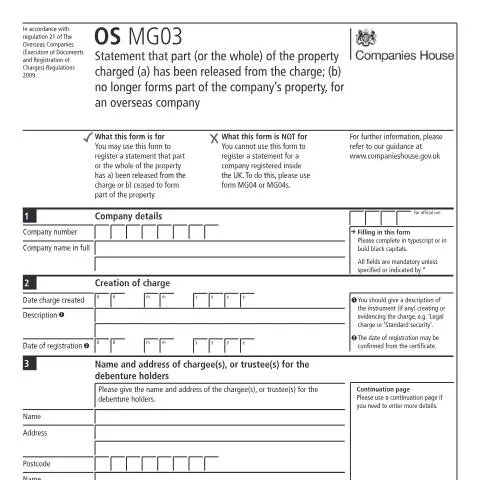
When dealing with the financial landscape of an overseas company operating within the UK, understanding the nuances of property charges is crucial. The OS MG03 form serves as a vital tool for registering statements regarding the release of property from a charge or when a property ceases to form part of the company's assets. This document is particularly relevant for overseas companies, and knowing how to complete and submit it correctly can significantly impact your company's legal and financial standing.Why the OS MG03 Matters
The OS MG03 form is not merely a bureaucratic requirement. It plays a pivotal role in ensuring that the financial dealings of an overseas company are transparent and in compliance with UK regulations. This document is specifically designed for recording:- When a part or the whole of the property charged has been released from the charge.
- When property no longer forms part of the company's assets.
Eligible Entities: Who Should File the OS MG03?
The OS MG03 form is tailored for overseas companies that have registered property charges in the UK. Companies registered within the UK should use different forms—specifically MG04 or MG04s—to register similar statements. It is essential for foreign entities involved in UK business to understand that the UK Companies House keeps a meticulous record of all such transactions, and accuracy here is paramount.Specific Situations Where OS MG03 is Required
Several scenarios may warrant the use of the OS MG03 form:- A property has been fully paid off, and its associated charge has been released.
- A part of the property has been sold off or transferred, necessitating an update to the charge registration.
- Changes in ownership or management of the company that affect property assets.
Completing the OS MG03 Form: A Step-by-Step Guide
Preparing the OS MG03 form requires attention to detail and an understanding of the specific information required. Below is a breakdown of each section and what you need to focus on:1. Company Details
Begin by entering your company’s full name and registration number. This information must match the details held in the public register to avoid processing delays.2. Details of the Charge
In this section, you’ll need to provide:- The date the charge was created.
- The date of registration.
- A brief description of the charge (e.g., “Legal Charge” or “Standard Security”).
3. Details of Chargees or Trustees
List all chargees or trustees involved in the transaction. This includes:- Name and address of each chargee.
- Postal codes and additional contact information, if available.
4. Property or Undertaking Details
Clearly state whether you are registering that:- A part of the property has been released from the charge.
- The whole property has been released.
- The property has ceased to belong to the company.
5. Signature Requirements
Sign the form in the designated area. The signature must be from either:- A creditor.
- A person authorized to represent the creditor.
The Submission Process: Where and How to File
Once the OS MG03 form is completed, it's time to submit it to the Companies House. Depending on your location within the UK, you have different addresses for submission:For England and Wales:
The Registrar of Companies, Companies House, Crown Way, Cardiff, Wales, CF14 3UZ.
For Scotland:
The Registrar of Companies, Companies House, Fourth Floor, Edinburgh Quay 2, 139 Fountainbridge, Edinburgh, Scotland, EH3 9FF.
For Northern Ireland:
The Registrar of Companies, Companies House, Second Floor, The Linenhall, 32-38 Linenhall Street, Belfast, Northern Ireland, BT2 8BG.
Submitting via the correct address is crucial since each division of the Companies House operates independently.After Submission: What to Expect
Once you have submitted the OS MG03 form, it will undergo a review process by Companies House. Here’s what you can expect:- Verification of the information provided against the public register.
- Possible requests for additional information or clarifications.
- Notification once your submission has been processed, which may take a few weeks.
Tracking Your Submission
To ensure that your submission is being processed smoothly, you can contact the Companies House directly for updates. Make sure to have your company registration details handy for reference.What If Things Go Wrong? Handling Rejections and Errors
Despite careful preparation, there may be instances where your OS MG03 submission could face challenges. Common reasons for rejection include:- Inaccurate company details.
- Missing signature or authorization.
- Incomplete sections of the form.
Correcting Errors Post-Submission
In cases where an error is identified after submission, it is advisable to act promptly. Contact Companies House with your specifics, and be prepared to submit the corrected form if necessary. In some circumstances, a court direction may be required to rectify the details.Unique Scenarios: Dealing with Complex Cases
Certain situations may complicate the submission of the OS MG03 form. Here are some examples:Overseas Companies with Multiple Properties
For companies dealing with numerous properties under a single charge, make sure to provide comprehensive descriptions and possibly use a continuation page if you run out of space on the form. This will ensure no details are overlooked.Impact of Changes in Ownership
If the company's ownership changes during the time of filling out the form, you must ensure that the new authorized representatives sign the document. This situation necessitates updating the Companies House records to reflect the change in management accurately.Understanding the Legal Framework Surrounding the OS MG03
The requirement for the OS MG03 form is not arbitrary; it is grounded in the regulatory framework established under the Overseas Companies (Execution of Documents and Registration of Charges) Regulations 2009. This legislation outlines the obligations and rights of overseas companies operating within the UK, ensuring that all property transactions are conducted transparently and legally.Regulatory Compliance and Its Importance
Compliance with these regulations is not just about filling in forms; it is integral to maintaining a good standing in the UK business environment. Non-compliance can result in legal penalties, loss of property rights, and diminished reputation in the market.Stay Informed: The Importance of Continuous Learning
Navigating the complexities of the OS MG03 and the overall procedures involving Companies House calls for an ongoing commitment to understanding changes in regulations and processes. Staying informed through dedicated resources—whether through government publications or professional consultation—can help ensure that your overseas company's dealings within the UK remain compliant and efficient.Resources for Further Information
For more detailed guidance on the OS MG03 and related topics, visiting the official Companies House website can provide valuable insights, templates, and updated requirements. Engaging with legal professionals specializing in corporate law can also offer tailored advice suited to your specific business situation. By mastering the OS MG03 submission process, overseas companies can ensure their property transactions are accurately recorded and legally compliant, ultimately supporting their operational success in the UK market.Understanding the Process of Registering a Statement using OS MG03
The OS MG03 form is essential for individuals or entities looking to communicate changes regarding a property’s charging status or its relevancy within certain property rights. When a part or the whole of a property is released from a charge, or if it ceases to form part of property under a specific charge, it is crucial to register this statement to maintain the accuracy of the official registers. This process not only ensures that the property records are correct but also protects the interests of all parties involved.
Before initiating the registration process, it is important to gather all relevant documents that demonstrate ownership, the exact nature of the charge, and any agreements made between parties. Common documents include title deeds, previous charge documents, and correspondence regarding the change in status. Having these documents readily available will facilitate smoother processing of the MG03 form.
Who Needs to Submit the OS MG03?
Understanding who is required to submit the OS MG03 form is critical. This applies to anyone with a registered interest in the property, including, but not limited to, property owners, lenders, or beneficiaries of the property. For example, if a lender has a charge over a property and the loan is fully paid, the lender must file an MG03 to formally remove the charge.
Moreover, if a property has been legally divided, leading to a portion being released from the original charge, the new owner of the released part may also need to submit an MG03. In instances where multiple parties hold interests in the property, it is advisable for all parties to collaborate to ensure that the registration accurately reflects the current situation and avoids potential disputes in the future.
In some situations, if a property is involved in a wider legal context, such as divorce proceedings or dissolution of partnerships, it may necessitate the submission of the OS MG03 by either party. Given the implications tied to property rights in such cases, it's best practice to seek legal advice to ensure compliance with all relevant laws and regulations.
Common Pitfalls and Considerations in the Registration Process
While registering a statement using the OS MG03 form is straightforward, there are common pitfalls that individuals and businesses should be aware of. One of the most significant errors is failing to provide accurate and complete information. The form requires precise details about the property, including the title number and the nature of the charge being released or modified. Any inaccuracies can lead to delays or even rejection of the application.
Additionally, the timing of the submission is crucial. If the form is submitted too late, it may not reflect the current status of the property in legal matters, potentially leading to disputes or financial loss. It's recommended to submit the OS MG03 as soon as an agreement is reached regarding the change in status to prevent complications.
Another consideration is confidentiality. Under the Data Protection Act 2018 and UK GDPR, you must ensure that personal data shared within the OS MG03 form is handled correctly. This includes only providing necessary information and safeguarding the data from unauthorized access.
Lastly, if the property subject to the MG03 form is part of a larger property portfolio or is linked to other legal agreements, it may be beneficial to consult with a property solicitor or a conveyancer. This can help navigate the complexities of property law and ensure that all legal obligations are met without oversight.