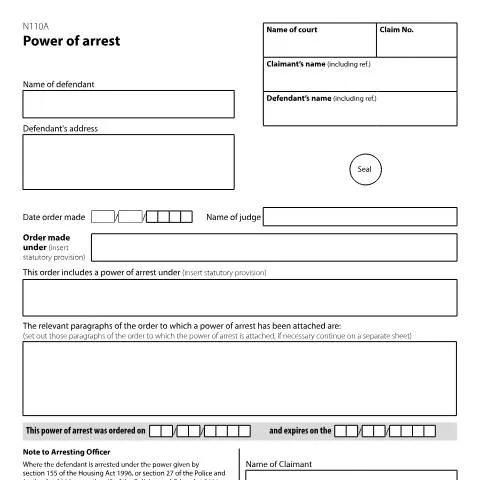
When Court Protection Meets Police Enforcement Powers
The moment a county court judge decides that an injunction needs the immediate backing of police powers, Form N110A becomes a critical document in the enforcement chain. This power of arrest attachment transforms what might otherwise be a civil remedy into something with immediate criminal justice consequences. When someone breaches certain types of injunction, police constables can arrest without warrant, bringing the defendant before a judge within 24 hours rather than waiting for lengthy contempt proceedings.
The N110A serves as both a formal court record and an operational instruction sheet for arresting officers. Unlike standard civil enforcement, this mechanism bridges the gap between civil protection orders and criminal law enforcement, particularly in cases involving anti-social behaviour, housing disputes, harassment, or domestic violence situations where immediate intervention may be essential for public safety or victim protection.
The Legislative Framework Behind Arrest Powers
Form N110A operates under multiple statutory provisions, each serving different contexts but sharing the common goal of rapid enforcement. The Housing Act 1996 section 155 primarily applies to anti-social behaviour injunctions sought by social landlords or local authorities. Meanwhile, section 27 of the Police and Justice Act 2006 and section 43 of the Policing and Crime Act 2009 extend these powers to different categories of anti-social behaviour orders.
The most recent addition, section 4 of the Anti-Social Behaviour, Crime and Policing Act 2014, significantly broadened the scope to include injunctions preventing nuisance and annoyance. This means that behaviours which might not constitute criminal offences in themselves—such as persistent loud music, aggressive begging, or intimidating groups gathering—can now result in immediate arrest if they breach an injunction with attached power of arrest.
Each statutory provision carries identical procedural requirements: the 24-hour rule for bringing defendants before a judge, immediate notification requirements for applicants, and specific exclusions for certain days when calculating the detention period. Christmas Day, Good Friday, and Sundays don't count towards the 24-hour limit, recognising that court availability may be restricted on these days.
Judicial Decision-Making: When Courts Attach Arrest Powers
Not every injunction receives a power of arrest attachment—judges exercise considerable discretion based on risk assessment and the likelihood of compliance. The court typically considers whether the defendant has previously breached similar orders, the severity of the conduct being restrained, and whether immediate arrest capability is necessary to protect the public or specific individuals.
In domestic violence cases, powers of arrest are almost routinely attached to non-molestation orders, recognising that breaches often escalate quickly and pose immediate danger. For anti-social behaviour injunctions, the decision depends more heavily on the specific circumstances: persistent neighbourhood disputes might warrant arrest powers, while minor nuisance behaviours might not.
The judge must specify exactly which paragraphs of the main injunction carry arrest powers—this is crucial because not every provision of a complex injunction may justify immediate arrest. For instance, an injunction might prohibit both entering a specific area and using threatening language, but the judge might only attach arrest powers to the exclusion zone violation, not to the verbal conduct element.
Factors Influencing Judicial Discretion
- Previous compliance history: Defendants with records of ignoring court orders are more likely to face arrest powers
- Vulnerability of protected persons: Cases involving elderly victims, children, or those with disabilities often receive enhanced enforcement
- Geographic considerations: Rural areas where police response times are longer may justify arrest powers for less severe conduct
- Time-sensitive situations: Market trading disputes, event-related disturbances, or seasonal anti-social behaviour patterns
Operational Mechanics: From Court Order to Street Enforcement
Once the judge signs Form N110A, it becomes an active enforcement tool that police custody sergeants and patrol officers must understand and implement correctly. The form's design reflects this operational reality—the "Note to Arresting Officer" section isn't mere legal text but practical guidance for frontline policing.
The notification requirements create an immediate communication chain. When police arrest someone under Housing Act powers, they must contact the applicant "forthwith"—essentially immediately. For arrests under the other statutory provisions, notification must happen "as soon as reasonably practicable," allowing slightly more flexibility but still requiring prompt action.
This notification serves multiple purposes: it allows the original applicant to prepare for the court hearing, ensures they can provide additional evidence of the breach, and maintains their involvement in proceedings that directly affect their safety or quality of life. In practice, this often means police contacting local authority housing officers in the middle of the night or tracking down private individuals who may not be expecting such calls.
The 24-Hour Court Appearance Requirement
The most operationally challenging aspect of N110A enforcement is the mandatory court appearance within 24 hours. Unlike standard criminal arrests where defendants might be released on bail or held for longer periods, breach of injunction with power of arrest creates an absolute deadline that cannot be extended.
This requirement often necessitates special court sittings, particularly for weekend arrests. Magistrates' courts may need to arrange emergency sessions, while county courts must ensure judicial availability. The calculation of the 24-hour period excludes Christmas Day, Good Friday, and Sundays, but includes all other days regardless of normal court operating hours.
| Arrest Day | Court Appearance Required By | Special Considerations |
|---|---|---|
| Monday | Tuesday (same time) | Standard court hours usually sufficient |
| Friday | Monday (same time) | Saturday and Sunday excluded from calculation |
| Saturday | Monday (24 hours later) | Sunday doesn't count towards time limit |
| Good Friday | Tuesday (24 hours later) | Both Good Friday and potential Sunday excluded |
Documentation Requirements and Evidence Preparation
Form N110A itself contains relatively few fields to complete, but its effectiveness depends heavily on the quality and precision of the underlying documentation. The court must clearly identify which specific paragraphs of the original injunction carry arrest powers, and this identification must be detailed enough for police officers to understand exactly what conduct justifies arrest.
Vague or overly broad descriptions create enforcement difficulties. For example, stating that arrest powers apply to "causing nuisance" provides insufficient guidance compared to specifying "playing amplified music audible outside the property between 11 PM and 7 AM" or "approaching within 100 metres of 15 Oak Street."
The original applicant must maintain detailed records of any breaches, including dates, times, witnesses, and photographic evidence where relevant. Since the 24-hour court appearance deadline leaves little time for evidence gathering, having comprehensive breach documentation ready becomes essential for successful enforcement proceedings.
Critical Documentation Elements
- Precise location descriptions: GPS coordinates, property boundaries, or specific street addresses rather than general area descriptions
- Time-specific restrictions: Exact hours, days of the week, or event-related timing rather than vague "reasonable hours" language
- Behavioural specifications: Objective, observable conduct rather than subjective assessments like "aggressive" or "threatening"
- Witness contact information: Updated phone numbers and addresses for potential court testimony
Multi-Agency Coordination in Enforcement
N110A enforcement rarely involves just courts and police—it typically requires coordination between multiple agencies and stakeholders. Local authority housing departments, social services, probation services, and victim support organisations may all play roles in the enforcement chain.
Housing associations and local authorities often employ dedicated anti-social behaviour officers who work closely with police and courts to ensure effective enforcement. These officers typically maintain the detailed incident logs needed for breach proceedings and can provide rapid response when police notify them of arrests under Housing Act powers.
In domestic violence cases, specialist police units coordinate with Independent Domestic Violence Advisors (IDVAs) and Multi-Agency Risk Assessment Conferences (MARACs) to ensure that N110A enforcement fits within broader safety planning. The immediate notification requirements become particularly important in these contexts, as risk levels may change rapidly following an arrest.
Probation services may become involved where defendants are subject to concurrent community orders or post-release supervision. Breach of an injunction with power of arrest can trigger additional enforcement action under other orders, creating complex multi-track proceedings that require careful case management.
Practical Challenges and Operational Limitations
Despite its apparent simplicity, Form N110A enforcement presents numerous practical challenges that affect its real-world effectiveness. Police officers must make rapid decisions about whether observed conduct constitutes a breach of the specific paragraphs identified in the form, often without detailed legal training in civil injunction interpretation.
The geographical mobility of many defendants creates jurisdictional complications. An injunction granted by Manchester County Court with N110A powers attached remains enforceable throughout England and Wales, but police forces in different areas may have varying levels of familiarity with these procedures. Information sharing systems don't always flag the existence of civil injunctions with arrest powers, unlike criminal warrants or court orders.
Resource implications for custody facilities and court services can be significant, particularly in areas with high volumes of anti-social behaviour injunctions. The 24-hour rule means that weekend arrests often require expensive emergency court sittings, while custody suites must accommodate defendants who cannot be released on police bail.
Language barriers and mental health issues among defendants create additional complications. Unlike criminal arrests where established procedures exist for interpretation services and mental health assessments, N110A arrests may catch custody officers unprepared for these support needs within the tight 24-hour timeframe.
Long-term Consequences and Case Progression
An arrest under Form N110A powers typically marks an escalation point in ongoing civil proceedings rather than a conclusion. The defendant's appearance before the court within 24 hours often leads to committal proceedings for contempt of court, which can result in imprisonment or significant fines even though the original conduct might not have constituted a criminal offence.
Successful enforcement often encourages applications for additional or extended injunctions with enhanced terms. Courts may impose more restrictive geographical exclusions, longer duration orders, or additional behavioural requirements based on evidence of breach and arrest.
For defendants, an N110A arrest creates a formal court record that may influence future applications for similar orders, housing allocations, or employment where criminal record checks are required. Although breach of civil injunction isn't technically a criminal conviction, the arrest and court appearance create documentation that appears in certain background checks.
The notification requirements built into Form N110A ensure that original applicants remain engaged with enforcement proceedings, often leading to more comprehensive evidence gathering and witness testimony for subsequent hearings. This can transform what began as neighbour disputes or minor anti-social behaviour into complex multi-hearing litigation with significant consequences for all parties involved.
Understanding Form N110A requires recognising it as part of a broader enforcement ecosystem rather than an isolated administrative document. Its effectiveness depends on coordination between multiple agencies, precise legal drafting, and operational flexibility to handle the immediate demands of the 24-hour court appearance requirement. For those involved in seeking or defending against injunctions with arrest powers, the stakes are considerably higher than typical civil proceedings, with the potential for immediate loss of liberty adding urgency to what might otherwise be routine legal disputes.
Enforcement Options When a Power of Arrest Is Not Available
Not all injunction applications qualify for a power of arrest attachment, and understanding alternative enforcement mechanisms becomes crucial when Form N110A cannot be utilised. The court's discretion in granting powers of arrest is governed by specific statutory criteria, particularly under the Family Law Act 1996 for domestic violence cases and the Protection from Harassment Act 1997 for harassment injunctions.
When a power of arrest is refused or deemed inappropriate, applicants retain several enforcement avenues. Contempt of court proceedings represent the primary alternative, requiring the applicant to return to court with evidence of breach and seek the respondent's committal to prison. This process demands completion of Form N78 (Application for committal for contempt of court) and adherence to strict procedural requirements, including personal service of the contempt application.
The evidential burden differs significantly from power of arrest scenarios. Without immediate police intervention capabilities, applicants must meticulously document breaches, often requiring witness statements, photographic evidence, or electronic communications demonstrating non-compliance. CCTV footage, mobile phone records, and third-party testimonies become particularly valuable in establishing clear breach patterns.
Alternative protective measures may include exclusion requirements within existing injunctions, specifying geographic boundaries or prohibited activities with greater precision. Courts might also consider electronic monitoring conditions where appropriate, though these typically require consent or specific statutory authority. Some applicants pursue restraining orders following criminal proceedings as parallel protection, particularly in harassment cases where CPS prosecution runs concurrently with civil injunction applications.
The without notice procedure (ex parte applications) offers another strategic consideration when immediate protection is required but power of arrest attachment seems unlikely. These applications, while not guaranteeing enforcement powers, can establish interim protection pending full hearings where power of arrest considerations receive fuller judicial scrutiny.
Jurisdictional Variations and Specialist Court Procedures
Power of arrest applications through Form N110A operate within a complex jurisdictional framework, with significant procedural variations between different court levels and specialist jurisdictions. Family Court proceedings follow distinct protocols under Family Procedure Rules 2010, particularly for domestic violence injunctions where powers of arrest are more readily granted given the immediate risk assessment factors.
The High Court's inherent jurisdiction allows broader discretionary powers in granting injunctive relief with arrest powers, particularly in complex harassment cases involving multiple respondents or cross-border elements. High Court applications often involve more sophisticated legal arguments around anticipatory breach and quia timet injunctions where future harm prevention justifies immediate arrest powers.
County Court limitations become apparent in multi-jurisdictional cases or where respondents operate across court boundaries. The territorial scope of arrest powers requires careful consideration - a power of arrest granted by Leeds Combined Court Centre carries enforcement authority throughout England and Wales, but practical coordination between different police force areas may present operational challenges.
Specialist procedures apply in commercial injunction contexts where Form N110A might accompany freezing orders or search orders. These applications typically require maximum expedition, often heard within hours of filing, with arrest powers serving to prevent asset dissipation or evidence destruction. The Commercial Court's approach emphasises undertakings in damages and cross-undertakings, creating financial safeguards absent in typical domestic violence scenarios.
Administrative Court considerations arise where injunctions seek to restrain public body actions or protest activities. Powers of arrest in these contexts require careful balancing against Article 10 and Article 11 ECHR rights (freedom of expression and assembly), with courts applying heightened scrutiny to arrest power applications that might chill legitimate protest or political expression.
The Technology and Construction Court occasionally encounters injunction applications with arrest powers in construction disputes involving site access or equipment removal. These cases demonstrate how Form N110A applications extend beyond traditional domestic or harassment scenarios into complex commercial relationships where immediate enforcement becomes essential for preserving the status quo.
Post-Grant Compliance Monitoring and Modification Procedures
Once Form N110A successfully secures a power of arrest attachment, ongoing compliance monitoring and potential modification procedures require systematic attention to ensure continued effectiveness. The court retains continuing jurisdiction over injunctions with arrest powers, enabling both parties to seek variations, extensions, or discharge applications as circumstances evolve.
Police liaison protocols establish crucial operational frameworks following successful applications. Forces typically maintain PNLD (Police National Legal Database) records of injunctions with arrest powers, enabling officers to verify enforcement authority during incidents. However, applicants should not assume automatic police awareness - providing officers with certified copies of the injunction and arrest power warrant often proves essential during enforcement situations.
The 28-day review mechanism built into many arrest power orders requires proactive applicant engagement. Courts frequently impose automatic expiry dates for arrest powers, requiring fresh applications via Form N110A if continued protection is necessary. This review period allows judicial reassessment of risk factors and respondent compliance, potentially leading to stepped-down protection where arrest powers are replaced with standard injunctive terms.
Breach documentation systems become critical for maintaining injunction effectiveness. Applicants should establish comprehensive recording protocols, noting dates, times, locations, and witness details for any potential breaches. This documentation serves dual purposes: supporting immediate police enforcement and providing evidence for subsequent contempt proceedings or arrest power renewal applications.
Cross-referencing with other legal proceedings requires ongoing attention, particularly where family proceedings, criminal cases, or employment tribunals run parallel to injunction orders. Changes in respondent circumstances - such as criminal convictions, employment termination, or family court orders - may justify either strengthening or relaxing arrest power conditions through formal variation applications.
The discharge application procedure allows respondents to challenge continuing arrest powers, typically arguing changed circumstances, compliance history, or disproportionate impact on their Article 8 rights (private and family life). Courts approach these applications with particular care, requiring clear evidence of sustained behavioural change and reduced risk before removing arrest powers that were initially justified by serious protective concerns.
Geographic and temporal modifications offer middle-ground solutions where full discharge seems inappropriate but original terms require adjustment. Courts might restrict arrest powers to specific locations (such as the applicant's workplace or residence) or limit temporal scope (such as school hours for child protection scenarios), providing continued protection while acknowledging changed risk profiles or respondent compliance efforts.