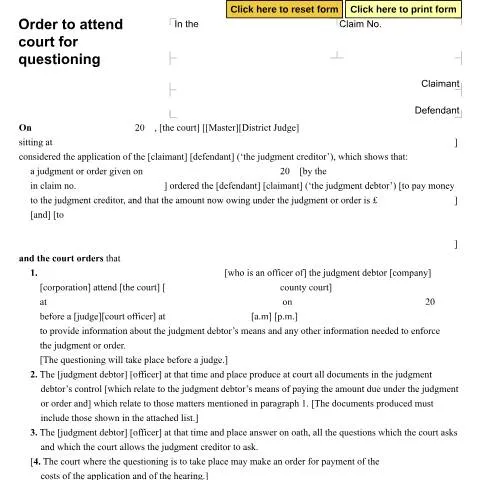
The N39 Order: When Courts Compel Attendance for Financial Disclosure
When a judgment debtor proves elusive about their financial circumstances or fails to honour a court order for payment, creditors face a frustrating impasse. The N39 Order to attend court for questioning represents a powerful judicial tool that transforms this standstill into action. Unlike voluntary disclosure processes or negotiated payment arrangements, the N39 compels attendance under threat of contempt proceedings, creating a formal mechanism where judgment debtors must face detailed scrutiny of their financial position under oath.
This court order operates within the enforcement framework administered by HM Courts & Tribunals Service, specifically targeting situations where a judgment creditor requires comprehensive information about a debtor's means to satisfy an outstanding judgment. The process moves beyond simple demand letters or payment reminders, establishing a judicial interrogation that can unlock previously hidden assets or income streams essential for effective debt recovery.
Understanding the Legal Framework Behind Compulsory Questioning
The N39 order derives its authority from the Civil Procedure Rules, specifically the provisions governing examination of judgment debtors. This legal foundation distinguishes it from voluntary financial disclosure requests or informal settlement discussions. When a district judge or master issues an N39, they create a legally binding obligation that carries the full weight of court authority.
The order typically emerges following an application by the judgment creditor, supported by evidence demonstrating that:
- A valid judgment or court order exists requiring payment
- The debtor has failed to satisfy the judgment voluntarily
- The creditor requires detailed financial information to pursue effective enforcement
- Previous attempts to obtain this information have proved unsuccessful
The court's consideration involves balancing the creditor's legitimate need for information against the debtor's rights, ensuring that questioning serves a genuine enforcement purpose rather than harassment. This judicial oversight prevents abuse while maintaining the order's effectiveness as an enforcement mechanism.
Scope of Judicial Authority
Once issued, the N39 creates several concurrent obligations. The judgment debtor must attend court at the specified time and location, produce comprehensive documentation relating to their financial position, and answer questions under oath. This tri-part structure ensures that the court obtains not merely assertions but verifiable evidence of the debtor's circumstances.
For corporate debtors, the order extends to company officers, requiring them to attend as representatives and disclose the company's financial position. This provision prevents limited liability structures from shielding directors from legitimate enforcement enquiries when their companies fail to honour court orders.
Who Faces N39 Proceedings: Debtor Categories and Circumstances
The N39 process typically involves judgment debtors who have demonstrated an unwillingness or apparent inability to satisfy court orders voluntarily. However, the specific circumstances vary considerably, creating distinct categories of affected individuals and entities.
| Debtor Type | Typical Circumstances | Attendance Requirements | Documentation Scope |
|---|---|---|---|
| Individual Debtors | Personal judgment debts, contract disputes, tort claims | Personal attendance mandatory | Complete personal financial records |
| Sole Traders | Business debts, commercial disputes | Personal attendance as business owner | Personal and business financial records |
| Limited Companies | Corporate judgment debts | Nominated officer attendance | Corporate financial records and accounts |
| Partnerships | Partnership liabilities | Partner attendance | Partnership and personal records |
Individual judgment debtors represent the most common category, encompassing everyone from consumers who have defaulted on credit agreements to defendants in personal injury claims. These debtors must attend personally, as the court requires direct testimony about their financial circumstances rather than representation through solicitors or family members.
Business debtors create more complex scenarios. Sole traders face dual obligations, as their personal and business finances often intertwine in ways that affect enforcement prospects. The court may require disclosure of both streams, recognising that apparent business poverty might mask personal wealth or vice versa.
Corporate Officer Responsibilities
When companies receive N39 orders, the nominated officer bears significant responsibility. Typically a director, company secretary, or senior manager, this individual must possess comprehensive knowledge of the company's financial position. The court expects them to provide detailed, accurate information rather than general impressions or partial knowledge.
This requirement creates practical challenges for larger organisations where financial information spans multiple departments or systems. The nominated officer must ensure they can access and explain all relevant financial data, from basic cash flow to complex asset structures or intercompany arrangements.
Documentary Evidence: The Paper Trail That Courts Demand
The N39 order's effectiveness relies heavily on comprehensive documentary disclosure, transforming abstract financial claims into concrete, verifiable evidence. The standard documentation requirements create an extensive paper trail that reveals the debtor's true financial position beyond mere assertions or estimates.
Personal financial documentation encompasses immediate income sources through pay slips and benefit statements, alongside longer-term financial commitments revealed through mortgage statements, hire-purchase agreements, and outstanding court orders. This combination provides courts with both snapshot and historical perspectives on the debtor's financial capacity.
Bank statements and building society books receive particular scrutiny, as they reveal actual cash flow patterns rather than declared income levels. Courts examine these documents for regular payments, unusual transactions, or evidence of undisclosed income sources that might affect enforcement strategies.
Business Documentation Requirements
Business debtors face additional layers of documentary disclosure reflecting commercial operations' complexity. Two years of balance sheets and profit and loss accounts provide historical context, while current management accounts reveal recent trading patterns that might indicate improved or deteriorating financial positions.
Outstanding invoices and debtor lists become crucial for creditors considering third-party debt orders or charging orders against business assets. These documents can reveal valuable enforcement opportunities that simple asset declarations might miss.
The documentation requirements extend beyond mere possession to active retrieval obligations. Debtors must obtain documents within their control, even if held by third parties such as accountants, banks, or business partners.
The Court Hearing: Procedure and Practical Realities
N39 hearings operate under formal court procedures while maintaining sufficient flexibility to address each debtor's unique circumstances. The questioning process typically occurs before either a district judge or designated court officer, with the choice affecting both the hearing's formality and the creditor's participation requirements.
Judge-led hearings require creditor attendance, as the court expects them to conduct direct questioning under judicial supervision. This arrangement provides creditors with maximum control over the information-gathering process, allowing them to pursue specific lines of enquiry based on their knowledge of the debt and debtor's circumstances.
Court officer questioning offers an alternative where creditors may attend but need not do so. The court officer conducts standardised questioning based on the N39 framework, focusing on comprehensive financial disclosure rather than debt-specific enquiries. This approach suits creditors who prefer professional questioning while reducing their direct involvement costs.
The Oath and Its Implications
All N39 questioning occurs under oath, transforming the proceedings from informal discussions into formal legal testimony. This requirement carries significant implications, as false or misleading answers constitute contempt of court rather than mere civil dispute.
The oath obligation extends beyond direct questions to encompass document authenticity and completeness. Debtors must confirm that their submitted documentation accurately reflects their financial position and that they have disclosed all relevant information within their knowledge or control.
Financial Consequences and Cost Implications
The N39 process creates immediate financial implications for all parties, extending beyond the original judgment debt to encompass hearing costs, travel expenses, and potential cost orders. Understanding these financial dynamics proves essential for both creditors contemplating applications and debtors facing orders.
Application fees represent the creditor's initial investment, typically ranging from £55 to £275 depending on the court and circumstances. These fees become recoverable costs if the application succeeds, but creditors must fund them initially regardless of the hearing's outcome.
Debtor travel expenses create an interesting dynamic where creditors may face demands for reasonable travel costs within seven days of serving the order. This provision prevents geographic disadvantage from undermining the order's effectiveness while ensuring creditors bear the costs of compelling attendance.
Cost Recovery and Additional Orders
Successful N39 proceedings often result in cost orders requiring debtors to reimburse creditors' legal expenses and court fees. These additional obligations can substantially increase the total debt, particularly where debtors have necessitated multiple enforcement attempts or demonstrated unreasonable non-cooperation.
The court's discretion in cost awards reflects both the hearing's outcome and the parties' conduct throughout the process. Debtors who attend punctually, provide comprehensive information, and cooperate fully may face reduced cost exposure compared to those who demonstrate obstruction or contempt.
Enforcement Consequences: Beyond Information Gathering
While information gathering represents the N39's primary purpose, the process often triggers immediate enforcement consequences based on the disclosed financial position. Courts may make payment orders, approve instalment arrangements, or authorise specific enforcement methods based on the revealed circumstances.
Immediate payment orders emerge when questioning reveals significant undisclosed assets or income streams. The court may direct immediate payment of specific amounts, particularly where debtors have demonstrated ability to pay despite previous non-compliance claims.
Instalment arrangements provide structured payment solutions based on verified income and expenditure figures rather than debtor assertions. These court-approved arrangements carry enhanced enforcement powers if debtors subsequently default on agreed payments.
Contempt Proceedings and Their Ramifications
Non-attendance or non-compliance with N39 orders can trigger contempt proceedings carrying potential imprisonment. This sanction transforms civil debt recovery into quasi-criminal proceedings, reflecting the court's determination to maintain its authority over judgment enforcement.
Contempt applications require careful preparation, as courts distinguish between wilful defiance and genuine inability to comply. Creditors must demonstrate that debtors received proper notice, understood their obligations, and deliberately chose non-compliance rather than facing insurmountable practical obstacles.
The imprisonment threat, while rarely implemented, provides powerful leverage encouraging voluntary compliance. Most debtors prefer attending hearings and providing information rather than risking custody, making the N39 an effective tool even where ultimate imprisonment seems unlikely.
Strategic Considerations for Creditors and Debtors
The N39 process requires careful strategic consideration from both creditors seeking information and debtors facing disclosure obligations. Success depends on understanding not merely the formal requirements but the practical dynamics that determine outcomes.
Creditor timing considerations prove crucial, as premature applications may fail where debtors retain reasonable payment prospects, while delayed applications might allow asset dissipation or debtor disappearance. The optimal timing balances immediate recovery prospects against information-gathering needs.
Debtor response strategies focus on comprehensive compliance rather than minimal cooperation. Courts respond favourably to debtors who demonstrate transparency and willingness to engage constructively, potentially leading to more manageable payment arrangements or reduced cost exposure.
The N39 order represents a pivotal moment in judgment enforcement, transforming information asymmetries into transparent financial disclosure. Its effectiveness relies on careful preparation, comprehensive compliance, and strategic understanding of the broader enforcement landscape. For creditors, it provides essential intelligence for enforcement decisions; for debtors, it offers an opportunity to demonstrate genuine financial constraints while avoiding more severe enforcement consequences.
Understanding the Legal Framework Behind Form N39
Form N39 operates within a sophisticated legal framework that balances the rights of judgment creditors to recover debts with the fundamental protections afforded to judgment debtors. The statutory foundation rests primarily on Part 71 of the Civil Procedure Rules (CPR), which governs oral examination procedures, and the County Courts Act 1984, which provides the underlying jurisdiction for enforcement proceedings.
The legal principles underpinning oral examinations trace back centuries in English common law, reflecting the courts' inherent power to compel attendance and truthful disclosure in aid of execution. However, modern practice is carefully circumscribed by procedural safeguards designed to prevent abuse whilst maintaining effective debt recovery mechanisms.
Under CPR 71.2, the court may only make an order for oral examination where it appears that a person has information about the judgment debtor's means or knowledge of where assets might be located. This threshold requirement prevents fishing expeditions and ensures examinations serve a legitimate investigative purpose rather than harassment.
The Human Rights Act 1998 adds another layer of protection, particularly regarding Article 8 (right to private and family life) when personal financial information is being disclosed. Courts must consider proportionality when ordering examinations, weighing the creditor's legitimate interest in recovering judgment debts against the debtor's privacy rights and dignity.
Significantly, the legal framework distinguishes between different categories of judgment debtors. Individual debtors receive stronger protections than corporate entities, reflecting the more severe personal consequences of enforcement action. Similarly, vulnerable debtors—including those with mental health conditions, learning difficulties, or severe financial hardship—may benefit from additional procedural safeguards or alternative approaches to information gathering.
The courts also possess discretionary powers to vary examination orders where circumstances change. For instance, if a debtor demonstrates genuine inability to attend due to serious illness or caring responsibilities, the court may reschedule the hearing, permit attendance by video link, or in exceptional cases, order written responses to specific questions instead of oral examination.
Tactical Considerations for Creditors and Strategic Responses
From a creditor's perspective, Form N39 represents just one tool within a broader enforcement strategy, and its effectiveness depends heavily on proper preparation and realistic expectations. Experienced practitioners recognise that oral examinations work best when combined with other intelligence-gathering methods and enforcement options.
Before applying for an oral examination, creditors should conduct preliminary investigations to identify potential assets or income sources. This might include credit reference checks, social media research (within legal boundaries), or analysis of public records such as Land Registry entries or Companies House filings. Such preparation enables more targeted questioning and increases the likelihood of uncovering recoverable assets.
The timing of examination applications can prove crucial. Applying too soon after judgment may catch debtors before they've had opportunity to dissipate assets, but insufficient time may also mean limited information is available. Conversely, delayed applications risk assets being moved beyond reach or debtors becoming genuinely unable to pay through changed circumstances.
Creditors must also consider the cost-benefit analysis carefully. Court fees for oral examinations, while modest, represent additional expense with no guarantee of recovery. More significantly, the time investment required—including preparation, attendance at hearings, and follow-up enforcement action—can be substantial. For smaller judgment debts, these costs may exceed realistic recovery prospects.
Strategic creditors often coordinate oral examinations with other enforcement methods. For example, scheduling an examination shortly before applying for a charging order on property can provide up-to-date asset information to support the application. Similarly, combining examinations with attachment of earnings applications for employed debtors can create comprehensive recovery strategies.
The psychological impact of examination orders shouldn't be underestimated. Many debtors, faced with the prospect of court attendance and detailed financial disclosure, choose to engage constructively with creditors to arrange payment plans or settlements. This 'settlement pressure' often proves more valuable than the information obtained through actual examination.
For debtors, strategic responses depend largely on individual circumstances and the nature of underlying debts. Complete non-engagement rarely proves effective and risks contempt proceedings with potential imprisonment. However, debtors do possess legitimate options for managing examination processes.
Proactive communication with creditors before examination hearings can sometimes lead to alternative arrangements. Offering realistic payment proposals, supported by detailed financial statements, may persuade creditors to accept voluntary disclosure rather than proceeding with formal examination. This approach avoids court attendance whilst potentially achieving creditor objectives.
Enforcement Mechanisms and Consequences of Non-Compliance
The enforcement powers available when debtors fail to comply with Form N39 orders represent some of the most serious consequences in civil debt recovery proceedings. Understanding these mechanisms is essential for both creditors seeking effective recovery and debtors facing potential sanctions.
The primary enforcement tool is the application for committal for contempt of court, governed by CPR Part 81. When a debtor fails to attend an oral examination without reasonable excuse, or attends but refuses to answer legitimate questions, creditors may apply for a committal order. This process can ultimately result in imprisonment for up to 14 days, though courts exercise this power sparingly and only after careful consideration of alternatives.
Before committal proceedings can commence, creditors must demonstrate that the debtor received proper notice of the examination order and that non-compliance was wilful rather than due to genuine inability to attend. The standard of proof mirrors criminal proceedings, requiring evidence beyond reasonable doubt that contempt occurred.
Courts typically follow a graduated approach to enforcement. Initial non-compliance often results in warnings and rescheduled hearings rather than immediate committal applications. However, persistent non-compliance, particularly when combined with evidence of asset dissipation or deliberate avoidance, can lead to more severe consequences.
The suspended committal order represents a powerful intermediate sanction. Under this arrangement, debtors face imprisonment if they breach specific conditions—typically attending rescheduled examinations and providing full disclosure. This mechanism maintains strong incentives for compliance whilst avoiding the expense and complexity of immediate custody.
Alternative enforcement mechanisms include applications for arrest warrants where debtors fail to attend examination hearings. Unlike committal proceedings, arrest warrants can be executed immediately upon non-attendance, bringing debtors directly to court for examination. However, this power is used sparingly and typically reserved for cases involving substantial debts or evidence of deliberate avoidance.
The practical effectiveness of enforcement mechanisms varies considerably. Imprisonment, while possible, rarely results in debt recovery and may actually reduce debtors' ability to pay through loss of employment. Consequently, experienced practitioners often view enforcement powers primarily as leverage to encourage voluntary compliance rather than ends in themselves.
For judgment creditors, the key lies in demonstrating consistent but proportionate enforcement. Courts expect creditors to pursue reasonable collection efforts before seeking committal orders, and excessive or vindictive enforcement action can backfire by generating judicial sympathy for debtors.
Debtors facing potential enforcement action should seek immediate legal advice, particularly where personal liberty is at risk. Valid defences to committal proceedings include genuine inability to attend (supported by medical evidence), lack of proper service of examination orders, or creditor procedural failures. However, these defences require proper presentation within strict time limits.
The interaction between civil enforcement and potential criminal liability also deserves attention. While oral examinations themselves are civil proceedings, deliberate false statements under oath may constitute perjury, carrying separate criminal penalties. Similarly, asset concealment revealed through examination processes might trigger investigations for fraudulent conveyancing or other offences.