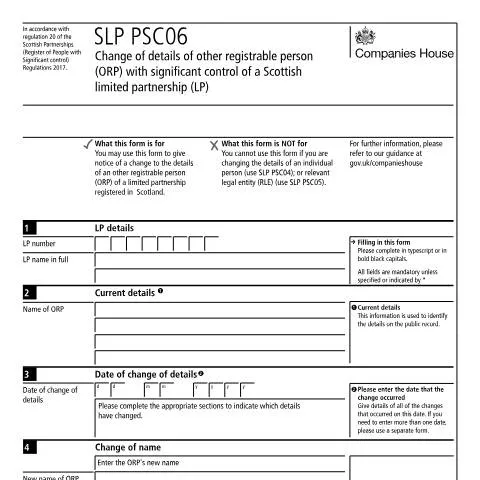
Navigating the SLP PSC06 Document: A Practical Guide
The process of managing a Scottish Limited Partnership (SLP) comes with various responsibilities, particularly when it involves notifying Companies House regarding significant changes. Among these notifications is the SLP PSC06 document, which concerns changes in details of an Other Registrable Person (ORP) with significant control of a partnership. Understanding how to effectively navigate this notice is crucial for compliance and transparency. This guide delves into the core components of the SLP PSC06, its relevance, and practical steps to ensure accurate reporting.
Understanding Significant Control and Its Implications
Before diving into the specifics of the SLP PSC06, it is essential to comprehend what significant control means in the context of a Scottish Limited Partnership. An ORP can be an individual or a legal entity that holds a certain level of influence over the management and operations of the partnership. This control manifests through various means, such as:
- Share of assets: The ORP may control a percentage of the surplus assets on winding up.
- Ownership of voting rights: The ability to impact decisions through voting power.
- Management authority: The right to appoint or remove management personnel.
- Significant influence: Even without direct control, the ORP can significantly influence operational decisions.
Understanding these dynamics is vital when completing Form SLP PSC06, as it requires clear identification of the nature of control exercised by the ORP.
When is the SLP PSC06 Required?
The SLP PSC06 is specifically designed for situations where there is a change in the details of an Other Registrable Person. This includes:
- A change in the name of the ORP.
- Changes in the legal form or governing law details.
- Adjustments in the nature of control exercised by the ORP.
If the changes pertain to an individual person or a Relevant Legal Entity (RLE), the appropriate forms to consider would be SLP PSC04 and SLP PSC05 respectively. Misusing the SLP PSC06 for these purposes can lead to compliance issues, so it is crucial to ensure the right form is utilized.
Dissecting the SLP PSC06: Key Sections and Their Importance
The SLP PSC06 form is structured to capture detailed information about the changes to an ORP. Below is an elaboration of the critical sections that need to be completed:
1. Current Details
This section establishes a baseline for the ORP currently registered with Companies House. It includes:
- Building name/number
- Street address
- Post town, county/region
- Postcode
Providing accurate current details ensures seamless identification and verification of the ORP’s information on public records.
2. Date of Change
The date on which the changes took effect is critical for the record-keeping process. Companies House emphasizes the need for accuracy here, as discrepancies could lead to complications in future transactions or compliance checks.
3. Nature of Control
Here, the form requires you to specify how the ORP holds significant control over the SLP. Options include:
- Percentage of surplus assets.
- Percentage of voting rights.
- Rights to appoint/remove management.
- Exercising significant influence or control.
Each of these aspects must be ticked to ensure that all forms of control are appropriately documented.
4. Changes in Legal Details
Should there be a change in the governing law details of the ORP, it must be accurately reflected in this section. This ensures that Companies House always has up-to-date records that align with the legal structure governing the ORP.
5. Signature Section
The form concludes with a section for signature, where the general partner must sign on behalf of the SLP. This signature serves as a declaration of the truthfulness of the information provided. Lack of this signature can render the submission invalid, highlighting the importance of thoroughness in this final step.
Practical Steps for Effective Utilization of the SLP PSC06
To leverage the SLP PSC06 efficiently, consider the following step-by-step approach:
- Gather Current Information: Before initiating the process, ensure that all current details regarding the ORP are up-to-date and accurate. This includes addresses and the nature of control.
- Determine the Nature of Change: Clearly identify what changes have occurred. This will dictate which sections of the form need to be filled out.
- Complete the Form Carefully: Use typescript or bold black capitals for clarity, making sure not to leave any mandatory fields blank.
- Consult Guidance as Necessary: Should uncertainties arise, refer to Companies House guidance or seek legal advice to clarify any complexities.
- Review and Sign: Before submission, review the completed form for accuracy and ensure that it is signed by the general partner.
- Submit Timely: The timely submission of the SLP PSC06 is crucial. Delays may lead to compliance issues, so ensure you submit within the stipulated deadlines.
Articulating the SLP PSC06 with Other Documentation
When navigating the regulatory landscape of a Scottish Limited Partnership, it is vital to understand how the SLP PSC06 interacts with other forms and submissions. For example:
| Document | Purpose | When to Use |
|---|---|---|
| SLP PSC04 | Change of individual persons with significant control | For changes pertaining to individual persons |
| SLP PSC05 | Change of relevant legal entity details | For changes concerning legal entities |
| SLP PSC06 | Change of details of other registrable persons | For ORP-specific changes |
This structured approach not only aids in understanding responsibilities but also fosters compliance across various forms and submissions mandated by Companies House.
Common Misinterpretations and How to Avoid Them
As with any regulatory process, misinterpretations can lead to significant compliance issues. The SLP PSC06 is often misunderstood in the following areas:
- Distinguishing Between ORPs and Individuals: It’s important to utilize SLP PSC06 solely for ORPs. Using it for individual changes can lead to incorrect filings.
- Understanding Control: Accurately defining the nature of control is critical. Failing to do so can misrepresent the ORP's level of influence, leading to potential scrutiny.
- Accuracy of Dates: Any discrepancies in the date of change can result in administrative challenges and potential penalties.
Being aware of these potential pitfalls enhances compliance and streamlines the process of reporting changes in significant control.
Final Thoughts on the SLP PSC06 Document
Engaging with the SLP PSC06 document is not a mere bureaucratic exercise; it’s a vital component of governance for Scottish Limited Partnerships. By thoroughly understanding its structure, the circumstances necessitating its use, and the implications of the information provided, partners can ensure they meet their legal obligations while fostering transparency. Given the intricate nature of partnerships and control, seeking professional advice when in doubt is advisable. This can safeguard against potential compliance issues and enhance the overall management of the partnership.
Understanding Significant Control in Scottish Limited Partnerships
A Scottish Limited Partnership (SLP) is a unique structure that allows for flexibility in management and operations while maintaining limited liability for its partners. Understanding the concept of "significant control" is critical for both compliance and governance. A person with significant control (PSC) is generally defined as an individual or entity that fulfills one or more of the following criteria:
- Holds more than 25% of the shares in the partnership.
- Has the right to appoint or remove the majority of the board of directors.
- Has significant influence or control over the partnership.
In the context of an SLP, it is vital to accurately identify and report the details of any individual or entity that meets these criteria. This not only ensures compliance with the requirements laid out in the Companies Act 2006 but also fosters transparency and accountability within the partnership structure.
The Process of Updating PSC Information
Updating the details of a person with significant control in your SLP is a pivotal administrative task that must be undertaken with diligence. Here is a step-by-step breakdown of the process involved:
- Identify the Changes: Regularly review the partnership's structure to identify any changes in control. This could include changes in shareholding, the appointment of new partners, or changes in the authority of existing partners.
- Gather Required Information: Ensure that you have all necessary details of the new PSC, including their full name, date of birth, nationality, and residential address. For non-natural persons, this will include the registered office address and company registration number.
- Complete the PSC06 Form: The PSC06 form must be completed with care. You can download the form from the Companies House website. Ensure that you follow the guidance notes provided with the form to avoid any errors.
- Submit the Form: The completed form can be submitted electronically or via post to Companies House. Ensure you keep a record of the submission for your own records.
- Monitor Compliance Deadlines: Keep in mind that any changes in PSC information must be reported within 14 days of the change taking place. Failure to comply may result in penalties, including fines or restrictions on the partnership.
Common Pitfalls When Filing the PSC06
While updating the PSC details may seem straightforward, several common pitfalls can lead to issues down the line. Here are a few key areas to watch out for:
- Inaccurate Information: Ensure all details entered on the PSC06 form are accurate and reflect the latest changes. Mistakes in spelling names, incorrect addresses, or wrong identification details can lead to rejections or queries from Companies House.
- Missing Deadlines: As mentioned previously, there's a strict 14-day deadline to report changes. Failing to meet this deadline not only puts the partnership at risk of penalties but also undermines the integrity of the partnership records.
- Lack of Documentation: It’s crucial to maintain proper documentation that supports the changes made. For instance, if a new PSC has been appointed, ensure you have minutes from partnership meetings where this was discussed and approved.
By being vigilant about these common issues, partnerships can ensure that their compliance records are up to date and free from discrepancies.