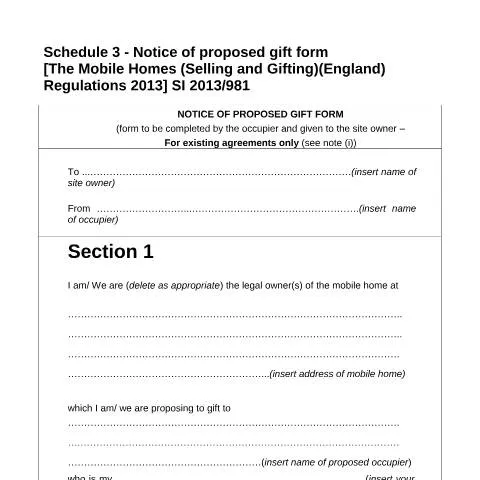
The Strategic Role of Gift Notifications in Park Home Succession Planning
When a park home owner decides to transfer their property to a family member without payment, they enter a regulatory landscape that differs markedly from conventional property transfers. The Notice of proposed gift form represents a crucial procedural gateway, designed to balance the legitimate interests of site owners with the rights of residents to pass their homes within their families. This document operates within the framework of existing agreements – those pitch agreements established under the Mobile Homes Act 1983 before 26 May 2013 that remain unassigned since that pivotal date.
Unlike standard property transactions, park home gifts trigger specific notification requirements that can determine whether a transfer proceeds smoothly or faces tribunal intervention. The form serves as both a declaration of intent and a protective mechanism, ensuring site owners receive adequate notice whilst providing residents with clear procedural pathways. Understanding its application becomes essential for anyone navigating the intersection of family succession planning and residential park home ownership.
Decoding the Legislative Framework: When This Notice Becomes Mandatory
The Notice of proposed gift form operates within a carefully defined regulatory perimeter established by the Mobile Homes (Selling and Gifting)(England) Regulations 2013. Its application hinges on a critical temporal and contractual distinction that many residents misunderstand. The form is exclusively required for mobile homes held under existing agreements – those pitch agreements created on or before 25 May 2013 that have never been assigned since that date.
This legislative architecture creates two distinct pathways for park home transfers. Properties governed by newer agreements (post-26 May 2013) or those where the original agreement has been assigned since the regulatory changes can be gifted without site owner notification. The distinction reflects Parliament's intention to grandfather existing arrangements whilst streamlining procedures for more recent agreements that already incorporate updated consumer protections.
| Agreement Type | Gift Notification Required | Site Owner Involvement |
|---|---|---|
| Pre-26 May 2013 (never assigned) | Yes - full notice procedure | 21-day review period, tribunal application rights |
| Post-25 May 2013 | No | None - direct family transfer permitted |
| Pre-2013 but subsequently assigned | No | None - treated as newer agreement |
The practical implications extend beyond mere procedural compliance. Residents operating under existing agreements who fail to serve proper notice risk invalidating their transfer, potentially leaving family members without secure tenure. Conversely, those mistakenly believing they need site owner consent when holding newer agreements may unnecessarily delay legitimate family succession.
Navigating Family Relationship Requirements and Evidence Thresholds
The statutory definition of "family member" for park home gifting purposes extends well beyond immediate relatives, encompassing a broad network of relationships that reflects modern family structures. Section 5 of the Mobile Homes Act 1983 establishes an inclusive framework that treats marriage and civil partnership relationships as equivalent to blood relationships, recognises half-blood connections as whole-blood relationships, and includes stepchildren within the family definition.
The legislation's approach to relationship evidence demonstrates particular sophistication in addressing contemporary family arrangements. Cohabiting couples who live together as husband and wife or civil partners qualify for family gifting rights without formal legal recognition of their relationship. This provision acknowledges long-term partnerships that may not have been formalised through marriage or civil partnership registration.
Evidence requirements follow a tiered approach that balances verification needs with practical accessibility:
- Formal documentation: Birth certificates, adoption certificates, marriage or civil partnership certificates provide primary evidence for direct relationships
- Sworn declarations: Written statements under oath can establish family connections where formal documentation proves inadequate or unavailable
- Alternative evidence: The regulations explicitly permit "other relevant evidence" that satisfactorily demonstrates family relationships, providing flexibility for complex family situations
This evidence framework proves particularly valuable in situations involving informal adoptions, long-term guardianship arrangements, or relationships complicated by historical circumstances. The key requirement centres on satisfactory proof rather than rigid adherence to specific documentation types, enabling legitimate family transfers whilst maintaining appropriate verification standards.
Site Rules Compliance: Navigating Age, Pet, and Vehicle Restrictions
Section 2 of the notice form addresses one of the most contentious aspects of park home transfers: ensuring proposed occupiers can comply with existing site rules. This section becomes mandatory only where sites maintain rules regarding age restrictions, pet ownership, or vehicle parking – areas where site owners retain legitimate operational interests that extend beyond simple property transfer mechanics.
Age restriction compliance requires careful attention to household composition details. Sites operating as retirement communities or adult-only developments can maintain these restrictions even during family gifts, provided they apply consistently and meet legal requirements. The form requires disclosure of all intended permanent residents with their ages, enabling site owners to assess compliance before transfer completion.
Pet ownership declarations reflect the practical realities of park home living, where animal behaviour can significantly impact community harmony. The form distinguishes between different animal types and specifically requires breed identification for dogs, recognising that some sites maintain breed-specific restrictions based on insurance requirements or community preferences. Importantly, residents must declare intentions regarding pet ownership rather than providing exhaustive inventories, focusing on compliance assessment rather than detailed registration.
Vehicle parking provisions address space allocation and community management concerns. Sites with limited parking or specific vehicle type restrictions can use this information to ensure new occupiers understand and accept existing arrangements. The form explicitly requests vehicle descriptions rather than registration numbers, maintaining privacy whilst enabling compliance verification.
Rule Communication and Acknowledgment Procedures
The notice form establishes a formal communication chain ensuring proposed occupiers receive comprehensive rule information before commitment. Current occupiers must provide rule copies to intended recipients, who must then confirm their understanding and compliance capability. This dual-acknowledgment system protects both parties by ensuring informed consent whilst creating documentary evidence of rule awareness.
Understanding the 21-Day Challenge Window and Tribunal Procedures
The notice form triggers a precisely defined 21-day period during which site owners can challenge proposed gifts through tribunal applications. This timeframe represents a carefully balanced compromise between site owners' legitimate interests and residents' transfer rights, providing sufficient review time whilst preventing indefinite delays.
Site owner challenge grounds remain strictly limited under regulation 7 of the Mobile Homes (Selling and Gifting) England Regulations 2013. Applications for refusal orders can only succeed where proposed occupiers would breach pre-commencement rules or existing site rules through age non-compliance, prohibited animal ownership, or unauthorised vehicle parking. Significantly, site owners cannot object based on personal preferences, financial concerns, or general suitability assessments.
The tribunal application process requires simultaneous action: site owners must both submit applications to the appropriate tribunal and serve notice copies on current occupiers within the 21-day window. Failure to meet either requirement invalidates the application, enabling residents to proceed with transfers without further consultation.
The legislation creates an automatic progression mechanism: if occupiers receive no tribunal application notice within 21 days of serving their gift notification, they may complete transfers immediately without site owner involvement.
This automatic progression feature prevents indefinite delays whilst maintaining site owners' substantive challenge rights. The system recognises that legitimate objections should be identifiable within reasonable timeframes, whilst protecting residents from tactical delays or administrative inefficiency.
Procedural Safeguards and Documentation Requirements
The notice form incorporates multiple safeguards designed to prevent disputes and ensure all parties understand their rights and obligations. The dual-signature requirement – from both current and proposed occupiers – creates shared accountability and confirms mutual agreement to proceed with the transfer under stated conditions.
Dating requirements serve crucial evidential purposes, establishing precise timelines for the 21-day challenge period and creating clear audit trails for potential dispute resolution. These timestamps become particularly important if site owners dispute service timing or claim inadequate notice periods.
The form's structure follows established administrative law principles, separating factual declarations from compliance assessments and procedural acknowledgments. This organisation enables efficient processing whilst ensuring comprehensive coverage of relevant legal requirements.
Integration with Broader Park Home Regulations
Gift notifications operate within the broader framework of park home consumer protection measures introduced through the Mobile Homes Act 2013 amendments. The notice procedure complements other regulatory protections including commission payment restrictions, improved security of tenure, and enhanced dispute resolution mechanisms.
Understanding this integration proves essential for residents navigating complex succession planning scenarios. Gift procedures may interact with pitch fee arrangements, site licence conditions, and local authority oversight responsibilities, creating multi-layered compliance requirements that extend beyond simple property transfer mechanics.
Practical Implementation Strategies for Different Family Scenarios
Successful gift notification implementation requires tailoring approaches to specific family circumstances and site characteristics. Straightforward transfers between spouses or civil partners typically proceed smoothly, requiring minimal documentation and facing few compliance challenges. However, more complex family arrangements demand careful preparation and strategic timing.
Multi-generational transfers, particularly those involving grandchildren or extended family members, benefit from comprehensive evidence gathering before notice service. Assembling birth certificates, marriage documentation, and relationship declarations in advance prevents delays and demonstrates transfer legitimacy to potentially sceptical site owners.
Blended family situations require particular attention to relationship evidence requirements. Stepparent-to-stepchild transfers, while legally permissible, may need additional documentation to establish clear family connections under the statutory definitions. In such cases, marriage certificates linking biological parents to step-relationships often provide crucial evidential support.
- Cohabiting couples: Focus on demonstrating stable partnership through joint financial arrangements, shared residence evidence, and mutual dependency documentation
- Informal adoptions: Gather guardianship records, long-term care evidence, and sworn declarations from multiple family members
- International families: Ensure foreign birth certificates receive appropriate apostille certification or official translation where necessary
Timing Considerations and Strategic Planning
Gift timing can significantly impact success rates and procedural complexity. Serving notices during site owner vacation periods or busy administrative periods may extend response times, whilst peak transfer seasons might strain tribunal processing capacity if disputes arise.
Some residents benefit from informal preliminary discussions with site management before formal notice service, particularly where rule compliance questions exist or family relationships appear complex. While such discussions carry no legal weight, they can identify potential issues and enable proactive resolution strategies.
Common Implementation Challenges and Resolution Approaches
Despite clear regulatory frameworks, gift notification procedures frequently encounter practical obstacles that require careful navigation. Relationship evidence challenges represent the most common implementation difficulty, particularly for families with complex histories, informal arrangements, or incomplete documentation.
Site rule compliance assessments can prove problematic where rules lack clarity or site owners interpret requirements inconsistently. Age restriction sites sometimes struggle with multi-generational household arrangements, whilst pet policies may inadequately address modern animal ownership patterns or assistance animal requirements.
Document service disputes occasionally arise where site owners claim non-receipt or inadequate notice provision. The regulations require service "on" site owners rather than specifying particular methods, creating potential ambiguity in service requirements. Best practice involves using recorded delivery methods with service acknowledgment requirements, creating clear evidence trails for potential dispute resolution.
Administrative capacity limitations at some sites can delay processing or create artificial barriers to legitimate transfers. While the 21-day response window remains absolute, some site owners struggle with complex relationship assessments or rule compliance evaluations within available timeframes.
Resolution strategies focus on proactive communication, comprehensive documentation, and clear timeline management. Residents benefit from maintaining detailed records of all communications, preserving evidence of service methods, and preparing comprehensive supporting documentation before notice service. Where disputes seem likely, early legal consultation can prevent procedural errors that might invalidate otherwise legitimate transfers.
The notice form's integration with broader park home protections means successful implementation often depends on understanding wider regulatory contexts and maintaining positive ongoing relationships with site management. Strategic approaches that balance legal rights with practical cooperation typically achieve better outcomes for all parties involved in these important family property transitions.