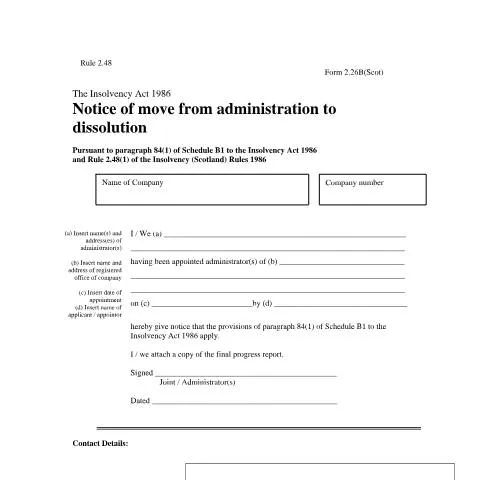
Understanding Form 2.26B: Transitioning from Administration to Dissolution in Scotland
The journey from administration to dissolution can be intricate for companies navigating financial difficulties. The Notice of move from administration to dissolution: Form 2.26B, administered by The Insolvency Service, serves as a critical document in this process. This guide delves into the nuances of this notice, exploring its practical applications and the essential considerations for administrators and stakeholders.
Essential Context: The Role of Administration in Insolvency
Before directly addressing Form 2.26B, it is crucial to grasp the concept of administration within the framework of the Insolvency Act 1986. Administration is a process designed to rescue a company in financial distress. Under this process, an administrator is appointed to manage the company's affairs, business, and property, with the primary goal of achieving a better outcome for creditors than would be likely if the company were liquidated.
Upon stabilizing the company's operations, should it become clear that a revival is unattainable, the next logical step is moving from administration to dissolution. This transition is where Form 2.26B becomes indispensable.
The Practical Steps for Administrators
Completing Form 2.26B involves several key steps, each pivotal to ensuring that the transition from administration to dissolution is smooth and compliant with legal stipulations.
- Appointment of Administrator: Clearly document the names and details of the appointed administrator(s) responsible for overseeing the administration process.
- Company Information: Include the registered name and address of the company facing dissolution, ensuring accuracy to avoid complications.
- Date of Appointment: Specify the date when the administrator was appointed, as this is vital for the timeline of the insolvency process.
- Attach Final Progress Report: It's essential to provide a copy of the final progress report, which outlines the administrator's actions and the company's status throughout the administration.
- Signature and Date: The document must be signed and dated by the administrator(s) to validate the notice.
Who Needs Form 2.26B? Identifying Relevant Stakeholders
Understanding who must engage with Form 2.26B is crucial. This document primarily concerns:
- Company Administrators: Those appointed to manage the administration process must use Form 2.26B to officially notify relevant parties of the shift to dissolution.
- Creditors: Creditors of the company have a vested interest in the outcome of the administration and subsequent dissolution, as it impacts their potential recoveries.
- Company Shareholders: Shareholders should be aware that the change in status affects their rights and entitlements concerning the company's assets.
Key Situations Necessitating the Use of Form 2.26B
Form 2.26B becomes essential in various scenarios:
- When the administration period has concluded, and the administrator determines that dissolution is the most beneficial path forward.
- If a company has not been able to achieve a satisfactory rescue plan or sale of its assets within the administration period.
- In cases where the business has ceased operations, and there are no ongoing activities warranting further administration.
Common Misinterpretations Surrounding the Notice
Misunderstandings about Form 2.26B can lead to significant complications. Here are some frequent misinterpretations:
- Assuming Automatic Approval: Filing Form 2.26B does not guarantee that dissolution will be approved; it signals the intention to dissolve but requires compliance with all statutory obligations.
- Neglecting Creditors' Rights: Administrators must be mindful of creditors' rights and the statutory requirements for reporting to them during this transition.
- Overlooking Final Reporting: Failing to attach the final progress report can delay the dissolution process or raise questions from Companies House.
Defining the Scope of Form 2.26B
This document serves as a formal notice, but its implications extend beyond mere notification. Some areas that Form 2.26B does not cover include:
- It does not address the distribution of assets among creditors; those matters are dictated by the order of priority in insolvency proceedings.
- The form does not provide details on potential claims against directors or officers of the company.
- It does not outline any ongoing liabilities the company may still possess at the time of dissolution.
The Legal Framework Surrounding the Form
Form 2.26B is grounded in the legal framework established by the Insolvency Act 1986 and the Insolvency (Scotland) Rules 1986. Specifically, it is referenced under:
Paragraph 84(1) of Schedule B1 and Rule 2.48(1), which outline the procedures for notifying relevant parties regarding the transition from administration to dissolution.
Key Concepts to Navigate the Form with Confidence
Familiarizing oneself with certain key concepts can ease the process of utilizing Form 2.26B:
- Administrator's Duties: Understanding the legal obligations of the administrator ensures all actions align with the provisions of the Insolvency Act.
- Final Progress Report: This document is crucial for transparency and must reflect all significant actions taken during the administration, including any realized assets and the distribution to creditors.
- Companies House Role: Recognizing that Companies House will scrutinize the notice helps administrators prepare accordingly, ensuring all required documents are submitted correctly.
Practical Application: A Step-by-Step Guide
To successfully utilize Form 2.26B, administrators should follow these detailed steps:
- Review the Final Progress Report: A thorough examination of this report is essential. Ensure it reflects the company’s financial status accurately and justifies the move to dissolution.
- Complete Form 2.26B: Fill in all required fields meticulously, ensuring there are no discrepancies in the information provided.
- Sign and Date the Form: The administrator(s) must sign and date the notice to authenticate it.
- Submission to Companies House: Send the completed form along with the final progress report to the Registrar of Companies at the designated Companies House address in Edinburgh.
- Maintain Copies: Keep copies of all submitted documents for future reference and to address any potential queries that may arise.
Conclusion: The Road Ahead
Engaging with Form 2.26B symbolizes a significant step in the insolvency process, marking the transition from administration to dissolution. For the stakeholders involved, understanding its implications, adhering to the prescribed procedures, and being aware of the surrounding legalities ensures a smoother transition.
As the process unfolds, maintaining clear communication with creditors and compliance with all statutory obligations will safeguard against potential disputes and facilitate a streamlined dissolution. The journey through insolvency can be fraught with challenges, but with the right knowledge and resources, stakeholders can navigate it effectively.
Understanding the Administration Process in Scotland
Before delving into the specifics of the 2.26B form and its implications for moving from administration to dissolution, it's essential to comprehend the administration process itself. In Scotland, administration is often seen as a rescue mechanism for companies facing financial difficulty. This process is initiated to protect a company from creditors while a licensed insolvency practitioner assesses the company's viability and explores options for recovery.
A company may enter administration for several reasons, including ongoing financial losses, overwhelming debts, or the inability to pay staff and suppliers. The aim is not only to protect the company but also to maximize the returns for creditors. During administration, the company is placed under the control of an administrator, who is responsible for making decisions regarding the company's assets and future operations.
Fill in your form directly online
No printing: type your details into the boxes of the official form, tick, then download the PDF ready to send.
- 1Type into the form boxes
- 2Tick in one click
- 3Save and download the PDF
It is crucial to note that the administration process is designed to be temporary. The length of administration can vary significantly depending on the company's circumstances, but it usually lasts for a maximum of 12 months. However, an extension may be granted by the court if necessary. After this period, the administrator must either return the company to its directors, propose a Company Voluntary Arrangement (CVA), or proceed to dissolution if recovery efforts have failed.
Eligibility Criteria for Filing Form 2.26B
Form 2.26B is critical for companies transitioning from administration to dissolution in Scotland. However, not every company can file this form; certain eligibility criteria must be met. Firstly, the company must be in administration for a specified period, typically a minimum of six months, to ensure that adequate efforts have been made to rescue the business.
Another essential criterion is that the company must not have outstanding debts or liabilities that could affect the dissolution process. This means that any claims from creditors must have been settled, or arrangements must be in place to address such claims adequately. If a company is unable to demonstrate this, the form cannot be filed, and further steps need to be undertaken to resolve outstanding debts before proceeding to dissolution.
Additionally, the directors must confirm that the company has no reasonable prospect of recovery, which is a key consideration in the decision to dissolve the company. Evidence supporting this claim should be documented and may be reviewed by the appointed insolvency practitioner. Companies that meet these criteria can proceed to file Form 2.26B, initiating the move towards dissolution.
The Role of Creditors in the Dissolution Process
In the context of moving from administration to dissolution, creditors play a crucial role. Their rights and claims must be taken into account at every stage of the process. Once a company is placed into administration, an administrator is appointed to manage the company's affairs, but they must also communicate with creditors regularly, keeping them informed of the company’s status and financial situation.
Prior to filing Form 2.26B, the administrator is required to prepare a report detailing the company's financial status, including the position of outstanding debts. This report is shared with creditors to ensure transparency and to allow creditors to voice any concerns or objections they may have regarding the dissolution. If creditors object to the dissolution, this can complicate and potentially delay the process.
Furthermore, creditors may be entitled to participate in any final distributions of the company's assets. As such, understanding their claims and ensuring equitable treatment during the dissolution is paramount. It is advisable for companies in administration to engage proactively with their creditors, establishing clear lines of communication and addressing any issues that may arise before filing Form 2.26B.