Navigating the Notice of Appeal Against a Detailed Assessment: An In-Depth Guide
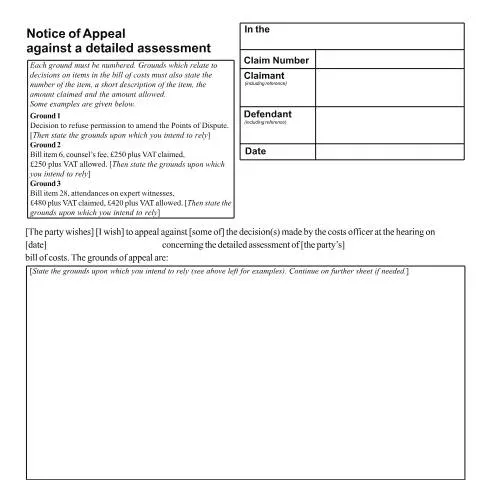
The Notice of Appeal Against a Detailed Assessment (Form N259) is a crucial step for parties who wish to contest a cost officer's ruling regarding legal costs in civil litigation. Understanding its content and implications is vital for both claimants and defendants alike. This article delves deeply into the various aspects of this notice, illuminating its purpose and providing practical guidance on its application in legal scenarios.
Understanding the Scope: What the N259 Covers
The N259 is specifically designed to challenge decisions made during a detailed assessment of legal costs. This process typically unfolds when one party contests the bill of costs submitted by another party following the conclusion of legal proceedings. The document serves multiple functions:
- It allows appellants to present their arguments against specific items within the bill of costs.
- The notice must clearly outline each ground for appeal, ensuring that the cost officer's decisions are scrutinised effectively.
- It establishes the framework for subsequent hearings in which these appeals will be assessed.
It’s important to note that the N259 does not serve as a means to challenge the overall ruling of the court case itself; rather, it focuses specifically on issues arising from the costs incurred. Thus, it has a defined and limited scope.
Common Misinterpretations: Evasion of Pitfalls
Many parties encounter challenges when interpreting the requirements laid out in the N259. There are a few common misinterpretations that can complicate the appeal process:
- Assuming that general dissatisfaction is sufficient: Simply being unhappy with the cost officer’s decision is not a valid ground for appeal. Each point must be clearly articulated with appropriate justification.
- Neglecting to specify bill items: When referencing decisions on bill items, appellants must include specific details, including the item number and corresponding amounts claimed versus amounts allowed. Failing to do so will result in ambiguity and potential dismissal of the appeal.
- Overlooking the necessity of supporting documents: The N259 requires appellants to submit copies of relevant documentation. Missing or incomplete documents can jeopardise the entire appeal.
Target Audience: Who Should Utilize the N259?
The N259 targets individuals and entities involved in civil litigation where a detailed assessment has taken place. Potential users include:
- Claimants: Parties seeking to recover legal costs after successful claims may need to appeal decisions that undervalue their costs.
- Defendants: Those who are disputing the costs incurred by the opposing party may also file this notice to challenge specific decisions.
- Legal Practitioners: Solicitors representing clients in cost disputes are instrumental in preparing and submitting the N259, ensuring that all grounds for appeal are robustly articulated.
In situations where the costs have been significantly reduced or particular items in the bill of costs have been disallowed, the N259 becomes indispensable. Parties who find themselves in such scenarios should be proactive in considering their right to appeal.
Key Concepts: Grasping Essential Terminology
To effectively utilise the N259, it's essential to understand certain key terms that frequently arise in the context of cost assessments:
- Detailed Assessment: This is the process by which a court or costs officer examines the bill of costs to determine the reasonable costs that should be allowed.
- Bill of Costs: A detailed statement of the legal costs incurred, which must be submitted for assessment.
- Points of Dispute: This document outlines the specific objections one party has against the bill of costs provided by the opposing party.
Familiarity with these terms will aid users in articulating their appeals and understanding the broader context of their case.
Interconnections with Other Legal Documents
The N259 should not be viewed in isolation; it interacts closely with several other documents within the cost assessment process. Understanding these interrelations is essential for a successful appeal:
| Document | Role in the Appeal Process |
|---|---|
| Bill of Costs | The foundational document outlining the costs incurred, which is subject to appeal. |
| Points of Dispute | Essential for identifying contested items in the bill that the appealing party wishes to address. |
| Costs Certificate | A formal document that certifies the costs allowed, necessary for reference in the appeal. |
| Written Reasons from the Costs Officer | Provides the rationale behind the decision, which must be challenged logically in the N259. |
Each of these documents plays a critical role in shaping the narrative of the appeal, and thorough familiarity with them is crucial for a persuasive N259 submission.
Common Procedural Queries: Navigating the Appeal Journey
Once the decision to appeal via the N259 is made, several procedural questions often arise. Addressing these queries can clarify the path forward:
- What is the timeframe for filing the N259?
There is typically a strict deadline for submitting the N259, often dictated by the specific court rules applicable to the case. It’s essential to determine this timeframe to avoid the risk of losing the right to appeal.
- Do I need representation to file the N259?
While it is possible to represent oneself, having legal representation can significantly enhance the clarity and strength of the appeal arguments presented in the N259.
- How is the appeal heard?
Appeals based on the N259 typically lead to a hearing where both parties can present their arguments regarding the disputed costs.
Step-by-Step Execution: Making the N259 Work for You
To leverage the N259 effectively, follow these step-by-step guidelines to ensure a smooth appeal process:
- Review the Costs Officer's Decision: Thoroughly examine the written reasons provided for the decision to identify specific grounds for appeal.
- Gather Supporting Documentation: Collect all necessary documents, including the Bill of Costs, Points of Dispute, and the Costs Certificate.
- Draft the Grounds for Appeal: Clearly number and articulate each ground, ensuring they are precise and refer to the relevant items in the bill of costs.
- Complete the N259: Fill out the notice with attention to detail, ensuring accuracy and clarity. Include all necessary details, including claim numbers and amounts.
- Submit it on Time: Ensure the N259 is filed within the required timeframe, following the relevant court procedures.
Following these steps will enhance the likelihood of a successful appeal, highlighting the key points and justifications effectively within the N259 framework.
After Filing: What to Expect Next
After the N259 is submitted, expect a series of follow-up steps:
- The court will notify both parties of the hearing date.
- Each party will have the opportunity to submit further documentation or clarification regarding the appeal.
- The hearing will provide a platform for both sides to present their arguments, and a judge or costs officer will ultimately render a decision regarding the appeal.
Understanding these post-submission steps can help appellants prepare adequately and strategize their arguments effectively.
Final Considerations: The Critical Nature of Detail
Engaging with the N259 is not merely a procedural exercise; it represents an opportunity to advocate for fairness in the assessment of legal costs. The level of detail and clarity in the grounds for appeal directly influences the outcome, making it imperative that appellants take the time to carefully construct their arguments and gather all necessary documentation. Moreover, familiarity with procedural nuances and deadlines is crucial, as it ensures that the appeal proceeds without unnecessary complications.
Ultimately, the N259 serves as a vital mechanism for maintaining the integrity of legal cost assessments, allowing parties in civil litigation to seek redress when they believe decisions have been rendered unjustly. By harnessing the knowledge and guidance provided in this article, appellants can navigate this process with confidence, increasing their chances of a favourable outcome.
Understanding the Detailed Assessment Process
The detailed assessment process in civil litigation is crucial for understanding how costs are determined after a case concludes. Typically, this process arises when one party believes that the costs claimed by the other party are excessive or not justified. The party disputing the costs can request a detailed assessment by filing the appropriate forms with the court. This part of the litigation process is governed by the Civil Procedure Rules (CPR), particularly CPR Part 47, which outlines the procedures for assessing costs.
A detailed assessment involves a thorough examination of the costs incurred during the litigation, including legal fees, disbursements, and any related expenses. The court, often in the form of a costs judge, will review the claims and may call for further evidence or justification from both parties. It's essential to note that the party challenging the costs must present sufficient grounds for their appeal, which may include arguments related to the reasonableness of the incurred costs or the necessity of specific legal actions taken during the proceedings.
When preparing for a detailed assessment, it is beneficial for both parties to maintain detailed records of all costs and communications throughout the litigation process. This practice not only supports transparency but also enables a more straightforward resolution during the assessment. Furthermore, understanding the detailed assessment process allows litigants to engage more effectively with the court, ensuring that they are well-prepared to present their arguments and evidence effectively.
Common Grounds for Appeal on a Detailed Assessment
Appealing against a detailed assessment can be complex, given the strict procedural requirements and the need for compelling grounds. Below are some common grounds that parties typically rely upon when filing Form N259 to appeal a decision made during the detailed assessment stage:
- Errors in Law: This is perhaps the most significant ground for appeal. If a party believes the costs judge misinterpreted the law or applied it incorrectly, they can challenge the decision. This might include claims that the judge applied the incorrect legal standards when assessing the reasonableness or proportionality of the costs.
- Inadequate Findings: If the costs judge failed to adequately consider key pieces of evidence or made findings that are not supported by the evidence presented during the assessment, this can be a valid ground for appeal. Parties should meticulously highlight any specific omissions that they believe have impacted the outcome of the assessment.
- Procedural Irregularities: Parties may also appeal on the basis that there were procedural errors during the detailed assessment process. This can range from improper notices, insufficient time to respond to claims, or failures to allow parties to submit necessary documents.
- Excessive or Insufficient Costs: A party may argue that the costs awarded are excessively high or unduly low based on the nature of the case. This argument often requires a detailed analysis of similar cases and the fees awarded therein to substantiate claims.
When formulating these grounds, it is essential for the appealing party to provide clear and concise evidence supporting each point. The appellate court requires a thorough and well-documented appeal to ensure that any errors can be adequately addressed within the legal framework.
Practical Steps After Filing Form N259
Once you have filed Form N259 to appeal a detailed assessment, several practical steps can help streamline the process and ensure your appeal is handled correctly:
- Await Acknowledgment: After submitting Form N259, you should receive an acknowledgment from the court. This document is vital as it contains important dates and information concerning the next steps in your appeal.
- Prepare for a Hearing: Depending on the specifics of your case and the grounds for your appeal, a hearing may be scheduled. This requires thorough preparation, including gathering all relevant documents, evidence, and witness statements that can support your appeal. Engaging with legal representatives who specialize in costs appeals can significantly enhance your preparation and representation.
- Notify the Other Party: Informing the opposing party about your appeal is not only courteous but often a procedural requirement. You may need to serve them with a copy of Form N259 and any accompanying documents. This opens up the opportunity for them to respond or prepare their defense against your appeal.
- Consider Alternative Dispute Resolution (ADR): Sometimes, before a hearing takes place, the parties may consider using Alternative Dispute Resolution mechanisms to resolve the costs dispute amicably. This can save both time and resources, and should the ADR fail, your appeal can still proceed.
- Review Timelines: Be conscious of any timelines specified by the court for your appeal. Failing to meet these deadlines can result in dismissal of your appeal, so it's crucial to stay organized and proactive throughout the process.
Successfully navigating the appeal process requires diligence, legality, and adherence to the procedural rules set by the courts. By following the steps outlined above, you can ensure your appeal against a detailed assessment is effectively handled, increasing your chances of a favorable outcome.