Understanding the Yacht Rating Certificate: Your Pathway to Commercial Yachting Careers
The yacht industry's continued expansion has created substantial demand for qualified crew members on vessels under 3000GT. Whether you're transitioning from traditional merchant shipping or entering the maritime sector directly through recreational sailing, the Yacht Rating Certificate represents a crucial credential that opens doors to employment on both commercial and privately-owned yachts operating worldwide.
Issued by the Maritime and Coastguard Agency under STCW regulations II/4 and III/4, this certificate specifically authorises holders to serve as ratings on yachts and sail training vessels less than 3000GT. Unlike broader merchant navy qualifications, the yacht rating certification acknowledges the unique operational environment of luxury yachts, where crew members often perform multiple roles across deck, interior, and guest services.
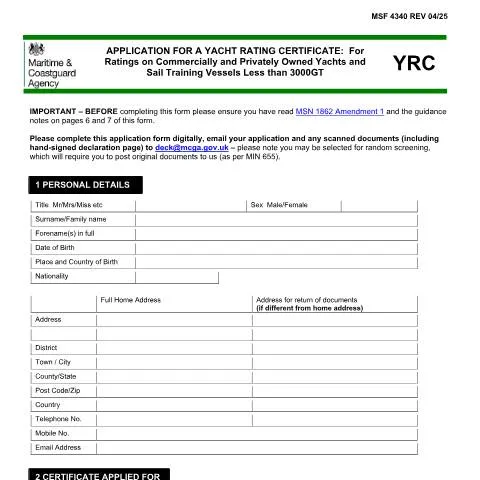
The application process, documented through form MSF 4340, requires careful attention to sea service documentation and compliance with both STCW safety standards and MCA-specific requirements. Understanding these nuances proves essential for successful certification, particularly given the agency's strict documentation standards and the potential for random screening procedures.
Qualification Pathways: Standard Route versus Exempted Applications
The MCA recognises two distinct pathways for obtaining yacht rating certification, each designed to accommodate different professional backgrounds and experience levels within the maritime community.
Standard Application Requirements
The comprehensive route demands at least six months yacht service, incorporating a minimum of two months actual sea service on vessels exceeding 15 metres in load line length. Applicants must also complete a Yacht Rating Training Record Book, demonstrating practical competency across various yacht operations.
This pathway particularly suits individuals entering yachting without prior maritime qualifications or those whose recreational sailing experience requires formal validation. The six-month requirement ensures candidates develop comprehensive understanding of yacht-specific operations, from anchoring procedures in challenging conditions to understanding the unique regulatory environment governing private vessels in international waters.
Exempted Route for Qualified Personnel
Experienced mariners can pursue an accelerated pathway requiring only two months actual sea service on vessels over 15 metres, provided they hold qualifying certifications. The MCA accepts several combinations:
| Primary Qualification | Additional Requirement | Typical Applicant Profile |
|---|---|---|
| Watch Leader Certificate | RYA Competent Crew Certificate | Merchant navy officers transitioning to yachts |
| Day Skipper Certificate | RYA Competent Crew or higher RYA qualification | Recreational sailors seeking commercial opportunities |
| Yacht Rating Course Completion Certificate | None additional | Dedicated yacht training programme graduates |
These exemptions reflect the MCA's recognition that competent mariners with relevant experience shouldn't repeat fundamental training. However, the requirement for actual yacht service ensures all certificate holders understand the specific operational demands of the luxury yacht sector.
Navigating Documentation Requirements and Evidence Standards
The MCA's documentation standards for yacht rating applications reflect the agency's commitment to maintaining professional standards across the commercial yacht sector. Understanding these requirements prevents common delays and ensures smooth processing.
Dual Evidence Requirement for Sea Service
Every period of declared sea service must be supported by two distinct forms of evidence. The first comprises official discharge book entries or certificates of discharge, while the second requires sea service testimonials countersigned by the vessel's master. This dual requirement addresses the informal nature of some yacht employment arrangements while maintaining verification standards.
Sea service testimonials must detail specific voyage information, including vessel particulars, trading areas, and the applicant's role aboard. Masters should clearly indicate whether service occurred in unlimited waters, near coastal areas, or restricted zones, as this affects the certificate's eventual scope.
STCW Safety Certification Compliance
All applicants must demonstrate compliance with STCW basic safety requirements through four mandatory certifications:
- Personal Survival Techniques (STCW A-VI/1-1) or equivalent RYA Basic Sea Survival
- Fire Prevention and Fire Fighting (STCW A-VI/1-2)
- Elementary First Aid (STCW A-VI/1-3)
- Personal Safety and Social Responsibilities (STCW A-VI/1-4)
These requirements ensure yacht crew can respond effectively to emergencies while maintaining the safety culture essential aboard vessels carrying guests in remote locations. The MCA accepts RYA equivalents for survival techniques, recognising the quality of recreational sailing safety training.
Medical Fitness Documentation
Valid medical fitness certification remains mandatory, with the MCA accepting ENG 1 certificates, equivalent international standards, or ML5 certificates where applicable. This requirement reflects the physical demands of yacht operations and the potential isolation from medical facilities during extended passages.
Certificate Scope and Professional Applications
The yacht rating certificate's specific limitation to vessels under 3000GT reflects both regulatory frameworks and practical operational considerations within the luxury yacht sector.
Operational Authority and Limitations
Certificate holders can serve as ratings on commercially operated yachts, privately-owned vessels engaging in commercial activities, and sail training vessels. The 3000GT limitation aligns with MLC 2006 requirements and reflects the typical size range of vessels requiring professional crew under yacht codes rather than full merchant vessel regulations.
This scope encompasses the vast majority of charter yachts, private vessels with permanent crew, and sail training operations. However, holders seeking positions on larger yachts must pursue additional qualifications as vessel size increases and regulatory requirements become more complex.
International Recognition and Career Progression
The certificate's STCW compliance ensures international recognition, enabling holders to work on British-flagged yachts worldwide or seek positions with foreign-flagged vessels recognising UK qualifications. This portability proves crucial in an industry where vessels frequently change flag states and operate across multiple jurisdictions.
Career progression typically leads toward officer-level qualifications, with yacht rating experience providing essential foundation knowledge. Many certificate holders subsequently pursue Yacht Officer of the Watch certification or specialise in specific yacht departments such as engineering or hospitality management.
Application Processing and Digital Submission Procedures
The MCA has streamlined yacht rating applications through digital submission processes, though traditional verification methods remain integral to maintaining certification integrity.
Digital-First Submission Protocol
Applications must be completed digitally and submitted to [email protected] along with scanned supporting documents. The declaration page requires physical signature before scanning, maintaining authentication while enabling electronic processing. This hybrid approach balances efficiency with security requirements.
Applicants should ensure all scanned documents meet professional standards, with clear text and complete page capture. Poor quality submissions delay processing and may require resubmission with original documents.
Random Screening and Original Document Requirements
The MCA operates a random screening programme requiring selected applicants to submit original documents by post, as detailed in MIN 655. This verification process helps combat fraudulent applications while maintaining reasonable processing timelines for legitimate candidates.
Selected applicants receive notification requiring original document submission within specified timeframes. Failure to comply results in application suspension, emphasising the importance of maintaining genuine documentation throughout the process.
Fee Structure and Payment Considerations
Yacht rating certificate fees align with current Merchant Shipping Fees Regulations, payable in pounds sterling through BACS transfer. The MCA publishes current fee schedules separately from application forms, ensuring accuracy as regulatory costs evolve.
Payment timing affects processing schedules, with incomplete applications held pending fee receipt. Applicants should verify current fee levels before submission, as outdated information may cause delays. International applicants must account for currency conversion and potential bank charges when calculating payment amounts.
Maintaining Certification Validity and Addressing Common Challenges
Yacht rating certificates require ongoing maintenance through medical certificate renewal and potential additional training as regulations evolve. Understanding these requirements prevents certification lapses that could interrupt employment opportunities.
Medical Certificate Renewal Cycles
Medical fitness certificates typically require renewal every two years for mariners under 18 years, annually for those aged 18-65, and every six months for those over 65. Certificate holders must track renewal dates carefully, as expired medical certificates invalidate yacht rating authority regardless of the certificate's own validity period.
Addressing Documentation Discrepancies
Applications may encounter challenges due to inconsistent name spellings across documents, missing voyage details, or insufficient master signatures on testimonials. The MCA's strict documentation standards mean minor discrepancies can cause significant delays.
Proactive document review before submission helps identify potential issues. Where discrepancies exist, applicants should provide explanatory letters with supporting evidence rather than hoping irregularities will pass unnoticed during processing.
Lost or damaged certificates require formal replacement applications through the MCA, involving verification procedures and replacement fees. Certificate holders should maintain secure storage and consider certified copies for routine employment verification while preserving originals.
Understanding the Different Types of Yacht Rating Certificates Available
The UK offers several distinct yacht rating certificate pathways, each serving specific purposes within the maritime regulatory framework. Understanding these variations is crucial for selecting the appropriate certification route for your vessel and intended use.
The Commercial Yacht Code (CYC) certificate represents the most comprehensive certification available through the Maritime and Coastguard Agency. This applies to yachts over 24 metres engaged in commercial operations, including charter activities with paying guests. The CYC framework operates under three distinct categories: Category 0 for unlimited commercial operations worldwide, Category 1 for operations up to 20 miles from a safe haven, and Category 2 for operations within 20 miles of the coast in favourable weather conditions.
For yachts between 12 and 24 metres operating commercially, the Workboat Code provides an alternative certification path. This code offers more flexibility in construction standards whilst maintaining safety requirements appropriate for smaller commercial vessels. Workboat Code certificates are particularly relevant for day charter operations, sailing instruction, or small passenger carrying activities.
Private yachts may require Recreational Craft Directive (RCD) certification when first placed on the UK market. Though not technically a rating certificate, RCD compliance demonstrates conformity with essential safety requirements and carries significant weight in insurance assessments and resale value. Post-Brexit, the UK maintains its own version of these standards through the Product Safety and Metrology regulations.
Specialist applications may require bespoke certification arrangements negotiated directly with the MCA. These typically apply to unique vessel designs, experimental craft, or vessels operating in specific niche markets. The MCA's Surveyor-in-Charge for your region can provide guidance on whether standard certification routes are appropriate or if alternative arrangements are necessary.
The choice between certification types significantly impacts ongoing compliance obligations, operational limitations, and commercial opportunities. CYC-certified vessels, for instance, must maintain detailed records of safety equipment inspections, crew certifications, and operational logs, whilst private vessels face considerably lighter administrative burdens.
Navigating the Survey and Inspection Process
The survey and inspection phase represents the most technically demanding aspect of yacht rating certification, requiring coordination between multiple parties and adherence to strict procedural requirements. Success depends largely on thorough preparation and understanding of surveyor expectations.
Pre-survey preparation should commence several weeks before the scheduled inspection. All certification documentation for installed equipment must be readily available, including CE marking certificates for safety equipment, engine type approval certificates, and electrical installation certificates. The vessel should be presented in a condition that allows full access to all areas requiring inspection – this often means removing interior panels, accessing engine spaces, and ensuring all systems are operational.
MCA surveyors conduct inspections according to detailed checklists derived from the applicable code. For CYC surveys, this includes structural integrity assessment, stability calculations verification, fire safety systems evaluation, and life-saving appliance inspection. The surveyor will examine the vessel's construction against the approved plans, verify compliance with stability requirements, and test all safety systems under operational conditions.
Common survey challenges frequently arise around documentation completeness and equipment specification compliance. Imported vessels often face particular scrutiny regarding equipment certification – US Coast Guard approved equipment, for instance, may not automatically satisfy MCA requirements without additional certification or equivalency determinations.
The stability assessment component requires particular attention, especially for vessels that have undergone modifications since construction. Changes to superstructure, equipment placement, or internal arrangements can significantly affect stability characteristics. Professional stability calculations, prepared by a qualified naval architect, are typically required for commercial certification and should account for all loading conditions the vessel may encounter in service.
Electrical installations must comply with current IET Wiring Regulations or equivalent international standards. This includes proper earthing arrangements, appropriate circuit protection, and adequate provision for shore power connections. Many older vessels require significant electrical upgrades to meet current standards, particularly regarding RCD protection and cable specifications.
Rectification procedures apply when surveys identify non-compliance issues. The MCA typically issues a deficiency list detailing required corrections, with timeframes for completion. Minor deficiencies may allow conditional certification pending rectification, whilst major structural or safety concerns will prevent certificate issue until fully resolved. Understanding the difference between 'observations' and 'conditions' in survey reports is crucial – conditions must be addressed before certification, whilst observations represent recommendations for best practice.
Re-inspection arrangements vary depending on the nature of deficiencies identified. Simple equipment replacements may be verified through documentary evidence, whilst structural modifications typically require full re-survey of affected areas. Planning for potential rectification work, both in terms of time and budget, is essential for realistic project timelines.
Managing Ongoing Compliance and Renewal Requirements
Yacht rating certificates are not 'set and forget' documents – they create ongoing compliance obligations that extend throughout the certificate's validity period. Understanding these requirements is essential for maintaining valid certification and avoiding operational disruptions.
Annual survey requirements apply to most commercial yacht certifications, though the scope varies significantly between certificate types. CYC certificates typically require annual safety equipment surveys, hull inspections (which may be conducted afloat for steel and aluminium vessels under certain conditions), and machinery surveys. These inspections focus on wear items, safety equipment condition, and continued compliance with certification standards.
The five-year major survey cycle represents a more comprehensive inspection equivalent to the initial certification survey. This includes full structural assessment, complete safety system testing, and stability verification. For older vessels, the five-year survey often identifies equipment reaching end-of-life or regulatory changes requiring upgrades.
Equipment certification maintenance requires ongoing attention throughout the certificate period. Life rafts require annual servicing by approved service stations, EPIRBs need battery replacement according to manufacturer specifications, and fire extinguishing systems require regular testing and certification. Maintaining a compliance calendar helps ensure these requirements don't lapse inadvertently.
Modification procedures must be followed for any changes to certified vessels. Even seemingly minor alterations – such as equipment relocations or specification changes – may require MCA approval before implementation. The modification approval process varies from simple notification for minor changes to full re-survey for significant alterations affecting safety or stability.
Insurance implications of certification compliance extend beyond basic coverage requirements. Many marine insurance policies include specific clauses regarding survey compliance, with potential coverage exclusions for vessels operating with expired or non-compliant certification. Regular communication with insurance providers about survey schedules and any compliance issues helps avoid coverage gaps.
Record-keeping requirements for certified vessels are substantial, particularly for commercial operations. Daily operational logs, maintenance records, safety drill records, and crew certification documentation must be maintained in formats acceptable to the MCA. Digital record-keeping systems are increasingly common, but paper backup systems remain advisable given the marine environment's challenges to electronic equipment.
International recognition of UK yacht rating certificates varies between jurisdictions and may affect operational flexibility. While CYC certificates generally receive recognition within EU waters under existing mutual recognition agreements, some jurisdictions require additional certification or endorsement. Planning international operations requires early verification of certification acceptance in destination countries.
The renewal process typically begins 2-3 months before certificate expiry, allowing time for survey scheduling, any required rectification work, and administrative processing. Early engagement with surveyors and certification bodies helps avoid operational interruptions, particularly during busy summer survey periods when surveyor availability may be limited.