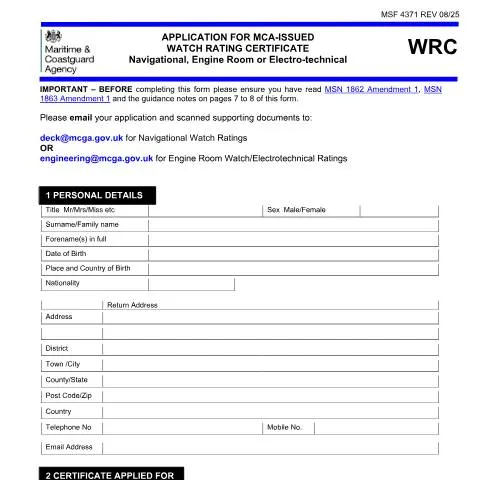
Understanding the Maritime Career Pathway: Watch Rating Certificates and Professional Opportunities
The merchant navy offers diverse career paths for those seeking maritime employment, from deck operations to engine room management and electrical systems maintenance. The Maritime and Coastguard Agency (MCA) issues watch rating certificates that serve as fundamental qualifications for entry-level positions aboard commercial vessels. These certificates represent the first professional step for aspiring seafarers, opening doors to employment on everything from cargo ships to luxury yachts operating in international waters.
Watch rating certificates come in three distinct categories: Navigational Watch Rating Certificate II/4, Engine Room Watch Rating Certificate III/4, and Electro-technical Rating III/7. Each certificate corresponds to specific STCW (Standards of Training, Certification and Watchkeeping for Seafarers) convention requirements and enables holders to work in their designated department under the supervision of qualified officers.
Eligibility Requirements and Citizenship Considerations
The MCA maintains specific eligibility criteria that applicants must satisfy before pursuing a watch rating certificate. UK citizenship represents the primary pathway, though EU citizens who are ordinarily resident in the UK may also apply for certain certificates. For the Electro-technical Rating III/7 certificate specifically, the MCA restricts eligibility exclusively to UK citizens and qualifying EU residents.
Beyond citizenship requirements, candidates must demonstrate medical fitness through a valid ENG 1 medical certificate or accepted equivalent. This medical assessment ensures seafarers can perform their duties safely in the challenging maritime environment. The certificate must remain valid throughout the application process and subsequent employment.
Age and Physical Standards
While the MCA doesn't specify minimum age requirements in the application form, international maritime conventions generally require seafarers to be at least 16 years old for rating positions. Physical standards align with those established in the medical fitness assessment, covering vision, hearing, cardiovascular health, and overall physical capability to perform maritime duties.
Sea Service Requirements: Building Maritime Experience
The foundation of any watch rating application lies in demonstrating adequate sea-going service. The MCA requires applicants to complete six months of sea service on vessels of at least 15 metres in load line length within the five years preceding their application. This experience must align with the department relevant to the certificate sought—deck service for navigational ratings, engine room service for engineering ratings.
| Certificate Type | Required Sea Service | Department | Vessel Size Minimum |
|---|---|---|---|
| Navigational Watch Rating | 6 months | Deck operations | 15 metres load line length |
| Engine Room Watch Rating | 6 months | Engine room | 15 metres load line length |
| Electro-technical Rating | 6 months | Engineering/Electrical | 15 metres load line length |
Reduced Sea Service Through Special Training
The MCA recognises that structured training can accelerate professional development. Candidates who complete MNTB (Maritime and Nautical Training Board) approved courses may reduce their sea service requirement from six months to two months. These intensive programmes combine classroom instruction with practical training.
For deck ratings, the MNTB Deck Rating Training encompasses STCW Basic Training for Seafarers and delivery assessment for the Level 2 Award in Maritime Studies (Watch Rating – Deck). This four-week college-based programme concludes with a Basic Safety Training and Maritime Studies Certificate that must accompany the application.
Similarly, engineering candidates can pursue MNTB Engine Rating Training, following the same structure but focusing on engine room operations and maintenance. Both programmes significantly reduce the time investment required to achieve certification while ensuring comprehensive preparation for maritime careers.
Documentation and Evidence: Building Your Application Portfolio
The MCA demands dual evidence for all declared sea service, reflecting the critical importance of accurate service records in maritime employment. Applicants must provide both primary documentation (Discharge Book entries or Certificates of Discharge) and secondary verification (Sea Service Testimonials countersigned by the vessel's Master).
Primary Documentation Requirements
- Discharge Book or Certificates of Discharge: Official records maintained throughout maritime service
- Yacht Service Record/Log Book: MCA-approved documentation for yacht service (eliminates need for testimonials)
- Attested passport scan: Identity page verification
- Passport-style photograph: Recent image meeting MCA specifications
Safety Training Certificates
All applicants must demonstrate current competency in fundamental safety disciplines through certificates less than five years old:
- Personal Survival Techniques (STCW A-VI/1-1): Complete course and updated training where applicable
- Fire Prevention and Fire Fighting (STCW A-VI/1-2): Full completion with current updates
- Elementary First Aid (STCW A-VI/1-3): Basic medical response training
- Personal Safety and Social Responsibilities (STCW A-VI/1-4): Workplace safety and professional conduct
Training Record Books and Competency Assessment
Beyond sea service and safety training, applicants must complete a watch rating training record book that documents practical competency development. These record books, available through MSN 1862 Amendment 1 (Navigational) or MSN 1863 Amendment 1 (Engineering), contain specific tasks that must be completed under supervision.
Each task requires sign-off by an officer holding an appropriate UK Certificate of Competency or UK Certificate of Equivalent Competency. The signing officer must record their details in the 'List of Competent Officers' provided in the relevant Marine Safety Note. Tasks are only considered complete when the signing signature matches the name on the approved list, ensuring accountability and maintaining training standards.
Officer Supervision Requirements
The MCA maintains strict oversight of the competency assessment process. For deck ratings, supervising officers must meet criteria outlined in Annex B, page 18 of MSN 1862 Amendment 1. Engineering ratings follow requirements detailed in Annex A, page 10 of MSN 1863 Amendment 1. This system ensures that practical training occurs under qualified supervision, maintaining the integrity of the certification process.
Electro-technical Rating: Specialised Qualification Pathway
The Electro-technical Rating III/7 certificate represents a specialised pathway requiring additional qualification assessment. Unlike navigational and engine room ratings, electro-technical candidates must submit their qualifications for pre-approval before completing their application.
Candidates must email scanned copies of their technical qualifications to [email protected] for examiner assessment. The MCA evaluates whether submitted qualifications meet STCW convention standards for electro-technical ratings. Upon successful assessment, candidates receive email confirmation that must accompany their formal application.
Technical Qualification Standards
While specific qualification requirements aren't detailed in the application form, the STCW III/7 standard typically encompasses electrical engineering, electronics, control systems, and power generation knowledge. Relevant qualifications might include electrical engineering degrees, maritime electrical diplomas, or equivalent technical certifications recognised by the MCA.
Application Submission and Processing Procedures
The MCA operates a digital submission system that streamlines application processing while maintaining security standards. Applicants email their completed forms and supporting documents to department-specific addresses: [email protected] for Navigational Watch Ratings or [email protected] for Engine Room Watch and Electrotechnical Ratings.
Before submission, applicants must thoroughly review Marine Safety Notes MSN 1862 Amendment 1, MSN 1863 Amendment 1, and the guidance notes provided on pages 7-8 of the application form. These documents contain critical information that affects application success and processing timelines.
Common Processing Delays
The MCA explicitly warns that applications lacking complete dual evidence for sea service will face processing delays. This requirement cannot be waived, emphasising the importance of thorough documentation preparation. Additionally, incomplete safety training records, expired medical certificates, or unsigned training record book entries will halt processing until deficiencies are addressed.
Professional Applications and Career Progression
Watch rating certificates serve as entry-level qualifications that enable immediate employment aboard commercial vessels while providing a foundation for career advancement. Navigational watch ratings typically progress toward deck officer positions, engine room ratings advance toward engineering officer roles, and electro-technical ratings specialise in shipboard electrical and electronic systems.
Certificate holders can seek employment with shipping companies, offshore operators, cruise lines, and yacht management companies. The international recognition of MCA certificates under STCW conventions enables worldwide employment opportunities, making these qualifications valuable for those seeking global maritime careers.
Continuing Professional Development
While watch rating certificates don't expire in the traditional sense, maritime professionals must maintain currency through continued sea service and updated safety training. Career progression typically requires additional sea time, advanced training courses, and eventually officer-level certifications. The MCA provides clear pathways for advancement through its comprehensive certification structure.
Many certificate holders use their initial positions to gain experience while pursuing higher qualifications part-time. This approach allows practical skill development alongside academic advancement, creating well-rounded maritime professionals capable of assuming increasing responsibility aboard modern vessels.
Understanding Different Watch Rating Classifications and Their Applications
The Maritime and Coastguard Agency operates a comprehensive classification system for watch rating certificates, each tailored to specific vessel types and operational requirements. Understanding these distinctions is crucial for determining which certificate aligns with your career objectives and current qualifications.
The Officer of the Watch (OOW) Deck Watch Rating represents the foundational level, suitable for those beginning their maritime career or transitioning from related marine occupations. This certificate permits you to maintain navigational watches on commercial vessels under the supervision of a qualified deck officer. Holders typically work on cargo ships, passenger ferries, or offshore support vessels within UK territorial waters and beyond.
For those seeking specialised roles, the Engine Watch Rating certificate focuses on mechanical systems and propulsion. This pathway suits individuals with engineering backgrounds or those who have completed relevant technical qualifications. Engine watch rating holders monitor machinery spaces, assist with maintenance procedures, and ensure compliance with safety protocols during operational watches.
The Electro-Technical Officer (ETO) Watch Rating has gained prominence due to increasingly sophisticated vessel electronics. This certificate requires demonstrated competency in electrical systems, automation, and digital navigation equipment. Candidates often hold electrical engineering qualifications or have completed approved shore-based training programmes covering marine electronics.
Certain vessels require specialised endorsements beyond standard watch rating certificates. For instance, passenger vessel operations may necessitate additional crowd management and emergency response training. Similarly, chemical tanker or liquefied gas carrier endorsements involve specific hazardous cargo handling procedures. These endorsements typically require separate assessment and may involve additional sea service requirements.
The MCA also recognises limited operational certificates for specific vessel categories. Offshore wind farm technician vessels, for example, may require watch ratings with particular competencies in dynamic positioning or helicopter operations. These niche qualifications often command premium employment opportunities but require targeted training investments.
Navigating Medical Fitness Requirements and Health Assessments
Medical fitness represents a non-negotiable component of watch rating certification, reflecting the demanding physical and mental requirements of maritime operations. The MCA mandates specific health standards to ensure certificate holders can perform essential duties safely and effectively during extended periods at sea.
All applicants must undergo examination by an MCA-approved doctor, not merely any registered medical practitioner. These specialists understand maritime-specific health requirements and can properly assess fitness for sea service. The examination covers cardiovascular health, vision and hearing acuity, musculoskeletal function, and psychological stability. Approved doctors maintain current knowledge of maritime medical standards and emergency procedures.
Vision requirements are particularly stringent, given the critical nature of visual watchkeeping duties. Candidates must demonstrate adequate visual acuity both with and without corrective lenses, satisfactory colour vision for signal recognition, and appropriate visual field coverage. Those requiring corrective lenses must provide evidence of spare glasses availability during sea service. Certain eye conditions, such as severe myopia or specific colour blindness types, may preclude certification or require operational limitations.
Hearing standards ensure watch rating holders can detect audio signals, radio communications, and emergency alarms. The assessment includes pure tone audiometry and speech discrimination tests. Significant hearing loss may necessitate hearing aid use, with specific requirements for backup devices and waterproof protection during maritime operations.
Cardiovascular fitness receives particular attention due to the physical demands and limited medical facilities aboard vessels. Conditions such as uncontrolled hypertension, significant heart rhythm disorders, or history of major cardiac events require careful evaluation. The examining doctor may request additional specialist reports or exercise tolerance testing to determine fitness levels.
Medication considerations can significantly impact certification decisions. Certain medications, particularly those affecting consciousness, reaction times, or cognitive function, may preclude sea service. Applicants must provide comprehensive medication lists, including over-the-counter preparations and supplements. Some conditions requiring ongoing medication may be compatible with limited operational areas or specific vessel types.
Mental health assessments ensure candidates can cope with the psychological stresses of maritime life, including extended periods away from shore, confined living conditions, and emergency situations. Previous mental health treatment does not automatically disqualify applicants, but requires careful evaluation of current stability and coping mechanisms.
The medical certificate typically remains valid for two years for candidates under 18 years and five years for those 18 and older, though specific conditions may require more frequent reassessment. Certificate holders must maintain fitness standards throughout their career and report significant health changes to the MCA promptly.
Employment Pathways and Career Development Opportunities
Obtaining a watch rating certificate opens diverse career pathways within the UK maritime sector, from traditional merchant shipping to emerging offshore industries. Understanding these opportunities helps candidates align their certification choices with long-term career objectives and market demands.
Merchant shipping remains the largest employer of watch rating certificate holders. Container shipping companies, bulk carriers, and tanker operators regularly recruit qualified ratings for global trading routes. Entry-level positions typically involve rotational schedules, with periods ranging from three to six months aboard followed by equivalent shore leave. Progression opportunities include advancement to able seaman, bosun, or ultimately deck officer roles through additional training and sea service.
The offshore energy sector offers particularly attractive employment prospects, especially given the UK's position as a North Sea oil and gas hub and growing renewable energy focus. Platform supply vessels, anchor handling tugs, and offshore construction vessels require specialist watch ratings familiar with dynamic positioning systems and offshore operations. These roles often command higher salaries than traditional merchant shipping but may involve more challenging working conditions.
Wind farm support represents a rapidly expanding employment sector. Crew transfer vessels, service operation vessels, and installation ships require watch ratings with specific competencies in offshore renewable energy operations. Many operators provide additional training for turbine access, electrical safety, and emergency response procedures specific to wind farm environments.
Passenger ferry operations offer regular schedule employment attractive to those preferring consistent home time. Cross-channel ferries, Scottish island services, and river cruise operations employ watch ratings for passenger vessel operations. These positions often require additional training in crowd management, passenger safety, and emergency evacuation procedures.
Naval auxiliary services provide opportunities within Royal Fleet Auxiliary vessels supporting Royal Navy operations. These positions offer stable employment, comprehensive benefits, and opportunities for advancement within a structured career framework. Security clearance requirements may apply for certain vessels or operational areas.
The superyacht industry attracts many watch rating certificate holders seeking international travel and premium working conditions. Large private yachts require qualified crew for global cruising, offering opportunities to visit exclusive destinations while developing skills in luxury hospitality alongside traditional seamanship. Language skills and hospitality experience often enhance employment prospects in this sector.
Survey and research vessels employ watch ratings for scientific expeditions, hydrographic surveys, and environmental monitoring. These positions often involve collaboration with research institutions and may offer opportunities to contribute to important scientific work while maintaining professional maritime skills.
Career development typically follows established progression pathways. Watch rating certificate holders can advance through able seaman qualifications to officer cadet programmes, ultimately achieving deck officer certification. Many shipping companies operate sponsored training schemes, funding further education in exchange for service commitments.
Shore-based opportunities also emerge from watch rating experience. Port operations, marine surveying, maritime education, and regulatory compliance roles often value practical sea-going experience. Some certificate holders transition into maritime law, ship management, or technical consultancy roles, leveraging their operational knowledge in shore-based positions.
Professional development continues throughout maritime careers through mandatory refresher training and voluntary skill enhancement. Regular updates in safety procedures, new technology familiarisation, and specialised endorsements maintain employability and open new opportunities within the evolving maritime industry.