Navigating the Path from Administration to Dissolution: Understanding Form AM23 (Scot)
In the delicate landscape of corporate management, companies sometimes face dire circumstances that lead them into administration. While this process can provide a lifeline, there may come a time when the company’s fate leads to dissolution. For businesses in Scotland, the transition from administration to dissolution is formalized through the AM23 (Scot) form, a critical document filed with Companies House. This article delves into the nuances of completing and submitting the AM23 form, ensuring that stakeholders are well-prepared as they traverse this essential phase.
Decoding the AM23 Form: Who Needs to File?
The AM23 form is primarily the responsibility of the appointed administrators of a company. Understanding who falls under this category is essential:
- Primary Administrator: The individual or entity initially appointed to manage the company's affairs during administration.
- Joint Administrators: In cases where multiple administrators are appointed, each must be accounted for in the submission.
- Company Directors: While they do not file the form directly, their knowledge of the company’s status and the decision to move toward dissolution can significantly influence the process.
When considering filing the AM23, it’s vital to confirm that all parties involved have agreed to the transition to dissolution, aligning with the final progress report that must accompany the form.
Understanding the Process: Where the AM23 Fits In
The journey from administration to dissolution involves several steps, with the AM23 form serving as a pivotal element. Here’s an overview of the entire procedure:
- Administrator's Reports: Prior to filing the AM23, administrators must prepare a final progress report that details the administration’s outcomes.
- Filing the AM23: Once the report is ready, the AM23 form must be duly filled out and submitted to Companies House.
- Public Record Update: Upon acceptance, Companies House updates the public record to reflect the company’s transition to dissolution.
- Dissolution Confirmation: After a notice period, the company will officially be dissolved, ceasing to exist in the eyes of the law.
This process exemplifies the careful regulatory framework governing corporate entities in the UK, particularly in the context of Scottish law. Understanding each stage ensures that involved parties remain compliant and informed.
Preparation is Key: Essential Documents and Their Importance
When preparing to submit the AM23 form, administrators must gather several accompanying documents to ensure completeness:
- Final Progress Report: A comprehensive overview of the administration period, detailing actions taken, outcomes achieved, and reasons for the transition to dissolution.
- Company Registration Documents: Ensure that the company name and number match the details recorded on the public register to avoid discrepancies.
- Signature of the Administrator: The form must be signed by the appointed administrator, affirming the accuracy of the information provided.
Without these key documents, the AM23 may be returned, leading to delays in the dissolution process. Thus, due diligence in preparation is paramount.
Filling Out the AM23 Form: A Step-by-Step Breakdown
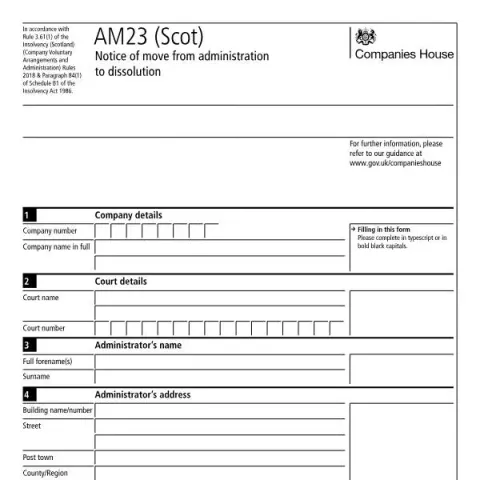
Completing the AM23 form is a meticulous task, requiring attention to detail. Each section of the form needs careful consideration to avoid common pitfalls. Below is an in-depth examination of each section of the AM23 form:
| Section | Details Required | Common Mistakes |
|---|---|---|
| 1. Company Details | Full company name and number. | Incorrect or mismatched details with the public register. |
| 2. Court Details | Name of the court that handled the administration. | Failure to specify the correct court name. |
| 3. Administrator’s Name | Full name of the administrator(s) involved. | Omission of joint administrators’ names. |
| 4. Administrator’s Address | Full address including postcode. | Incomplete address that may hinder communication. |
| 5. Final Progress Report | Attaching the report is mandatory. | Failing to include this critical document. |
| 6. Signature | Administrator's signature and date of signing. | Missing signature or date, rendering the form invalid. |
Each section serves a specific purpose, and overlooking even the smallest detail can jeopardize the submission process. Therefore, it is crucial to double-check every entry before filing.
Channels for Submission: Navigating Your Options
Once the AM23 form is completed, the next step involves deciding how to submit it to Companies House. There are several channels available, each with its own set of advantages:
- Online Submission: This method is often the fastest, allowing for immediate processing. However, it requires a registered account with Companies House.
- Paper Submission: This traditional method involves mailing the form to Companies House. While it may take longer, it is suitable for those who prefer not to engage in online transactions.
- In-Person Submission: For those who wish to have direct interaction, submitting the form in person at a Companies House office can provide peace of mind. However, this may not always be practical for all companies.
Determining the best submission method depends on the company’s situation, urgency, and the resources available to the administrators. Opting for the online channel can significantly expedite the process, so long as all requirements are met.
After Submission: What Comes Next?
Following the submission of the AM23 form, administrators can expect a few critical developments:
- Acknowledgment from Companies House: Administrators will receive confirmation that the AM23 form has been filed. This acknowledgment is essential for record-keeping.
- Public Record Update: Companies House updates the company status to reflect its dissolution, making this information publicly accessible.
- Final Dissolution Confirmation: Once the notice period concludes, and if no objections arise, the company will be officially dissolved.
It's important for administrators to stay vigilant during this phase, as any disputes or challenges can alter the dissolution timeline.
Tackling Challenges: What If Issues Arise?
Despite meticulous preparation and submission, challenges may still arise post-filing. Here are strategies to address potential issues:
- Refusal to Process the Form: If Companies House returns the AM23 due to errors, promptly address any discrepancies and resubmit. Ensure all required documents are included to avoid multiple submissions.
- Missing Documents: Should a document be overlooked, rectify the omission by including it with the resubmission. Delays caused by missing paperwork can extend the dissolution process unnecessarily.
- Objections to Dissolution: In the event of disputes, administrators may need to engage legal counsel to navigate objections effectively.
Addressing issues swiftly can help mitigate delays, ensuring that the transition from administration to dissolution proceeds as smoothly as possible.
Understanding the Broader Implications of the AM23 Submission
Completing the AM23 form and transitioning to dissolution isn’t merely about closing a chapter; it carries significant implications for all stakeholders involved:
- Liabilities and Obligations: Administrators must ensure that all outstanding debts are accounted for before dissolution to avoid personal liability.
- Impact on Employees: Employees have rights, and their situations must be managed sensitively during the dissolution process, aligning with employment law.
- Reputation and Future Opportunities: How a dissolution is handled can impact the reputation of directors and administrators in future business endeavors.
Understanding these ramifications highlights the importance of thorough planning and execution throughout the dissolution process, as the repercussions can extend beyond the immediate closure of the business.
Final Thoughts: Ensuring a Smooth Transition
Transitioning a company from administration to dissolution using the AM23 form requires careful attention to detail, strategic planning, and compliance with legal requirements. By preparing diligently, understanding the implications, and engaging with Companies House through the appropriate channels, administrators can navigate this challenging process with confidence. It’s not just about filling out a form; it’s about responsibly concluding a business journey while safeguarding the interests of all stakeholders involved.
Fill in your form directly online
No printing: type your details into the boxes of the official form, tick, then download the PDF ready to send.
- 1Type into the form boxes
- 2Tick in one click
- 3Save and download the PDF
Understanding the Administration Process in Scotland
Before we delve into the specifics of moving a Scottish company from administration to dissolution, it’s crucial to understand the administration process itself. Administration is a legal procedure that allows a struggling company to restructure its debts and become viable again. It is governed by the Insolvency Act 1986 in the UK, with particular provisions applicable in Scotland. The appointment of an administrator, typically a licensed insolvency practitioner, initiates this process. The administrator’s primary duty is to act in the best interests of the creditors, and they must ensure that the company is either sold, restructured, or its assets realized for the benefit of creditors.
In Scotland, the administration process also allows the company some breathing room from creditor action during the administration period, which usually lasts for up to one year, although this can be extended. It’s important to note that the administrator will assess the company’s financial position and determine if there is a realistic chance of rescuing it or if moving towards dissolution is the more appropriate course of action. If, after thorough investigation, the administrator concludes that the company cannot be saved, they will begin preparations to dissolve the company.
Criteria for Moving from Administration to Dissolution
The transition from administration to dissolution involves specific criteria and steps that must be met to ensure compliance with the law. Firstly, the administrator must confirm that all potential avenues for rescuing the company have been exhausted. This includes evaluating the feasibility of a Company Voluntary Arrangement (CVA) or identifying a suitable buyer for the business or its assets.
If the administrator concludes that the company has no viable future, they must then move towards liquidation. Liquidation is the process of selling off the company’s assets to pay creditors, which can be done via a creditors’ voluntary liquidation or a compulsory liquidation ordered by a court. It is important to highlight that the dissolution cannot proceed until all debts have been settled or adequately addressed in some manner. Failure to meet these criteria may result in legal repercussions for the administrator as well as potentially complicating the dissolution process.
Another consideration is the company's tax obligations. Before dissolution can occur, the administrator must ensure that the company’s tax affairs with HMRC are in order. This includes settling any outstanding tax liabilities and ensuring that the final tax return, usually the SA100 for corporations, is submitted. The tax year in the UK runs from 6 April to 5 April the next year, and the administrator must keep this timeline in mind to avoid complications during the dissolution process.
Potential Challenges in the Dissolution Process
While moving a company from administration to dissolution might seem straightforward, several potential challenges can arise. One of the primary challenges is dealing with outstanding debts and claims from creditors. A thorough examination of the company’s liabilities must be conducted to ensure that all claims are addressed properly. This often involves negotiating settlements or payment plans with creditors, which can be time-consuming and complex.
Moreover, the administrator must navigate the implications of the Data Protection Act 2018 and UK GDPR, especially if the company holds significant personal data. Ensuring that data is handled correctly during the transition is not only a legal obligation but also vital for maintaining the reputation of the involved parties. Any breach of data protection regulations during this process could lead to severe penalties and complicate the dissolution process further.
Additionally, there may be complications if the company owns property or assets that are subject to legal claims or disputes, which can delay the dissolution process. The administrator must carefully manage these issues to facilitate a smooth transition out of administration.