Navigating Disability Discrimination Claims: When Schools Fall Short of Legal Obligations
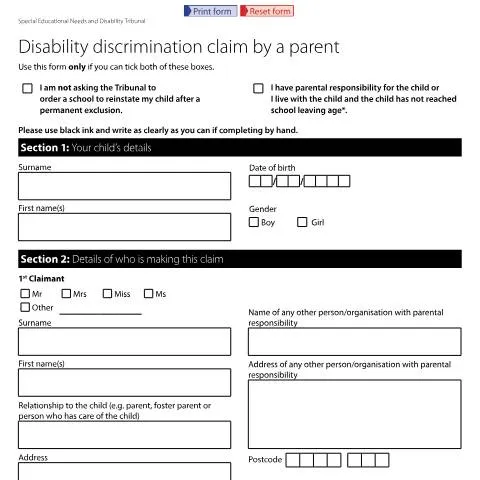
When a school fails to provide appropriate support for a disabled child or treats them unfavourably due to their disability, parents face a complex legal landscape that extends far beyond simple complaints procedures. The Form SEND4A serves as the gateway to formal tribunal proceedings through HM Courts & Tribunals Service, specifically designed for disability discrimination claims where parents believe their child has suffered unlawful treatment under the Equality Act 2010.
This specialised form addresses situations where standard school grievance processes have failed or where the discrimination is so severe that immediate tribunal intervention becomes necessary. Unlike general complaints about school policies or academic performance, Form SEND4A deals exclusively with disability-related discrimination, requiring parents to demonstrate that their child's treatment directly correlates to their disability status.
The tribunal system recognises that disability discrimination in educational settings can manifest in numerous ways: from outright exclusions and denied participation in school activities to more subtle forms of unfavourable treatment and failures to implement reasonable adjustments. Each scenario requires careful documentation and precise legal framing to succeed at tribunal level.
Eligibility Boundaries: Who Can Submit Form SEND4A
The form establishes strict eligibility criteria that determine whether parents can pursue this particular route. Two fundamental conditions must be met simultaneously, creating a specific subset of discrimination cases suitable for this process.
Firstly, the claim must not involve permanent exclusion reinstatement. This distinction proves crucial because permanent exclusion cases follow entirely separate tribunal procedures with different forms, deadlines, and legal standards. Parents seeking reinstatement after permanent exclusion must pursue alternative legal routes, even if disability discrimination contributed to the exclusion decision.
Secondly, the person making the claim must hold parental responsibility or live with the child who hasn't reached school leaving age. This creates several important subcategories:
- Biological parents automatically qualify if they retain parental responsibility
- Foster parents can claim when they have formal parental responsibility arrangements
- Step-parents qualify if they've acquired parental responsibility through legal processes
- Guardians appointed by courts hold the necessary authority
- Carers without formal parental responsibility can still claim if they live with the child
The school leaving age definition carries particular significance, occurring on the last Friday in June during the academic year when the young person turns 16. After this point, the young person must submit their own discrimination claim using different procedures, reflecting the legal principle that they can now represent their own interests in tribunal proceedings.
Unpacking the Form Structure: Strategic Completion Approach
Form SEND4A employs a methodical structure that builds the legal case progressively, moving from basic identification details through to complex discrimination allegations and requested remedies. Each section serves specific evidential purposes within tribunal proceedings.
Child and Claimant Identification
Sections 1 and 2 establish the legal parties and relationships. The child's details must match exactly with school records and any existing Education, Health and Care Plans. Gender identification should reflect the child's current status rather than birth assignment if relevant to the discrimination claim.
The claimant details section accommodates joint claims where both parents wish to pursue the case together. This proves particularly valuable when parents share parental responsibility but have different perspectives on the discrimination incidents or when one parent has stronger documentary evidence than the other.
Representative information becomes crucial for parents who lack confidence in legal procedures or face complex disability discrimination law. While legal qualification isn't mandatory for representatives, it influences how the tribunal manages proceedings and expects submissions to be formatted.
School and Timing Specifications
Section 3 requires precise school identification, distinguishing between maintained schools, academies, and independent institutions because different legal frameworks apply to each category. Local authority maintained schools face different obligations compared to academy trusts, while independent schools operate under distinct regulatory regimes.
The discrimination date in Section 4 proves absolutely critical for tribunal jurisdiction. The six-month time limit runs from either the specific discriminatory act or the most recent incident in a connected series. Parents must identify this date precisely because tribunals lack discretion to accept claims beyond statutory deadlines without exceptional circumstances.
Discrimination Categories: Building Your Legal Foundation
Section 5 presents five distinct discrimination scenarios, each requiring different types of evidence and legal analysis. Understanding these categories helps parents frame their experiences within legal frameworks that tribunals recognise.
| Discrimination Type | Key Evidence Required | Common Examples |
|---|---|---|
| Fixed-term exclusions | Exclusion letters, disciplinary records | Disproportionate punishment for disability-related behaviour |
| Trip/activity exclusions | Communication about trips, risk assessments | Blanket bans without considering adjustments |
| Unfavourable treatment | Witness statements, contemporaneous notes | Isolation, reduced curriculum access |
| Reasonable adjustment failures | Adjustment requests, school responses | Refusing auxiliary aids, physical modifications |
| Other discriminatory acts | Comprehensive documentation | Harassment, victimisation, indirect discrimination |
Each category demands specific contextual information. For exclusions, parents must provide exact dates and the school's stated reasons, enabling tribunals to assess whether disability contributed to the decision. Trip exclusions require documentation of the school's decision-making process, particularly whether they considered reasonable adjustments before excluding the child.
Unfavourable treatment encompasses a broad range of potential discriminatory acts, from obvious examples like verbal abuse referencing the child's disability to subtler forms such as consistently applying policies more harshly to disabled children. The key lies in demonstrating the connection between the treatment and the child's disability.
Reasonable adjustment failures often present the strongest discrimination cases because they involve clear legal obligations. Schools must make anticipatory adjustments and respond to specific requests, making failures easier to evidence than more subjective treatment issues.
Disability Documentation Requirements
Section 6 demands comprehensive disability information that goes beyond simple diagnosis labels. Tribunals need to understand how the disability affects the child's daily functioning, creating the context for discrimination claims.
Medical diagnoses provide legal foundation, but functional impact descriptions prove more valuable for tribunal purposes. Parents should explain how the disability affects the child's ability to participate in education, social interactions, physical activities, and learning processes. This functional approach helps tribunals understand why certain school actions constitute discrimination.
Time Limits and Late Claim Procedures
The six-month statutory deadline creates significant challenges for parents who often spend months attempting to resolve issues through school complaints procedures before realising they need tribunal intervention. Section 7 addresses situations where claims exceed this deadline, requiring compelling justifications for late acceptance.
Tribunals consider several factors when evaluating late claims:
- Reason for delay: Genuine ignorance of tribunal procedures carries more weight than simple procrastination
- Length of delay: Claims submitted weeks late face easier acceptance than those months overdue
- Prejudice to respondent: Whether late submission disadvantages the school's ability to respond
- Merits of claim: Strong discrimination cases may justify accepting late submissions
Common acceptable reasons include: ongoing attempts to resolve matters through school procedures, awaiting medical assessments that confirm discrimination connections, or genuine misunderstanding about tribunal deadlines. Unacceptable reasons typically involve simple delay without justification or choosing to pursue other remedies first.
Parents should document their efforts to resolve matters before tribunal submission, demonstrating they attempted reasonable solutions before formal proceedings. This approach supports both timely submission arguments and shows tribunals that parents exhausted alternative remedies.
Remedies and Tribunal Powers: Setting Realistic Expectations
Section 8 addresses what tribunals can actually order if discrimination is proven, managing parental expectations about available remedies. Significantly, tribunals cannot order compensation payments, distinguishing education discrimination claims from employment or services cases where financial awards are possible.
Available tribunal orders include:
- Declaratory orders confirming that discrimination occurred
- Mandatory orders requiring specific actions to remedy discrimination
- Prohibitory orders preventing continuation of discriminatory practices
- Prospective orders establishing future obligations
Practical remedy examples include ordering schools to provide specific reasonable adjustments, cease particular discriminatory practices, provide appropriate staff training, or review policies that facilitate discrimination. Tribunals can also order schools to take positive steps like ensuring equal access to activities or implementing individual support plans.
Parents should frame requested remedies realistically, focusing on practical changes that address the discrimination's root causes rather than seeking punishment or financial compensation. Effective remedies often involve systemic changes that benefit not only the claimant's child but other disabled pupils facing similar issues.
Strategic Submission Considerations and Follow-up Procedures
Successful Form SEND4A submission requires careful preparation beyond simply completing the form fields. The tribunal process demands substantial documentary evidence, witness statements, and legal argument development that extends far beyond the initial form submission.
Essential supporting documentation includes:
- Complete school correspondence regarding the discrimination incidents
- Medical reports confirming the child's disability and functional impacts
- Education, Health and Care Plans or statements of special educational needs
- Contemporaneous notes or diaries documenting discriminatory incidents
- Witness statements from other parents, teachers, or professionals
- School policies and procedures relevant to disability equality
Once submitted, the tribunal registers the claim and serves it on the school, beginning a structured legal process with strict deadlines for responses, evidence exchange, and hearing preparation. Schools typically have 30 working days to submit their response, after which case management begins.
The tribunal may order case management conferences to clarify issues, identify evidence requirements, and set timetables for hearing preparation. Parents should expect several months between submission and final hearing, during which they must comply with tribunal directions about evidence submission and case preparation.
Throughout this process, settlement discussions may occur, potentially resolving matters without full hearings. However, any settlement must address the discrimination adequately and provide meaningful remedies that prevent future occurrences. Parents retain the right to continue tribunal proceedings if settlement offers prove inadequate.
When SEND4A Claims Involve Multiple Local Authorities
Parents may encounter situations where their child's special educational needs span multiple local authority boundaries, creating complex jurisdictional questions for discrimination claims. This commonly occurs when families move during the assessment process, when children attend schools in different local authorities, or when specialist provision is arranged through inter-authority agreements.
If your child was attending a maintained school in Local Authority A but you resided in Local Authority B, determining the responsible authority for SEN provision—and consequently, the correct respondent for your Form SEND4A claim—requires careful analysis. The Children and Families Act 2014 establishes that the local authority where the child is ordinarily resident typically holds responsibility, but exceptions exist for looked-after children or those in independent schools with SEN funding arrangements.
When submitting Form SEND4A in multi-authority scenarios, you must identify all potentially liable parties in Section 3 of the form. The First-tier Tribunal (Special Educational Needs and Disability) has jurisdiction to determine which authority bears primary responsibility, but this can extend case timelines. Consider whether discrimination occurred at both the school level (potentially implicating the school's local authority) and the home authority level (regarding assessment delays or resource allocation decisions).
Cross-border cases often involve disputes over funding responsibility, particularly for expensive specialist placements. If discrimination stems from one authority's refusal to fund provision identified by another authority, your claim should clearly articulate how these inter-authority disagreements directly impacted your child's access to education. The tribunal can make binding determinations about authority responsibilities, but gathering evidence from multiple sources may prove more challenging.
Parents should be aware that different local authorities may have varying policies regarding SEN transport, short breaks, or transition planning. What constitutes discrimination in one authority's context may differ based on their published local offer and available resources. When completing Form SEND4A, reference both authorities' SEN policies and highlight any disparities in treatment that disadvantage your child compared to similar cases within each authority's jurisdiction.
Employment and Workplace Discrimination Implications for SEND Parents
Parents pursuing SEND4A claims often face secondary discrimination in their workplace due to time off for tribunal hearings, school meetings, or managing their child's additional needs. While Form SEND4A addresses educational discrimination against the child, parents should understand their separate employment rights under the Equality Act 2010 regarding associative discrimination.
Associative discrimination occurs when someone faces less favourable treatment because of their association with a disabled person—in this case, your child with special educational needs. If your employer refuses reasonable adjustments for tribunal attendance, penalises you for SEN-related absences, or creates a hostile environment due to your child's needs, you may have grounds for a separate employment tribunal claim alongside your SEND4A submission.
The interaction between these parallel legal processes requires strategic consideration. Evidence gathered for your Form SEND4A claim—such as records of school meetings, assessment delays, or inadequate provision—may also support an employment discrimination claim if they demonstrate the extent of parental involvement required. Conversely, workplace discrimination may have compounded your child's educational disadvantage if it prevented you from advocating effectively.
When completing Section 8 of Form SEND4A (remedy sought), consider whether your child's educational discrimination was exacerbated by your own workplace constraints. For instance, if employer inflexibility prevented you from attending crucial SEN meetings, leading to delayed assessments or inappropriate placements, this connection strengthens your compensation claim. Document any financial losses resulting from unpaid leave, reduced hours, or career progression impacts directly linked to fighting for your child's educational rights.
Parents should maintain separate records for each claim type while recognising their interconnection. Employment tribunal claims have different time limits (usually three months from the discriminatory act) compared to SEND4A submissions (six months from the educational discrimination). Strategic timing may involve pursuing the employment claim first to establish your credibility as an advocate, then leveraging that success in your child's educational discrimination case.
Complex Evidence Challenges in Institutional Discrimination Cases
Form SEND4A claims involving systemic or institutional discrimination present unique evidential challenges that extend beyond individual treatment decisions. These cases typically arise when local authorities implement blanket policies that disproportionately disadvantage children with specific types of SEN, or when schools adopt practices that systematically exclude disabled pupils from mainstream opportunities.
Institutional discrimination often manifests through seemingly neutral policies with discriminatory effects. Examples include automatic exclusion policies for children displaying certain behaviours associated with autism or ADHD, blanket bans on one-to-one support in specific settings, or funding formulae that systematically underprovide for particular disability categories. Proving institutional discrimination requires statistical evidence, policy analysis, and expert testimony that individual parents rarely possess independently.
When completing Form SEND4A in institutional discrimination cases, Section 6 (details of discrimination) should clearly distinguish between individual treatment and systemic practices. Reference specific policies, procedures, or decision-making frameworks that create discriminatory outcomes. If possible, identify other families affected by similar practices—though data protection considerations may limit access to comparative cases.
The burden of proof in institutional discrimination cases often shifts during proceedings. Once you establish a prima facie case showing disproportionate impact on disabled children, the respondent must prove their practices are proportionate means of achieving legitimate aims. This legal framework means your Form SEND4A submission should focus on demonstrating disparate impact rather than proving intentional discrimination.
Consider engaging with disability rights organisations or parent groups who may have encountered similar institutional practices. Their experiences can provide crucial context for your individual case, though tribunal rules regarding group litigation or representative actions in SEN cases remain limited. Some organisations may provide expert witnesses or policy analysis that strengthens institutional discrimination claims beyond individual parent resources.
Institutional cases often involve complex legal arguments about reasonableness, proportionality, and resource allocation. Your Form SEND4A should anticipate likely defences—such as budget constraints or health and safety concerns—and provide evidence undermining these justifications. Statistical data showing successful reasonable adjustments in comparable authorities, expert evidence on alternative approaches, or documentation of discriminatory impact on educational outcomes all strengthen institutional discrimination claims.