When Your DBS Certificate Goes Wrong: Navigating the Dispute Process
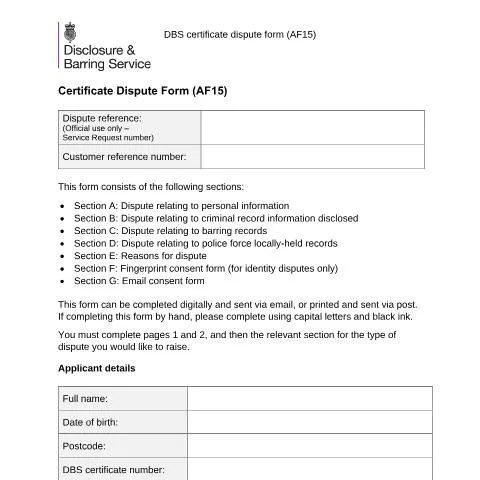
Few things can derail a job application or professional opportunity faster than discovering errors on your DBS certificate. Whether it's someone else's criminal record appearing under your name, incorrect personal details that raise identity questions, or disputed police intelligence that shouldn't have been disclosed, these mistakes can have serious consequences for your career and reputation. The Certificate Dispute Form (AF15) serves as your formal route to challenge and correct such errors through the Disclosure and Barring Service's structured dispute resolution process.
Unlike simple administrative corrections that might be resolved with a phone call, DBS certificate disputes require documented evidence, specific procedures, and often involve multiple agencies including police forces and the Independent Monitor. The complexity of this process reflects the serious nature of criminal record disclosures and the robust safeguards needed to protect both individual rights and public safety.
Understanding the Scope of Certificate Disputes
The AF15 form addresses four distinct categories of disputes, each with its own procedural requirements and resolution pathways. Personal information disputes cover basic identity details such as incorrect names, dates of birth, addresses, or employment details that appear on the certificate header. These might seem minor but can create significant problems when employers cannot match the certificate to the individual presenting it.
Criminal record information disputes represent the most serious category, involving challenges to convictions, cautions, reprimands, or warnings that appear on the certificate. This includes cases where all disclosed information belongs to someone else entirely – a situation that typically requires fingerprint verification to resolve identity confusion within police databases.
Barring record disputes focus specifically on inclusion in the DBS Children's Barred List or Adults' Barred List under Section 142 of the Education Act 2002. These listings prevent individuals from working in regulated activities with vulnerable groups, making accurate records essential for both employment prospects and child protection.
The fourth category addresses police force locally-held records – information disclosed at Chief Police Officers' discretion that might include allegations, intelligence, or other relevant details not resulting in formal charges. Disputes in this area often centre on accuracy, relevance to the specific role, or whether disclosure was appropriate given the circumstances.
Identity Confusion and the Fingerprint Requirement
When criminal records appear that don't belong to the certificate holder, the dispute process becomes significantly more complex. The form requires completion of Section F (fingerprint consent) alongside submission of a passport-style photograph. This isn't merely administrative procedure – it reflects the serious challenge of distinguishing between individuals in police databases where names, dates of birth, or other identifying details might overlap.
The fingerprint consent declaration authorises police forces to take prints "if required" for dispute resolution. This conditional wording acknowledges that not all identity disputes need fingerprint verification, but provides necessary legal authority when database checks prove insufficient. The process typically involves comparison against prints taken during the original arrest or charge that led to the disputed record.
| Dispute Type | Additional Requirements | Typical Resolution Time |
|---|---|---|
| Personal information only | None beyond basic form | 2-4 weeks |
| All criminal records incorrect | Fingerprint consent + photograph | 6-12 weeks |
| Some criminal records incorrect | Fingerprint consent + photograph | 8-16 weeks |
| Police intelligence disputes | Independent Monitor review | 12-20 weeks |
Third-Party Disputes: When Others Can Act on Your Behalf
The form accommodates situations where someone other than the certificate holder needs to raise a dispute. Countersignatories – the authorised individuals who process DBS applications on behalf of organisations – can dispute certificates they've countersigned. This proves particularly important when employers discover discrepancies that affect their duty of care or regulatory compliance.
Employers themselves may initiate disputes when certificate errors impact their ability to make informed recruitment decisions. Licensing authorities, such as those overseeing taxi drivers, security personnel, or financial services professionals, also have legitimate interests in ensuring certificate accuracy given their statutory responsibilities.
However, the form explicitly excludes solicitors from acting as interested parties in their professional capacity. Legal representatives cannot simply submit disputes on behalf of clients – the process requires direct involvement from either the certificate holder or an organisation with legitimate operational interest in the certificate's accuracy.
When third parties raise disputes, they must specify their exact interest and provide full contact details. The form warns that dispute results will be shared with both the applicant and countersignatory, ensuring transparency while respecting the certificate holder's rights regarding their personal information.
Police Intelligence Disputes and the Independent Monitor
Disputes involving police force locally-held records follow a distinct pathway when they challenge relevance or appropriateness of disclosure rather than factual accuracy. The Independent Monitor – an independent statutory role established under the Police Act 1997 – reviews these cases to balance individual privacy rights against legitimate disclosure in the public interest.
This review process applies specifically when disputing that disclosed information is not relevant to the position or workforce, or that it should not have been disclosed at all. The three-month time limit for raising such disputes reflects the need for timely resolution while recognising that individuals may need time to understand the implications of disclosed information.
The Independent Monitor's role involves scrutinising Chief Police Officers' decisions about what constitutes "other relevant information" worthy of disclosure. This might include unproven allegations, intelligence about associates, or historical matters where no charges were brought. The Monitor must weigh the potential harm to the individual against the risk to public safety or the integrity of the role in question.
Documentary Evidence and Supporting Information
Section E of the form requires comprehensive details about the disputed information, moving beyond simple tick-box selections to demand substantive explanation. Applicants must provide full details of any offences, barring information, or approved information being disputed, along with clear reasoning for the challenge.
For missing offence disputes, the form specifically requests court details, attendance dates, and supporting evidence. This might include court correspondence, legal representation records, or official documentation proving that an offence occurred but doesn't appear on the certificate. The burden of proof rests with the dispute raiser to demonstrate what should be included.
When disputing inaccurate information, relevant dates become crucial. Conviction dates, court locations, sentence details, or the circumstances of cautions all require precise documentation. Police forces maintain records across different systems and time periods, so specific details help identify the correct entries for review or correction.
The form's design accommodates both digital completion and traditional paper submission, recognising that users may prefer different methods or lack access to digital tools. However, email submission requires additional consent in Section G, acknowledging the sensitivity of transmitting criminal record information electronically.
Procedural Safeguards and Data Protection
The dispute process operates under strict data protection frameworks, reflecting the highly sensitive nature of criminal record information. The requirement for signed declarations, whether physical or digital, creates an audit trail and legal accountability for dispute submissions. False or frivolous disputes could potentially constitute offences under data protection or fraud legislation.
Email consent requirements in Section G specifically address the risks of electronic transmission. While convenient for applicants, emailing criminal record disputes raises questions about data security, recipient verification, and potential interception. The DBS provides a dedicated email address ([email protected]) but requires explicit consent acknowledging these risks.
The alternative postal route to Customer Services in Liverpool maintains traditional security through physical mail handling and established government processing procedures. This dual approach ensures accessibility while allowing individuals to choose their preferred level of digital engagement based on their circumstances and comfort with electronic communication.
Resolution Outcomes and Ongoing Implications
Successful disputes result in corrected certificates being issued free of charge, but the implications extend beyond the immediate document. Corrected information must be updated across all relevant databases, including police records, DBS systems, and potentially other agencies that received the original incorrect information.
For identity-related disputes resolved through fingerprint verification, the process may reveal broader issues with how records are stored or cross-referenced in police systems. Multiple forces might hold incorrect associations, requiring coordinated correction efforts across different jurisdictions and potentially affecting historical data beyond the immediate certificate.
When police intelligence disputes succeed through Independent Monitor review, the outcome may influence future disclosure decisions for similar circumstances. These precedents help establish clearer boundaries around relevance and proportionality, though each case ultimately depends on its specific facts and the role in question.
Unsuccessful disputes don't necessarily end the process. Applicants retain rights to seek judicial review of decisions, particularly where procedural errors occurred or where new evidence emerges. The formal dispute process through AF15 creates the necessary administrative record for any subsequent legal challenges, making thorough initial submissions crucial for protecting future options.
The Certificate Dispute Form represents more than administrative correction – it embodies the balance between individual rights and public protection that underpins the entire DBS system. Whether challenging mistaken identity, disputing irrelevant disclosures, or correcting factual errors, the process demands precision, evidence, and patience. For those facing certificate errors, understanding these procedures and requirements proves essential for protecting both immediate employment prospects and long-term professional reputation.
Understanding the Different Levels of DBS Certificate Disputes
Not all DBS certificate disputes follow the same pathway, as the complexity and available remedies depend significantly on the level of check involved and the nature of the disputed information. Basic DBS certificates present unique challenges since they only show unspent convictions under the Rehabilitation of Offenders Act 1974, leaving limited grounds for dispute beyond factual errors in personal details or conviction dates.
For Standard and Enhanced DBS certificates, disputes become considerably more nuanced. These certificates may include spent convictions, cautions, warnings, and reprimands that would not appear on basic checks. Enhanced certificates additionally feature police intelligence information—often the most contentious element in disputes. This non-conviction information might include allegations that never led to charges, incidents where no further action was taken, or intelligence gathered during investigations.
The Enhanced with Barred Lists check adds another layer of complexity, as disputes may involve not only the DBS certificate content but also placement on the Disclosure and Barring Service's barred lists. Being barred from working with children or vulnerable adults requires separate appeal processes through the DBS, distinct from certificate disputes handled by the independent monitor.
When challenging police intelligence information on Enhanced certificates, applicants must understand that the threshold for inclusion differs markedly from criminal conviction standards. Police forces may include information they consider "relevant and proportionate" to the role, even if it resulted in no formal action. Successfully disputing such information often requires demonstrating either factual inaccuracy, lack of relevance to the specific position, or disproportionality given the circumstances and time elapsed.
Certain categories of information prove particularly difficult to dispute successfully. Domestic violence allegations, even when unsubstantiated, frequently remain on Enhanced certificates for roles involving vulnerable people. Similarly, financial misconduct concerns may persist on certificates for positions involving money handling, regardless of whether formal charges were brought.
Fingerprint Consent Complications and Resolution Strategies
Fingerprint consent issues extend far beyond simple form completion errors, encompassing a range of technical, legal, and procedural complications that can significantly delay DBS processing. Understanding these complexities helps applicants navigate potential obstacles more effectively.
Biometric data quality problems represent one of the most common yet frustrating consent-related delays. Poor fingerprint impressions may result from various factors including manual work that affects finger ridge patterns, medical conditions such as eczema or dermatitis, age-related skin changes, or simply inadequate technique during capture. When initial prints prove unsuitable, applicants must return for re-scanning, potentially multiple times, with each attempt adding weeks to processing timelines.
For individuals with compromised fingerprint quality due to medical conditions, occupational factors, or age, the DBS may require additional documentation from healthcare professionals confirming the reasons for poor print quality. This medical evidence pathway can extend processing times considerably, particularly if specialist consultations become necessary.
Technical consent complications often arise when applicants have complex identity histories. Individuals who have legally changed names multiple times, held multiple nationalities, or lived abroad for extended periods may encounter consent form requirements that seem impossible to satisfy completely. In such cases, the DBS typically requires comprehensive documentation spanning the entire identity history, including foreign police certificates that may take months to obtain.
The consent withdrawal process presents its own challenges. While applicants retain the right to withdraw consent for fingerprint processing, doing so after submission typically results in application cancellation rather than alternative processing methods. Understanding the implications before consent submission proves crucial, as withdrawal often necessitates starting the entire application process afresh.
Employer consent complications frequently occur in complex organisational structures. When applications involve umbrella organisations, franchises, or multiple employer relationships, determining the appropriate consenting authority can prove problematic. Educational institutions with complex governance structures, healthcare trusts with multiple sites, or large retail chains with franchise arrangements may encounter particular difficulties establishing clear consent chains.
For applicants experiencing persistent fingerprint consent issues, several resolution strategies may prove effective. Medical documentation supporting poor print quality can expedite alternative processing methods. Comprehensive identity documentation addressing all name changes, nationality variations, and residence history helps prevent consent delays. Early employer engagement ensures all organisational consent requirements are properly understood and documented before submission.
Long-term Implications and Rights Protection Strategies
The long-term implications of DBS certificate disputes and fingerprint consent complications extend well beyond immediate employment concerns, potentially affecting career progression, professional registration, and personal circumstances for years to come. Understanding these broader consequences enables individuals to make informed decisions about dispute strategies and rights protection.
Professional registration implications vary significantly across different sectors and regulatory bodies. Healthcare professionals registered with the General Medical Council, Nursing and Midwifery Council, or Health and Care Professions Council may find that DBS certificate disputes affect not only immediate employment but also ongoing professional registration status. Similarly, teachers registered with the Teaching Regulation Agency may encounter registration complications that persist beyond individual employment situations.
The portability of dispute outcomes represents a crucial consideration for career development. Successfully disputing information on one DBS certificate does not automatically ensure removal from future certificates, as each application triggers fresh consideration of available information. However, documented successful disputes may strengthen arguments in subsequent cases, particularly when challenging the same police intelligence information across multiple applications.
Data retention and deletion rights under UK GDPR provide additional avenues for addressing problematic information. Individuals may request deletion of personal data held by police forces where it no longer serves a legitimate purpose, though law enforcement exemptions significantly limit these rights. Nevertheless, formal data subject access requests can reveal the full extent of held information and provide insights into why particular details appear on DBS certificates.
The rehabilitation timeline impact affects how long various types of information may continue appearing on different levels of DBS certificate. While the Rehabilitation of Offenders Act 1974 provides clear timelines for when convictions become spent for basic certificate purposes, Enhanced certificates may continue showing spent convictions and police intelligence indefinitely. Understanding these timelines helps individuals plan career transitions and dispute strategies effectively.
International implications increasingly affect UK residents seeking overseas employment or travel. DBS certificate information may influence visa applications, international background checks, or professional registration in other countries. Some nations' immigration authorities specifically request UK police certificates, making DBS certificate content relevant beyond domestic employment contexts.
For individuals facing long-term career implications from DBS certificate content, several protective strategies merit consideration. Professional legal advice may prove valuable for complex disputes involving serious allegations or professional registration concerns. Regular monitoring of DBS certificate content through periodic applications can identify when information changes or ages off certificates. Documentation maintenance ensuring all supporting evidence for successful disputes remains accessible for future applications.
Alternative career pathway planning may become necessary for individuals unable to successfully dispute information that affects their chosen profession. Understanding which roles require different levels of DBS checking enables informed career decisions. Some positions may accept older certificates or different checking levels, while others might offer alternative routes to employment that circumvent standard DBS requirements.
The evolving legal landscape around data protection, rehabilitation periods, and DBS procedures means that unsuccessful disputes today might succeed in future as legal interpretations develop. Staying informed about relevant case law, policy changes, and procedural updates through legal professionals or specialist advisory services can identify new opportunities for challenging persistent problematic information.