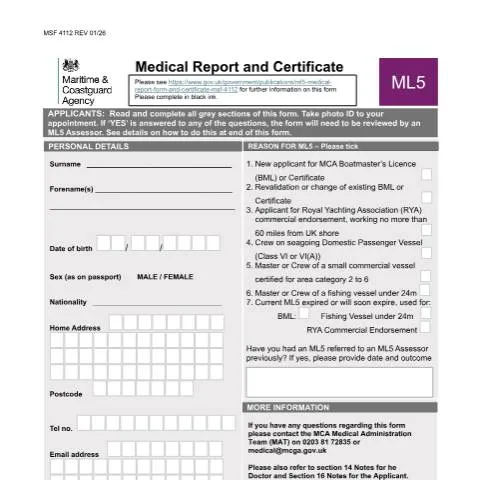
The ML5 Medical Certificate: Gateway to Commercial Maritime Careers
Working aboard commercial vessels in UK waters requires more than seamanship skills and navigation knowledge—it demands proven medical fitness through the ML5 medical report form and certificate (MSF 4112). This Maritime and Coastguard Agency document stands as the definitive health assessment for thousands of maritime professionals, from fishing boat skippers to passenger vessel crew members operating in challenging coastal waters.
The ML5 serves a critical safety function that extends far beyond individual health checks. When weather turns savage in the North Sea or equipment fails on a remote Scottish loch, crew members may find themselves the sole competent persons responsible for vessel safety, passenger welfare, and environmental protection. The certificate ensures these maritime professionals possess the physical and mental capacity to handle such demanding situations without compromising safety.
Understanding the ML5's Scope and Maritime Applications
The ML5 medical certificate covers a remarkably diverse range of maritime activities, each with distinct operational demands and risk profiles. New applicants for MCA Boatmaster's Licences (BML) or Certificates represent the largest category, encompassing those seeking to command commercial vessels in UK waters. These individuals undergo comprehensive assessment covering cardiovascular fitness, visual acuity, and neurological stability.
Commercial fishing operations under 24 metres require ML5 certification for both masters and crew members. Given the physical demands of hauling nets, operating winches, and working in confined spaces during extended periods at sea, the medical standards focus particularly on musculoskeletal health and fatigue management capabilities.
| Vessel Category | Personnel Requiring ML5 | Key Medical Focus Areas |
|---|---|---|
| Domestic Passenger Vessels (Class VI/VI(A)) | All crew members | Emergency response capability, communication skills |
| Small commercial vessels (Area categories 2-6) | Masters and crew | Navigation competence, weather decision-making |
| RYA commercial endorsement vessels | Endorsed operators | Client safety responsibility, rescue capability |
| Fishing vessels under 24m | Masters and crew | Physical strength, injury prevention |
The Royal Yachting Association commercial endorsement pathway requires ML5 certification for operators working within 60 miles of UK shores. This category often involves instructors, charter skippers, and commercial yacht crew who must demonstrate capability to manage clients' safety while maintaining vessel operations in varying conditions.
The Medical Assessment Framework: Beyond Basic Health Checks
The ML5 examination employs a sophisticated dual-assessment approach combining vision testing by qualified opticians or optometrists with comprehensive medical evaluation by registered doctors. This separation ensures specialised expertise applies to each component while maintaining overall assessment integrity.
Vision assessment standards demand exceptional precision. Applicants must achieve 6/6 vision or better in one eye and 6/12 vision or better in the other eye, with or without visual aids. However, the requirement for 6/60 vision in each eye separately without aids creates a safety net ensuring basic visual function remains even if corrective lenses are lost overboard.
Colour vision testing uses the Ishihara plate system exclusively—online versions are explicitly prohibited due to screen calibration variations. The 24-plate version allows two errors maximum for a pass, while the 38-plate version permits three errors. Applicants failing initial colour vision tests receive one retest opportunity before referral to MCA CAD test centres for alternative assessment.
The cardiac assessment section reflects the demanding nature of maritime work. Examiners evaluate coronary artery disease history, cardiac examination abnormalities, and current treatment regimens. Given the potential for medical emergencies occurring hours from shore-based assistance, cardiovascular stability becomes paramount for crew safety and operational reliability.
Navigating the ML5 Assessment Process
Successful ML5 completion requires careful preparation and understanding of the multi-stage process. Applicants must complete all grey sections of the form before attending appointments, ensuring personal details, reason for certification, and previous ML5 history are accurately documented. Photo identification becomes mandatory at each appointment stage.
The vision assessment appointment typically occurs first, conducted by opticians, optometrists, or doctors with appropriate qualifications. Applicants wearing contact lenses must bring storage cases and solution, as testing requires both aided and unaided vision measurements. This practical requirement often catches applicants off-guard, potentially delaying certification if forgotten.
Medical assessment follows vision testing, conducted exclusively by registered doctors. The examining physician reviews medical history, conducts physical examination, and evaluates fitness for specific maritime roles. Any positive responses to screening questions trigger automatic referral to ML5 Assessors, potentially extending the certification timeline significantly.
Documentation Requirements and Professional Verification
Each examining professional must provide comprehensive identification and registration details. Doctors must include their GMC number, while opticians and optometrists provide GOC or HPC registration numbers. Professional stamps and signatures authenticate each section, creating an auditable trail for regulatory compliance.
The form's completion in black ink only reflects document scanning and archival requirements. Blue ink or pencil entries risk rejection, requiring complete re-examination and additional costs for applicants.
When Medical Standards Meet Maritime Reality
The ML5's medical criteria acknowledge the harsh realities of commercial maritime operations. Working single-handed on fishing vessels, managing passenger safety during rough crossings, or conducting rescue operations in adverse weather demands exceptional physical and mental resilience. The assessment framework balances inclusive employment practices with uncompromising safety standards.
Progressive eye diseases receive particular scrutiny due to their potential impact over certification periods. Conditions such as glaucoma or diabetic retinopathy may not currently impair vision but could deteriorate rapidly, compromising safety during future operations. Examiners must predict medical stability over extended periods while considering treatment advances and condition management.
Visual field defects present complex assessment challenges. While peripheral vision loss might seem manageable in office environments, maritime operations demand comprehensive visual awareness for collision avoidance, weather assessment, and emergency response. The examining professional must evaluate how specific defects might impact operational safety in dynamic marine environments.
The ML5 Assessor Referral Process
Certain medical findings automatically trigger referral to specialised ML5 Assessors—highly qualified professionals with extensive maritime medicine expertise. This referral occurs when examining doctors answer "yes" to any screening questions, indicating conditions requiring specialist evaluation.
Previous ML5 Assessor referrals must be declared, including dates and outcomes. This historical information helps current assessors understand medical progression and treatment effectiveness. Applicants who've undergone successful treatment for previously concerning conditions may achieve certification following assessor review.
Certification Validity and Professional Implications
ML5 certificates carry specific validity periods tied to the holder's maritime role and medical risk profile. Revalidation requirements ensure continued fitness throughout maritime careers, with timing dependent on age, medical history, and operational demands. Older mariners or those with managed medical conditions face more frequent assessment cycles.
The certificate's expiry triggers immediate loss of commercial operating authority. Unlike driving licences with grace periods, expired ML5 certificates create immediate compliance breaches for vessel operators and individual crew members. This strict approach reflects the safety-critical nature of commercial maritime operations.
Changes to existing Boatmaster's Licences or Certificates require fresh ML5 assessment. Upgrading from coastal to unlimited operations, adding passenger endorsements, or changing vessel categories all trigger new medical evaluation. This ensures medical fitness matches operational responsibilities and risk exposure.
Managing ML5 Certificate Documentation
Lost or damaged ML5 certificates require complete re-examination rather than simple replacement. The Maritime and Coastguard Agency maintains no central database of certificate details, placing responsibility for document security entirely on certificate holders. This approach prevents fraudulent replacements but creates significant inconvenience for careless certificate management.
Employers often require ML5 certificate copies for crew documentation and insurance purposes. However, original certificates must remain accessible for maritime enforcement inspections, creating practical challenges for crew members working multiple vessels or operating across different companies.
Professional Support and Medical Administration
The MCA Medical Administration Team (MAT) provides essential support for complex ML5 cases and procedural queries. Available on 0203 81 72835 or [email protected], the team handles assessor referrals, appeals processes, and clarification of medical standards. Their expertise proves invaluable for applicants with unusual medical histories or challenging certification circumstances.
Communication with the MAT should include specific reference to MSF 4112 and relevant section numbers when discussing technical queries. The team maintains detailed knowledge of assessment criteria and can provide guidance on borderline cases or complex medical scenarios.
The ML5 system reflects the UK maritime industry's commitment to safety through comprehensive health assessment. While demanding in its standards and rigorous in its application, the certificate provides assurance that commercial maritime operations maintain the highest safety standards. For maritime professionals, the ML5 represents not just regulatory compliance but professional credibility and operational competence in one of Britain's most challenging working environments.
Understanding the ML5's requirements, preparing thoroughly for assessment appointments, and maintaining certificate validity ensures maritime careers proceed smoothly while contributing to the industry's exemplary safety record. The certificate's demanding standards reflect the serious responsibilities undertaken by commercial maritime professionals and the trust placed in their competence by passengers, crew members, and the wider maritime community.
Common Medical Conditions and ML5 Assessment Criteria
The ML5 medical report serves different purposes depending on the underlying medical condition being assessed. Maritime medical examiners apply specific evaluation criteria that vary significantly based on the nature and severity of health conditions presented by seafarers.
Cardiovascular Conditions
Heart conditions represent one of the most scrutinised areas in ML5 assessments. The Maritime and Coastguard Agency maintains strict protocols for evaluating cardiovascular fitness, particularly given the remote nature of maritime work where immediate medical intervention may not be available.
Hypertension cases require careful documentation of blood pressure readings over time, current medication regimens, and evidence of effective management. Medical examiners typically request at least three separate readings taken on different occasions, preferably including measurements from the candidate's GP practice. Controlled hypertension with readings consistently below 160/100 mmHg may result in certification with periodic review requirements.
Previous myocardial infarction or cardiac surgery cases undergo particularly thorough evaluation. The ML5 must include detailed cardiac function assessments, often requiring recent echocardiograms, exercise tolerance tests, or cardiology specialist reports. Recovery periods vary, but typically a minimum of six months post-incident is required before certification consideration, with some cases requiring annual reviews.
Arrhythmia conditions, including atrial fibrillation, require comprehensive documentation of the underlying rhythm disorder, anticoagulation therapy if applicable, and stroke risk assessments. Pacemaker or implantable cardioverter defibrillator recipients face additional scrutiny, with specific electromagnetic interference considerations for shipboard equipment.
Respiratory and Pulmonary Assessments
Respiratory fitness evaluation through the ML5 process addresses both chronic conditions and acute recovery scenarios. Asthma cases require detailed documentation of triggers, medication usage patterns, and exercise tolerance levels. Peak flow measurements and spirometry results often supplement the clinical examination findings.
Chronic obstructive pulmonary disease (COPD) assessments focus heavily on functional capacity and oxygen saturation levels during physical exertion. The ML5 documentation must demonstrate adequate respiratory reserve for emergency situations, including firefighting activities and confined space work that may be required aboard vessels.
Sleep apnoea cases have gained increased attention in maritime medical assessments, given the safety implications of excessive daytime sleepiness in watchkeeping roles. Continuous positive airway pressure (CPAP) therapy compliance records often form part of the ML5 submission, with some cases requiring specialist sleep study reports.
Diabetes and Metabolic Conditions
Diabetes mellitus cases require particularly detailed ML5 documentation due to the potential for acute complications in remote maritime environments. Type 1 diabetes assessments focus heavily on hypoglycaemic awareness, blood glucose monitoring compliance, and emergency management protocols.
HbA1c results from the previous 12 months must be documented, with values consistently below 58 mmol/mol (7.5%) generally required for unrestricted certification. Higher values may result in restricted certificates or requirements for more frequent medical reviews.
Insulin-dependent seafarers face additional scrutiny regarding storage requirements for medication, blood glucose monitoring equipment reliability, and protocols for managing diabetes during extended voyages. The ML5 must address these practical considerations alongside clinical stability indicators.
Type 2 diabetes managed through diet and oral medications typically undergoes less restrictive evaluation, though documentation of diabetic complications, particularly retinopathy, nephropathy, or neuropathy, significantly influences certification decisions.
Appeals Process and Medical Review Procedures
When an ML5 medical assessment results in certification refusal or restrictions that significantly impact a seafarer's career prospects, formal appeal mechanisms provide structured pathways for challenging these decisions through the Maritime and Coastguard Agency framework.
Grounds for Medical Appeals
Medical appeals typically succeed when procedural irregularities in the original assessment process can be demonstrated, when new medical evidence becomes available that wasn't considered in the initial evaluation, or when the original medical examiner's interpretation of existing evidence can be legitimately challenged.
Procedural grounds for appeal might include situations where the medical examiner failed to consider relevant specialist reports, applied incorrect assessment criteria for the specific condition, or didn't provide adequate opportunity for the candidate to present medical evidence. Documentation errors in the ML5 form itself, such as incorrect condition codes or inaccurate medical history recording, also constitute valid appeal grounds.
New medical evidence appeals often arise when additional diagnostic tests become available after the original assessment, when surgical interventions or new treatments significantly improve the candidate's condition, or when specialist opinions provide different interpretations of existing medical data.
Appeal Submission Requirements
Appeals must be submitted within 28 days of receiving the original medical decision, accompanied by comprehensive supporting documentation that addresses the specific grounds for challenge. The appeal submission requires completion of dedicated forms available through the Maritime and Coastguard Agency, along with payment of prescribed fees that vary depending on the complexity of the case.
Supporting medical evidence for appeals should include recent specialist reports, updated diagnostic test results, and detailed explanations of how the new information addresses the original certification concerns. Independent medical opinions from specialists in relevant fields often strengthen appeal cases, particularly when these opinions directly contradict the original assessment conclusions.
Legal representation isn't mandatory for medical appeals, though complex cases involving multiple medical conditions or significant career implications often benefit from professional advocacy. Maritime law specialists familiar with medical certification requirements can provide valuable guidance on evidence presentation and procedural compliance.
Independent Medical Review Panels
Complex appeals undergo evaluation by independent medical review panels comprising specialists in maritime medicine, relevant clinical disciplines, and Maritime and Coastguard Agency medical advisers. These panels operate independently from the original assessment process, ensuring objective evaluation of appeal submissions.
Panel reviews typically involve comprehensive case file analysis, consideration of all submitted medical evidence, and sometimes additional medical examinations by panel-appointed specialists. The review process duration varies significantly based on case complexity, ranging from several weeks for straightforward appeals to several months for cases requiring extensive specialist consultation.
Panel decisions can result in complete reversal of the original assessment, modification of restrictions or conditions attached to certification, or confirmation of the original decision with additional reasoning. In cases where panels identify systemic issues with assessment procedures, recommendations for policy changes may accompany individual case decisions.
International Recognition and Reciprocity Arrangements
The ML5 medical report and associated MSF 4112 certificate operate within complex international frameworks that govern mutual recognition of maritime medical fitness assessments between different flag state administrations and port state control authorities worldwide.
STCW Convention Compliance
International Maritime Organization Standards of Training, Certification and Watchkeeping (STCW) Convention requirements establish minimum medical fitness standards that all signatory nations must implement through their domestic certification processes. The UK's ML5 system exceeds these minimum requirements in several areas, creating both advantages and complications for international recognition.
STCW medical fitness standards focus primarily on vision, hearing, cardiovascular fitness, and general physical condition necessary for safe watchkeeping duties. However, individual flag states may impose additional requirements beyond STCW minimums, creating variations in medical assessment scope and criteria that affect reciprocity arrangements.
UK-certified seafarers working on foreign-flagged vessels may encounter situations where their ML5-based certification doesn't fully satisfy the flag state's medical requirements, necessitating additional medical assessments or specialist reports. Conversely, foreign nationals seeking to work on UK-flagged vessels must demonstrate medical fitness equivalent to ML5 standards, even when holding valid medical certificates from their home countries.
European Union Medical Directive Implications
Post-Brexit arrangements have created new complexities for UK maritime medical certification recognition within European Union waters and by EU flag state administrations. The European Maritime Safety Agency (EMSA) medical fitness directive establishes harmonised standards across EU member states, with specific provisions for third-country medical certificate recognition.
UK seafarers operating within EU waters now require additional documentation demonstrating equivalence between ML5 assessment standards and EU directive requirements. This typically involves submission of detailed medical assessment criteria, examiner qualification evidence, and quality assurance procedures to relevant EU authorities.
Reciprocal arrangements with individual EU member states vary significantly, with some maintaining full recognition of UK medical certificates under bilateral agreements, while others require supplementary medical assessments or periodic re-validation by EU-qualified medical examiners.
Port State Control Implications
Port state control inspections worldwide increasingly scrutinise crew medical fitness documentation, with ML5-based certificates generally receiving acceptance due to the UK's reputation for rigorous maritime medical standards. However, specific regional memorandums of understanding may impose additional documentation requirements.
Paris Memorandum of Understanding inspections within European and North Atlantic waters typically accept ML5 certificates without additional requirements, reflecting established confidence in UK medical assessment procedures. However, inspectors may request additional documentation when crew members have medical conditions requiring ongoing management or periodic review.
Asia-Pacific and Indian Ocean port state control regimes sometimes require additional medical documentation, particularly for crew members with diabetes, cardiovascular conditions, or other chronic diseases requiring medication management. Seafarers operating in these regions should maintain comprehensive medical records beyond the basic ML5 certificate requirements.
Bilateral Recognition Agreements
The Maritime and Coastguard Agency maintains formal bilateral agreements with numerous countries regarding mutual recognition of medical fitness assessments, though these arrangements require periodic review and updating to reflect evolving medical standards and assessment procedures.
Commonwealth countries generally maintain strong reciprocity arrangements with UK medical certification, reflecting shared maritime traditions and similar medical assessment frameworks. However, individual variations in assessment criteria and examiner qualification requirements can create complications for seafarers moving between these jurisdictions.
Emerging maritime nations increasingly seek recognition agreements with established flag states like the UK, creating opportunities for expanded mutual recognition but also requiring careful evaluation of medical assessment equivalence and quality assurance procedures.