When Court Battles End: Understanding the Financial Settlement Through Form N256
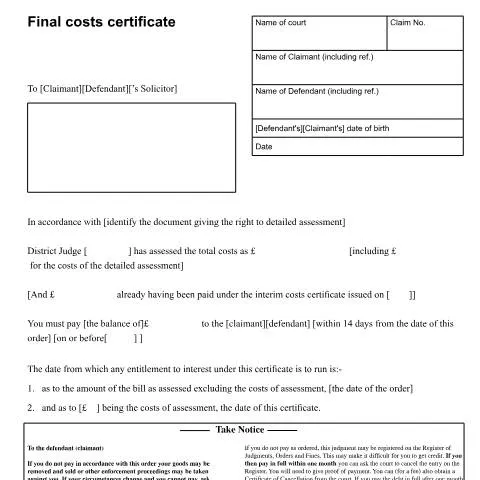
After months or even years of legal proceedings, when the courtroom drama finally concludes and the dust settles, one critical document emerges to formalise the financial aftermath of litigation: the Final Costs Certificate, Form N256. This unassuming piece of paperwork carries significant weight in the English civil justice system, representing the court's final word on who owes what to whom following a detailed assessment of legal costs.
Unlike the dramatic verdict that determines liability, the costs assessment process often unfolds quietly in the background, yet its outcome can prove equally consequential. The N256 certificate transforms what might have been a provisional or estimated costs award into a definitive, enforceable judgment that carries the full authority of HM Courts & Tribunals Service.
For successful litigants, this document represents vindication—not just of their legal position, but of their decision to pursue costly litigation. For unsuccessful parties, it often delivers the final financial blow, crystallising their total liability in stark numerical terms. The certificate doesn't merely state an amount; it creates a legally binding obligation backed by the court's enforcement powers.
The Detailed Assessment Journey: From Bill to Binding Certificate
The path to receiving Form N256 begins when a court makes an order for costs following judgment, but leaves the precise amount to be determined through detailed assessment. This process, overseen by a District Judge or Costs Judge, involves meticulous line-by-line scrutiny of legal bills to determine what constitutes reasonable and proportionate expenditure.
The detailed assessment procedure typically unfolds over several months. Initially, the receiving party serves a bill of costs on the paying party, who then has the opportunity to dispute specific items. If agreement cannot be reached, the matter proceeds to a formal assessment hearing where a judicial officer examines each contested element.
| Stage | Timeline | Key Actions |
|---|---|---|
| Service of Bill | Within 3 months of costs order | Detailed breakdown of all costs claimed |
| Points of Dispute | 21 days after service | Paying party challenges specific items |
| Reply to Points | 21 days after receipt | Receiving party responds to challenges |
| Assessment Hearing | Court listing dependent | Judicial determination of disputed costs |
| Final Certificate | Following assessment | Form N256 issued with binding amounts |
During this process, parties might receive an interim costs certificate allowing partial payment of undisputed amounts. However, only the final certificate provides complete certainty about the total financial obligation.
The Role of Proportionality in Modern Cost Assessment
Since the Jackson reforms fundamentally altered the costs landscape, proportionality has become paramount in detailed assessments. District Judges now consider not just whether individual cost items are reasonable, but whether the total costs bear an appropriate relationship to the value and complexity of the case. This shift means that even reasonable costs may be reduced if they appear disproportionate to the overall dispute.
The final certificate reflects this balancing exercise, often showing significant reductions from the originally claimed amounts. Legal representatives have adapted by presenting more focused, defensible cost schedules, knowing that excessive claims risk substantial disallowance.
Anatomy of the Final Certificate: Decoding the Financial Verdict
Form N256 presents its information with stark clarity, leaving no ambiguity about financial obligations. The certificate identifies the court, claim number, and parties before delivering its key components: the assessed costs amount, any interim payments already made, and the outstanding balance requiring payment.
The document distinguishes between base costs—the substantive legal costs of the original proceedings—and assessment costs—the additional costs incurred during the detailed assessment process itself. This separation proves crucial for interest calculations, as different rates and start dates may apply to each component.
Interest Provisions and Their Financial Impact
The certificate specifies precise dates from which interest begins to accrue on different cost components. For base costs, interest typically runs from the date of the original costs order, while assessment costs attract interest from the certificate date. Given that detailed assessments can take many months to complete, accumulated interest often represents a substantial additional burden for paying parties.
Current interest rates on judgment debts fluctuate with Bank of England base rates, but compound daily, meaning delays in payment can prove increasingly expensive. The certificate's clear identification of interest start dates removes any uncertainty about these calculations.
Payment Obligations and Enforcement Mechanisms
The final costs certificate creates an immediate payment obligation, typically requiring settlement within 14 days of the certificate date unless the court specifies an alternative timeframe. This deadline is non-negotiable—the certificate represents a final determination rather than an opening negotiating position.
Form N256 includes prominent warnings about enforcement consequences for non-compliance. These aren't empty threats but reflect the court's extensive enforcement powers, including seizure and sale of goods, attachment of earnings, third-party debt orders, and charging orders against property.
"If you do not pay in accordance with this order your goods may be removed and sold or other enforcement proceedings may be taken against you."
The certificate also warns about potential registration on the Register of Judgments, Orders and Fines—a development that can severely impact creditworthiness. This public record remains visible to credit reference agencies and potential lenders, making future borrowing significantly more difficult and expensive.
Strategic Considerations for Payment Timing
Paying parties face an important strategic decision regarding payment timing. Prompt payment within one month of any Register entry allows application for cancellation, completely removing the adverse credit record. Later payment only permits marking the entry as "satisfied," which, while better than an outstanding judgment, still signals previous payment difficulties to future creditors.
The certificate emphasises that payments must go directly to the receiving party or their representative, not to the court. This requirement reflects the court's role as adjudicator rather than debt collector, though it places the burden on paying parties to ensure payments reach the correct recipient and are properly credited.
Challenging and Appealing Cost Determinations
While Form N256 represents a final determination, it isn't necessarily the end of the road for dissatisfied parties. The certificate can be challenged through various mechanisms, though each has strict time limits and procedural requirements.
A review application allows parties to ask the assessing judge to reconsider their decision, typically on grounds that significant evidence wasn't available during the original hearing or that an obvious error occurred. Such applications must be made promptly—usually within 21 days of the certificate—and face a high threshold for success.
More substantially, parties can appeal to a Costs Judge or Circuit Judge, depending on the original assessing officer and the value involved. Appeals focus on points of principle or procedure rather than re-examining every line item, and must demonstrate that the original assessment was wrong in principle or plainly wrong in quantum.
The Economics of Further Challenge
Challenging a final costs certificate involves significant risk-reward calculations. Unsuccessful challenges typically result in liability for the other party's costs of defending the challenge, potentially adding thousands of pounds to an already substantial bill. Courts expect clear, compelling grounds before entertaining such applications.
The proportionality principle also applies to challenge costs themselves. Spending £10,000 to challenge a £15,000 certificate rarely makes economic sense, particularly given the uncertain prospects of success and potential additional liability.
Practical Management of Final Cost Certificates
Receiving Form N256 triggers immediate practical considerations beyond the payment obligation itself. The certificate should be carefully cross-checked against previous interim certificates to ensure accuracy in calculating the outstanding balance. Arithmetic errors, while uncommon, can occur and are more easily corrected promptly than after payment.
For paying parties, the certificate provides essential information for financial planning and potential settlement discussions. The certainty it provides often facilitates negotiations that might have been impossible during the uncertain assessment period. Some parties prefer to settle even slightly above the certificate amount to avoid enforcement proceedings and associated costs.
Record-Keeping and Documentation
The certificate emphasises the importance of maintaining comprehensive payment records. Given the substantial sums often involved, disputes about payment amounts or timing can arise months or years later. Proof of payment—whether bank transfers, cheques, or other methods—becomes crucial evidence in resolving such disputes.
Recipients should also retain certificates permanently, as they may be required for various purposes including tax calculations, insurance claims, or future legal proceedings. The certificate's status as a formal court document gives it particular evidential weight in subsequent disputes.
The Certificate's Role in Legal and Financial Planning
Beyond its immediate payment function, Form N256 serves important roles in broader legal and financial contexts. For successful parties, it provides definitive evidence of cost recovery for accounting and tax purposes. The distinction between base costs and assessment costs can affect tax treatment, particularly for commercial litigants claiming costs as business expenses.
Insurance implications also flow from the certificate. Legal expenses insurers often require final certificates before making final settlements under after-the-event policies. The document's precision helps insurers calculate precise liability and determine whether policy limits have been exceeded.
For legal practitioners, certificates provide valuable precedent information for future cost budgeting and assessment predictions. The detailed breakdown helps solicitors and barristers calibrate their expectations in similar cases and advise clients more accurately about potential cost exposure.
Wider Implications for Civil Justice
The final costs certificate system reflects broader tensions within civil justice between access to justice and cost proportionality. The detailed assessment process, while thorough, adds time and expense to litigation resolution. However, it provides essential protection against excessive or unreasonable cost claims that could otherwise deter legitimate litigation or create unfair financial burdens.
Recent years have seen increasing judicial scrutiny of costs through the assessment process, with certificates often showing substantial reductions from original claims. This trend reflects judicial determination to ensure that costs remain proportionate to the underlying dispute, even in complex commercial litigation where legal fees can easily exceed the sums in dispute.
The certificate thus represents more than a simple payment demand—it embodies the court's final judgment on what constitutes reasonable expenditure in pursuing or defending legal rights. In an era of increasing litigation costs and growing concerns about access to justice, Form N256 serves as both protection against excessive charges and final vindication of necessary legal expenditure.
Understanding the Assessment Process and Potential Challenges
Once you've submitted Form N256, the detailed assessment process begins with a costs officer examining every aspect of your bill of costs. This scrutiny extends far beyond simple arithmetic checks – the officer will evaluate whether each claimed item represents work that was reasonably necessary for the conduct of the case and whether the time claimed appears proportionate to the complexity of the task performed.
The assessment typically follows a structured approach, beginning with an examination of the hourly rates claimed for different categories of fee earners. Costs officers will compare these rates against current guideline figures, which vary significantly across different court centres and regions. For instance, solicitors practising in Central London may justify higher rates than those in provincial centres, but this geographical variation must be supported by evidence of the actual location where work was undertaken.
Particular attention focuses on the grade of fee earner assigned to specific tasks. The officer will question whether senior partner time was genuinely necessary for routine correspondence or whether a trainee solicitor could reasonably have undertaken complex legal research. This analysis becomes especially critical in cases where multiple fee earners have worked on the same matter, as the officer must determine whether such deployment represented efficient case management or unnecessary duplication of effort.
Time recording practices frequently become a point of contention during assessment. Courts expect contemporaneous time records that demonstrate not merely the duration of work undertaken but also its substance and necessity. Vague entries such as "considering papers generally" or "various telephone calls" are likely to face significant reduction. The officer will look for specific details about what was considered, why it was necessary, and what outcome was achieved.
Disbursements face equally rigorous examination, with particular scrutiny applied to expert witness fees, court fees, and travel expenses. The officer will consider whether the number of experts instructed was reasonable, whether their fees align with established scales or market rates, and whether alternative, less expensive options might have achieved the same objective. Travel and accommodation expenses must be supported by receipts and justified by reference to the specific requirements of the case.
The proportionality test adds another layer of complexity to the assessment process. Even if individual items appear reasonable in isolation, the officer must consider whether the overall costs bear a reasonable relationship to the matters at stake in the litigation. This assessment encompasses not only the financial value of the claim but also its complexity, the importance of the matter to the parties, and the broader public interest considerations that may apply.
Challenging Assessment Decisions Through the Appeals Process
When a costs officer's provisional assessment results in significant reductions to your claimed costs, you retain important rights of challenge through the appeals mechanism. The process begins with a careful analysis of the provisional assessment certificate, which should detail the specific reasons for each reduction or disallowance. Understanding these reasons becomes crucial for determining whether an appeal offers realistic prospects of success.
The initial appeal route involves requesting an oral hearing before the same costs officer who conducted the provisional assessment. This request must be made within 21 days of service of the provisional assessment, accompanied by the prescribed court fee. The oral hearing provides an opportunity to present additional evidence, clarify misunderstandings, and argue for reinstatement of reduced items. However, success requires more than simply repeating arguments already considered during the paper assessment.
Preparation for an oral hearing demands meticulous attention to the specific objections raised in the provisional assessment. Where time recording has been criticised, you might present additional contemporaneous records or witness statements from fee earners explaining the work undertaken. If hourly rates have been reduced, comparable evidence from similar cases or updated market research might support your original claims.
The costs officer conducting the oral hearing will expect focused submissions addressing the specific points in dispute rather than general arguments about the reasonableness of costs. Effective advocacy at this stage requires demonstrating why the provisional assessment was wrong on the facts or applied incorrect legal principles, rather than simply asserting that the work was necessary or reasonably undertaken.
Should the oral hearing fail to produce satisfactory results, further appeal rights exist to a costs judge and, in exceptional circumstances, to the Court of Appeal. However, these higher-level appeals face increasingly stringent tests, with appellate courts generally reluctant to interfere with detailed assessments unless clear errors of law or principle can be demonstrated.
The appeal process carries inherent risks that must be carefully weighed against potential benefits. Unsuccessful appeals may result in liability for additional costs, including the other party's costs of resisting the appeal. The court may also reduce the assessed costs below the level of the provisional assessment if it concludes that the appeal was misconceived or that the original assessment was, if anything, too generous.
Special Considerations for Different Types of Legal Proceedings
The assessment of costs through Form N256 varies considerably depending on the nature of the underlying legal proceedings, with different types of cases attracting distinct approaches to what constitutes reasonable and proportionate expenditure. Personal injury claims, for instance, operate within established frameworks that include fixed costs for certain categories of case, detailed guideline rates for different types of work, and specific provisions for success fees and after-the-event insurance premiums.
In clinical negligence cases, the complexity and specialist nature of the work often justify higher rates and more extensive investigation costs. However, costs officers will scrutinise whether the number of experts instructed was appropriate, whether joint expert instruction might have achieved the same result more efficiently, and whether the scope of each expert's investigation was proportionate to the issues in dispute. The substantial disbursements typical in such cases – including medical records, expert reports, and specialist legal advice – require detailed justification and supporting documentation.
Commercial litigation presents different challenges, particularly where international elements introduce additional complexity and expense. Costs officers must balance the commercial realities of complex business disputes against the fundamental principle that costs should be proportionate to what is at stake. This assessment becomes particularly nuanced where the financial value of a claim may be modest but the commercial implications for the parties are substantial.
Family proceedings attract special considerations reflecting the sensitive nature of the disputes and the court's paramount concern for children's welfare. The assessment process must account for the emotional context in which such work is undertaken, the need for specialist expertise in areas such as child psychology or forensic accounting, and the particular challenges of dealing with litigants who may be under considerable personal stress.
Insolvency proceedings operate within a distinct costs framework that reflects the statutory nature of much insolvency work and the need to balance the interests of creditors with the efficient administration of insolvent estates. Costs officers will examine whether work was undertaken in accordance with statutory requirements, whether the level of investigation was appropriate to the circumstances of the insolvency, and whether alternative approaches might have achieved better outcomes for creditors at lower cost.
Public law cases, including judicial review proceedings, face assessment criteria that recognise the broader public interest considerations at stake. While this may justify certain work that might appear disproportionate in purely private litigation, costs officers will still scrutinise whether the approach adopted was the most efficient means of resolving the public law issues in question.
Criminal proceedings that result in costs orders present unique assessment challenges, particularly where private prosecutors or interested parties seek to recover costs from public funds. The assessment must consider not only the reasonableness of the work undertaken but also its necessity within the context of the criminal justice system and the availability of alternative remedies or procedures that might have achieved the same result at lower cost.