When Wildlife Conservation Meets Financial Reality: Understanding CITES Fee Waivers
For researchers studying endangered pangolins in Southeast Asia, zoo curators developing breeding programmes for critically endangered species, or academic institutions conducting vital conservation research, the financial burden of CITES permits can present a significant barrier to essential conservation work. The Animal and Plant Health Agency (APHA), operating under the Department for Environment, Food and Rural Affairs, recognises this challenge through its fee waiver programme for CITES certificates and permits.
The Convention on International Trade in Endangered Species of Wild Fauna and Flora (CITES) regulates international trade in wildlife specimens to prevent over-exploitation. Whilst these controls are vital for conservation, the associated permit fees can sometimes hinder legitimate conservation activities, educational programmes, and scientific research that directly benefit threatened species.
Qualifying Activities: Four Pathways to Financial Relief
The CITES fee waiver system recognises four distinct categories of activity that merit financial support, each with carefully defined parameters and specific evaluation criteria.
Captive Breeding and Artificial Propagation Programmes
Legitimate breeding programmes form the backbone of many species recovery efforts. To qualify for fee waiver under this category, programmes must demonstrate clear conservation benefits to wild populations. The programme cannot be primarily commercial in nature, though this doesn't preclude all commercial elements provided the primary objective remains conservation-focused.
Key qualifying factors include participation in recognised breeding programmes, legal acquisition of breeding stock, and documented conservation outcomes. Specimens that have been confiscated by regulatory authorities and subsequently reallocated are considered legally acquired for waiver purposes, acknowledging the complex pathways through which conservation programmes may acquire breeding stock.
Reintroduction and Translocation Initiatives
Reintroduction programmes represent some of the most ambitious conservation undertakings, requiring substantial resources and long-term commitment. Fee waivers for these activities carry additional scrutiny, particularly regarding adherence to IUCN reintroduction guidelines and the permanent nature of species translocation or reintroduction.
Programmes must demonstrate that specimens will be introduced within their known native range, unless exceptional circumstances justify introduction outside this range. International projects require documented support from both donor and recipient countries, ensuring that reintroduction efforts align with broader conservation strategies.
Educational and Training Applications
Educational institutions and training providers may qualify for fee waivers when specimens are required for recognised academic qualifications or established training programmes. The educational value must be demonstrable, with clear connections between specimen use and learning objectives.
Commercial training providers face additional scrutiny, as the programme must demonstrate that conservation education, rather than profit generation, remains the primary objective. University research programmes, museum collections for educational display, and recognised wildlife management training courses typically qualify under this category.
Scientific Research Purposes
Scientific applications often present the most straightforward cases for fee waivers, particularly when conducted by recognised academic or research institutions. The research must address identified scientific needs and demonstrate potential conservation benefits to wild populations of the species concerned.
Research applications benefit from institutional recognition, with registered academic institutions and established research bodies typically receiving favourable consideration. However, private research organisations may also qualify provided they can demonstrate legitimate scientific objectives and appropriate institutional frameworks.
Assessment Criteria: Navigating the Evaluation Process
Each waiver application undergoes rigorous evaluation against specific criteria, with different emphases depending on the activity category. Understanding these assessment parameters proves crucial for successful applications.
| Assessment Factor | Captive Breeding | Reintroduction | Education | Scientific Research |
|---|---|---|---|---|
| Non-commercial nature | Essential | Essential | Essential | Essential |
| Conservation benefit | Required | Required | Required | Required |
| Legal acquisition | Mandatory | Mandatory | Mandatory | Mandatory |
| Programme recognition | Preferred | Essential | Required | Institutional status |
| IUCN compliance | Not applicable | Mandatory | Not applicable | Not applicable |
The Commercial Activity Test
All waiver categories explicitly exclude activities undertaken primarily for commercial purposes. However, the boundaries between commercial and non-commercial activities can be nuanced. A zoo's breeding programme may generate revenue through visitor admissions, but if the primary objective remains species conservation, commercial elements don't automatically disqualify the application.
The critical distinction lies in primary purpose versus incidental commercial activity. Research that may eventually lead to commercial applications can still qualify, provided the immediate research objectives focus on conservation or scientific advancement rather than product development.
Documentary Evidence: Building Your Application Foundation
Successful waiver applications depend heavily on comprehensive documentary evidence that substantiates claims about programme objectives, conservation benefits, and legal compliance.
Institutional Documentation
Academic and research institutions should provide evidence of their recognised status, including registration details, accreditation certificates, and institutional policies regarding wildlife research. Professional memberships in relevant scientific societies or conservation organisations strengthen applications significantly.
For breeding programmes, documentation should include studbook entries, genetic management plans, and participation records in recognised breeding programmes such as European Endangered Species Programmes (EEPs) or Species Survival Plans (SSPs).
Project-Specific Evidence
Each application must demonstrate how the specific project contributes to conservation objectives. This includes detailed project descriptions, methodology statements, anticipated outcomes, and measures of success. Research proposals should reference peer-reviewed literature and demonstrate scientific rigour.
International projects require additional documentation, including formal agreements with partner countries, government endorsements, and compliance statements regarding local regulations and international treaties.
Legal Provenance Documentation
Proving legal acquisition of specimens requires careful documentation of the specimen's history. This includes original import permits, previous CITES certificates, breeding records, or official documentation regarding confiscated specimens that have been reallocated for conservation purposes.
For specimens with complex histories, particularly those involving multiple jurisdictions or lengthy captive histories, comprehensive provenance documentation becomes essential. Missing documentation can result in application rejection, regardless of the merit of the proposed activity.
Government Support and International Coordination
UK Government support, whilst not mandatory for all categories, significantly strengthens waiver applications and may be essential for certain types of international conservation work.
Defining Government Support
Government support can manifest in various forms, from formal endorsement letters from relevant departments to participation in government-sponsored conservation initiatives. Projects aligned with UK Biodiversity Action Plans, National Species Recovery Programmes, or international conservation commitments typically receive favourable consideration.
Research councils, government agencies, and public funding bodies provide implicit government support through their funding decisions. Projects supported by the Natural Environment Research Council (NERC), Biotechnology and Biological Sciences Research Council (BBSRC), or similar bodies demonstrate government recognition of scientific merit.
International Project Considerations
Projects involving overseas biodiversity face additional requirements for donor and recipient country support. This requirement acknowledges the complex international dimensions of conservation work and ensures that UK-based activities align with broader international conservation strategies.
Donor country support typically involves formal agreements with countries providing specimens or genetic material. Recipient country support requires documentation that receiving countries welcome and will support reintroduction or research activities within their territories.
Application Process: From Submission to Decision
The waiver application process requires careful attention to procedural requirements and timing considerations that can significantly impact project timelines.
Form Completion and Submission
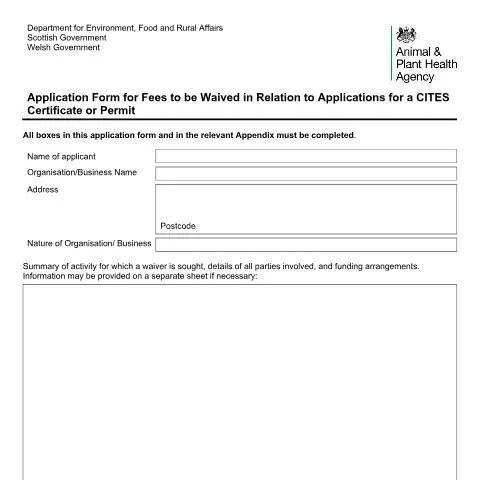
The CITB20 application form demands complete information across all sections, with incomplete applications typically returned without consideration. Each relevant appendix must be completed in full, with clear responses to all assessment questions.
Applications may be submitted electronically to [email protected] or by post to the Animal and Plant Health Agency's Centre for International Trade in Bristol. Electronic submission often provides faster processing and easier tracking of application status.
Processing Timelines and Coordination
Waiver applications require processing time before any associated CITES permit applications can be finalised. Applicants should factor this additional timeline into project planning, particularly for time-sensitive conservation activities or research with specific seasonal requirements.
Complex applications involving multiple specimens, international coordination, or novel conservation approaches may require extended assessment periods. Early submission, well in advance of project commencement, prevents delays that could compromise conservation outcomes.
Decision Communication and Next Steps
Successful waiver applications receive formal confirmation that enables fee-free processing of associated CITES permit applications. This confirmation typically includes specific conditions or limitations that must be observed throughout the project duration.
Unsuccessful applications receive detailed explanations of deficiencies, often with guidance on addressing concerns for potential resubmission. Common issues include insufficient evidence of conservation benefits, unclear legal provenance of specimens, or inadequate demonstration of non-commercial objectives.
Compliance Monitoring and Long-term Obligations
Fee waiver approval creates ongoing obligations for recipients, extending beyond the initial permit issuance through project completion and beyond.
Reporting Requirements
Waiver recipients typically face enhanced reporting requirements compared to standard permit holders. These may include progress reports on conservation outcomes, updates on project developments, and final reports documenting achieved results against stated objectives.
Research projects often require publication of results in peer-reviewed journals or presentation at relevant scientific conferences. Educational programmes may need to document student outcomes or training effectiveness. Breeding programmes must maintain detailed records of breeding success and genetic management.
Audit and Compliance Verification
APHA reserves the right to verify that waiver conditions continue to be met throughout project duration. This may involve site visits, documentation reviews, or requests for additional information about project developments.
Changes to project scope, objectives, or commercial arrangements must be reported promptly, as these may affect waiver eligibility. Significant departures from approved activities could result in waiver withdrawal and retrospective fee liability.
The fee waiver system represents a crucial intersection between regulatory necessity and conservation imperative, enabling essential conservation work whilst maintaining the integrity of CITES controls. Success depends on careful preparation, comprehensive documentation, and ongoing commitment to the conservation objectives that justify this financial support.
Documentation Requirements for Different CITES Fee Waiver Categories
The documentation you'll need to provide with your CITES fee waiver application varies significantly depending on which category of exemption you're claiming. Understanding these specific requirements beforehand can prevent delays and unnecessary correspondence with APHA.
For scientific research applications, you'll need to submit detailed documentation proving the legitimate research purpose. This includes a comprehensive research proposal outlining the study's objectives, methodology, and expected outcomes. The proposal must demonstrate clear scientific merit and show how the CITES specimens are essential to the research. You'll also need institutional backing - typically a letter from your university department head, research institute director, or supervising professor confirming the project's academic legitimacy.
Academic institutions should provide evidence of their research status, such as registration with Research England or equivalent bodies. Independent researchers may need additional verification, including peer-reviewed publications or collaboration agreements with recognised institutions. The research timeline must be realistic and align with standard academic project durations.
For educational purposes, the requirements focus on proving genuine educational benefit. Schools, colleges, and universities need to provide detailed lesson plans or curriculum documents showing how the CITES specimens will be integrated into educational activities. Museum education departments should include visitor engagement strategies and learning outcome assessments.
Educational fee waivers often require evidence of the target audience - whether primary school children, university students, or adult learners. The educational institution's registration status with Ofsted, the Office for Students, or relevant educational authorities strengthens the application considerably.
Conservation breeding programmes represent one of the most complex waiver categories. Applicants must demonstrate participation in recognised conservation initiatives, such as European Endangered Species Programmes (EEPs) or similar international breeding schemes. This requires detailed studbook records, genetic management plans, and evidence of collaboration with other accredited institutions.
Zoo licensing documentation becomes crucial here - establishments must hold current licences under the Zoo Licensing Act 1981. Conservation breeding applications should include population management strategies, release protocols where applicable, and detailed husbandry records demonstrating expertise in species management.
For public exhibition in accredited facilities, the focus shifts to visitor education and conservation awareness. Museums, zoos, and botanical gardens need to provide evidence of their accreditation status with bodies like the Association of Independent Museums, British and Irish Association of Zoos and Aquariums, or Botanic Gardens Conservation International.
Exhibition plans should detail how the specimens will be displayed, interpreted for visitors, and integrated into broader conservation messaging. Facilities must demonstrate appropriate storage, display conditions, and security measures for CITES specimens.
Law enforcement training applications require official confirmation from relevant authorities such as APHA itself, Border Force, or police wildlife crime units. Training programmes must be formally structured with clear learning objectives related to CITES enforcement or wildlife crime detection.
Processing Timelines and Managing Application Delays
CITES fee waiver applications don't follow the same processing timelines as standard permit applications, and understanding these extended timeframes is crucial for project planning. Unlike regular CITES permits, which APHA typically processes within 15-20 working days, fee waiver applications can take significantly longer due to the additional verification steps required.
Initial assessment typically takes 3-4 weeks after submission. During this phase, APHA officers review your application completeness, verify supporting documentation, and may conduct preliminary eligibility checks. Applications with missing or unclear documentation will receive requests for additional information during this period, effectively resetting the processing clock.
The detailed review phase can extend 4-8 weeks, particularly for complex applications involving conservation breeding or scientific research. APHA may consult with external specialists, verify institutional credentials, or seek additional clarification about project details. Applications involving internationally coordinated programmes often require longer processing times due to cross-border verification requirements.
For time-sensitive applications, such as those linked to academic term dates or breeding seasons, submit your waiver request at least 12-16 weeks before you need the actual CITES permit. This buffer accounts for potential delays in both waiver approval and subsequent permit processing.
If your application faces delays, maintain regular contact with APHA's CITES team. The agency typically provides status updates every 4-6 weeks for complex applications, but proactive communication can help identify and resolve bottlenecks more quickly. When contacting APHA, reference your application number and provide specific questions rather than general status enquiries.
Seasonal variations significantly impact processing times. Applications submitted during summer months (June-August) often face longer delays due to staff leave patterns. Similarly, the period immediately following major international CITES meetings can slow domestic processing as policy updates are implemented.
Budget-related delays can occur near the end of the financial year (March) when APHA reviews fee waiver allocations against available resources. Applications submitted in February or March may face additional scrutiny or delays as the agency manages its waiver budget for the upcoming financial year.
To minimise delays, consider submitting applications in early autumn (September-October) when staffing levels are typically stable and the new financial year's processing capacity is available. Avoid submission immediately before major holidays or during known peak periods for standard CITES applications.
For ongoing projects requiring multiple permits over several years, discuss framework arrangements with APHA. Some institutions establish ongoing relationships that streamline future waiver applications, though each permit still requires individual assessment.
Appeals Process and Resolving Waiver Rejections
When APHA rejects your CITES fee waiver application, you have several options for challenging the decision or addressing the underlying issues. Understanding the appeals framework and alternative approaches can often salvage projects that initially fail to qualify for fee relief.
APHA's initial rejection letter will specify the grounds for refusal - whether based on eligibility criteria, insufficient documentation, or policy considerations. These rejection reasons provide your roadmap for either appealing the decision or resubmitting with additional evidence. Common rejection grounds include failure to demonstrate genuine non-commercial purpose, inadequate institutional credentials, or insufficient detail about project methodology.
The formal appeals process begins with a written request for reconsideration submitted within 28 days of receiving the rejection notice. Your appeal should directly address each rejection ground with additional evidence or clarification. Simply restating your original arguments without new supporting material rarely succeeds.
Successful appeals often include additional documentation that wasn't available during the initial application. This might be updated research proposals, additional institutional endorsements, or clarification of project timelines. For research applications, peer review comments or preliminary results from pilot studies can strengthen appeal cases.
If your appeal focuses on procedural issues, such as claims that APHA misinterpreted your application or failed to consider relevant evidence, provide specific references to application sections and supporting documents. Procedural appeals require demonstrating that proper consideration would likely have resulted in approval.
The appeals review typically takes 6-8 weeks and involves senior APHA officers not involved in the original decision. Complex cases may require consultation with external advisers or policy specialists. You'll receive a detailed written response explaining the appeal outcome and reasoning.
If your formal appeal fails, consider resubmission with substantial modifications. This approach works best when rejection was based on correctable deficiencies rather than fundamental eligibility issues. Significant changes to project scope, methodology, or institutional partnerships can transform an unsuccessful application into an approvable one.
For applications rejected on policy grounds rather than technical deficiencies, engage with APHA's policy team to understand current interpretation of fee waiver criteria. Policy positions can evolve, particularly following international CITES meetings or domestic policy reviews.
Alternative funding arrangements may resolve fee waiver rejections without requiring appeals. Some institutions negotiate payment deferrals, staged payment plans, or cost-sharing arrangements with partner organisations. While not technically fee waivers, these approaches can make permit costs manageable for legitimate projects.
For recurring projects, consider whether programme modifications might improve future waiver eligibility. Enhanced educational components, additional conservation outcomes, or expanded research partnerships can strengthen subsequent applications even if current projects proceed with full fee payment.
In exceptional circumstances involving significant public benefit or urgent conservation needs, direct ministerial representations may be appropriate. These cases typically involve high-profile conservation emergencies or nationally significant research projects where standard waiver criteria don't adequately address the public interest considerations.
Document all communications during the appeals process carefully. APHA's responses often provide valuable guidance for future applications, even when immediate appeals are unsuccessful. This institutional knowledge becomes particularly valuable for organisations making regular CITES applications across multiple projects.