Navigating the LIQ15 (Scot): Your Guide to Court Orders in CVL and MVL Winding Up
The LIQ15 (Scot) document serves a crucial purpose in the realm of company insolvency in Scotland, particularly during a Creditors' Voluntary Liquidation (CVL) or Members' Voluntary Liquidation (MVL). When a court issues an order to stay or sist proceedings regarding winding up, it is essential for stakeholders to understand how to effectively utilize the LIQ15 document. This guide delves into the nuances of the LIQ15 notice, its practical applications, and common pitfalls to avoid.
Understanding the LIQ15 Notice: Core Components Unpacked
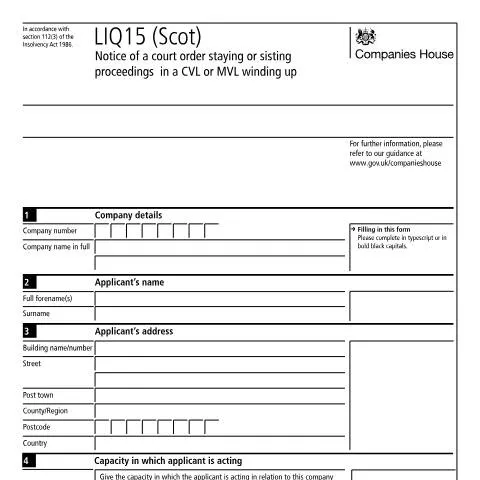
At first glance, the LIQ15 (Scot) may appear to be a straightforward form. However, dissecting its components reveals several critical elements that must be comprehended to ensure compliance with legal requirements. Below are the key sections found within the LIQ15 document:
- Company details: Essential company information, including the full name and registration number, must be accurately stated. This information must match what is recorded on the public register.
- Applicant details: The person submitting the notice must provide their full name and address. Understanding who is applying is vital, as this establishes accountability.
- Date of court order: The exact date when the court order was issued must be recorded to avoid any ambiguity in the timeline of proceedings.
- Attachment of the court order: A copy of the court order itself must be attached to the LIQ15 notice, acting as evidence of the legal decision made by the court.
- Signature and capacity: The applicant must sign the document and indicate in what capacity they are acting (e.g., as a director, liquidator, etc.). This helps clarify the authority behind the submission.
Practical Steps to Submitting the LIQ15 Notice
To leverage the LIQ15 notice effectively, it's essential to follow a series of practical steps. Here’s how to proceed:
- Gather documents: Collect all necessary documents, including the court order and any previously submitted forms related to the winding-up process.
- Fill out the LIQ15 form: Ensure that all sections of the form are completed in typescript or bold black capitals, as stipulated in the instructions.
- Review for accuracy: Double-check that the company name and number match the public register to prevent any administrative delays.
- Attach the court order: Include a copy of the court order along with the LIQ15 notice to substantiate your claim.
- Sign and date: The applicant must sign and date the form before submission to validate the document.
- Submit to Companies House: Return the completed form to any Companies House address, although it is advised to send it to the Edinburgh office for timely processing.
Key Terms and Concepts: Demystifying Legal Jargon
In order to navigate the complexities of the LIQ15 notice and related court orders, it is beneficial to familiarize oneself with some key terms:
- Stay of proceedings: This is a legal term referring to the suspension of legal proceedings, typically ordered by a court to allow for a resolution outside of court.
- Sisting: Similar to a stay, to 'sist' proceedings means to temporarily halt legal action while other matters are resolved.
- Insolvency Act 1986: This Act establishes the framework for insolvency procedures in the UK, including the protocols for liquidations.
Importance of Timeliness: The Role of Deadlines in Liquidation Proceedings
Timeliness is a pivotal factor in the successful submission of the LIQ15 notice. Failure to act promptly can lead to complications that may impact the winding-up process. Key deadlines to keep in mind include:
- Submission Timeline: The LIQ15 must be submitted as soon as possible after the court order is issued.
- Annual Return Deadlines: Ensure that annual returns are up to date to maintain compliance during the liquidation process.
Common Misunderstandings: Clarifying Misinterpretations of the LIQ15 Notice
Even seasoned professionals can misinterpret aspects of the LIQ15 notice. Here are some common misconceptions:
- Not all court orders require a LIQ15 notice: Only specific instances involving CVL or MVL winding-up proceedings necessitate this particular notification.
- Signature Not Mandatory: Some may believe that a signature is optional; however, submitting a signed LIQ15 is essential for validity.
Interconnections with Related Documentation: Understanding the Bigger Picture
The LIQ15 notice does not exist in isolation; it interacts with various other documents and procedures within the liquidation process. Understanding these connections can help streamline the process:
| Document | Purpose |
|---|---|
| Form LIQ1 | Application for a liquidator's appointment. |
| Form LIQ2 | Notice to creditors regarding liquidation. |
| Form LIQ3 | Notice of meetings of creditors. |
Maintaining Transparency: The Public Record and Its Implications
It is essential to recognize that all information provided in the LIQ15 notice enters the public record. This transparency can influence various stakeholders, including creditors and potential investors. Therefore, accuracy and thoroughness in completing the document are paramount.
- Public Access: Any person can access details from Companies House, highlighting the need for meticulous attention to detail.
- Impact on Reputation: The status of a company in liquidation can affect its reputation and future business relationships.
Final Considerations: Engaging Professional Support
While this guide provides a comprehensive overview of the LIQ15 notice and its utilities, seeking expert legal advice can be invaluable. Insolvency practitioners, legal advisors, and financial consultants can provide tailored support and ensure that all proceedings follow the appropriate legal framework.
Understanding the full scope of responsibilities associated with the LIQ15 notice can vastly improve outcomes in CVL and MVL processes. Armed with the right knowledge and resources, stakeholders can navigate the complexities of winding-up procedures more effectively.
Understanding the Implications of a Stay or Sist in Winding Up Proceedings
A court order to stay or sist proceedings in a Company Voluntary Liquidation (CVL) or Members' Voluntary Liquidation (MVL) signifies a pause or temporary halt in the legal processes involved in dissolving a company. It's crucial to understand the implications of such a decision on both the creditors and the debtors of the company. When a court orders a stay, it might mean that ongoing legal actions, including those seeking to recover debts or enforce claims against the company, are frozen. This can provide the company with an opportunity to restructure its affairs, negotiate with creditors, or potentially resolve disputes without the pressure of immediate legal consequences.
In the context of CVL or MVL, a stay can also affect the timeline for the completion of the liquidation process. It could postpone the distribution of assets to creditors, which may lead to frustrations among creditors who are eager to recover their debts. However, while a stay can be seen as a disadvantage to creditors, it may also serve to protect the interests of all parties by allowing for a more orderly and structured approach to resolving outstanding issues. It is not uncommon for companies facing liquidation to experience a range of legal challenges, and a stay can provide essential breathing space to devise proper exit strategies.
Procedural Steps Following a Court Order for Stay or Sist
Once a court issues an order to stay or sist proceedings, it's essential to follow specific procedural steps to ensure compliance with the order and to outline the next steps for the stakeholders involved. The liquidator must notify all relevant parties about the court's decision promptly. This notification obligation includes informing creditors, the Registrar of Companies, and any other interested parties, ensuring transparency and maintaining trust in the winding-up process.
Moreover, the liquidator must carefully assess the reasons behind the court's order. Understanding whether the stay is due to a pending appeal or another legal matter can help gauge the expected duration of the stay and its potential impact on the liquidation process. In some cases, stakeholders may have the opportunity to apply for a variation of the stay order if there’s a belief that continuing with the proceedings is in the best interest of all parties. Legal advice should be sought at this stage to determine the most appropriate course of action.
Additionally, it's important to keep thorough records of all communications and actions taken in relation to the stay. This documentation can be vital if disputes arise later, providing a clear account of how the situation has been handled and demonstrating adherence to legal obligations.
Potential Challenges and Considerations During a Stay or Sist
While a stay can provide temporary relief, it also brings with it a host of challenges and considerations that must be navigated carefully. One significant challenge can be managing creditor expectations. Creditors may express frustration over the delay in recovering their debts, and maintaining open lines of communication can be crucial in mitigating discontent. It's advisable for the liquidator to hold meetings with creditors to update them on the status of the liquidation process and address any concerns that may arise.
Another consideration is the potential for the company to build up additional liabilities during the stay period. If the liquidation process is effectively paused, ongoing costs such as employee salaries, rent, and other operational expenses may continue to accumulate, complicating the financial picture further. Stakeholders need to assess whether it is advisable to maintain any operations during the stay or if significant costs can be avoided.
Furthermore, there may be a finite window for the company to resolve its affairs satisfactorily within the stay’s timeframe. If issues remain unresolved, there's a risk that the stay could be lifted, resulting in a resumption of proceedings and further complications for the company. Thus, strategic planning and timely action are paramount during this period to ensure that the company emerges from the stay with a clear path forward.