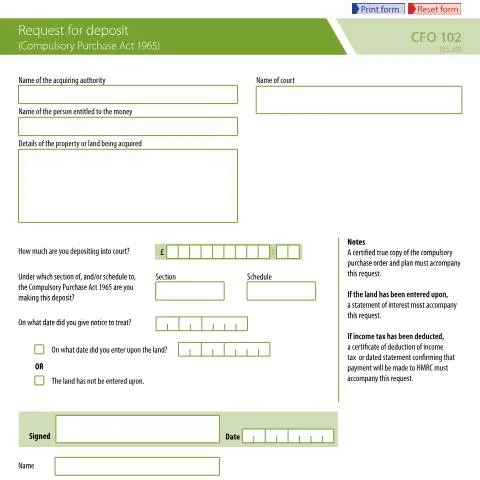
Understanding the Role of the Court Funds Request for Deposit
The Request for Deposit form is a critical component of the compulsory purchase process, governed by the Compulsory Purchase Act 1965. It serves to formally deposit funds into the court's account when property or land is being acquired compulsorily. Understanding its importance can save time and mitigate potential legal complications.
Why is this Form Essential for Property Acquisition?
In scenarios where an authority must acquire land for public benefit, such as infrastructure projects, the Request for Deposit form is vital for ensuring that compensation is provided to property owners. By depositing funds, the acquiring authority demonstrates its commitment to compensating the property owner fairly and legally.
Key Participants in the Process
- Acquiring Authority: The governmental or public body responsible for the compulsory purchase.
- Property Owner: The individual or entity from whom the land is being acquired.
- Court Funds Office: The body managing the funds deposited during compulsory purchases.
Step-by-Step Completion of the Request for Deposit
Completing the Request for Deposit form requires careful attention to detail. Here’s a breakdown of the essential sections that must be filled out accurately:
- Name of Court: Indicate the court where the request is submitted.
- Acquiring Authority: Provide the name of the authority making the compulsory purchase.
- Name of the Entitled Person: Specify the property owner's name as per the land registry.
- Details of the Property: Include the exact property or land description, as this will be crucial for court records.
- Deposit Amount: Clearly state how much is being deposited into court.
- Dates: Mention relevant dates, including when notice to treat was given and when entry upon land occurred.
- Documentation: Ensure certified copies of necessary documents, such as the compulsory purchase order and any statements of interest, accompany the form.
The Importance of Accompanying Documentation
When submitting the Request for Deposit form, it is crucial to include specific documents that verify the legitimacy of the claim and the deposit amount. Missing or incorrect documentation can result in delays or rejection of the application. Here are the key documents that should accompany your submission:
- A certified true copy of the compulsory purchase order and associated plans.
- A statement of interest if the land has been entered upon.
- If income tax has been deducted, a certificate of deduction or a confirmation of payment to HMRC must be included.
Each of these documents plays a pivotal role in validating the claim and ensuring the court has all necessary information to proceed with the deposit.
Navigating Potential Complexities in Submission
Understanding the nuances of the form and its requirements can prevent common pitfalls. For instance, if the property owner has not been notified properly or if the amount does not match the compensation determined by the acquiring authority, there may be significant ramifications.
Common Issues and Their Resolutions
- Incomplete Forms: Always double-check all sections are filled out, as incomplete submissions can lead to delays.
- Incorrect Amounts: Ensure the deposit amount corresponds with the agreed compensation, as discrepancies could result in legal challenges.
- Missing Documentation: Lack of required documents could lead to rejection. A check-list can aid in ensuring everything is included before submission.
What Happens After Submission?
Once the Request for Deposit form has been submitted, the process does not end there. The Court Funds Office will review the application and the accompanying documentation. Here’s a typical sequence of events that follow:
- Review and Verification: The court will review all submissions to ensure compliance with legal requirements.
- Payment Processing: Upon approval, the deposit will be processed and officially recorded in the court’s accounts.
- Notification: Both the acquiring authority and the property owner will be notified of the deposit and its implications.
Dealing with Rejections: Your Next Steps
In the unfortunate event that your Request for Deposit is rejected, it is essential to understand the appeals process. Rejections may stem from various reasons, such as incomplete documentation or failure to meet statutory requirements. Here’s how to approach a rejection:
- Review the Rejection Notice: Carefully examine the reasons provided for the rejection.
- Gather Additional Documentation: If the rejection was due to missing documents, obtain these as quickly as possible.
- Consult Legal Advice: If the rejection appears unjust, seeking legal advice may help in understanding your rights and next steps.
Understanding the Legal Framework: Compulsory Purchase Act 1965
The Request for Deposit form is anchored in the Compulsory Purchase Act 1965, which outlines the rights and responsibilities of all parties involved in the compulsory purchase process. This act provides the framework that governs how land can be acquired for public benefit and ensures that property owners are fairly compensated.
Key Provisions of the Compulsory Purchase Act 1965
| Section | Description |
|---|---|
| Section 1 | Provides the authority for public bodies to acquire land. |
| Section 5 | Outlines the procedure for making a request for deposit. |
| Section 19 | Details compensation rights for property owners. |
Preparing for Future Compulsory Purchase Applications
Understanding the intricacies of the Request for Deposit form not only aids in the current application but also equips property owners for future interactions with acquiring authorities. Here are proactive steps to take:
- Stay Informed: Be proactive in understanding local authority plans and potential compulsory purchases that may affect your property.
- Document Everything: Keep detailed records of all communications and documents related to your property and any compulsory purchase proceedings.
- Engage with Professionals: Consider hiring legal or property experts to assist during compulsory purchase processes to ensure compliance and fair treatment.
Understanding Compulsory Purchase: The Legal Framework
In the UK, compulsory purchase orders (CPOs) grant specific authorities the power to acquire land or properties without the consent of the owner, typically for public projects. This process is governed by the Compensation Code, which aims to ensure that landowners receive fair compensation for their loss. The legal basis for CPOs can be found in several acts, including the Land Compensation Act 1961 and the Planning Act 2008. It's crucial for property owners to understand their rights under these laws.
The CPO process begins when an authority issues a notice, which must detail the purpose of the acquisition, the land affected, and the expected timeline. Once a CPO is confirmed, a deposit may be paid to the affected landowners to cover initial losses and related expenses while negotiations for full compensation continue. This deposit is often referred to as a compulsory purchase payment.
Landowners should be aware that they have the right to challenge the CPO in court if they believe it is not justified or if proper procedures have not been followed. Engaging a legal expert who specialises in property law can provide valuable guidance in these matters, particularly regarding the nuances of appealing a CPO decision.
Steps to Request a Deposit Under a Compulsory Purchase Order
The process of requesting a deposit following a compulsory purchase order is both detailed and time-sensitive. Here’s a breakdown of the necessary steps:
- Notification of Compulsory Purchase: Once a CPO is issued, the affected landowner will receive formal communication from the acquiring authority. This document outlines the purpose of the CPO and provides essential details about the affected property.
- Understanding the Deposit Process: The initial deposit amount is typically calculated based on the estimated value of the land and associated damages. It is important for landowners to understand that this deposit is not the final compensation but rather a payment to assist during the acquisition process.
- Submission of Request: To formally request a deposit, the landowner must submit the Section 10 Notice to the acquiring authority. This notice typically requires documentation, such as ownership proof, property value estimates, and details of any related losses incurred due to the CPO.
- Negotiation of Terms: Once the request is submitted, the acquiring authority will review the claim. This may involve negotiations, where the authority may propose an alternative deposit amount based on their assessments.
- Payment of Deposit: After agreement on the deposit amount, the acquiring authority will process the payment. It’s advisable for landowners to keep accurate records of all correspondence and payments received to avoid future disputes.
It's essential to note that each case may vary depending on the specifics of the CPO and the policies of the relevant authority. Therefore, consulting with professionals who are familiar with compulsory purchase law is often beneficial to ensure a smooth process.
Tax Implications of Receiving a Compulsory Purchase Deposit
Receiving a deposit for compulsory purchase can have significant tax implications for property owners. Understanding these implications is vital to ensuring compliance with HM Revenue and Customs (HMRC) regulations and to avoid any potential unforeseen liabilities.
Primarily, the amount received as a deposit may be considered as part of the total compensation for the loss of the property or land. As such, it may influence the calculation of any capital gains tax (CGT) that may be applicable when the final compensation is received and the property officially transferred to the purchasing authority. Capital gains tax is charged on the profit when you sell an asset that has increased in value, but it's essential to note that the taxpayer is only charged on profits over the annual exempt amount.
Landowners must also consider how the timing of the payment affects their tax year. In the UK, the tax year runs from 6 April to the following 5 April. Receiving a deposit during one tax year could impact the amount of CGT owed if the final compensation payment is made in a different tax year. Thus, meticulous record-keeping becomes vital to ensure that all income is reported correctly and that any potential tax liabilities are calculated accurately.
Additionally, landowners should be aware of the potential for tax relief on the costs incurred as a result of the compulsory purchase. This may include legal fees or other expenses directly tied to the acquisition process. Keeping receipts and thorough documentation will assist in claiming any allowable relief properly and ensuring compliance with HMRC guidelines.
Consulting a tax professional or financial advisor with experience in property transactions can help navigate these complexities and provide guidance on how to best manage the tax implications that arise from compulsory purchase transactions.