Navigating the Application to Transfer Incorrectly Classified Goods or Services
In the landscape of intellectual property in the UK, the Application to Transfer Incorrectly Classified Goods or Services plays a crucial role for trademark owners seeking to rectify classifications before registration. This application allows for the adjustment of goods and services listed under a trademark to ensure they accurately reflect the intended use. Misclassification can lead to significant ramifications, including legal disputes and loss of rights. Understanding this process thoroughly is essential for any trademark holder.
Understanding the Context: Why Classification Matters
The UK’s classification system for trademarks, based on the Nice Classification, categorizes goods and services into 45 different classes. Accurate classification is not merely a bureaucratic formality; it affects the scope of protection and enforceability of a trademark. A misclassified trademark could potentially limit its legal protections, making it vulnerable to infringement. Therefore, submitting the Application to Transfer Incorrectly Classified Goods or Services is a pivotal step that trademark owners must undertake when they discover discrepancies in their filings.
Identifying Incorrect Classifications
To initiate the application process, trademark owners must first identify the specific goods or services that are incorrectly classified. This stage involves a thorough review of the trademark registration, comparing it against the intended classification as defined by the Nice Classification. The following scenarios often necessitate such applications:
- Expansion of Product Range: If a business expands its offerings beyond the initially classified goods or services, an adjustment is warranted.
- Misinformation: Errors during the initial application process may lead to incorrect classifications.
- Change of Business Focus: A shift in business strategy, such as entering into new markets, may require reclassification.
For instance, a company that initially registered its trademark under Class 25 (clothing) may find that it needs to include additional categories such as Class 35 (advertising and business management services) due to a broadening of services.
Formulating Your Application: Key Sections Explained
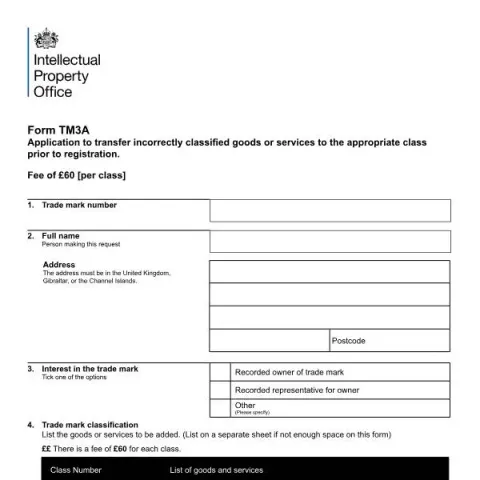
Completing the application form accurately is imperative for a smooth processing experience. The Form TM3A requires specific details, which are critical for both administrative processing and legal clarity.
Essential Information to Include
- Trade Mark Number: This is your unique identifier that links your application to your trademark.
- Your Personal Details: Name and address must be provided; note that the address must be within the UK, Gibraltar, or the Channel Islands.
- Interest in the Trademark: Indicate your relationship to the trademark—whether you are the owner, a representative, or another interested party.
- Classification Details: Clearly list the goods or services that need to be classified correctly. If space is limited on the form, attach a separate sheet.
- Payment Information: Include the relevant fee of £60 per class being requested, along with your preferred payment method.
Payment Options
When submitting your application, you have several payment methods at your disposal:
- Online Payment: Utilise a debit or credit card via a secure online portal.
- Cheque: Payable to the Intellectual Property Office, sent along with your application.
- Bank Transfer: Directly wire your payment using provided bank details.
- IPO Deposit Account: If you have an account, payments can be deducted automatically.
Deadlines: When to Submit Your Application
The timing of your application is critical. There is no strict deadline for submitting the TM3A, but the sooner you rectify an incorrect classification, the better. Delaying an application can expose you to potential infringement risks. Once your application is submitted, the Intellectual Property Office (IPO) will process it, generally within 20 weeks. However, this can vary based on workload and specific circumstances surrounding your application.
Post-Submission Steps
After submitting your form, you can expect several outcomes:
- Application Accepted: If the examiner approves your request, the changes will be reflected in the official register.
- Further Queries: The IPO may contact you for additional information or clarification, so ensure that your contact details are accurate.
- Application Refused: If your request is denied, you will receive a notification along with reasons for the refusal, allowing you the opportunity to appeal or rectify the situation.
Administrative Processing: What Happens Behind the Scenes
Once the application is received by the IPO, it enters a systematic review process. This involves:
- Initial Scrutiny: The IPO will verify that all required fields are duly completed and that the fee has been paid. Incomplete applications may be returned, causing delays.
- Classification Review: The examiner will assess whether the classification of goods and services aligns with the criteria set forth by trademark law.
- Decision Communication: Following the review, the IPO will inform you of their decision via email or post, providing clear communication throughout.
Tracking Your Application
To stay informed about the status of your application, you can monitor progress through direct communication with the IPO. If you have not received updates within the expected timeline, feel free to reach out with your reference number handy for a more efficient inquiry.
Special Circumstances: Managing Unique Cases
While the standard application process is straightforward, certain scenarios may complicate matters. Below are some situations that may require special consideration:
International Applicants
If you are applying from outside the UK, ensure that you are familiar with the specific requirements set forth by the IPO. The process remains largely the same, but additional documentation may be required to verify your identity and the legitimacy of your trademark. Consider seeking local legal counsel to navigate this aspect effectively.
Minor Applicants
Minors wishing to apply for trademark changes should be aware that the process must be handled by a legal guardian. The guardian's information must be included on the application, and the guardian will assume responsibility for any legal implications arising from the trademark registration.
Urgent Situations
If you believe your incorrectly classified goods or services are at risk of infringement, it may be advantageous to mark your application as urgent. While this does not guarantee expedited processing, it alerts the IPO to the necessity of a quicker resolution.
Broader Implications of Your Application
Your Application to Transfer Incorrectly Classified Goods or Services is not an isolated action; it forms part of a broader intellectual property strategy that includes registration, enforcement, and potential litigation. Understanding how this form fits within that ecosystem can provide clarity and context.
Linking with Other IP Processes
This application often intersects with other intellectual property rights processes, such as:
- Trademark Registration: Ensuring your trademark is correctly classified is fundamental to its registration.
- Enforcement Actions: A correctly classified trademark strengthens your position in any legal disputes.
- International Filings: If you plan to expand your trademark protection overseas, proper classification will be essential in those jurisdictions as well.
Consultative Support
Should you find yourself needing further assistance, consider engaging with legal practitioners who specialize in intellectual property law. Their expertise can be invaluable in navigating complex situations and ensuring compliance with legislative requirements.
Final Thoughts: Ensuring Your Trademark's Success
Submitting the Application to Transfer Incorrectly Classified Goods or Services is more than just a paperwork exercise; it is a fundamental step in safeguarding your intellectual property. By understanding the process, preparing thoroughly, and adhering to the guidelines laid out by the Intellectual Property Office, you can enhance the security and marketability of your trademark. Remember that this is just one piece of a larger puzzle; continual vigilance in managing your intellectual property will benefit your business greatly.
Understanding the Classification of Goods and Services
Classifying goods and services correctly is essential for businesses that wish to register trademarks or navigate the complexities of intellectual property. In the UK, the classification system is primarily based on the Nice Classification, an international system used to categorize various products and services. This classification can influence everything from registration costs to the protection of your trademark rights.
When registering a trademark with the Intellectual Property Office (IPO), applicants must specify which classes their goods or services fall into. The system consists of 45 classes: 34 for goods and 11 for services. An incorrect classification can lead to a range of issues including potential disputes, limited market reach, or even outright rejection of the trademark application.
Understanding the nuances of classification is crucial, particularly when dealing with overlapping categories or specialized goods that may not fit neatly into the predefined classes. For example, a product that incorporates both technology and art may require careful consideration to determine whether it should be classified under technical goods or as a creative service.
Businesses should also keep in mind that the classification of goods may evolve over time, influenced by market trends and technological advancements. Hence, staying updated with the latest changes from the IPO and ensuring that your classification remains relevant is a best practice for maintaining your brand's integrity.
Fill in your form directly online
No printing: type your details into the boxes of the official form, tick, then download the PDF ready to send.
- 1Type into the form boxes
- 2Tick in one click
- 3Save and download the PDF
Common Challenges and Solutions in Classification
Filing for a trademark can be challenging, particularly when it involves complex classifications. Businesses frequently encounter scenarios where their goods or services do not fit neatly into existing categories. As a result, they may need to consider filing an application to transfer incorrectly classified goods or services. This process can bring about several challenges, including documentation requirements, proving the need for reclassification, and understanding the potential implications on existing trademarks.
One of the primary challenges is the need to provide sufficient evidence to support a reclassification request. The Intellectual Property Office (IPO) may require detailed descriptions and examples of how the product or service functions in its market context. This might entail market research, customer feedback, or expert opinions to strengthen the case for why a particular classification is more appropriate.
Another challenge lies in the possibility of conflicts with existing trademarks. If the reclassification puts you in direct competition with another trademark, you may face legal hurdles. To mitigate this risk, it is advisable to conduct a thorough search through the IPO’s trademark database to identify potential overlaps. Engaging with a legal expert can also help navigate these complexities and offer tailored solutions specific to your situation.
Additionally, businesses should weigh the long-term implications of any decision to transfer classifications. While it may seem expedient in the short term, the repercussions could affect brand identity or lead to increased scrutiny from the IPO in future filings. Thus, comprehensive strategic planning is essential.
Impact of Incorrect Classification on Branding and Market Strategy
Choosing the correct classification for goods and services is not just a legal necessity but also a strategic business decision that can significantly impact branding and market strategy. Incorrect classification can lead to dilution of brand identity, reduced consumer trust, and an inability to enforce trademark rights effectively.
For example, if a business classifies its artisanal food products under a generic category instead of a specific one related to organic or specialty foods, it risks losing the competitive edge that comes with branding. Consumers searching for unique or organic products might overlook these goods entirely, affecting sales and brand visibility.
Moreover, the impact of incorrect classification can extend beyond immediate sales. It can affect partnerships, collaborations, and distribution channels. For instance, retailers and distributors often seek specific classifications to align with their market offerings. Misalignment may hinder opportunities for partnerships that could have been beneficial for growth.
Furthermore, as businesses scale, the consequences of past misclassifications can snowball. Companies looking to expand into new markets or regions may find that their existing trademarks hinder rather than help their efforts due to incorrectly classified goods or services. This can complicate licensing arrangements and franchise opportunities, which are crucial for scaling operations.
Ultimately, it’s essential for businesses to maintain proactive strategies when it comes to classification. Regular audits of existing trademarks and staying informed about changes in classification guidelines from the IPO can help mitigate risks associated with incorrect classifications and support an effective branding strategy in the long term.