Understanding the Official Process for Appealing a First-tier Tribunal (Social Entitlement Chamber) Decision in the UK
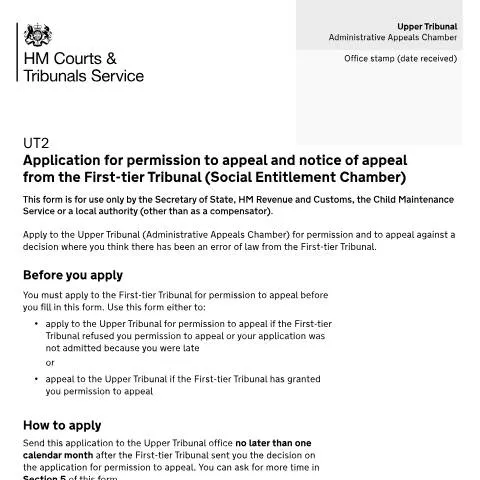
The UK legal system provides a structured process for challenging decisions made by the First-tier Tribunal (Social Entitlement Chamber). This process is crucial for individuals or organisations, such as the Secretary of State, HM Revenue and Customs (HMRC), or local authorities, who believe a tribunal decision involves an error of law. The official form used for this purpose is the Form UT2, which serves both as an application for permission to appeal and as a notice of appeal.
The Purpose and Scope of Form UT2
Form UT2 is a formal document designed exclusively for specific parties involved in social entitlement cases. These include the Secretary of State, HM Revenue and Customs, the Child Maintenance Service, or local authorities (excluding as a compensator). Its primary purpose is to enable these parties to seek permission to appeal a decision made by the First-tier Tribunal, or to proceed with an appeal if permission has already been granted.
This form is not intended for individual claimants or appellants who are seeking to challenge decisions. Instead, it is a procedural tool for government bodies and authorities to correct potential legal errors identified in tribunal decisions.
When and How to Use Form UT2
Timing and Deadlines
Applicants must submit their completed UT2 form within one calendar month of receiving the tribunal’s decision. It is essential to adhere to this deadline to ensure the appeal process remains valid. If there are circumstances that justify a delay, an extension can be requested by providing detailed reasons in Section 4 of the form.
Application Process
- Before applying to the Upper Tribunal, an applicant must first seek permission from the First-tier Tribunal. If permission is refused or the application is late, only then can the applicant proceed with an appeal to the Upper Tribunal using Form UT2.
- The completed form should be sent to the Upper Tribunal’s office within the specified timeframe. The form includes detailed sections to provide information about the appellant, the respondent(s), and the grounds for appeal.
Key Sections of Form UT2
Section 1: Appellant’s Details
This section captures essential information such as the reference number of the original tribunal decision, the date of that decision, and the identity of the appellant, whether it is a government department or local authority. Accurate details here are vital to ensure proper processing of the appeal.
Section 2: Representation Details
If the appellant is represented by a solicitor or legal advisor, their contact details and organisation information are recorded here. Correspondence from the Upper Tribunal will be directed to this representative.
Section 3: Respondent Details
The form also requires information about the respondent(s), typically the party that made the original decision. Multiple respondents can be listed if applicable, with their contact details included.
Section 4: Reasons for Delay
If the application is submitted after the one-month deadline, this section allows the applicant to request an extension by explaining the reasons for the delay. The Upper Tribunal will consider these reasons before deciding whether to accept the late submission.
Section 5: Grounds for Appeal
This is a critical part of the form where the appellant must clearly state the legal error they believe occurred in the tribunal’s decision. The explanation should specify why the decision is considered wrong in law, providing a basis for the Upper Tribunal to review the case.
The Impact of Using Form UT2
Completing and submitting Form UT2 correctly is a vital step in the legal process for challenging tribunal decisions related to social entitlement. It ensures that the case is formally recognized for review by the Upper Tribunal and that the grounds for appeal are properly documented. This process ultimately helps maintain the integrity of decisions affecting social benefits and entitlements, safeguarding the rights of individuals and the responsibilities of public authorities.
Anyone involved in this process should ensure all sections are completed accurately and within the specified deadlines. For detailed guidance, it is advisable to consult official resources or seek legal advice to navigate the complexities of tribunal appeals effectively.