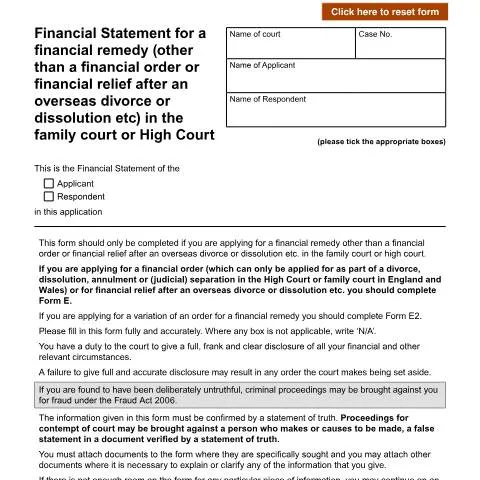
The Strategic Role of Form E1 in Complex Financial Remedy Applications
When standard divorce proceedings cannot address your financial circumstances, Form E1 emerges as the specialised tool for seeking financial remedies outside the conventional framework. Unlike the well-known Form E used in divorce financial orders, Form E1 serves a distinct purpose: it handles financial remedy applications that fall beyond the scope of traditional divorce, dissolution, or separation proceedings in England and Wales.
This financial statement becomes essential when you're pursuing remedies such as applications under the Trusts of Land and Appointment of Trustees Act 1996, property disputes between unmarried cohabitants, or claims involving beneficial interests in property where no matrimonial proceedings exist. The form's comprehensive structure reflects the court's need for complete financial transparency, particularly when determining property rights and financial obligations outside the matrimonial context.
The duty of full and frank disclosure carries significant weight here. Courts rely heavily on the accuracy of information provided, and any deliberate misrepresentation can result in orders being set aside or even criminal proceedings under the Fraud Act 2006. This makes Form E1 not merely an administrative requirement, but a legally binding declaration of your complete financial position.
Navigating the Distinction: When Form E1 Takes Precedence Over Other Financial Forms
Understanding when to use Form E1 rather than its counterparts requires careful consideration of your specific circumstances. The form explicitly excludes applications for financial orders within divorce proceedings and financial relief following overseas divorce or dissolution, which remain the domain of Form E.
| Application Type | Correct Form | Key Characteristics |
|---|---|---|
| Financial order during divorce/dissolution | Form E | Part of matrimonial proceedings |
| Overseas divorce financial relief | Form E | Recognition of foreign orders |
| Variation of existing financial remedy | Form E2 | Modification of current arrangements |
| Property disputes between unmarried partners | Form E1 | No matrimonial proceedings involved |
| Trust-related financial claims | Form E1 | Beneficial interest applications |
The distinction becomes particularly important when dealing with cohabitation disputes. Unmarried couples who separate and have property or financial entanglements cannot access the divorce court's financial remedy provisions. Instead, they must pursue claims through different legal avenues, often involving constructive trusts, resulting trusts, or proprietary estoppel claims, all of which require Form E1 for financial disclosure.
Decoding the Employment and Income Disclosure Requirements
Section 2 of Form E1 demands meticulous attention to employment details, recognising that income patterns in non-matrimonial financial disputes often present complex scenarios. The form accommodates various employment statuses: employed, self-employed, unemployed, or pensioner, with each category triggering different disclosure obligations.
For employed individuals, the documentation requirements are comprehensive. You must provide your P60 from the last financial year, typically received shortly after 5 April, alongside your three most recent payslips. If you've received a P11D form detailing benefits in kind, this becomes mandatory supporting evidence. The form seeks both historical data and forward-looking estimates, requiring you to project your net income for the coming twelve months.
The distinction between gross and net income receives particular emphasis. While gross income appears on your P60, the form requires detailed breakdown of deductions including income tax and National Insurance contributions. This granular approach enables courts to understand your actual disposable income when making financial remedy determinations.
Self-employed applicants face additional complexities. The form requires business accounts, profit figures, and detailed explanations of how personal and business finances interrelate. This becomes especially relevant in property disputes where one party claims their business activities contributed to property acquisition or improvement.
Bonus Payments and Irregular Income Patterns
The form specifically addresses bonus payments and occasional income, recognising that many financial disputes involve parties whose income varies significantly. You must detail the basis upon which bonuses are calculated and paid, whether performance-related, seasonal, or discretionary. This information proves crucial when courts assess ongoing financial capacity for property transfers or maintenance obligations.
Benefits in kind require separate disclosure, covering company cars, accommodation allowances, travel expenses, and other perks. The annual value of these benefits must be quantified, often requiring reference to HMRC benefit-in-kind valuations or P11D figures.
Personal Circumstances and Dependency Obligations
Form E1's personal information section extends beyond basic demographics to capture the complex web of dependencies and obligations that influence financial remedy decisions. The form recognises that financial capacity cannot be assessed in isolation from personal circumstances and ongoing responsibilities.
The residence details require specification of occupancy terms, whether as owner-occupier, tenant, or under other arrangements. This information becomes particularly significant in property disputes where occupation rights and beneficial interests intertwine. Courts need to understand not just who lives where, but under what legal basis and with what ongoing financial obligations.
Children's arrangements receive detailed treatment, distinguishing between those living with you and those residing elsewhere. For children not in your care, you must specify any maintenance payments being made, creating a complete picture of your financial commitments. This extends to other dependents, including elderly relatives or disabled family members requiring ongoing support.
Health Considerations and Educational Responsibilities
The form acknowledges that health issues can significantly impact both financial capacity and needs. You must disclose health conditions affecting yourself or children if these should influence the court's decision. This might include ongoing medical expenses, reduced earning capacity due to illness, or special needs requiring additional financial provision.
Educational arrangements demand both current details and future planning. Courts recognise that educational commitments, particularly private schooling or university expenses, represent significant ongoing financial obligations that must factor into any financial remedy determination.
Child Support Integration and Maintenance Calculations
Section 1.11 addresses the intersection between Child Support Agency calculations and court-ordered maintenance, an area where many applicants encounter confusion. The form requires details of any existing Child Support maintenance calculations, court orders, or private agreements affecting children of the family.
Where no formal arrangement exists, you must estimate the non-resident parent's liability under the Child Support Act 1991. This estimation process requires understanding of the Child Support Service's calculation methodology, which considers the paying parent's gross income, number of qualifying children, and overnight contact arrangements.
The interaction between child support and financial remedies becomes particularly complex in property disputes. While the Child Support Service handles ongoing maintenance for children, courts retain jurisdiction over property transfers, lump sum payments, and other capital provisions that might benefit children indirectly.
Prior Proceedings and Legal History Documentation
Form E1 requires comprehensive disclosure of any previous court proceedings between the parties, whether concerning money, property, children, or other matters. This historical context proves essential for courts understanding the relationship dynamics and any previous judicial determinations affecting the current application.
The requirement extends beyond family court proceedings to include any civil litigation, property disputes, or business-related legal actions. Case numbers, court details, and proceeding types must be specified, enabling judges to access previous court files and understand the broader legal context.
This section often reveals patterns of behaviour, previous settlement attempts, or judicial findings that influence the current application's prospects. For instance, if previous proceedings established one party's beneficial interest in property, this creates important precedents for the current financial remedy claim.
Supporting Documentation Strategy and Evidence Assembly
The effectiveness of your Form E1 application depends heavily on the quality and comprehensiveness of supporting documentation. Beyond the mandatory attachments specified for each section, you may include additional documents necessary to explain or clarify your financial position.
For property-related disputes, essential documentation typically includes title deeds, mortgage statements, property valuations, and records of financial contributions to purchase or improvement. Bank statements spanning the relevant period help establish the source of funds and payment patterns that might support beneficial interest claims.
Employment documentation extends beyond payslips and P60s to include employment contracts, particularly where these contain relevant terms about bonuses, benefits, or future income security. Self-employed applicants need comprehensive business records, including profit and loss accounts, balance sheets, and evidence of business asset values.
Organising Financial Records by Timeline
Courts appreciate chronologically organised evidence that tells a clear story of financial developments. Consider organising documents by key periods: pre-relationship finances, joint financial arrangements during cohabitation, and post-separation positions. This approach helps demonstrate how financial positions evolved and supports claims about contributions or entitlements.
Digital records require careful consideration. While electronic bank statements and online documents are acceptable, ensure they display all necessary details including account numbers, transaction dates, and clear identification of account holders. Screenshots from mobile banking apps often lack sufficient detail for court purposes.
Procedural Compliance and Statement of Truth Requirements
Form E1 must be verified by a statement of truth, making you personally liable for the accuracy of all information provided. This goes beyond mere administrative compliance to create potential liability for contempt of court proceedings if false statements are included.
The statement of truth requirement means that even inadvertent errors can have serious consequences if they materially affect the court's understanding of your financial position. Before signing, carefully review every figure, date, and factual assertion, considering whether you can verify its accuracy from available records.
Where information is estimated or approximate, this should be clearly indicated rather than presenting estimates as precise figures. Courts understand that some financial information, particularly future income projections or asset valuations, involves reasonable estimation, but they expect transparency about the basis for such estimates.
The filing process through HM Courts & Tribunals Service requires attention to court-specific requirements and deadlines. Different courts may have particular procedures for financial remedy applications, and ensuring compliance with local practice directions can significantly impact your application's progress.
Form E1 represents more than administrative compliance; it's your opportunity to present a compelling, accurate, and comprehensive picture of your financial circumstances to support your claim for financial remedy. The investment in thorough preparation and honest disclosure typically proves worthwhile when courts make their determinations about property rights and financial obligations in these complex disputes.
Complex Financial Arrangements and Form E1 Requirements
Form E1 becomes particularly intricate when dealing with sophisticated financial structures common in high-net-worth cases. Trusts, offshore holdings, and complex business arrangements require detailed disclosure that goes beyond standard employment income and residential property.
Trust Interests and Beneficial Ownership
When you hold interests in trusts, whether as settlor, trustee, or beneficiary, Form E1 demands comprehensive disclosure. You must detail the nature of your interest, the trust's assets, and any distributions received or expected. This includes discretionary trusts where future benefits remain uncertain, as well as bare trusts where your interest is clearly defined.
For offshore trusts, particularly those established in jurisdictions like the Channel Islands or Gibraltar, you'll need to provide trust deeds, annual accounts, and correspondence with trustees. The court expects transparency regarding your influence over trust decisions, even when you're not formally a trustee. If you've made loans to trusts or guaranteed trust borrowings, these arrangements must be fully disclosed with supporting documentation.
Business Valuations and Professional Interests
Professional practices and business interests present unique valuation challenges in Form E1. For partnerships, whether in legal, medical, or accountancy fields, you must distinguish between capital value and ongoing income streams. The form requires details of profit-sharing arrangements, restrictive covenants, and any agreements affecting your ability to realise your interest.
Limited company shareholdings need careful analysis, particularly for director-shareholders where salary and dividend policies may be flexible. You must disclose any shareholders' agreements, pre-emption rights, or restrictions on share transfers. Recent management accounts, profit and loss statements, and balance sheets are essential, along with any pending transactions or restructuring plans that might affect valuations.
International Assets and Tax Implications
Cross-border elements significantly complicate Form E1 completion. UK residents with overseas assets must convert all foreign holdings to sterling using appropriate exchange rates, typically those published by HMRC for the relevant dates. Property in jurisdictions like France, Spain, or the United States requires local valuations translated and certified for UK court use.
Tax implications of asset transfers become crucial when considering financial remedies. Capital gains tax consequences, inheritance tax planning, and the impact of non-domiciled status all influence how assets are presented in Form E1. You must disclose any tax advice received regarding potential financial settlements, as this affects the net value available for distribution.
Ongoing Financial Obligations and Future Planning
Form E1 extends beyond static asset disclosure to encompass dynamic financial commitments that will influence your post-divorce financial position. Understanding how to present these obligations accurately ensures the court has a complete picture of your financial landscape.
Maintenance and Support Commitments
Existing maintenance obligations from previous relationships significantly impact your available income for new financial arrangements. Form E1 requires detailed disclosure of any court orders, voluntary arrangements, or Child Maintenance Service assessments affecting your finances. This includes maintenance for former spouses, children from previous relationships, and any step-children for whom you've assumed financial responsibility.
When calculating your ability to meet future maintenance obligations, you must consider the interaction between existing commitments and proposed arrangements. The court will assess whether your total maintenance burden remains sustainable, particularly where your income fluctuates or you're approaching retirement age. Any agreements to vary existing maintenance must be disclosed, along with the circumstances prompting such changes.
Educational and Healthcare Provisions
School fees and healthcare costs represent substantial ongoing commitments that Form E1 must address comprehensively. For children attending independent schools, you need to provide current fee schedules, projected increases, and any additional costs like uniforms, trips, or extra-curricular activities. The court considers not just current expenses but the sustainability of such commitments through university and beyond.
Healthcare provisions, including private medical insurance, dental treatment, and specialist care needs, require careful documentation. Where children have particular medical conditions or learning difficulties requiring ongoing support, these costs significantly influence financial remedy decisions. You must provide medical reports and cost projections where appropriate, particularly for long-term care needs that may extend into adulthood.
Pension Planning and Retirement Provision
Pension arrangements in Form E1 encompass more than current fund values. You must consider contribution patterns, employer matching schemes, and the impact of any proposed pension sharing orders on your retirement planning. For defined benefit schemes, the cash equivalent transfer value may not reflect the true value of guaranteed benefits, requiring actuarial analysis.
State pension entitlement, including National Insurance contribution records and projected payments, forms part of the overall pension picture. Where you have gaps in your contribution history or periods of overseas residence affecting entitlement, these factors influence the court's assessment of your retirement provision needs. Any pension protection schemes or compensation arrangements following employer insolvency must also be disclosed.
Documentation Standards and Court Expectations
The family courts maintain exacting standards for Form E1 documentation, reflecting the document's central role in financial remedy proceedings. Understanding these expectations prevents delays and ensures your case progresses efficiently through the court system.
Verification and Authentication Requirements
Every figure in Form E1 requires supporting documentation that meets court standards for authenticity and relevance. Bank statements must be consecutive and complete, with any missing pages explained. Investment statements should be the most recent available, with interim valuations for volatile holdings where significant movements have occurred since the last formal statement.
Property valuations require particular attention to methodology and currency. Estate agents' opinions may suffice for initial disclosure, but contested cases often need formal RICS valuations. For commercial property or unusual residential properties, specialist valuers with relevant expertise become essential. All valuations must be dated appropriately and reflect current market conditions rather than historical assessments.
Digital Records and Electronic Disclosure
Modern financial management increasingly relies on digital platforms, creating new challenges for Form E1 compliance. Online-only banks and investment platforms may not provide traditional paper statements, requiring you to generate appropriate records for court submission. Screenshots alone rarely meet court standards; formal account summaries or certified downloads are typically necessary.
Cryptocurrency holdings present particular disclosure challenges, given their volatility and the complexity of digital wallet management. You must provide wallet addresses, transaction histories, and current valuations from recognised exchanges. Where cryptocurrency has been transferred or converted, complete transaction records become essential to demonstrate the current position accurately.
Professional Assistance and Representation Standards
While Form E1 can be completed without legal representation, the complexity of most cases makes professional assistance highly advisable. Solicitors specialising in family finance bring expertise in asset valuation, tax implications, and court expectations that significantly improve disclosure quality. They can identify potential issues before they become problematic and ensure all relevant information is presented clearly.
Accountants play a crucial role where business interests or complex income arrangements require analysis. Their involvement in preparing supporting schedules and explanatory notes often proves invaluable, particularly where self-employment income fluctuates or business structures are complex. The court expects professional input where circumstances warrant it, and attempting to manage complex disclosure alone may prove counterproductive.
When engaging professionals, ensure they understand the specific requirements of family court proceedings, which differ significantly from commercial or tax-focused work. The duty of full and frank disclosure overrides normal client confidentiality considerations in some respects, and your advisers must understand these obligations when preparing your case.