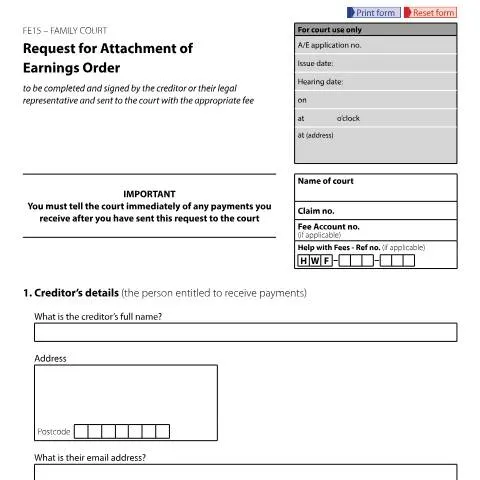
Navigating the Request for Attachment of Earnings Order: Understanding Form FE15
When a debtor fails to meet their financial obligations, seeking enforcement through the legal system may become necessary. Form FE15, the Request for Attachment of Earnings Order, offered by HM Courts & Tribunals Service, is a pivotal document for creditors aiming to recover owed amounts, especially in family law scenarios. This article delves into the specifics of Form FE15, elucidating its contents, the processes surrounding its completion, and the subsequent actions following its submission.
Breaking Down Form FE15: A Section-by-Section Examination
Understanding the nuanced sections of Form FE15 is essential for effective completion. Below is a detailed analysis of each segment of the form to help you avoid pitfalls while filling it out.
1. Creditor’s Details
The initial section requires specific information about the creditor, the individual or entity entitled to receive payments. Accurate details are crucial here:
- Full Name: Provide the complete name to avoid confusion.
- Address: Ensure the address is detailed and includes the postcode for accuracy.
- Email and Phone Number: These contact details are important for communication regarding the application.
2. Details of the Judgment or Order
This section pertains directly to the legal basis of the application. The details required include:
- Name of Court: Specify the court that made the initial judgment.
- Date of Judgment: This date is vital in timelines related to enforcement.
- Case Number: If applicable, this identifier helps track the case through the court system.
3. Address for Service and Payment
In this part, the creditor must provide an address where documents can be served and payments sent. Make sure that:
- The address is accurate and easily accessible.
- Contact information, including a phone number, is included for any follow-ups.
4. Debtor’s Details
Information about the debtor is critical for the court to process the order:
- Name and Address: Complete details are important, particularly the postcode.
- Payment Amount: Specify how much the debtor was ordered to pay and the frequency (weekly, monthly, etc.).
5. Outstanding Debt
In this section, the creditor must clarify the status of the debt:
- Select whether the order should cover arrears, ongoing payments, or both.
- Outstanding Amount: Specify the arrears and the issue fee for the application, as well as the total amount due.
6. Debtor’s Employment Details
This information is vital for the court to enforce the order effectively:
- Employer’s Name and Address: This helps the court establish where the debtor is employed.
- Provide as much detail as possible about the debtor’s employment, including job title and contact information.
7. Additional Details
Any further information that may assist the court in understanding the debtor’s situation should be included:
- Consider mentioning any relevant circumstances that could affect the debtor's ability to make payments.
8. Declaration
The form concludes with a declaration where the creditor certifies the application is accurate:
- Ensure that the creditor (or their legal representative) signs and dates the form.
Unique Scenarios: When and How to Use Form FE15
While Form FE15 serves a general purpose, certain unique scenarios warrant special consideration. Understanding these situations can help in determining the need for an attachment of earnings order.
1. Cases Involving Minors
When the debtor is a minor, specific legal protections apply. The creditor must carefully assess the appropriateness of pursuing an attachment of earnings order against a minor. Courts often prefer to consider the broader implications for young individuals, particularly in family cases.
2. Cross-Border Considerations
In instances where the debtor resides outside the UK, complexities arise. Legal jurisdictions may differ significantly, impacting the enforcement of payments:
- Check if international treaties may affect your ability to enforce the order.
- Consider consulting a legal professional experienced in international family law for guidance.
3. Situations of Urgency
In urgent cases where immediate payment is needed, creditors can stress this urgency in section 7 of the form. Providing evidence of financial distress can expedite the process to some extent, although the court's discretion still prevails.
Essential Documentation: Gathering Evidence for Form FE15
Supporting documentation is critical for a successful application. Here's a guide to what you may need based on varying circumstances:
| Situation | Required Documents | Notes |
|---|---|---|
| Standard Application | Copy of judgment/order, proof of debts. | Ensure all documents are originals or certified copies. |
| Debtor Unknown | Last known address, any prior communication. | Document all attempts to contact the debtor. |
| Debtor Outside the UK | Evidence of residence, any previous court orders. | Legal counsel may be necessary. |
| Urgent Enforcement | Proof of financial hardship. | Attach documents showing the necessity of immediate action. |
Form FE15 vs. Similar Forms: What Sets It Apart?
The confusion surrounding various court forms can lead to mistakes. Understanding the distinctions between Form FE15 and other related forms is essential:
- Form N8: Primarily for initiating claims in family court—Form FE15 is specifically for enforcement.
- Form N225: Used for applying for a charging order, not directly related to earnings attachment.
- Form EX160: Pertains to fee exemptions, which may or may not apply depending on the creditor's financial situation.
After Submission: What to Expect and How to Follow Up
Once Form FE15 is submitted, there are critical steps in the process that can affect the timeline and outcome:
1. Court Processing
Upon receiving Form FE15, the court will process the application. Typically, they will:
- Review for completeness and accuracy.
- Set a hearing date, if necessary, to discuss the order.
2. Communicating with the Court
Creditor follow-ups are essential. If you need to check on the status of your application, consider the following:
- Use reference numbers provided at the time of submission.
- Keep a detailed record of all communications with the court.
Potential Issues: What to Do in Case of Refusals or Errors
In the unfortunate event that your application is refused, or if you discover errors in your submission, swift action is crucial:
1. Addressing Refusals
If your request is denied, you will usually receive a notification from the court detailing the reasons:
- Review the reasons carefully.
- Consider whether you can rectify any issues and resubmit.
2. Correcting Mistakes
Should you discover an error post-submission, it’s vital to:
- Contact the court immediately to discuss correction procedures.
- Provide any necessary clarification or documentation promptly.
Exploring Submission Channels: The Pros and Cons of Each Method
Form FE15 can be submitted through various channels, each with distinct advantages and drawbacks:
| Submission Method | Advantages | Disadvantages |
|---|---|---|
| Online Submission | Quick and convenient; instant confirmation. | Requires access to a reliable internet connection. |
| Postal Submission | Allows for careful review before sending. | May experience delays; risk of postal issues. |
| In-person Submission | Face-to-face interaction can clarify doubts. | Travel may be necessary; potential long wait times. |
Understanding the nuances of Form FE15 is crucial for any creditor seeking to enforce a family court order effectively. By carefully navigating the complexities of this process, creditors can enhance their chances of successfully recovering owed amounts.
Understanding Attachments of Earnings Orders: Mechanism and Purpose
An Attachment of Earnings Order (AEO) is a legal mechanism utilized within the Family Court context to ensure that maintenance payments are collected from the income of the paying party. This order allows the court to directly deduct payments from the earnings of an individual who has failed to comply with a maintenance agreement or court order related to child support or spousal maintenance. The AEO is particularly relevant for cases where the paying parent is employed, as it facilitates a more efficient collection process.
The primary aim of an AEO is to provide financial security for the receiving party—typically the parent with whom the child resides. By ensuring that payments are deducted directly from salaries before they reach the payer, the risk of default is significantly reduced. This measure is crucial, especially in situations where the payer has shown a pattern of non-compliance with voluntary payment arrangements.
To initiate an Attachment of Earnings Order, the receiving party must first apply using Form FE15, providing evidence of the unpaid maintenance. Once the form is submitted and the court has granted the order, an official notification is sent to the employer of the payer to commence the deduction. Employers are legally required to comply with the order, ensuring that the agreed-upon amounts are deducted and forwarded to the Child Maintenance Service or the receiving parent as stipulated in the court's order.
Step-by-Step Guide to Completing Form FE15
Completing Form FE15 is a crucial step in requesting an Attachment of Earnings Order. Here, we outline a detailed guide to assist you in filling out this form accurately.
Section 1: Applicant's Details
In this section, you will need to provide your personal information, including your full name, address, and contact details. Ensure that this information is current, as any discrepancies could delay the processing of your application.
Section 2: Respondent's Information
Next, you will fill in the details of the person you are seeking the order against. This includes their name, address, and any known employment details. A comprehensive understanding of the respondent's financial situation will strengthen your application.
Section 3: Maintenance Arrears
This section requires you to detail the amount of maintenance that is owed. Be sure to include any previous agreements, court orders, or payment plans that have not been adhered to. Accurate records will support your claim and assist the court in determining the enforcement of the order.
Section 4: Declaration
Finally, you will need to sign a declaration affirming the accuracy of the information provided. This declaration is not only a formality but also a legal affirmation that the details you have submitted are true to the best of your knowledge.
Once you have completed the form, it is essential to submit it to the relevant court, ensuring you retain copies for your records. The court staff can provide guidance on submission methods, including whether you may submit electronically or require a physical filing.
Enforcement and Challenges: What Happens After Submission?
After submission of Form FE15 and the subsequent issuance of an Attachment of Earnings Order, the payer's employer will receive notification to start deducting payments. However, various scenarios can arise during this enforcement phase.
Employer Compliance and Responsibilities
Employers are required by law to comply with the AEO. They must deduct the specified amount from the employee's salary and forward it to the appropriate authority promptly. Failure to comply can result in penalties against the employer, making it in their best interest to adhere strictly to the order.
Respondent's Rights: Challenging the Order
The respondent has the right to challenge an Attachment of Earnings Order. If they believe the order was unjustified or that the amount deducted is excessive, they can apply to the court to set aside or vary the order. It is advisable for respondents to seek legal advice to understand their rights and the process of contesting the order effectively.
Dealing with Non-Compliance
If the employer fails to adhere to the court order or if the respondent continues to default on payments, the receiving party may have further recourse through the court system. This may include applying for further enforcement actions, such as an application for a warrant of arrest, compelling the individual to comply with the order. Understanding these options is crucial to ensuring that maintenance payments are received as intended.
Support and Resources for Applicants
Considering the emotional and financial strain often associated with court processes, applicants seeking an Attachment of Earnings Order should be aware of the various support resources available.
Legal Advice and Representation
While it is possible to complete Form FE15 without legal representation, consulting with a solicitor or a legal advisor specializing in family law can significantly enhance your application. They can provide guidance on best practices, help you gather essential documentation, and even represent you in court if necessary.
Support Groups and Charitable Organizations
Many organizations provide support and advice to individuals navigating family law issues, including matters related to maintenance payments. These groups often offer free legal clinics, counseling services, and workshops aimed at empowering individuals to understand their rights and options within the legal framework.
In addition, local Citizens Advice Bureaus can provide guidance on filling out forms, understanding the implications of court orders, and accessing further resources for support.
Online Resources
The UK government and various family law organisations provide a wealth of online resources and guidance documents. These can serve as valuable tools to help you understand the process, from completing Form FE15 to navigating subsequent steps post-application. Being informed can mitigate the stress associated with such proceedings.