When Court Orders Cross Regional Boundaries: The Essential Role of Form D151
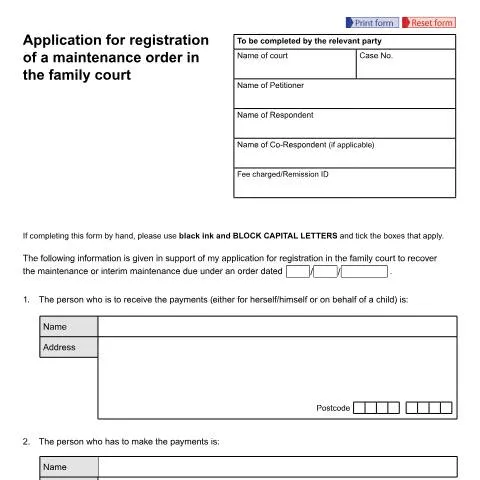
Maintenance orders issued by family courts don't always stay within the same jurisdiction where they were originally made. When circumstances change—a former spouse relocates to another part of England and Wales, or enforcement becomes difficult through the original court—the Form D151 application for registration of a maintenance order becomes the crucial bridge connecting different family court jurisdictions. This HM Courts & Tribunals Service document enables the transfer of enforcement powers from one family court to another, ensuring that maintenance obligations remain legally enforceable regardless of geographical boundaries.
The registration process addresses a fundamental challenge in family law: maintaining effective enforcement when parties live in different court catchment areas. Rather than requiring fresh legal proceedings, Form D151 allows an existing maintenance order to be registered in a new family court, transferring jurisdiction and enforcement authority. This mechanism proves particularly valuable when the paying party has moved to a different region, making enforcement through the original court impractical or impossible.
Distinguishing Registration from Fresh Applications and Variations
Form D151 serves a distinctly different purpose from other family court applications that applicants sometimes confuse with registration procedures. Understanding these distinctions prevents delays and ensures the correct legal pathway.
| Procedure Type | Purpose | When Used | Form Required |
|---|---|---|---|
| Registration (D151) | Transfer enforcement to different court | Existing order, new jurisdiction needed | D151 |
| Fresh Application | Obtain new maintenance order | No existing order in place | C100 or other application forms |
| Variation Application | Change terms of existing order | Circumstances changed, order terms need adjustment | C79 (vary/discharge) |
| Enforcement Application | Recover arrears through same court | Non-payment, original court retains jurisdiction | D11 or other enforcement forms |
Registration specifically applies when an existing maintenance order remains valid and appropriate, but enforcement needs to occur through a different family court. The original order's terms remain unchanged—registration simply transfers the administrative and enforcement jurisdiction. This differs fundamentally from variation applications, which seek to alter the order's substantive terms, or fresh applications for entirely new maintenance arrangements.
The Maintenance Orders Act 1958 Framework
Form D151 operates within the framework established by the Maintenance Orders Act 1958, which governs the registration and enforcement of maintenance orders across different courts. Section 8 of the form specifically requires confirmation that the order is not already registered under this Act, preventing duplicate registrations that could create conflicting enforcement proceedings. This legislative framework ensures that only one court holds active jurisdiction over enforcement at any given time, avoiding the complications that would arise from multiple courts attempting to enforce the same order simultaneously.
Navigating the Complexities of Arrears Calculation and Documentation
Section 3 of Form D151 requires detailed information about maintenance arrears, presenting one of the most technically challenging aspects of the application. The form distinguishes between arrears owed to the petitioner/respondent directly and those relating to child maintenance, recognising that different calculation methods and legal considerations may apply to each category.
Calculating Arrears for Adult Maintenance
For spousal or partner maintenance, applicants must provide the total arrears amount, the date to which this calculation extends, and the next payment due date. This information enables the receiving court to understand both the historical debt and ongoing obligations. Accuracy in these calculations proves crucial, as incorrect figures can lead to improper enforcement action or challenges to the registration.
The calculation date holds particular significance because maintenance arrears continue to accrue until payment. Courts need to know the precise cut-off point for the stated arrears figure to calculate any additional amounts that have accumulated between application submission and court processing. This temporal precision prevents disputes over the exact debt amount when enforcement proceedings commence.
Child Maintenance Complexities
Child maintenance arrears calculations involve additional considerations, particularly when multiple children are involved or when Child Maintenance Service assessments may also be in place. The form requires individual details for each child, including names and dates of birth, alongside specific arrears calculations. This granular approach recognises that child maintenance obligations may vary between children based on their ages, circumstances, or residence arrangements.
When completing this section, applicants should be aware that child maintenance through the Child Maintenance Service operates separately from court-ordered child maintenance. Registration under Form D151 applies only to court orders, not CMS assessments. This distinction becomes particularly important when parents have experienced both types of maintenance arrangements at different times.
Strategic Considerations Behind Registration Decisions
Section 5 of Form D151 requires applicants to explain their reasons for seeking registration, moving beyond mere procedural requirements to address the strategic and practical considerations driving the application. Courts use this information to assess whether registration represents the most appropriate enforcement route and to understand the specific circumstances necessitating the jurisdictional transfer.
Geographic Enforcement Challenges
The most common reason for registration involves geographic separation between the parties and the original court. When the paying party has relocated to a different region, enforcement through the original court becomes impractical. Local enforcement officers, bailiffs, and court staff in the new area lack direct authority from the distant original court, creating practical barriers to effective enforcement action.
Registration transfers this enforcement authority to a court with local jurisdiction, enabling direct action against the paying party's assets, employment, or residence within that area. This geographic proximity proves particularly valuable for enforcement methods such as attachment of earnings orders, which require ongoing liaison with local employers, or charging orders against property located in the new jurisdiction.
Department for Work and Pensions Involvement
Section 6 specifically addresses situations where the DWP has requested registration due to the applicant's receipt of Income Support or other means-tested benefits. This reflects the department's interest in recovering maintenance payments that could reduce benefit entitlement. When individuals receive Income Support, the DWP may pursue maintenance recovery as part of benefit administration, using registration to facilitate enforcement through the most appropriate court jurisdiction.
This DWP involvement doesn't require the recipient to actively participate in enforcement—the department can pursue recovery independently. However, registration through Form D151 ensures that enforcement efforts occur through the correct court jurisdiction, maximising the likelihood of successful recovery while minimising administrative complications.
Selective Registration: Choosing Specific Order Provisions
Section 7 of Form D151 offers sophisticated options for partial registration, allowing applicants to register the entire order or select specific paragraphs or provisions. This flexibility addresses situations where different aspects of a maintenance order may require enforcement in different jurisdictions or where only certain provisions remain relevant to current circumstances.
Whole Order Registration
Complete order registration transfers all maintenance obligations and enforcement powers to the new court. This comprehensive approach suits situations where the paying party has relocated entirely and all future enforcement will occur through the new jurisdiction. Whole order registration provides the receiving court with complete authority over all aspects of the maintenance arrangement, avoiding the need for coordination between multiple courts.
Selective Paragraph Registration
Partial registration becomes valuable when maintenance orders contain multiple provisions that may require different enforcement approaches. For example, an order might include both ongoing periodic payments and lump sum provisions. If the paying party has assets in multiple jurisdictions, selective registration allows strategic enforcement through the most appropriate court for each type of obligation.
When selecting specific paragraphs for registration, applicants must carefully identify each provision by its paragraph number within the original order. This precision ensures that the receiving court understands exactly which obligations fall under its jurisdiction and which remain with the original court or other jurisdictions.
Submission Pathways and Processing Timescales
Form D151 applications follow specific submission requirements that differ from many other family court procedures. Understanding these pathways and their respective processing implications helps applicants choose the most appropriate route for their circumstances.
Paper-Based Applications
The form explicitly requires completion in black ink using block capital letters when submitting paper applications. This specification reflects the document scanning and processing systems used by HM Courts & Tribunals Service, where clear, high-contrast text ensures accurate digital processing and reduces delays caused by illegible submissions.
Paper applications must be submitted to the family court where registration is sought, not the original court that made the order. This submission route requires careful attention to the correct court address and may involve longer processing times due to manual handling and postal delays. However, paper submission remains essential when supporting documentation is extensive or when applicants lack access to digital submission methods.
Court Processing and Verification
Once submitted, courts must verify that the application meets the requirements under the Maintenance Orders Act 1958 and that no conflicting registrations exist. This verification process involves checking court records and may require communication with the original court to confirm order details and current status. Processing times vary depending on court workloads and the complexity of verification required.
The court may request additional information or documentation during processing, particularly if the original order contains unusual provisions or if there are questions about current enforceability. Applicants should be prepared to provide supplementary evidence or clarification within specified timeframes to avoid application delays.
Managing Concurrent Proceedings and Potential Conflicts
Section 4 of Form D151 addresses the critical issue of concurrent proceedings, requiring applicants to declare any other maintenance recovery proceedings that may be pending. This declaration prevents conflicting enforcement actions and ensures that courts can coordinate their activities effectively when multiple legal processes involve the same maintenance obligations.
Identifying Concurrent Proceedings
Concurrent proceedings encompass various legal processes that could affect maintenance recovery, including existing enforcement applications, bankruptcy proceedings, or other debt recovery actions involving the paying party. Even proceedings that don't directly target maintenance payments may impact the paying party's financial capacity or the priority of different creditor claims.
Applicants must provide specific details of any writs, warrants, or other legal processes currently in force against the paying party. This information enables courts to assess whether registration would conflict with existing legal actions or whether coordination between different proceedings might be necessary. Failure to disclose concurrent proceedings can result in registration being refused or subsequently challenged.
Coordination with Other Courts
When concurrent proceedings exist, courts may need to coordinate their activities to prevent conflicting orders or enforcement actions. This coordination might involve staying certain proceedings until others are resolved, or establishing priority arrangements between different types of legal action. The receiving court uses the information provided in Section 4 to make these coordination decisions and to communicate with other courts as necessary.
Post-Registration Enforcement Powers and Limitations
Successful registration through Form D151 transfers comprehensive enforcement powers to the receiving court, but applicants should understand both the capabilities and limitations of this transferred jurisdiction. Registration doesn't create new legal obligations—it simply relocates the enforcement authority for existing obligations established by the original order.
The receiving court gains access to the full range of enforcement mechanisms available under family court procedures, including attachment of earnings, charging orders, third-party debt orders, and committal proceedings for contempt of court. However, the court cannot alter the terms of the original order through the registration process. Any changes to payment amounts, frequency, or other substantive terms require separate variation proceedings.
Registration also doesn't automatically resolve enforcement challenges related to the paying party's financial circumstances or willingness to comply. While it provides local jurisdiction for enforcement action, success still depends on the paying party's assets, income, and cooperation. Courts may need to use multiple enforcement methods or pursue contempt proceedings for persistent non-compliance, regardless of which court holds jurisdiction.
Understanding these enforcement realities helps applicants maintain realistic expectations about registration outcomes while ensuring they pursue the most effective legal pathway for their specific maintenance recovery needs. Form D151 provides the jurisdictional framework for enforcement, but successful recovery ultimately depends on strategic use of the available legal mechanisms and the specific circumstances of each case.