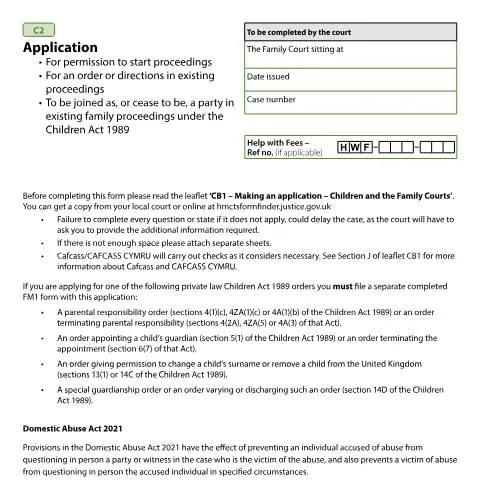
Navigating Ongoing Family Court Proceedings with Form C2
When family court proceedings concerning children are already underway, circumstances frequently change. A parent might need to modify contact arrangements, seek additional safeguarding measures, or request urgent directions from the court. Rather than starting fresh proceedings, the Form C2 serves as the gateway for making new applications within existing Children Act 1989 cases. This procedural tool enables parties to adapt court orders to evolving family situations whilst maintaining the continuity of established proceedings.
The Family Court recognises that children's welfare rarely fits neatly into static arrangements. Job relocations, changes in living circumstances, concerns about a child's wellbeing, or the need for special guardianship can all arise months or years after initial orders were made. Form C2 provides the structured mechanism for bringing these matters before the same court that has developed familiarity with the family's history.
The Application Landscape: When C2 Becomes Your Route Forward
Form C2 operates within a specific procedural context that distinguishes it from initial applications. Unlike starting fresh proceedings with Form C100, the C2 route applies when a case number already exists and the Family Court retains jurisdiction over the children involved. This distinction carries practical advantages: the court file contains previous assessments, Cafcass reports, and judicial familiarity with the family dynamics.
The form accommodates three distinct application types, each serving different procedural purposes. Permission applications become necessary when the applicant lacks automatic standing to make certain requests. Order or directions applications constitute the most common usage, covering modifications to existing arrangements or requests for additional provisions. Party status applications address situations where someone seeks to join proceedings as a formal party or withdraw from their current party status.
Interconnection with Mediation Information and Assessment Meetings
Significantly, applications made via Form C2 in existing proceedings may still trigger requirements for Mediation Information and Assessment Meetings (MIAMs). The Children Act framework emphasises resolution outside court wherever possible, and this principle extends to variation applications. However, certain circumstances—such as domestic abuse allegations or urgent child protection concerns—can exempt applicants from MIAM requirements.
The court expects evidence of MIAM attendance or valid exemption grounds, particularly for applications seeking substantial changes to contact or residence arrangements. This requirement acknowledges that even within established proceedings, parties should explore alternative dispute resolution before seeking judicial intervention.
Identifying Your Standing: Who Can Apply and When Permission Is Required
The Children Act 1989 creates a hierarchy of applicant rights that directly impacts Form C2 usage. Automatic applicants—including parents, guardians, and those holding residence orders—can generally apply without seeking the court's permission first. However, the legislation restricts certain individuals to permission applications, requiring them to demonstrate sufficient connection to the child and that the application serves the child's welfare.
| Applicant Category | Permission Required | Common Examples |
|---|---|---|
| Parents with parental responsibility | No | Married parents, fathers on birth certificate post-2003 |
| Special guardians | No | Court-appointed long-term carers |
| Extended family members | Yes | Grandparents, aunts, uncles, step-parents |
| Foster carers | Yes (with exceptions) | Local authority foster placements |
Permission applications undergo judicial scrutiny focusing on the applicant's connection with the child, the nature of the proposed application, and any disruption to the child's life. Courts particularly consider whether the applicant has attempted alternative resolution methods and whether the application addresses genuine welfare concerns rather than adults' preferences.
Special Considerations for Fathers Without Parental Responsibility
Fathers who lack parental responsibility face unique procedural requirements when using Form C2. If seeking parental responsibility orders alongside other applications, they must complete both Form C2 and the separate Form FM1. This dual requirement reflects the legislation's structure, which treats parental responsibility applications as distinct from other Children Act orders despite their frequent interconnection in practice.
Dissecting the Form: Section-by-Section Completion Strategy
Form C2's structure reflects the court's information needs for effective case management. The initial summary section requires precise articulation of the orders sought, using the Children Act's statutory language rather than colloquial descriptions. Courts expect applicants to specify whether they seek child arrangements orders, prohibited steps orders, specific issue orders, or other statutory provisions.
The child details section demands comprehensive information about each child, including their current living arrangements and relationships to all parties. This information enables the court to assess jurisdiction, consider each child's individual circumstances, and determine appropriate procedural directions. Age-related considerations become particularly important, as the court's approach varies significantly between infants, school-age children, and teenagers approaching majority.
Applicant and Respondent Information Requirements
Personal details sections serve multiple purposes beyond mere identification. Five-year address histories enable the court to assess stability, identify potential jurisdictional issues, and facilitate service of proceedings. The form's emphasis on previous addresses reflects practical enforcement considerations—courts need current information to ensure respondents receive proper notice of applications.
Confidentiality provisions acknowledge domestic abuse contexts where applicants cannot safely disclose their addresses. The cross-reference to Form C8 (Confidential Contact Details) provides a structured approach to maintaining safety whilst ensuring court communications reach the applicant. This dual-form approach balances transparency principles with protection needs.
The court's ability to make informed decisions depends heavily on complete, accurate information. Incomplete forms delay proceedings and may result in applications being returned unprocessed, potentially compromising urgent child welfare situations.
The FM1 Requirement: Navigating Dual-Form Applications
Certain private law applications trigger mandatory completion of both Form C2 and Form FM1, creating a dual-form requirement that frequently confuses applicants. This requirement applies specifically to parental responsibility orders, guardian appointments, name change permissions, and special guardianship orders. The legislative framework treats these applications as requiring additional procedural safeguards and enhanced information gathering.
Form FM1 captures detailed family dynamics, domestic abuse histories, and child welfare concerns that inform the court's risk assessment processes. Unlike Form C2's procedural focus, FM1 delves into substantive welfare considerations, previous social services involvement, and any factors that might impact the child's safety or wellbeing.
Coordinating Submission Timing
Both forms must be filed simultaneously when the dual requirement applies. Courts will not progress applications where FM1 accompanies C2 applications outside the specified categories, nor will they accept C2 applications lacking required FM1 forms. This strict requirement reflects the legislation's structured approach to different application types and their associated procedural safeguards.
Legal representatives often coordinate these submissions through bulk filing systems, but self-represented litigants must ensure both forms reach the court together. Postal submissions should include both forms in the same envelope, whilst online submissions require separate but simultaneous uploads through the designated court portal.
Safeguarding and Domestic Abuse Considerations
The Domestic Abuse Act 2021 introduced significant procedural protections that directly impact Form C2 applications. These provisions prevent alleged perpetrators from personally cross-examining victims during court hearings, fundamentally altering how domestic abuse cases progress through the family justice system.
When Form C2 applications involve domestic abuse allegations, the court may issue supplementary forms EX740 or EX741 to assess cross-examination prohibitions. These forms enable the court to determine whether questioning restrictions should apply, balancing fair hearing principles with victim protection requirements.
Cafcass Involvement and Safeguarding Checks
Every Form C2 application triggers Cafcass (or CAFCASS Cymru in Wales) involvement, regardless of the application's apparent complexity. Cafcass conducts safeguarding checks that may include police national computer searches, local authority consultations, and previous court file reviews. These checks inform the court's initial risk assessment and case management decisions.
Cafcass involvement extends beyond administrative checks to include potential welfare reporting, child impact assessments, and recommendations about case progression. In complex cases, Cafcass officers may be appointed as children's guardians, fundamentally altering the proceedings' dynamics and introducing additional procedural requirements.
Strategic Timing and Case Management Implications
Form C2 applications significantly impact existing case timetables and judicial management approaches. Courts must balance new application urgency against established case progression plans, often requiring case management hearings to recalibrate directions and timescales. Urgent applications may justify expedited listing, but applicants must demonstrate genuine urgency rather than mere convenience.
The court's response varies considerably based on application timing within the existing proceedings' lifecycle. Applications made during early case management stages integrate more easily into established timetables, whilst applications made shortly before final hearings may necessitate adjournments and revised preparation schedules.
Fee Considerations and Help with Fees Applications
Form C2 applications attract court fees unless applicants qualify for fee remissions through the Help with Fees scheme. Fee structures vary based on application types and whether hearings become necessary. The form includes specific provision for Help with Fees reference numbers, acknowledging that many family court users face financial constraints that impact their access to justice.
Fee remission assessments consider household income, savings thresholds, and benefit receipt status. Successful applicants receive fee waivers or reductions that enable them to progress applications without financial barriers. However, the assessment process can delay application processing if remission applications require additional evidence or clarification.
Post-Submission Procedures and Court Response Mechanisms
Once submitted, Form C2 applications enter the court's case management system where administrative staff conduct initial reviews for completeness and jurisdictional appropriateness. Incomplete applications typically generate rejection letters identifying missing information and requiring resubmission, potentially delaying urgent matters if applicants fail to address deficiencies promptly.
Accepted applications receive case numbers (if new proceedings) or integration into existing case files. The court then determines appropriate procedural responses, ranging from administrative orders granted without hearings to complex applications requiring full judicial consideration with legal representation and expert evidence.
Service requirements mandate that applicants ensure all parties receive copies of applications and supporting documents. The court provides specific directions about service methods, timescales, and proof requirements. Failure to achieve proper service can invalidate proceedings, emphasising the importance of following prescribed procedures exactly.
Throughout this process, the overriding objective remains the child's welfare, with procedural requirements serving this fundamental principle. Form C2 applications must ultimately demonstrate how proposed orders serve children's best interests, moving beyond adults' preferences to focus on developmental needs, safety considerations, and long-term stability requirements.
Specific Circumstances Requiring Form C2 Applications
The versatility of Form C2 becomes apparent when examining the diverse circumstances that necessitate its use in children proceedings. Each situation carries distinct legal considerations and procedural requirements that applicants must navigate carefully.
Emergency Protection Applications
When immediate safeguarding concerns arise, Form C2 serves as the vehicle for urgent applications such as Emergency Protection Orders or Prohibited Steps Orders. These applications require compelling evidence of imminent risk to the child's welfare. The court expects detailed witness statements documenting specific incidents, dates, and circumstances that justify emergency intervention.
For emergency applications, practitioners often need to demonstrate that delay would cause significant harm. This might include situations involving domestic violence where a perpetrator has threatened to remove a child from the jurisdiction, or cases where a parent with substance abuse issues has relapsed and poses immediate danger. The application must clearly articulate why standard notice periods cannot be observed and why the matter cannot await a scheduled hearing.
Variation of Contact Arrangements
Changes to existing contact orders frequently require C2 applications, particularly when circumstances have materially altered since the original order. Common scenarios include a parent's relocation affecting travel arrangements, changes in work patterns that impact contact times, or concerns about a child's emotional wellbeing during contact sessions.
The court scrutinises variation applications carefully, expecting evidence that the proposed changes serve the child's best interests rather than parental convenience. Supporting documentation might include school reports indicating behavioural changes following contact, expert assessments of the child's needs, or evidence of new circumstances such as housing changes or employment modifications.
Applications for Specific Issue Orders
Disputes over significant decisions in a child's life often require Specific Issue Orders obtained through Form C2. These applications address disagreements between parents or carers about matters such as medical treatment, educational choices, religious upbringing, or international travel.
Medical treatment disputes represent a particularly sensitive category, especially involving procedures like circumcision, cosmetic surgery, or controversial treatments. The court requires detailed medical evidence, expert opinions, and careful consideration of the child's own views where age-appropriate. Educational disputes might concern school choice, home education decisions, or special educational needs provision, requiring evidence of the child's academic needs and available options.
Procedural Safeguards and Child Protection Measures
The family court system incorporates multiple safeguards to protect children's interests throughout C2 application proceedings. Understanding these mechanisms helps applicants prepare appropriately and ensures proper procedural compliance.
Guardian Appointment and CAFCASS Involvement
The Children and Family Court Advisory and Support Service (CAFCASS) plays a crucial role in many C2 applications. When appointed, CAFCASS officers conduct independent investigations to provide the court with objective assessments of the child's circumstances and needs. Their reports carry significant weight in judicial decision-making.
CAFCASS involvement typically includes interviewing the child (age-permitting), observing family interactions, reviewing relevant documentation, and liaising with professionals already working with the family. The timing of CAFCASS reports can influence hearing schedules, and applicants should anticipate potential delays whilst comprehensive assessments are completed.
In complex cases, the court might appoint a guardian ad litem to represent the child's interests independently. This appointment is particularly common in cases involving serious allegations of abuse, where conflicts of interest exist, or where the child's wishes differ significantly from what appears to be in their best interests.
Disclosure Requirements and Information Sharing
C2 applications operate within strict disclosure frameworks designed to balance transparency with child protection. Standard disclosure typically includes all documents relevant to the child's welfare, including social services records, school reports, medical records, and police incident reports where applicable.
However, certain information may be subject to special protection measures. This includes confidential social services assessments, therapeutic records, or information that could compromise ongoing investigations. The court has discretionary powers to order disclosure of specific documents or to restrict access to particularly sensitive material.
Applicants must understand their continuing duty of disclosure throughout proceedings. New information that emerges after the initial application must be promptly shared with other parties and the court, subject to any protective arrangements in place.
Child's Voice and Participation Rights
Recent procedural developments emphasise the importance of hearing children's views in proceedings affecting them. The court has various mechanisms for ascertaining and considering a child's wishes and feelings, depending on their age, maturity, and the nature of the proceedings.
Direct judicial interviews with children remain relatively uncommon but may occur in appropriate cases, typically involving older children who express strong views about contact arrangements or living situations. More commonly, the child's voice is heard through CAFCASS reports, independent social work assessments, or specialist child psychologist evaluations.
The court must balance respecting children's autonomy against protecting them from inappropriate involvement in adult disputes. This creates particular challenges in cases where children have been influenced by parental conflict or where their expressed wishes might not align with professional assessments of their welfare needs.
Cost Implications and Financial Considerations
Understanding the financial landscape surrounding C2 applications is essential for effective case management and client advice. The cost structure encompasses court fees, legal representation expenses, and additional professional services that may be required during proceedings.
Court Fees and Fee Remission
Form C2 applications attract specific court fees set by HM Courts & Tribunals Service fee schedules. The current fee structure distinguishes between different types of applications, with some variations carrying higher charges than others. Emergency applications may incur additional costs due to out-of-hours processing requirements or expedited hearing arrangements.
Fee remission schemes provide important access to justice safeguards for applicants with limited financial means. The Help with Fees service assesses eligibility based on income, savings, and family circumstances. Successful applicants may receive full or partial fee remissions, ensuring that financial constraints do not prevent legitimate applications from proceeding.
The remission process requires detailed financial disclosure and supporting documentation such as benefit award letters, wage slips, or bank statements. Processing times for remission applications can affect overall case timescales, and applicants should factor these delays into their procedural planning.
Legal Representation and Funding Options
The complexity of children proceedings often necessitates professional legal representation, creating significant cost considerations for many families. Legal aid remains available for children cases in specific circumstances, particularly where domestic violence is involved or where the case concerns child protection issues.
Private funding arrangements require careful consideration of likely costs throughout proceedings. Family cases can be unpredictable in terms of duration and complexity, making initial cost estimates challenging. Fixed fee arrangements may be available for straightforward applications, whilst more complex matters typically require hourly billing structures.
Alternative funding mechanisms include after-the-event insurance, litigation funding arrangements, and family procedure costs orders in appropriate cases. These options require careful evaluation of their terms and conditions, particularly regarding coverage limitations and success fee arrangements.
Additional Professional Costs
C2 proceedings often require input from various professionals beyond legal representatives. Expert witness fees can be substantial, particularly for specialist child psychologists, psychiatrists, or independent social workers. The court's case management powers include controlling expert evidence to manage costs proportionately.
Single joint expert appointments have become increasingly common as a cost-management measure. Rather than each party instructing separate experts, the court may direct that a single expert provides evidence for all parties. This approach reduces overall costs whilst maintaining access to specialist expertise.
Other potential costs include process serving fees, translation services for non-English speaking parties, and specialist communication support for parties with disabilities. These ancillary costs can accumulate significantly and should be factored into overall budget planning from the outset of proceedings.