When Your Family History Lies in Court Archives: Accessing Parental Order Records
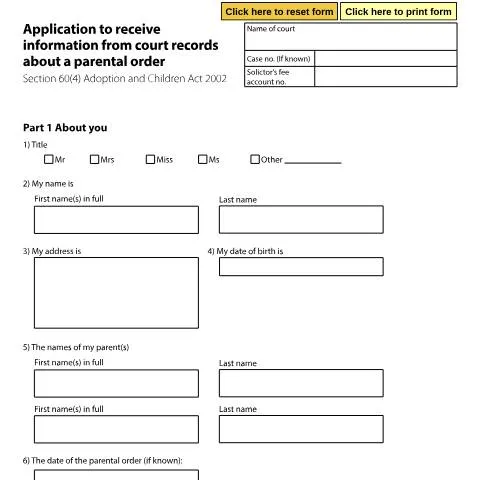
For adults born through surrogacy arrangements, the journey to understanding their origins often leads to a particular type of court document: the parental order. These legal instruments, which formally transfer parentage from birth mothers to intended parents, create official records that remain sealed within court archives for decades. The Form A64A represents the key to unlocking this deeply personal information, providing a structured pathway for individuals to access their own court files once they reach adulthood.
Unlike adoption records, which follow well-established disclosure procedures, parental order documentation occupies a more specialised corner of family law. The Adoption and Children Act 2002, specifically Section 60(4), governs this process, creating a framework that balances transparency with privacy protection. This legislative backdrop means that accessing parental order information requires more than simple curiosity – it demands proper legal channels and careful preparation.
The Legal Architecture Behind Parental Order Disclosure
Parental orders emerged from the Human Fertilisation and Embryology Act 2008, which formalised surrogacy arrangements within UK law. When intended parents successfully obtain such an order, it extinguishes the legal parentage of the surrogate mother and her partner, transferring full parental responsibility to the commissioning couple. These proceedings generate substantial documentation: application forms, supporting evidence, court reports, and judicial decisions.
The court system maintains these records indefinitely, but access remains strictly controlled. The Adoption and Children Act 2002 extends certain adoption-related provisions to parental orders, creating parallel disclosure rights for individuals seeking their own records. However, this legislative crossover means that parental order disclosure follows adoption procedures rather than standard court record access routes.
Three categories of information typically exist within parental order files:
- Application materials – the original forms submitted by intended parents, though supporting documents attached to these forms remain excluded from disclosure
- Judicial records – the parental order itself, any interim orders, and transcripts of court hearings where available
- Professional reports – assessments by parental order reporters, who investigate the arrangement's suitability before the court grants the order
Eligibility Thresholds and Timing Considerations
Form A64A applications remain exclusively available to the individuals who were the subject of parental order proceedings. Parents, whether intended or surrogate, cannot use this process to access court records, nor can other family members or legal representatives without specific court permission through alternative procedures.
No minimum age threshold applies to Form A64A submissions, unlike adoption record access which typically requires applicants to reach 18 years. However, practical considerations often delay applications until adulthood. Young people may need assistance understanding the documentation they receive, and the mandatory counselling component assumes a level of emotional maturity to process potentially complex family history information.
| Application Timing | Considerations | Typical Outcomes |
|---|---|---|
| Under 18 years | Requires parental consent; counselling availability varies | Limited uptake due to complexity |
| 18-25 years | Independent decision-making; often coincides with identity questions | Moderate application volumes |
| Over 25 years | Established personal circumstances; may relate to own family planning | Steady application stream |
The parental order date significantly influences available documentation. Orders granted in recent years typically generate more comprehensive files, as reporting standards and record-keeping practices have evolved. Historical cases, particularly those from the early years following the 2008 Act, may contain less detailed information.
Navigating the Counselling Prerequisite
Form A64A includes an unusual mandatory element: counselling consideration. Applicants must demonstrate they have received information about available counselling services and been offered the opportunity to engage with professional support before accessing their records. This requirement reflects the potentially sensitive nature of surrogacy arrangements and their impact on family relationships.
The court cannot process applications without evidence of counselling consideration, but actual participation in counselling sessions remains voluntary. Applicants need only confirm they have been "informed about the availability of counselling services" and "given an opportunity to receive counselling". This creates a deliberate pause in the application process, encouraging reflection on the potential emotional impact of accessing court records.
Counselling services specialising in surrogacy and assisted reproduction typically offer the most relevant support. The Department of Health and Social Care maintains information about approved counselling providers, though local court staff can also provide guidance. Many applicants find that initial counselling consultations help them prepare for the type of information they might encounter within court files.
Understanding Counselling Documentation Requirements
The form requires applicants to certify their counselling consideration, but courts rarely demand detailed evidence of specific counselling contacts. A simple confirmation that the applicant has received information and been offered support typically satisfies this requirement. However, some courts may request basic documentation showing counselling service contact, particularly where applications involve complex family circumstances.
Essential Documentation and Identity Verification
Form A64A applications require two critical supporting documents: a certified copy of the Parental Order Register entry and photographic identification. These requirements create the foundation for secure record access while preventing unauthorised applications.
The Parental Order Register, maintained by the General Register Office, provides the definitive record of all parental orders granted in England and Wales. Applicants must obtain a full certified copy of their register entry before submitting Form A64A. This document contains essential details including the court that granted the order, case reference numbers, and key dates that enable court staff to locate the correct files.
Obtaining register entries involves a separate application process through the General Register Office, typically requiring:
- Proof of identity and relationship to the parental order
- Payment of prescribed fees
- Processing time of several weeks
- Potential delays where historical records require manual searching
Identity verification follows stringent protocols designed to prevent fraudulent access to sensitive court records. Acceptable identification must include both a photograph and signature, with passports and driving licences representing the most commonly accepted documents. Court officers examine identification in person, make detailed notes on the application form, and return original documents immediately.
Alternative Identification Scenarios
Applicants without standard photographic identification face additional challenges, though courts maintain procedures for exceptional circumstances. Alternative documentation might include combination approaches using multiple identity sources, though each court exercises discretion in assessing adequacy. Early consultation with court staff helps clarify acceptable alternatives before formal application submission.
Completing Form A64A: Section-by-Section Breakdown
Form A64A follows a straightforward three-part structure, though several sections contain subtle complexities that can affect processing outcomes. Part 1 captures basic applicant information, requiring complete accuracy to match court records and prevent processing delays.
The name section demands particular attention, as court records may contain historical name variations or formal versions that differ from everyday usage. Applicants should provide names exactly as they appear on their parental order register entry, even where these differ from current identification documents. Middle names require full spelling rather than initials, and any name changes since the parental order should be clearly documented.
Address information serves multiple purposes beyond simple correspondence. Courts use addresses to verify applicant identity and may cross-reference location details with historical records. Current addresses suffice for most applications, though applicants who have moved frequently might consider providing previous addresses to assist with identity confirmation.
Parent name sections often create confusion, as applicants may be uncertain about which parents to include. The form typically expects details of the intended parents who obtained the parental order, rather than birth parents or surrogate mothers. However, where applicants know only limited parent information, partial completion with explanatory notes usually proves acceptable.
Part 2: Specifying Required Documents
Part 2 allows applicants to select specific categories of court documentation, though most applicants request all available materials to ensure comprehensive access to their records. The four standard categories each serve different purposes:
- Application forms reveal the intended parents' original submissions to court, including their statements about the surrogacy arrangement and motivations for seeking a parental order
- Orders and court decisions provide the formal legal outcomes, including any conditions or special provisions attached to the parental order
- Hearing transcripts offer insights into judicial reasoning and any concerns raised during proceedings, though availability varies significantly between courts
- Reporter assessments contain professional evaluations of the arrangement's suitability, often including detailed background information about all parties involved
Selective document requests rarely provide significant advantages, as court fees typically remain constant regardless of the volume of material requested. Comprehensive requests also prevent the need for subsequent applications if initial documentation proves insufficient for the applicant's needs.
Processing Pathways and Administrative Coordination
Form A64A creates an unusual administrative journey involving multiple court locations and specialised procedures. Applications begin at any convenient court location, regardless of where the original parental order was granted. This accessibility reflects recognition that applicants may live far from their birth locations and should not face geographical barriers to accessing their records.
The receiving court performs initial verification procedures, checking identification and ensuring form completion meets basic requirements. However, these courts do not maintain parental order records themselves. Instead, they forward verified applications to the specific court that granted the original parental order, creating a two-stage processing system.
This administrative split can extend processing timescales, particularly where original courts have limited resources for historical record searches. Family courts that handled significant volumes of parental order applications often maintain better archival systems, enabling faster response times. Smaller courts may require several weeks to locate and prepare relevant documentation.
Record Location and Retrieval Challenges
Historical parental order records present varying retrieval challenges depending on the granting court's archival practices. Recent cases typically benefit from digital record systems, enabling relatively swift document preparation. However, older cases may require manual searches through physical files, particularly where courts have undergone administrative reorganisation or record transfer processes.
Some courts maintain comprehensive parental order archives, while others may have transferred historical records to centralised storage facilities. These variations mean that processing timescales can differ significantly between applications, even for orders granted in similar timeframes.
Understanding Disclosure Limitations and Redactions
Form A64A provides access to substantial court documentation, but certain limitations govern the scope of disclosure. The most significant restriction affects supporting documents attached to original applications. While applicants receive copies of the application forms themselves, medical reports, financial statements, character references, and other supporting materials typically remain excluded from disclosure.
This limitation reflects privacy protection for third parties who provided information during parental order proceedings. Medical professionals, employers, and referees who contributed to original applications did so without expecting future disclosure to the subjects of those proceedings. Courts therefore maintain strict boundaries around third-party confidential information.
Professional reports by parental order reporters occupy a different category, as these officials prepare assessments specifically for court proceedings with awareness of potential future disclosure. However, even these reports may contain redacted sections where information relates to other individuals or sensitive details deemed inappropriate for disclosure.
Redaction practices vary between courts and individual cases, creating some uncertainty about the extent of information applicants will receive. Recent trends favour more comprehensive disclosure, recognising individuals' rights to understand their origins while maintaining appropriate confidentiality protections.
Appeals and Additional Information Requests
Applicants who consider their disclosure insufficient may request reviews or seek additional information through alternative legal procedures. However, Form A64A represents the standard disclosure route, and courts rarely provide additional materials beyond those specified in the original application categories. More extensive information access typically requires separate legal proceedings with associated costs and complexity.