When Family Court Proceedings Land on Your Doorstep: Understanding Form C7
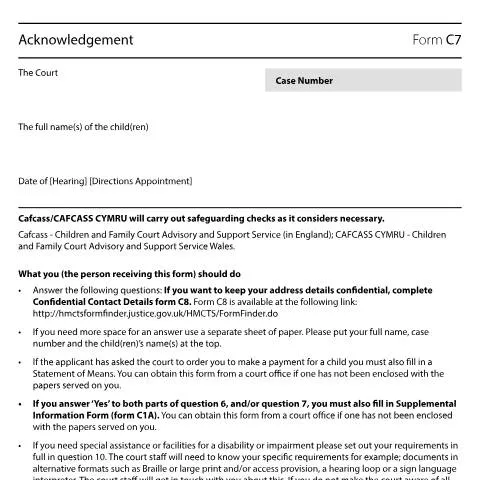
Receiving official court papers about a child can be overwhelming, particularly when you're suddenly thrust into family court proceedings. Form C7 serves as your formal acknowledgement and response mechanism when someone has made an application to the court regarding a child where you have parental responsibility, care arrangements, or other significant involvement. This isn't merely a receipt confirmation—it's a critical document that shapes how the court views your position and determines your future involvement in the child's life.
The form arrives alongside other court documents, including the original application (typically forms C1, C100, C78, or C79) and a Notice of Proceedings. Your response through Form C7 directly influences whether you'll be treated as an active participant in proceedings or remain on the periphery, potentially affecting crucial decisions about contact arrangements, residence orders, or specific issue orders concerning the child.
The Fourteen-Day Window: Critical Timing Requirements
Form C7 operates within an inflexible fourteen-day deadline from when you received the Notice of Proceedings. This timeframe isn't merely administrative courtesy—it's a legal requirement that can significantly impact your standing in the proceedings if missed. The clock starts ticking from the date you were personally served the documents or, if posted, from the postmark date on the envelope containing the Notice of Proceedings.
Missing this deadline doesn't automatically exclude you from proceedings, but it severely complicates your position. You'll need to apply for permission to file a late acknowledgement, explaining the delay to the court's satisfaction. Judges take a dim view of unexplained delays, particularly in children matters where time is often of the essence for the child's welfare.
The fourteen-day period must accommodate several tasks beyond simply completing the form. You need time to seek legal advice, potentially complete additional forms (C1A for safeguarding concerns or a Statement of Means for financial orders), make copies for all parties, and ensure proper service on both the applicant and any other named parties.
Calculating Your Deadline Precisely
Court staff calculate the fourteen days from the service date, not the date you opened the envelope or first read the contents. If served personally by a court bailiff or process server, the service date is when you physically received the documents. For postal service, it's the postmark date, regardless of when Royal Mail delivered to your address or when you collected from a sorting office.
Weekends and bank holidays don't extend the deadline unless the final day falls on a non-business day, in which case you have until the next working day the court office is open. However, relying on this extension is risky—courts expect prompt responses in children matters.
Decoding the Response Framework: Your Strategic Choices
Form C7's structure appears straightforward, but each question carries tactical implications for your case. Question 5 asks whether you oppose the application—a seemingly binary choice that actually encompasses various levels of disagreement. You might oppose the application entirely, agree with some aspects while disputing others, or support the principle while questioning specific details.
Your response to question 5 determines how the court initially categorises your position. Answering "Yes" (you oppose) signals you'll actively contest the application, likely leading to a contested hearing where evidence will be examined in detail. Answering "No" suggests you're not opposing, but this doesn't mean you're agreeing—you might have concerns about implementation details or wish to propose alternative arrangements.
Question 8 explores whether you intend to make your own application to the court. This could involve cross-applications for contact, residence arrangements, or specific issue orders. Making a cross-application through this question is often more efficient than filing separate proceedings later, as both applications can be heard together, reducing costs and court time.
The Safeguarding Dimension
Questions 6 and 7 address safeguarding concerns—arguably the most sensitive aspects of Form C7. Question 6 asks about any Supplemental Information Form (C1A) received from the applicant, which details allegations of domestic abuse, violence, or other harm. Your response here isn't just about whether you received the form, but whether you wish to comment on the allegations made.
Question 7 requires you to disclose any concerns about harm to the child from domestic abuse, violence, abduction risks, or other conduct by anyone involved in caring for or having contact with the child. This question often creates ethical dilemmas—you might know information that could protect the child but worry about the implications for family relationships or your own position.
Navigating Confidentiality: The Form C8 Connection
Form C8 (Confidential Contact Details) runs parallel to Form C7, addressing situations where revealing your address could compromise safety. This isn't limited to domestic abuse scenarios—it might apply if you're concerned about harassment, have relocated to escape family pressure, or work in sensitive occupations where address disclosure poses professional risks.
The confidentiality mechanism operates on a need-to-know basis. The court holds your actual contact details while other parties receive only what's necessary for legal service. However, absolute confidentiality isn't guaranteed—if your address becomes relevant to the child's welfare or the court's decision-making, judges may order disclosure despite your initial request for confidentiality.
Completing Form C8 requires careful consideration of what information truly needs protection. You might keep your home address confidential while revealing your workplace, or provide a solicitor's address for correspondence while protecting your residential location. The court expects genuine reasons for confidentiality requests, not tactical advantages in proceedings.
Additional Forms: When C7 Triggers Further Documentation
Form C7 often activates requirements for additional documentation, transforming a simple acknowledgement into a comprehensive response package. If the original application seeks financial provision for a child, you must complete a Statement of Means detailing your income, expenditure, assets, and liabilities. This financial disclosure goes beyond basic salary information to include benefits, investments, property ownership, and regular outgoings.
The Statement of Means serves multiple purposes beyond calculating potential financial orders. It helps the court understand your capacity to comply with any orders made and influences decisions about legal funding eligibility. Incomplete or inaccurate financial disclosure can lead to orders being set aside later, so thorough preparation is essential.
If you answer "Yes" to both parts of question 6 or to question 7, Form C1A becomes mandatory. This Supplemental Information Form requires detailed disclosure about safeguarding concerns, including specific incidents, dates, witnesses, and any previous involvement from social services or police. The form's completion often determines whether the court orders a fact-finding hearing to resolve disputed allegations before considering the main application.
The Interconnected Forms System
| Trigger Condition | Required Additional Form | Purpose | Deadline |
|---|---|---|---|
| Financial provision sought | Statement of Means | Disclose financial circumstances | With Form C7 (14 days) |
| Safeguarding concerns raised | Form C1A | Detail abuse/harm allegations | With Form C7 (14 days) |
| Address confidentiality needed | Form C8 | Protect contact details | With Form C7 (14 days) |
| Cross-examination prohibition | Form EX740/EX741 | Prevent personal questioning | When hearing listed |
Cafcass Involvement: The Independent Assessment Process
Form C7's completion triggers automatic involvement from Cafcass (Children and Family Court Advisory and Support Service) in England or CAFCASS CYMRU in Wales. These agencies conduct independent safeguarding checks on all parties involved in children proceedings, using information from police, local authorities, and other agencies to assess any risks to the child's welfare.
Cafcass officers have extensive powers to investigate backgrounds, interview parties, and make recommendations to the court about arrangements serving the child's best interests. Their involvement isn't limited to cases with obvious safeguarding concerns—every children case receives some level of Cafcass scrutiny, from basic records checks to detailed welfare reports involving interviews with the child.
The safeguarding checks can reveal historical information you might not expect to be relevant, including spent convictions, social services involvement with other children, or domestic incident reports where no charges were brought. Understanding this scrutiny helps explain why complete honesty in Form C7 is crucial—inconsistencies between your responses and Cafcass findings seriously undermine your credibility.
Preparing for Cafcass Engagement
Cafcass officers typically contact parties within weeks of Form C7 submission to arrange telephone interviews or meetings. These conversations explore your relationship with the child, views on the application, and any concerns about arrangements. The officer's assessment influences court directions about the need for detailed welfare reports, contact arrangements pending the final hearing, and interim orders.
Your responses in Form C7 provide Cafcass with their initial framework for understanding your position. Contradictions between your written responses and subsequent conversations raise red flags about reliability. Similarly, failing to disclose concerns in Form C7 that later emerge through Cafcass investigations can damage your standing with both the agency and the court.
Service Requirements: Ensuring All Parties Receive Copies
Form C7's completion is only half the process—proper service on all parties is equally critical. You must provide copies to the applicant and every other party named in the original application, not just those you consider relevant or with whom you maintain relationships. This includes estranged family members, former partners, or anyone granted party status by the court.
Service can be achieved by post to addresses shown in the original application or by hand delivery. Email service isn't acceptable unless specifically agreed by the receiving party and confirmed to the court. When serving by post, use recorded delivery or similar trackable methods to prove service occurred within the deadline period.
Form C8 (confidential contact details) has different service requirements—it goes directly to the court only, not to other parties. Accidentally serving Form C8 on other parties defeats its entire purpose and could compromise your safety if confidentiality was genuinely needed.
Evidence of Service
Maintaining proof of service protects you if other parties claim non-receipt or if court directions require confirmation of compliance. Postal receipts, delivery confirmations, or acknowledgement receipts from hand delivery provide essential evidence. If serving by hand, consider having a witness present or obtaining written acknowledgement from the recipient.
Late service, even by a few days, can have serious consequences in children proceedings where courts prioritise prompt resolution. If you anticipate service difficulties—perhaps because another party has moved address or is avoiding service—contact the court immediately for guidance rather than letting deadlines pass.
Court Accessibility and Special Requirements
Question 10 of Form C7 addresses disability-related requirements for court attendance, but this encompasses far more than obvious physical disabilities. The court must make reasonable adjustments for various conditions including hearing impairments, learning disabilities, mental health conditions affecting concentration, mobility issues, or visual impairments requiring alternative document formats.
Specific requirements might include hearing loops for those with hearing aids, sign language interpreters (which require advance booking), documents in large print or Braille, wheelchair-accessible courtrooms, or break facilities for those with medical conditions. The court can also arrange for evidence to be given via video link if attendance poses particular difficulties.
Mental health conditions often require sensitive handling. If anxiety, depression, or other conditions might affect your ability to participate effectively, the court can arrange for regular breaks, support persons to accompany you, or modified hearing arrangements. However, the court needs detailed information about your specific requirements to make appropriate arrangements.
Failure to identify special requirements in Form C7 can result in hearing adjournments when the court cannot accommodate needs identified at the last minute. This delays proceedings, potentially affects the child's welfare, and may result in wasted costs orders against you if the adjournment was avoidable.
Interpreter Services and Language Support
Question 9 covers interpreter requirements, but this extends beyond non-English speakers to include British Sign Language users or those who need support with complex legal terminology despite general English proficiency. Court interpreters are professionally qualified and bound by confidentiality requirements, ensuring accurate translation without compromising your position.
The court must arrange interpreters in advance—same-day requests often cannot be accommodated, leading to adjournments. If your language requirements change between Form C7 submission and the hearing (perhaps due to stress affecting language processing), notify the court immediately rather than struggling during proceedings.