Child Arrangements Applications: When Family Court Intervention Becomes Necessary
When parents or guardians cannot reach agreement about arrangements for their children following separation, divorce, or other family changes, the Form C100 serves as the gateway to formal court intervention. This comprehensive application, governed by section 8 of the Children Act 1989, enables individuals to seek legally binding orders concerning child arrangements, prohibited steps, specific issues, or modifications to existing orders.
The form represents a significant step in family law proceedings, as it formally requests HM Courts & Tribunals Service to make judicial decisions about children's welfare when private negotiations have failed. Unlike many administrative forms, the C100 carries substantial weight—once submitted, it initiates proceedings that can fundamentally alter family dynamics and establish long-term legal frameworks for child custody, contact arrangements, and parental responsibilities.
However, accessing this judicial pathway isn't straightforward. The application process is deliberately structured to encourage alternative dispute resolution, with mandatory mediation requirements serving as a crucial preliminary step before court intervention becomes available.
Mandatory Mediation Requirements: The MIAM Gateway System
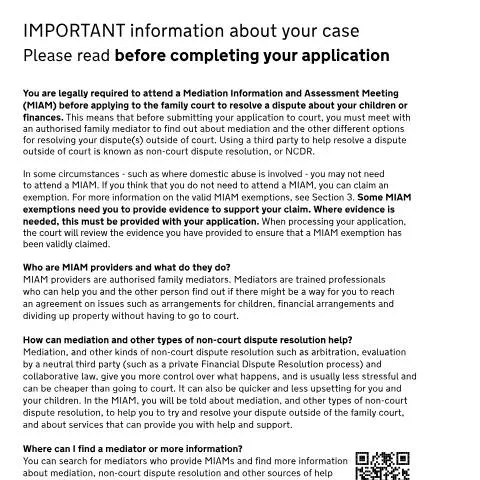
Before submitting a C100 application, applicants must navigate the Mediation Information and Assessment Meeting (MIAM) requirement—a legal obligation designed to explore non-court dispute resolution options. This mandatory consultation with an authorised family mediator represents the government's commitment to reducing court caseloads while potentially achieving better outcomes for families.
During the MIAM, trained professionals assess whether mediation, arbitration, collaborative law, or other alternative dispute resolution methods might resolve the dispute without court intervention. The meeting covers various approaches including private Financial Dispute Resolution processes and neutral third-party evaluations, each offering different advantages in terms of cost, speed, and emotional impact on children.
MIAM Exemptions and Evidence Requirements
Certain circumstances allow applicants to bypass the MIAM requirement through valid exemptions. These typically include situations involving:
- Domestic abuse where mediation would be inappropriate or unsafe
- Child protection concerns requiring immediate court intervention
- Previous unsuccessful mediation attempts within specified timeframes
- Geographic or practical barriers preventing MIAM attendance
- Urgency requiring immediate court orders for child welfare
When claiming exemptions, applicants must provide supporting evidence alongside their C100 application. The court scrutinises this evidence carefully—insufficient or inappropriate documentation can result in application rejection until MIAM attendance is completed. This verification process ensures the exemption system isn't misused to circumvent mediation requirements.
Financial Considerations and Legal Aid Eligibility
MIAM costs vary significantly between providers, with most people paying privately for the service. However, legal aid eligibility can make MIAMs free of charge for qualifying individuals. The assessment considers household income, capital assets, and the nature of the dispute, with domestic abuse cases often receiving priority consideration for funding.
Understanding Section 8 Orders: The Legal Framework
Form C100 applications seek various types of orders under the Children Act 1989, each serving different purposes in child welfare protection. Understanding these distinctions helps applicants identify the most appropriate legal remedy for their specific circumstances.
| Order Type | Purpose | Typical Scenarios |
|---|---|---|
| Child Arrangements Order | Determines living arrangements and contact schedules | Post-separation custody disputes, relocation disagreements |
| Prohibited Steps Order | Prevents specific actions without court consent | Blocking international travel, preventing school changes |
| Specific Issue Order | Resolves particular disputes about child welfare | Medical treatment decisions, educational choices |
| Variation/Discharge Orders | Modifies or cancels existing arrangements | Changed circumstances, non-compliance issues |
Each order type requires different evidence and justification. Child arrangements orders demand comprehensive information about proposed living situations, contact schedules, and parental capabilities. Prohibited steps orders require specific evidence of potential harm or inappropriate actions, while specific issue orders need detailed documentation of the disputed matter and proposed resolutions.
Permission Requirements for Certain Applications
Some C100 applications require court permission before proceeding, particularly when applicants lack automatic legal standing. This includes applications from grandparents, step-parents, or other family members seeking involvement in child arrangements. The permission stage involves demonstrating sufficient connection to the child and showing that the application serves the child's best interests.
Completing the C100 Application: Technical Requirements and Safeguarding Integration
The C100 form demands comprehensive completion, with every question requiring an answer—even if the information is unavailable. This thoroughness stems from the form's dual purpose: initiating court proceedings while enabling Cafcass or Cafcass Cymru to conduct essential safeguarding checks before the first hearing.
Missing information creates significant delays, as Cafcass cannot perform initial safeguarding assessments without complete data. These assessments involve checking criminal records, social services involvement, and other factors affecting child welfare—crucial work that must occur before judicial proceedings commence.
Essential Documentation and Supporting Evidence
Beyond the completed form, applications require various supporting documents depending on the order type and circumstances:
- MIAM certificates or exemption evidence demonstrating compliance with mediation requirements
- Children's birth certificates establishing relationships and legal status
- Previous court orders if seeking variations or discharge of existing arrangements
- Supporting statements explaining the dispute and proposed resolutions
- Safeguarding evidence where domestic abuse or child protection concerns exist
The quality and completeness of supporting documentation significantly influence case progression. Well-prepared applications with comprehensive evidence enable faster court scheduling and more informed judicial decision-making, while incomplete submissions face delays and requests for additional information.
Applicant and Respondent Information Requirements
The form requires detailed information about all parties, including full names, addresses, contact details, and relationships to the children involved. This information serves multiple purposes: enabling court communication, facilitating service of proceedings, and supporting Cafcass safeguarding checks.
Accuracy is crucial—incorrect respondent details can delay proceedings significantly, while incomplete applicant information may prevent proper case management. The court uses this data to coordinate with other agencies and ensure all relevant parties receive appropriate notification of proceedings.
Submission Pathways and Processing Procedures
C100 applications can be submitted through multiple channels, each with distinct advantages and requirements. The online submission system offers convenience and immediate confirmation, while paper submissions provide comprehensive documentation options for complex cases requiring extensive supporting evidence.
Court counter submissions enable immediate queries resolution and face-to-face guidance, particularly valuable for applicants navigating the system without legal representation. However, capacity limitations may require appointments, and not all courts offer comprehensive counter services for family proceedings.
Fee Structure and Help with Fees Provisions
C100 applications incur court fees, though the exact amount varies based on order types and case complexity. The Help with Fees scheme provides remissions for eligible applicants based on income and capital assessments. Applications include specific sections for Help with Fees reference numbers, enabling fee processing alongside case management.
Fee exemptions often apply to domestic abuse cases and applicants receiving certain benefits. The assessment considers household circumstances, with partial remissions available for borderline cases. Processing can delay case commencement if fee status remains unclear.
Case Progression and Judicial Oversight Powers
Once accepted, C100 applications trigger structured case management procedures designed to balance judicial efficiency with child welfare priorities. The court assigns case numbers and scheduling based on urgency assessments, with emergency applications receiving expedited processing when immediate child protection concerns exist.
Judges retain significant discretionary powers throughout proceedings, including the authority to pause cases if non-court dispute resolution appears viable and safe. This judicial oversight ensures that court resources focus on cases genuinely requiring legal intervention while encouraging settlement wherever appropriate.
Cafcass Integration and Safeguarding Protocols
Simultaneously with court processing, Cafcass or Cafcass Cymru receives application details to commence safeguarding assessments. These assessments involve background checks, risk evaluations, and preliminary welfare assessments that inform judicial decision-making from the first hearing onwards.
The integration between court administration and Cafcass services creates a comprehensive approach to child welfare protection, ensuring that legal proceedings incorporate professional assessments of family dynamics and risk factors. This collaborative framework distinguishes family court proceedings from other civil litigation.
Strategic Considerations and Long-term Implications
Submitting a C100 application represents a significant escalation in family disputes, with long-term consequences extending beyond immediate legal outcomes. Court orders create enforceable obligations that can affect family relationships for years, while the adversarial nature of proceedings may impact future co-parenting cooperation.
Successful applications result in legally binding orders that all parties must follow, with contempt of court proceedings available for non-compliance. However, orders can be varied or discharged if circumstances change significantly, requiring fresh applications and evidence of material changes affecting child welfare.
The court's paramount consideration remains the child's best interests, evaluated through comprehensive welfare checklists considering factors including the child's wishes, physical and emotional needs, likely effects of change, characteristics, and potential harm risks. These assessments inform judicial decisions that can fundamentally reshape family structures and relationships.
Understanding these implications helps applicants approach C100 applications with appropriate seriousness while recognising both the protective potential and relationship costs of formal court intervention in family disputes.
Understanding Court Fees and Financial Support Options
When submitting Form C100, applicants must pay a court fee of £232 as of 2024. This fee applies regardless of how many children are included in your application or the number of orders you're requesting. The court will not process your application without payment or an approved fee remission.
If you're experiencing financial hardship, you may qualify for Help with Fees (formerly known as fee remission). This scheme can reduce or completely waive the court fee based on your financial circumstances. You'll need to complete form EX160 alongside your C100 application. The assessment considers your gross monthly income, savings, and benefits received.
Generally, you may receive full fee remission if you're receiving certain benefits including Universal Credit, Income Support, income-based Jobseeker's Allowance, or income-related Employment and Support Allowance. Partial remission may apply if your household income falls below specific thresholds but you don't receive qualifying benefits.
For those on low incomes not receiving benefits, the monthly gross income limits vary by household size. A single person household might qualify with income below £1,170 per month, whilst a couple with two children might qualify with combined income below £1,795 monthly. These figures are subject to regular updates, so check current thresholds on GOV.UK.
Evidence requirements for fee remission include recent benefit letters, payslips covering the last three months, bank statements, and details of any savings or investments exceeding £3,000. If you're self-employed, you'll need to provide your most recent Self Assessment tax return or accounts.
The court may also consider exceptional circumstances for fee remission, such as domestic violence cases where the applicant has limited access to finances. Supporting evidence from domestic violence support services, healthcare professionals, or legal advisors can strengthen such applications.
Payment methods for the court fee include debit or credit card (online or by telephone), cheque made payable to 'HM Courts & Tribunals Service', or postal order. Cash payments are not accepted. If applying by post, include payment with your completed forms to avoid processing delays.
Preparing for Your First Court Hearing and What to Expect
Once your C100 application is processed, the court will schedule a First Hearing Dispute Resolution Appointment (FHDRA), typically within 4-6 weeks of submission. This initial hearing serves multiple purposes: allowing both parties to present their positions, exploring whether agreement can be reached without a full hearing, and determining what steps are needed if the case must continue.
Before the FHDRA, you should prepare thoroughly by gathering all relevant documentation supporting your case. This includes evidence of your relationship with the child, records of attempted communication with the other parent, documentation of any safeguarding concerns, and details of the child's current living arrangements, school, and healthcare provision.
The hearing typically takes place in a private room rather than a formal courtroom, with a district judge or magistrates presiding. Both parties will have the opportunity to speak, usually without legal representation initially, though you may bring a McKenzie Friend for support if desired. The atmosphere is generally less formal than other court proceedings, focusing on the child's welfare rather than adversarial argument.
Fill in your form directly online
No printing: type your details into the boxes of the official form, tick, then download the PDF ready to send.
- 1Type into the form boxes
- 2Tick in one click
- 3Save and download the PDF
During the FHDRA, the court will review the allegations and issues raised in the C100 and any response from the other party. The judge will explore whether mediation or other alternative dispute resolution methods might resolve matters without further court intervention. If both parties are willing, the court may adjourn proceedings to allow mediation to take place.
If safeguarding concerns have been raised, the court may order a Cafcass (Children and Family Court Advisory and Support Service) officer to conduct initial safeguarding checks. These involve reviewing police and local authority records to identify any known risks to the child. The Cafcass officer will typically speak with both parties before the hearing to gather preliminary information.
Potential outcomes from the FHDRA include reaching a full agreement that can be made into a consent order, partial agreement with remaining issues listed for further hearings, or identification of the need for more detailed investigation through reports or assessments. The court may also make interim arrangements for contact while the case progresses.
If the case cannot be resolved at the FHDRA, the court will give directions for the next steps. This might include ordering a Section 7 report from Cafcass, requesting medical or educational records, or scheduling a Dispute Resolution Appointment where more time is available for negotiation. In complex cases involving serious allegations, the court may order a fact-finding hearing to determine disputed matters before considering final arrangements.
Practical Preparation Tips
Arrive at court at least 30 minutes early to allow time for security procedures and to familiarise yourself with the building layout. Bring identification, copies of all relevant documents, and any court orders already in place. Dress smartly but comfortably, as hearings can last several hours.
Consider what outcomes you would find acceptable before attending court. While you should be clear about your preferred arrangements, showing flexibility and willingness to compromise demonstrates that you're putting the child's interests first. The court views parents who can communicate and cooperate more favourably than those who appear inflexible or hostile.
Long-term Considerations and Enforcement of Court Orders
Successfully obtaining a court order through the C100 process represents just the beginning of implementing new arrangements for your child. Understanding how orders work in practice, what happens when circumstances change, and how to address non-compliance is crucial for long-term success.
Court orders made following C100 applications typically remain in force until the child reaches 16, or 18 in specific circumstances. However, life circumstances inevitably change, and the arrangements that work when an order is first made may become unsuitable over time. The court recognises this reality and has established procedures for varying or discharging existing orders when necessary.
To vary an existing order, you'll need to complete Form C2 (Application for a court order in existing family proceedings) rather than submitting a fresh C100. This process is generally quicker and less expensive, though you'll still need to demonstrate that circumstances have changed significantly since the original order was made. Examples of substantial changes might include one parent relocating, changes in the child's school or health needs, or alterations in either parent's work circumstances affecting their availability.
When seeking variations, the court will again prioritise the child's welfare as the paramount consideration. Simply wanting different arrangements isn't sufficient grounds for variation; you must show that the proposed changes would better serve the child's interests. The court may require updated Cafcass reports or other assessments to evaluate the new circumstances properly.
Unfortunately, not all parents comply with court orders voluntarily. If the other parent fails to follow the arrangements specified in your order, several enforcement options are available. Initially, try to resolve matters through direct communication or mediation, as the court expects parents to attempt resolution before seeking enforcement action.
When informal resolution fails, you can apply for enforcement using Form C79. The court has various powers available, including unpaid work requirements (community service), financial compensation for losses incurred due to non-compliance, and in serious cases, committal to prison for contempt of court. However, the court generally views enforcement as a last resort and will explore why non-compliance is occurring before imposing penalties.
Some non-compliance stems from practical difficulties rather than deliberate defiance. For instance, a parent might struggle with contact arrangements due to work commitments, transport issues, or the child's reluctance. In such cases, the court may vary the order to address these practical challenges rather than impose sanctions.
Building Sustainable Arrangements
The most successful post-separation arrangements are those that both parents actively support and that adapt to the child's changing needs over time. Consider building flexibility into any proposed arrangements, such as allowing for holiday adjustments or accommodating the child's developing social activities and friendships.
Maintain detailed records of contact sessions, including dates, times, any issues that arise, and positive developments. This documentation proves valuable if future court intervention becomes necessary and demonstrates your commitment to making arrangements work effectively.
Communication methods between parents often require careful consideration. Some find that using communication apps designed for separated families helps maintain focus on practical arrangements whilst reducing opportunities for conflict. Others prefer written communication through email or text messages that create a clear record of discussions.
Remember that children's needs and preferences evolve as they mature. A contact schedule suitable for a five-year-old may require significant modification when that child becomes a teenager with their own social commitments and opinions about spending time with each parent. Successful co-parenting involves regular review and adjustment of arrangements to reflect these developmental changes.
If you're considering relocation, either within the UK or internationally, be aware that this may require court permission if it would significantly affect existing arrangements. Applications for permission to relocate (often called 'leave to remove' applications) involve complex considerations balancing your rights as a parent against the importance of maintaining the child's relationship with the other parent.