When Family Courts Need Your Story: The C120 Witness Statement in Child Arrangement Disputes
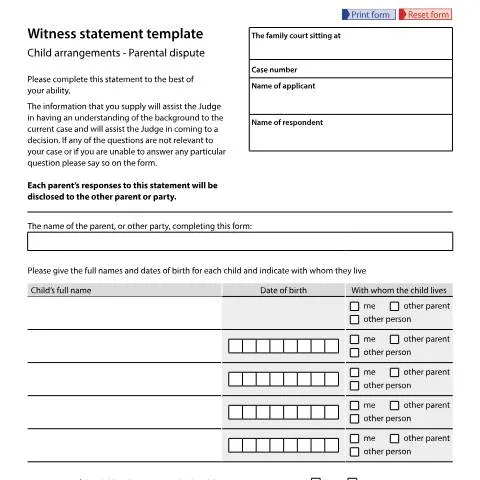
When parents cannot agree on where children should live or how much time they should spend with each parent, family courts across England and Wales rely on a crucial document to understand the reality behind the legal dispute. The C120 Witness Statement template for Child arrangements - Parental dispute serves as the primary vehicle for parents to present their perspective directly to the judge, transforming complex family dynamics into structured evidence that can guide life-changing decisions.
This eight-page document, issued by HM Courts & Tribunals Service, represents more than just paperwork—it's often the foundation upon which judges build their understanding of what arrangements will best serve a child's welfare. Unlike many court forms that focus on legal technicalities, the C120 delves deep into the practical realities of family life, from bedtime routines to school runs, from housing conditions to parenting concerns.
The statement becomes particularly significant because each parent's responses will be disclosed to the other parent or party, creating a transparent but potentially challenging environment where honesty must be balanced with the knowledge that every word will be scrutinised by the opposing party and their legal representatives.
Mapping Family Life: Understanding the C120's Comprehensive Structure
The C120 witness statement follows a methodical progression through 18 core questions, each designed to paint a complete picture of the children's current circumstances and future needs. The form begins with basic identification details—the family court location, case number, and parties involved—before diving into the heart of family arrangements.
Child-focused foundation: The opening section requires detailed information about each child, including full names, dates of birth, and current living arrangements. This seemingly straightforward section can become complex in cases involving multiple children with different arrangements, or where children split their time between households.
The medical history question (Question 1) often catches parents off-guard with its implications. While it appears simple, any disclosed medical conditions can significantly influence custody arrangements, particularly if ongoing treatment requires proximity to specific healthcare providers or if one parent has demonstrated better management of medical needs.
Relationship timeline and separation: Questions 2 and 3 establish the relationship history and separation circumstances. These responses provide crucial context for understanding current tensions and can reveal patterns of behaviour that may influence parenting arrangements. The court uses this information to assess whether relationship breakdown affects parenting capacity.
The pre-proceedings childcare arrangements (Question 4) often become the baseline for future arrangements. Courts typically favour maintaining established patterns that work well for children, making accurate documentation of historical arrangements essential.
Daily Realities: Documenting Children's Routines and Living Conditions
Questions 5 through 12 form the practical heart of the C120, requiring parents to document the minutiae of children's daily lives. This section transforms abstract parenting concepts into concrete evidence that judges can evaluate.
Weekly routines and weekend arrangements must be described comprehensively, including which parent handles specific responsibilities like homework supervision, meal preparation, or bedtime routines. Extended family involvement becomes particularly relevant here, as grandparents or other relatives who provide regular childcare can strengthen a parent's case for increased time with children.
Employment considerations (Question 6) directly impact practical arrangements. Parents must detail working hours and existing childcare solutions, which can reveal capacity for increased responsibility or highlight potential challenges in proposed arrangements.
| Housing Assessment Factor | Key Considerations | Potential Impact on Arrangements |
|---|---|---|
| Property type and size | Number of bedrooms, space for homework | Determines overnight capacity |
| Sleeping arrangements | Separate bedrooms for children, age-appropriate arrangements | Influences frequency of overnight stays |
| Geographic proximity | Distance between homes, transport links | Affects practical feasibility of arrangements |
| School accessibility | Journey time, transport method, safety considerations | Determines school-week living arrangements |
The housing assessment questions (7-10) require specific details that go beyond simple property descriptions. Courts evaluate whether children have adequate space, appropriate sleeping arrangements, and reasonable access to schools and activities from each parent's home. Journey times between homes become particularly crucial in determining the practicality of shared arrangements.
Beyond the Basics: Children's Activities, Personalities, and Educational Needs
Questions 11 through 14 shift focus from logistics to the children's individual characteristics and needs. This section allows parents to demonstrate detailed knowledge of their children's personalities, interests, and educational requirements—factors that can significantly influence custody decisions.
Extracurricular activities and hobbies (Question 11) serve multiple purposes in court assessments. They demonstrate parental engagement with children's interests and reveal practical considerations about transport to activities, equipment provision, and schedule coordination. Parents who can maintain children's established activities often strengthen their position for increased time.
The personality assessment (Question 12) requires nuanced understanding of each child's individual needs. Courts look for evidence that parents recognise their children as unique individuals rather than viewing them as a collective unit. Responses might include details about:
- Individual communication styles and emotional needs
- Specific likes and dislikes that influence daily routines
- Particular sensitivities or triggers that require careful management
- Special interests or talents that need nurturing
- Friendship patterns and social needs
Educational concerns (Question 13) can reveal significant issues affecting children's welfare. While a simple "No" might seem preferable, courts often view honest disclosure of educational challenges as evidence of engaged parenting, particularly when accompanied by details of steps taken to address concerns.
The relationship quality assessment (Question 14) requires particular care, as responses will be shared with the other parent. Courts look for balanced perspectives that acknowledge both strengths and areas for improvement in parent-child relationships, rather than wholly positive or negative assessments that may appear unrealistic.
Emotional Landscapes: Assessing Children's Coping and Parental Concerns
Questions 15 through 18 venture into more sensitive territory, requiring parents to assess their children's emotional wellbeing and express concerns about the other parent's capabilities. These responses often carry the greatest weight in judicial decision-making while requiring the most careful consideration.
Children's coping mechanisms (Question 15) demand honest assessment of how separation and ongoing disputes affect young people. Courts recognise that children's reactions vary significantly based on age, personality, and the level of conflict they witness. Effective responses might describe:
- Behavioural changes observed since separation
- Emotional responses to transitions between homes
- Sleep or appetite changes that may indicate stress
- Academic performance fluctuations
- Social interaction changes with friends or extended family
The proposed arrangements section (Question 16) requires parents to articulate their ideal outcomes while providing reasoned justification. Courts favour proposals that demonstrate flexibility and focus on children's needs rather than parental preferences. Successful responses typically acknowledge the other parent's importance while explaining why specific arrangements would benefit the children.
Parenting ability concerns (Question 17) present a particular challenge, as they will be shared with the other parent and may escalate conflict. However, genuine welfare concerns must be raised. Courts distinguish between concerns rooted in evidence of harm or inadequate care versus those stemming from relationship breakdown or different parenting styles.
Official Involvement and Safeguarding: When Authorities Have Been Involved
Question 18 addresses any previous involvement with social services or police, requiring disclosure that can significantly impact court decisions. This section demands careful attention to accuracy and completeness, as courts have access to official records that can verify disclosed information.
Social services involvement doesn't automatically prejudice court decisions, but failure to disclose known involvement can severely damage credibility. Parents must provide specific details including:
- The local authority involved and approximate dates
- Reasons for initial referral or investigation
- Outcomes of any assessments or interventions
- Current status of any ongoing involvement
- Contact details if known and relevant
Police involvement might range from domestic violence incidents to welfare checks, each carrying different implications for custody arrangements. Courts need complete information to assess any ongoing risks to children's safety or wellbeing.
The form explicitly requests contact details for involved agencies, enabling courts to obtain additional information if necessary. This transparency requirement means parents cannot selectively disclose only favourable aspects of official involvement.
Strategic Completion: Maximising Impact While Maintaining Credibility
Completing the C120 effectively requires balancing honesty with strategic presentation. Courts value detailed, specific responses over generalised statements, but excessive detail can obscure key points. Each response should focus on children's welfare rather than parental grievances or relationship history.
The instruction to complete the statement "to the best of your ability" provides flexibility for parents who cannot answer specific questions due to limited knowledge or relevance to their situation. However, stating "I don't know" requires careful consideration—courts may interpret lack of knowledge about children's routines or needs as evidence of limited involvement.
Documentary evidence can support witness statement claims, though the C120 itself doesn't request specific attachments. Parents might consider preparing supporting materials such as:
- School reports or communication with teachers
- Medical records relevant to disclosed conditions
- Photographs of living accommodations or children's spaces
- Activity schedules or club membership confirmations
- Character references from relevant professionals
The mutual disclosure requirement means every statement serves dual purposes: advocating for desired arrangements while potentially providing ammunition for the opposing party. Effective completion requires anticipating how responses might be challenged while maintaining accuracy and completeness.
Court Integration and Next Steps: How Your Statement Influences Proceedings
The completed C120 becomes part of the court bundle reviewed by judges before hearings, often forming the foundation for further court directions. Unlike witness statements in other legal contexts, family court witness statements focus primarily on factual circumstances rather than legal arguments, though they significantly influence judicial decision-making.
Courts may use C120 responses to identify areas requiring additional investigation, such as ordering social services assessments, child welfare reports, or specialist evaluations. Discrepancies between parents' statements often highlight disputed facts that require resolution through additional evidence or expert testimony.
The statement's timing within proceedings affects its impact. Early completion allows courts to identify key issues and make appropriate directions, while delayed submission may limit the court's ability to gather additional evidence before final hearings.
Judges typically review both parents' statements alongside any responses from children's guardians or social workers involved in proceedings. The comparative analysis reveals different perspectives on the same circumstances, helping courts identify areas of agreement and dispute.
Subsequent court directions might include requirements for updated statements if circumstances change significantly, or specific questions arising from initial submissions. The C120 thus begins rather than concludes the evidence-gathering process in child arrangement proceedings, establishing the factual foundation upon which courts build comprehensive assessments of children's best interests.
Understanding the Court's Assessment Framework for Child Arrangement Orders
When completing Form C120, it's crucial to understand how the court evaluates witness statements within the broader framework of child arrangement cases. The Children Act 1989 establishes the paramount principle that the child's welfare is the court's primary consideration, but this translates into specific assessment criteria that directly influence how your witness statement should be structured.
The court applies what's known as the 'welfare checklist' under Section 1(3) of the Children Act 1989. Your witness statement must address these factors systematically: the ascertainable wishes and feelings of the child (considered in light of their age and understanding), their physical, emotional and educational needs, the likely effect of any change in circumstances, their age, sex, background and relevant characteristics, any harm suffered or at risk of suffering, and how capable each parent is of meeting the child's needs.
When addressing the child's wishes, avoid simply stating what they've told you. Instead, provide context about when and how these views were expressed, whether they appeared coached or spontaneous, and how they align with the child's demonstrated behaviour. For instance, rather than writing "Sophie wants to live with me," explain: "During our regular bedtime routine on Tuesday evenings, Sophie consistently expresses anxiety about returning to her father's house, specifically mentioning feeling 'scared' when he raises his voice during homework time."
The court pays particular attention to evidence of parental capacity. This encompasses practical care arrangements, emotional availability, and ability to promote the child's relationship with the other parent. Document specific instances that demonstrate these qualities, including how you've handled challenging situations, your approach to discipline, and crucially, your efforts to facilitate contact with the other parent despite any personal difficulties.
Educational continuity carries significant weight in court decisions. If seeking to change the child's residence, address how this would affect their schooling, friendships, and extracurricular activities. Provide concrete details about school performance, attendance records, and any special educational needs. Where possible, reference communications with teachers or educational professionals, though remember that their direct statements would typically require separate witness statements from those individuals.
Financial considerations, while not determinative, remain relevant to the court's assessment. However, avoid detailed financial disclosures in Form C120 unless directly relevant to the child's welfare. Instead, focus on how resources are used to benefit the child - for example, maintaining a stable home environment, funding activities that support their development, or ensuring adequate childcare arrangements that allow you to work.
Addressing Allegations and Counter-Allegations Effectively
Parental dispute cases often involve serious allegations that require careful handling in your witness statement. The court expects you to address concerning behaviours or allegations made against you directly and proportionately, while maintaining focus on the child's welfare rather than engaging in character assassination of the other parent.
When responding to allegations, structure your response in three parts: acknowledge what happened (if anything), provide your perspective with supporting evidence, and demonstrate what you've learned or changed as a result. For example, if accused of inappropriate discipline, you might acknowledge a specific incident, explain the circumstances and your reasoning, provide evidence of any parenting courses attended subsequently, and describe how your approach has evolved.
Avoid blanket denials unless allegations are completely false. Courts are experienced in family dynamics and recognise that most situations involve elements of truth on both sides. Instead, provide nuanced responses that show self-reflection and commitment to improvement. If allegations involve domestic abuse, take them particularly seriously - even if you believe they're exaggerated, demonstrate understanding of their impact on children and outline specific steps taken to address any concerning behaviours.
When making counter-allegations, ensure they're directly relevant to the child's welfare rather than attempts to discredit the other parent. Focus on patterns of behaviour rather than isolated incidents, and provide specific examples with dates where possible. For instance, rather than stating "He's always late for contact," specify: "Contact handovers arranged for 6pm on Fridays have occurred after 7pm on six occasions in the past two months (specific dates), causing disruption to Emma's bedtime routine and her anxiety levels the following day."
Document any professional involvement carefully. If social services, police, or healthcare professionals have been involved, reference their involvement appropriately but avoid speculating about their conclusions unless you have written evidence. Simply state facts: "Following the incident on [date], I contacted the local authority children's services team and a social worker visited our home on [date]. I understand they are conducting an assessment and am cooperating fully with their enquiries."
Remember that the court may order a Section 7 report from CAFCASS (Children and Family Court Advisory and Support Service) or a Section 37 investigation by the local authority. Your witness statement should demonstrate openness to professional scrutiny and willingness to engage with support services where recommended.
Practical Considerations for Complex Family Circumstances
Many child arrangement cases involve additional complexities that require specific attention in your witness statement. These might include international elements, special needs children, domestic abuse histories, substance abuse concerns, or involvement of extended family members. Each scenario demands tailored approaches while maintaining focus on the child's best interests.
For cases involving international elements - perhaps where one parent is from another country or there are concerns about child abduction - address these issues directly in your statement. Outline your ties to the UK, including employment, property, family connections, and the child's established life here. If the other parent has expressed intentions to relocate abroad with the child, document these statements with dates and circumstances. Equally, if you're seeking to relocate, provide comprehensive plans demonstrating how the move would benefit the child and how contact with the other parent would be maintained.
When children have special educational needs or disabilities, your witness statement should demonstrate detailed understanding of their requirements and how you meet them. Include information about medical appointments attended, therapy sessions facilitated, school meetings participated in, and specialist equipment or adaptations provided. Show how you coordinate with professionals and advocate for your child's needs within educational and healthcare systems.
Substance abuse allegations require particularly careful handling. If you have a history of substance abuse, demonstrate concrete steps toward recovery including treatment programmes completed, ongoing support accessed, and lifestyle changes implemented. Provide evidence of sustained sobriety where applicable, such as regular testing or professional supervision. If making allegations about the other parent's substance use, focus on observed effects on the child rather than speculation about consumption levels.
Extended family involvement can significantly impact child arrangement decisions. Document positive relationships between your child and grandparents, aunts, uncles, or family friends who provide support. Conversely, if there are concerns about the other parent's family members, focus on specific incidents affecting the child rather than general disapproval. The court recognises that children benefit from wide support networks when these relationships are healthy and positive.
Mental health considerations affecting either parent should be addressed sensitively but honestly. If you have mental health challenges, demonstrate how you manage them without compromising your parenting capacity. Include information about treatment received, medication compliance where relevant, and support systems in place. Avoid stigmatising language about the other parent's mental health, instead focusing on observable impacts on parenting capacity and the child's wellbeing.
Financial abuse often intertwines with child arrangement disputes, particularly where one parent has controlled household finances or hidden assets. While detailed financial matters are typically addressed in separate proceedings, reference relevant impacts on child welfare in your statement. This might include inability to provide adequate housing, educational opportunities, or healthcare due to financial control or lack of access to resources.
Technology and social media present modern challenges in family disputes. Address any concerns about inappropriate online exposure of children, cyberbullying between parents, or use of technology to monitor or control. Conversely, demonstrate your own responsible use of technology and social media, particularly regarding posting about your children or the family situation.