When Child Arrangements Break Down: Navigating the C79 Enforcement Application
The breakdown of child arrangements can be one of the most distressing experiences for separated families. When a parent repeatedly fails to comply with a court-ordered child arrangements order—missing handovers, denying contact, or ignoring the agreed schedule—the affected parent faces a difficult reality: how to enforce what should be a legally binding commitment to their child's welfare.
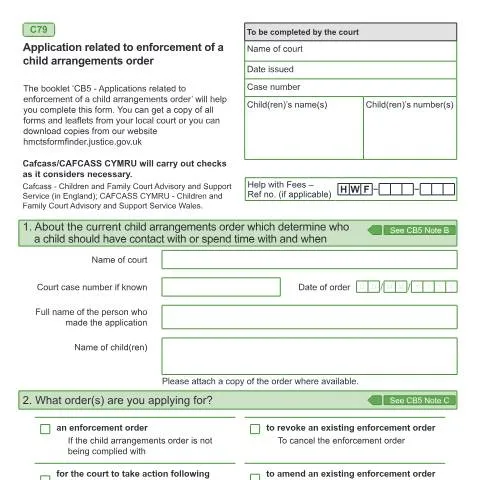
Form C79 represents the formal mechanism through which HM Courts & Tribunals Service addresses these breaches. This application form serves multiple enforcement purposes, from seeking initial enforcement orders to claiming compensation for financial losses incurred when the other parent fails to honour their obligations. Unlike other family court forms that establish new arrangements, C79 specifically deals with the aftermath of non-compliance, making it a crucial tool in the family justice system.
The form's significance extends beyond simple rule enforcement. It acknowledges that breached child arrangements orders cause genuine hardship—not just emotional distress, but tangible financial consequences when parents incur costs for cancelled travel, lost work time, or emergency childcare arrangements. The compensation mechanism built into C79 recognises these practical impacts whilst maintaining focus on the child's best interests.
The Enforcement Arsenal: Understanding Your Application Options
Form C79 offers several distinct enforcement pathways, each designed for specific circumstances. The choice between these options depends entirely on your current situation and the history of non-compliance.
Primary Enforcement Orders
An enforcement order represents the court's first formal response to persistent breaches. This isn't merely a warning—it typically includes unpaid work requirements for the non-complying parent, usually between 40 and 200 hours of community service. The court views this as both punishment and deterrent, designed to impress upon the respondent the seriousness of their obligations to their child.
The unpaid work component serves a dual purpose: it provides tangible consequences for the breach whilst allowing the parent to remain in the community and potentially resume proper contact arrangements. Courts generally prefer this approach to more severe sanctions that might further disrupt the child's relationship with both parents.
Financial Compensation Claims
The compensation for financial loss provision acknowledges that breached arrangements often trigger significant costs. Parents may face expenses including:
- Cancelled travel bookings when the other parent fails to hand over the child
- Emergency childcare costs when expected contact doesn't materialise
- Lost wages from taking time off work for contact that doesn't occur
- Additional accommodation costs for extended stays that become necessary
- Professional fees for attempting to resolve the breach
The key requirement is demonstrating direct financial consequence from the breach. Courts expect detailed evidence—receipts, booking confirmations, employment records showing lost pay—rather than broad estimates of inconvenience.
Modification and Management Orders
Several C79 options address ongoing management of existing enforcement orders. These include:
| Order Type | Purpose | Common Scenarios |
|---|---|---|
| Revocation | Cancel existing enforcement order | Compliance restored, circumstances changed fundamentally |
| Amendment by residence change | Transfer unpaid work location | Respondent has moved to different local justice area |
| Hours amendment | Reduce unpaid work requirement | Partial compliance, health issues, exceptional circumstances |
| Time extension | Extend 12-month completion period | Illness, employment changes, other valid delays |
These modifications reflect the court's recognition that enforcement orders must remain practical and achievable. A parent who demonstrates genuine effort to comply may find the court sympathetic to reasonable adjustments.
Establishing Your Case: Documentation and Evidence Requirements
Success with Form C79 depends heavily on the quality and completeness of your evidence. Courts require clear demonstration that breaches have occurred and, where relevant, that financial losses stem directly from non-compliance.
Proving the Breach
Your application must establish not just that contact didn't happen, but that this constitutes a clear breach of the existing child arrangements order. This requires:
Precise documentation of the original order: Attach a copy of the current child arrangements order, highlighting the specific provisions that have been breached. Courts need to see exactly what was ordered and how the respondent's actions (or inaction) contravene those requirements.
Chronological breach record: Document each incident with dates, times, and circumstances. Note attempts to contact the other parent, their responses (or lack thereof), and any explanations provided. Text messages, emails, and call logs can provide crucial evidence of your attempts to resolve matters directly.
Impact on the child: While C79 focuses on enforcement rather than welfare, courts remain interested in how breaches affect the child. Document any distress, confusion, or disappointment expressed by the child, though be mindful not to involve them directly in the legal process.
Financial Loss Evidence
Claims for compensation require meticulous financial documentation. Courts apply strict evidential standards, expecting:
- Direct causation: Clear links between the breach and the expense incurred
- Reasonable mitigation: Evidence that you took steps to minimise losses where possible
- Proportionate costs: Expenses that seem reasonable in the circumstances
For travel-related losses, provide booking confirmations, cancellation charges, and evidence of alternative arrangements made. Employment-related claims need supporting documentation from employers confirming lost wages or used annual leave. Be prepared to explain why costs were necessary and unavoidable given the breach circumstances.
Completing the C79: Section-by-Section Navigation
Form C79's structure reflects the complexity of enforcement scenarios, requiring careful attention to ensure all relevant information reaches the court.
Court and Order Identification
The opening section establishes the foundation for your application. You must identify the court that made the original child arrangements order and provide the case number if known. This enables the court to access the complete case history and understand the context for your enforcement application.
When providing the order date, ensure accuracy—courts maintain strict records, and discrepancies may delay processing. If you cannot locate the exact case number, contact the court office where the original order was made; they can often retrieve this information using party names and approximate dates.
Applicant Details and Representation
Section 3 requires comprehensive applicant information, with particular attention to address confidentiality. If you have safety concerns about the respondent knowing your current address, leave the address fields blank and complete the separate C8 Confidential Address Form. This protection mechanism recognises that enforcement proceedings may escalate tensions between parties.
Legal representation details require precision if you have instructed a solicitor. Ensure all contact information is current—courts will use these details for case management communications, and outdated information can cause significant delays.
Child and Respondent Information
Sections 4 and 5 capture essential details about all parties affected by the enforcement application. For children, provide complete names exactly as they appear in the original order—variations in spelling or name usage can create confusion in court records.
Respondent details should be as current and complete as possible. If the respondent has moved since the original order, provide their current address if known. Unknown addresses don't prevent application, but they may complicate service of proceedings and delay resolution.
The Application Narrative
Section 7 represents the heart of your C79 application, where you explain the circumstances driving your enforcement request. This section varies significantly depending on your chosen remedy:
Enforcement order applications require detailed chronology of breaches, including specific dates, circumstances, and the respondent's conduct. Explain not just what happened, but the pattern of behaviour that demonstrates persistent non-compliance warranting court intervention.
Compensation claims need clear financial quantification with supporting evidence. Break down costs by category and incident, explaining why each expense was necessary and unavoidable. The total claimed amount should reflect genuine losses rather than punitive estimates.
Strategic Timing and Court Expectations
The timing of C79 applications can significantly influence their success. Courts expect applicants to demonstrate reasonable attempts at resolution before seeking formal enforcement, but they also recognise that persistent non-compliance requires prompt judicial intervention.
The Reasonable Efforts Standard
Before filing C79, courts generally expect evidence of attempts to resolve breaches directly with the other parent. This might include:
- Written communications highlighting the breach and requesting compliance
- Attempts to discuss and resolve practical obstacles to contact
- Reasonable flexibility where the other parent faces genuine difficulties
However, this expectation has limits. Courts don't require applicants to tolerate persistent or deliberate breaches indefinitely. A pattern of non-compliance, particularly where the respondent provides no reasonable explanation, may justify immediate enforcement proceedings.
Case Management and Processing
Once submitted, C79 applications follow established case management procedures. The court will:
- Initial review: Administrative staff check form completion and fee payment
- Service arrangements: Court serves the application on all respondents and relevant parties
- Response period: Respondents receive opportunity to respond to allegations
- Hearing scheduling: Court lists the matter for judicial consideration
Processing times vary significantly depending on court workload and case complexity. Simple enforcement applications may be resolved within weeks, whilst contested matters involving complex breach allegations or substantial compensation claims may take several months.
Financial Implications and Fee Structures
C79 applications attract court fees, though the family justice system provides several mechanisms for fee mitigation or exemption where appropriate.
Fill in your form directly online
No printing: type your details into the boxes of the official form, tick, then download the PDF ready to send.
- 1Type into the form boxes
- 2Tick in one click
- 3Save and download the PDF
Standard Fee Requirements
Enforcement applications incur application fees payable upon submission. The exact amount depends on the nature of your application and may differ between enforcement orders and compensation claims. Courts accept various payment methods, including fee account arrangements for represented applicants.
The Help with Fees scheme provides potential relief for applicants meeting financial eligibility criteria. This means-tested system can reduce or eliminate court fees entirely, ensuring that financial constraints don't prevent access to enforcement remedies. Applications require detailed financial disclosure, but the process is straightforward and can be completed alongside your C79 submission.
Cost Implications of Success
Successful C79 applications may result in cost orders against non-complying respondents, though family courts exercise this discretion carefully. Courts consider factors including the respondent's conduct, their financial circumstances, and the overall impact on the child's welfare when deciding whether to make cost orders.
For compensation claims, successful applicants recover their proven losses rather than receiving punitive awards. This distinction is important—C79 aims to restore the applicant's financial position rather than punish the respondent beyond the enforcement order itself.
After Submission: Court Processes and Potential Outcomes
The period following C79 submission involves several stages, each with implications for all parties involved in the enforcement proceedings.
Service and Response Procedures
Courts serve C79 applications on respondents through established procedures designed to ensure they receive proper notice of the proceedings. Service methods may include personal service, postal service to last known address, or alternative methods where standard approaches prove ineffective.
Respondents typically receive 14 days to file responses, though courts may extend this period in exceptional circumstances. Response forms allow respondents to admit or deny breach allegations, explain their conduct, and present evidence of compliance efforts or mitigating circumstances.
Judicial Consideration and Decision-Making
Family courts approach C79 applications with careful attention to proportionality and the child's welfare. Judges consider multiple factors:
- Breach severity and frequency: Isolated incidents may receive different treatment than persistent patterns of non-compliance
- Respondent's explanations: Genuine difficulties versus deliberate defiance influence judicial responses
- Child welfare implications: Courts balance enforcement against potential disruption to the child's relationships
- Proportionate remedies: Sanctions should match the seriousness of non-compliance
Hearings may proceed as paper exercises where facts are undisputed, or require oral evidence where breach allegations are contested. Courts maintain discretion to adjourn proceedings where further evidence or investigation seems necessary.
Enforcement Order Implementation
Successful enforcement applications result in orders requiring specific action from respondents. Unpaid work requirements typically involve community service arranged through local probation services, with reporting requirements and completion deadlines.
The 12-month completion period for unpaid work reflects recognition that respondents need reasonable time to fulfil their obligations whilst maintaining employment and family commitments. However, this period isn't automatic—courts may specify shorter timeframes where circumstances warrant more urgent compliance.
Compensation orders require payment within specified timeframes, typically 14 to 28 days unless the court allows instalment arrangements. Non-payment may trigger additional enforcement proceedings, though courts generally prefer arrangements that enable compliance rather than creating further financial hardship.
Ongoing Compliance Monitoring
Enforcement orders don't end court involvement in your case. The court retains jurisdiction to monitor compliance with unpaid work requirements and may take further action if respondents fail to complete their obligations within the specified timeframe.
This ongoing oversight creates accountability mechanisms that extend beyond the initial enforcement hearing. Respondents who demonstrate consistent compliance may find courts receptive to applications for order modification, whilst continued non-compliance may result in more severe sanctions including potential imprisonment for contempt of court.
The enforcement process ultimately aims to restore effective child arrangements whilst maintaining focus on the child's best interests. Success often depends not just on obtaining the right order, but on building a comprehensive record that demonstrates both the need for enforcement and your commitment to facilitating the child's relationship with both parents within appropriate boundaries.