Navigating the IE04 Form: Understanding Its Role and Importance in Insolvency Procedures
In the complex landscape of corporate insolvency, the IE04 form represents a significant step for businesses undergoing liquidation in the UK. This document is pivotal for any company registered in the UK that finds itself in insolvency proceedings in another EU member state. It not only serves as a formal declaration of such proceedings but also includes a request for consent to dissolve the company. Understanding the nuances of the IE04 form is crucial for ensuring compliance with UK insolvency laws and maintaining corporate accountability.Decoding the Structure of the IE04 Form
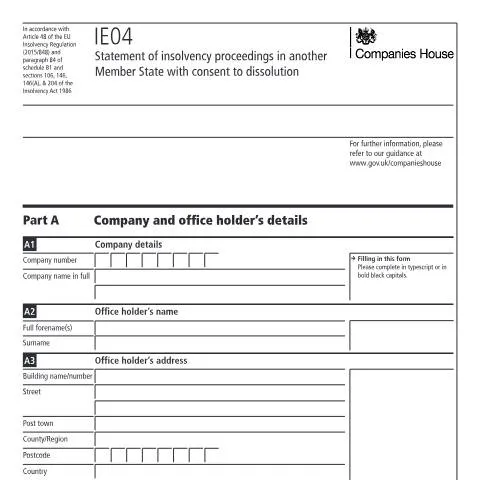
The IE04 form is meticulously designed to capture essential information regarding a company’s insolvency status. It is structured into distinct parts, each serving a specific purpose. Below is a breakdown of these sections:Part A: Company and Office Holder’s Details
This initial part requires basic information about the company involved in the insolvency process as well as the office holder managing the proceedings.- Company Name and Number: Ensure the name and company number match the public register to avoid complications.
- Office Holder’s Information: Fill in the full name and address of the office holder, which could be a liquidator or another insolvency practitioner.
Part B: Other Insolvency Proceedings
In this section, the focus is on disclosing any concurrent insolvency proceedings that may be occurring in other EU member states.- Member State Liquidator’s Information: If insolvency proceedings are taking place in another country, provide the liquidator’s name and address.
- Details of Proceedings: This section allows for the inclusion of relevant court details and any other office holders involved in the process.
Part C: Attachments and Signature
The final section of the IE04 form requires the office holder to sign and date the document, affirming the accuracy of the information provided.- Attachments: Check the relevant boxes to indicate the documents you are attaching, such as LIQ14, WU15, AM23, or others as specified.
- Signature: Ensure that the form is signed as incomplete forms may be returned by Companies House.
Unique Aspects of the IE04 Form: A Comparative Approach
It is essential to distinguish the IE04 form from other forms associated with the insolvency process. While similar documents exist, each serves a unique purpose. Below, the key differences are outlined:| Form | Purpose | Distinguishing Features |
|---|---|---|
| IE04 | Statement of insolvency proceedings in another Member State with consent to dissolution | Requires consent from a Member State liquidator; specific to cross-border insolvency. |
| LIQ14 | Notice of appointment of a liquidator | Focuses on the initiation of liquidation, not on dissolution consent. |
| WU15 | Statement of affairs | Provides a detailed overview of the company’s financial situation. |
Timing: The Crucial Calendar of Events
Filing the IE04 form is time-sensitive and has implications for the broader insolvency process. Here’s a timeline of essential dates and what to expect:- Date of Insolvency Proceedings: This is the date when the insolvency process begins in the EU member state. The IE04 must be filed promptly thereafter.
- Filing Deadline: While there is no strict deadline for filing the IE04, it should be submitted as soon as the liquidator consents to dissolution.
- Review Period: Companies House typically reviews submitted forms within a few weeks. Any errors or omissions may lead to delays.
- Post-filing Confirmation: Once the IE04 is accepted, Companies House will notify the office holder of the successful dissolution of the company.
Special Circumstances: Handling Diverse Scenarios
Certain circumstances may complicate the completion of the IE04 form. Here are a few scenarios and considerations:Cross-Border Complexities
If a company is registered in the UK but undergoing insolvency proceedings in multiple EU countries, a thorough analysis of each jurisdiction’s requirements is essential. Ensure that all relevant details from each country are accurately reflected in the IE04 to prevent conflicting information.Minor Stakeholders
In instances where the office holder is a minor, or if there are complexities involving minors as stakeholders, legal advice may be necessary to navigate the submission of the form. The involvement of an experienced insolvency practitioner is advisable to ensure compliance with all legal obligations.Urgent Proceedings
In cases where urgent liquidation is required, expedited handling of the IE04 form may be necessary. While there’s no formal expedited process, contacting Companies House directly and explaining the urgency may provide solutions that help speed up the process.The Importance of Accuracy: Consequences of Inaccurate Filings
Completing the IE04 form accurately is not only a legal requirement but also a means of preserving the integrity of the corporate dissolution process. Inaccuracies or omissions can lead to significant consequences:- Pursuit of Legal Action: Stakeholders may pursue legal action against the office holder for negligence if the form is filled out incorrectly.
- Delays in Dissolution: Companies House may reject incorrectly filled forms, resulting in prolonged insolvency proceedings.
- Financial Penalties: The office holder may face financial repercussions, including fines for non-compliance with insolvency regulations.
Final Thoughts: Ensuring Compliance and Efficiency
Successfully navigating the IE04 form requires a nuanced understanding of its role within the broader framework of insolvency proceedings. From accurate completion to timely filing, each step carries weight and importance. As companies face insolvency, understanding the specifics of the IE04 and adhering to all associated regulations ensures a smoother transition through the dissolution process. Consulting with a legal professional experienced in insolvency law can prove invaluable in ensuring compliance and mitigating risks. For those seeking to dissolve a company under these circumstances, the IE04 form stands as a critical document in facilitating an orderly and legally compliant dissolution.Understanding the IE04 Form and Its Importance
The IE04 form is a crucial document for UK businesses undergoing insolvency proceedings in another member state of the European Union. It serves as a declaration that a business consents to the dissolution process in line with the regulations set forth by the relevant jurisdiction. This form not only provides necessary information about the company’s financial situation but also ensures that the dissolution is recognized across borders within the EU.
When filling out the IE04, it is essential to gather accurate and comprehensive details about the company, including its registration number, registered office address, and particulars of the insolvency proceedings that have commenced in the other member state. Furthermore, the form requires the inclusion of a statement affirming the company’s consent to dissolution, which should be signed by an authorized representative of the company.
Understanding the nuances of insolvency laws in different EU member states is vital, as procedural differences can affect the timeline and outcome of the dissolution process. Therefore, seeking legal advice from a professional with expertise in cross-border insolvency matters can be beneficial to ensure compliance and to navigate potential challenges that may arise during the process.
Steps to Complete and Submit the IE04 Form
Completing the IE04 form requires careful attention to detail to avoid any delays or complications in the insolvency proceedings. Here’s a breakdown of the steps involved in filling out and submitting the form:
- Gather Required Documentation: Before starting the application process, ensure you have all the necessary documents at hand. This includes the company's registration documents, recent financial statements, and any correspondence related to the insolvency proceedings in the other member state.
- Fill Out the Form Thoroughly: Ensure all sections of the IE04 form are filled out accurately. Pay special attention to the company details and the declaration statement of consent for dissolution. Each piece of information will be scrutinized, so clarity is key.
- Obtain Necessary Signatures: The form must be signed by an authorized person, such as a director or company secretary. Their signature confirms the validity of the information provided and the company’s consent to the dissolution.
- Submit the Form to the Appropriate Authority: The completed IE04 form should be submitted to Companies House in the UK. Ensure that you also comply with any requirements set by the relevant authority in the member state where the insolvency proceedings are taking place.
- Monitor for Confirmation: After submitting the form, keep an eye out for any correspondence confirming receipt and acceptance of the form from Companies House. It’s important to maintain records of your submission and any communications for future reference.
Each step carries its significance, and missing any detail can lead to delays or complications. Therefore, meticulousness is essential when completing the IE04 form.
Common Pitfalls to Avoid When Submitting the IE04 Form
While many businesses successfully complete the IE04 form, there are common mistakes that can hinder the process. Awareness of these pitfalls can save time and resources:
- Inaccurate Information: Providing incorrect details about the company can lead to rejection of the form. Double-check all entries, particularly the registration number and address.
- Incomplete Documentation: Failing to include necessary supporting documents can cause delays. Ensure you attach all relevant paperwork as required by the form’s instructions.
- Lack of Proper Authority: Submitting the form without the appropriate signatures can invalidate the process. Confirm that the person signing the form has the authority to do so on behalf of the company.
- Missing Deadlines: Each jurisdiction may have its deadlines for submitting insolvency documentation. Be vigilant about the timelines to avoid complications.
- Neglecting to Communicate: After submission, maintain open communication with both the UK authorities and the relevant authority in the member state. Responding promptly to any inquiries can expedite the dissolution process.
By being aware of these pitfalls and taking proactive steps to avoid them, businesses can streamline their insolvency proceedings and enable a smoother transition through the dissolution process.