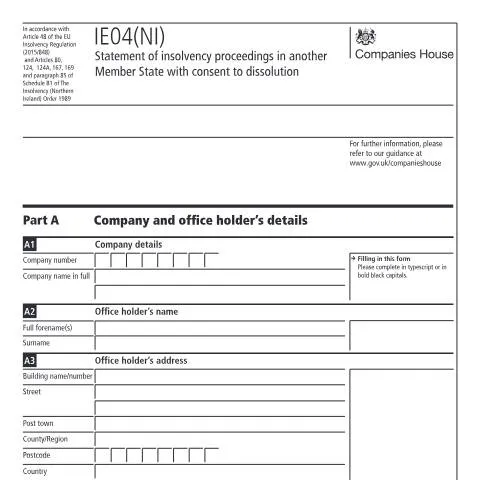
Understanding the IE04(NI) Form: A Key Document in Insolvency Procedures
In the complex landscape of business insolvency, the IE04(NI) form serves a pivotal role in ensuring that companies experiencing financial distress can navigate the intricacies of dissolution with the necessary transparency and compliance. This document is not merely a bureaucratic requirement; it facilitates the proper handling of insolvency proceedings across member states of the European Union, specifically tailored for companies operating in Northern Ireland. Understanding the IE04(NI) form is essential for office holders tasked with the management of insolvency situations, as it provides a structured way to communicate the status of proceedings and consent to dissolution.
The Framework of Insolvency Regulation
The IE04(NI) form operates under the parameters set by the EU Insolvency Regulation, particularly Article 48, which governs cross-border insolvency matters. The intention behind this regulation is to provide a unified approach to insolvency proceedings, ensuring that companies collapsing in one member state can be efficiently managed in another.
Purpose of the Regulation: The regulation aims to facilitate cooperation between courts and insolvency practitioners across the EU. This includes recognizing insolvency proceedings opened in one member state and ensuring that creditors' rights are protected in various jurisdictions.
Significance for Northern Ireland: For businesses registered in Northern Ireland, the IE04(NI) form is particularly important because it allows them to communicate insolvency proceedings that have originated in another EU member state. This is crucial for compliance with both local and European insolvency laws.
Who Needs to File the IE04(NI) Form?
Identifying whether you need to file the IE04(NI) form largely depends on the circumstances surrounding the insolvency of a company. Here are the key profiles of individuals and entities that may be involved:
Office Holders: Typically, insolvency practitioners such as liquidators are responsible for filing this form. An office holder is usually appointed to manage the insolvency process and ensure all legal documents, including the IE04(NI), are accurately completed and submitted.
Company Directors: In some cases, directors may need to be involved, particularly if there are other insolvency proceedings that affect the company or if there are specific liquidators mentioned in the form from different member states.
Cross-Border Insolvency Cases: If a company with a registered office in Northern Ireland is undergoing insolvency proceedings in another EU member state, the IE04(NI) becomes necessary to inform Companies House of the status and consent for dissolution.
Delving into the Components of the IE04(NI) Form
The IE04(NI) form is divided into distinct sections, each requiring specific information. Let's break down these components to ensure complete comprehension and accurate completion.
Part A: Company and Office Holder’s Details
This section requires the office holder to provide critical information about the company involved in insolvency proceedings. The details to be included are:
- Company Name and Number: Enter the full registered name of the company and its unique registration number as recorded in Companies House.
- Office Holder’s Name and Address: Provide the full name and the registered address of the office holder managing the insolvency case.
It is crucial to ensure that the company name and number exactly match the public records to prevent any delays in processing.
Part B: Overview of Other Insolvency Proceedings
In this section, the office holder must disclose if there are other insolvency proceedings open in another member state concerning the same company. The information required includes:
- Liquidator’s Information: Full name and address of the liquidator in the member state where additional proceedings are taking place.
- Court Details: Name and court number related to the insolvency proceedings.
This part is critical as it establishes the interconnectedness of insolvency processes and ensures that all relevant jurisdictions are aware of the status.
| Detail | Description |
|---|---|
| Liquidator’s Name | Full name of the liquidator managing the insolvency in the other member state. |
| Court Name | Name of the court where proceedings are taking place. |
| Court Number | Unique identifier for the court case in the respective member state. |
Part C: Attachments and Signature
Proper completion of the form must conclude with the office holder’s signature, confirming the accuracy of the information provided. Additionally, this section requires the inclusion of any necessary attachments that may support the insolvency statement. This can include:
- Documentation evidencing the insolvency status in the other member state.
- Any court orders or consent letters from the relevant liquidator.
It is essential to double-check that all required documents are attached before submitting the form, as the absence of documentation can lead to rejections or delays.
Navigating the Submission Process
Once the IE04(NI) is accurately completed, the next step involves its submission to Companies House. Understanding the submission process will help streamline the filing and ensure compliance with the relevant regulations.
Where to Submit: The form can be sent to any Companies House address, but for expediency, it is recommended to send it to:
The Registrar of Companies, Companies House, Second Floor, The Linenhall, 32-38 Linenhall Street, Belfast, Northern Ireland, BT2 8BG.
Submission Method: The IE04(NI) can be submitted via post. Ensure that it is sent through a reliable postal service to avoid misplacement or delays.
Tracking Your Submission
Monitoring the status of your submission is vital. Companies House does not provide tracking for forms submitted by post, but should any issues arise, you can contact them for clarification or updates regarding your filing. It is prudent to keep copies of all submitted documents for your records.
Common Pitfalls and Best Practices for Filling Out the IE04(NI)
Filling out the IE04(NI) form can be straightforward, but certain common mistakes can lead to complications. Here are some best practices to ensure your submission is successful:
- Accuracy is Key: Ensure all names, addresses, and numbers are spelled accurately and match the records at Companies House.
- Legibility: The form should be filled in typescript or in bold black capitals. Illegible handwriting can cause processing delays.
- Double-Check Attachments: Verify that all required documents are included before sending the form to avoid unnecessary delays.
Distinctive Features of the IE04(NI) Compared to Similar Forms
The IE04(NI) form may be confused with other insolvency-related forms due to the overlapping nature of insolvency regulations. However, it has distinctive features that set it apart:
- Cross-Border Functionality: Unlike regular insolvency forms that pertain solely to domestic cases, the IE04(NI) specifically addresses cross-border insolvency situations within the EU.
- Focus on Consent to Dissolution: This form explicitly includes the liquidator's consent for the dissolution of the company, a critical factor that may not be a requirement in other forms.
Understanding these distinctions will help office holders and directors effectively select the appropriate forms during the insolvency process.
Conclusion: The Importance of the IE04(NI) in Business Continuity
Filing the IE04(NI) is a significant step for any company undergoing insolvency proceedings in Northern Ireland, especially when those proceedings span across EU member states. It ensures that all parties are informed and that the dissolution process is conducted properly and in accordance with both local and EU regulations.
In these challenging times for companies facing financial difficulties, ensuring compliance and clarity through procedures such as this one not only fosters a sense of order but also protects the rights of creditors and stakeholders involved.
Understanding the Insolvency Process in the UK and EU Member States
Insolvency proceedings can vary significantly from one jurisdiction to another, particularly between the UK and EU member states. For businesses operating across borders, it's essential to comprehend how these differences can affect the insolvency process. In the UK, the Insolvency Act 1986 governs the procedures for individuals and companies, while the EU regulations on insolvency provide a framework for cross-border insolvency cases.
When a company faces insolvency, it may become necessary to bring proceedings in another EU member state, especially if the company has significant operations or assets located there. Understanding the local laws and processes becomes crucial. For instance, if a UK-based company is facing insolvency proceedings in Ireland, the process will involve different legal stipulations, including notices, filings, and potential hearings. The company must also consider the impact of the € value, as exchange rates can affect debts significantly.
It’s essential for directors and stakeholders to engage with legal advisors who specialize in cross-border insolvency. They can provide insight into the local practices and may facilitate a smoother transition regardless of jurisdiction. This is especially true when proceedings may involve multiple stakeholders across jurisdictions, requiring coordination and compliance with each relevant legal system.
Key Considerations When Filing an IE04(NI) Form
Filing an IE04(NI) form to give a statement of insolvency proceedings in another member state comes with its own set of important considerations. Firstly, it is imperative to ensure that the form is completed accurately, as errors can result in delays or complications in processing. The form requires detailed information about the company, including its registration number, the nature of the insolvency proceedings, and the specific consent to dissolution.
Moreover, understanding the timeline is critical. Once the form is submitted, the Companies House will process the application, and the overall timeline can be affected by various factors, such as the volume of applications being processed or the complexity of the case at hand. Additionally, if there are disputes regarding the insolvency or any claims by creditors, these can further prolong the process.
It is also crucial to ensure compliance with the Data Protection Act 2018 and UK GDPR when submitting personal data as part of the insolvency process. Information relating to directors, shareholders, and creditors must be handled and processed in accordance with data protection regulations to avoid potential legal repercussions.
The Role of Administrators and Liquidators in Cross-Border Insolvency
In cases of insolvency, the role of administrators and liquidators becomes particularly pivotal, especially when dealing with cross-border issues. Administrators are typically appointed to manage a company’s affairs, business, and property during the insolvency process. Their primary focus is to rescue the company as a going concern, if possible. In contrast, liquidators are appointed when the company is being dissolved, and their responsibility is to settle the company’s debts and redistribute remaining assets.
When proceedings are initiated in another EU member state, the designated administrator or liquidator must understand both the UK and the local jurisdiction's legal framework. They may need to be registered with local authorities and adhere to local reporting and operational requirements. Communication between cross-border administrators and liquidators is crucial to ensure that asset recovery and creditor claims are managed efficiently and in compliance with both jurisdictions’ laws.
Furthermore, the appointment of administrators or liquidators might also involve navigating challenges such as language barriers, differing legal practices, and the potential need for additional legal representation in the foreign jurisdiction. This makes it all the more essential for businesses to have robust cross-border insolvency plans in place and to seek guidance from professionals experienced in international insolvency matters.