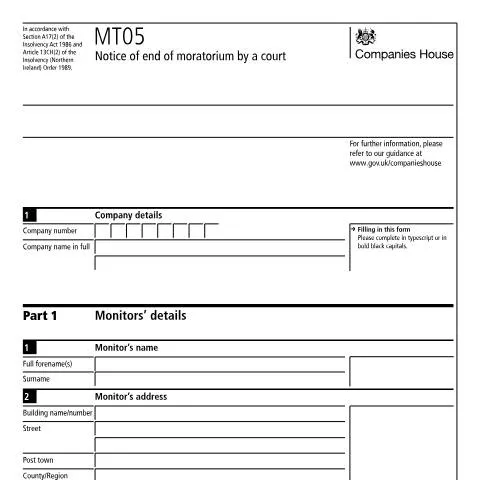
Navigating the End of a Court-Mandated Moratorium: The MT05 Form Explained
For businesses in the UK facing financial difficulties, a moratorium represents a vital protective measure, allowing time to restructure without creditor pressure. The MT05 form is pivotal for ensuring that this protection is officially brought to an end, a procedure that requires keen attention to detail. This document is not merely a formality; it has significant implications for the future of a company. Understanding how to navigate the MT05 process is critical for those involved.
Understanding the Moratorium Timeline: Key Dates and Implications
When a moratorium is granted, there are specific timelines that both the company and its creditors must adhere to. The timeline for a moratorium’s end is crucial — it dictates not just the end of protection, but also sets the stage for subsequent obligations and actions.
Key Dates:- Moratorium Start Date: The date on which the moratorium was initially granted by the court.
- Moratorium End Date: The date specified in the MT05 form indicating when the moratorium officially concludes.
- Court Order Date: This is the date when the court issued the order for the moratorium to end.
Once the moratorium ends, creditors are permitted to initiate actions to recover debts, which may include legal proceedings. Understanding this timeline helps businesses prepare for the transition back to standard financial operations.
The MT05 Form: Section-by-Section Breakdown
Completing the MT05 form accurately is paramount to avoid delays or refusals. Let’s dissect the MT05 to highlight essential sections that require careful attention.
Company Details
This section requires you to provide the full name of the company alongside its registered number. It is critical that this information matches the records held by Companies House precisely. Any discrepancies could lead to processing delays or rejection of the form.
Monitor’s Information
The monitor is typically the individual responsible for overseeing the moratorium process. Providing accurate information, including their full name, address, email, and telephone number, is essential. If there are additional monitors, their details must also be entered in the respective sections.
Moratorium End Date and Court Order Details
In this section, you will specify the end date of the moratorium and the date of the court order that indicates the conclusion. Make sure you enter these dates in the correct format (dd/mm/yyyy) to comply with submission requirements.
Signature Confirmation
The final section of the MT05 requires the signature of the monitor. This is a critical validation step; without a signature, the form is incomplete.
Handling Common Issues: Refusals and Missing Information
Submitting the MT05 can sometimes lead to complications, particularly if the form is incorrectly filled out. If Companies House identifies an issue, they may return the form for resubmission, which can lead to delays.
Common Issues Include:- Discrepancies between company name and registered number.
- Missing signatures or dates.
- Incomplete addresses for the monitor.
In the event of a refusal, it is advisable to carefully examine the feedback provided by Companies House, rectify any issues, and resubmit promptly to mitigate further complications. Keeping communication lines open with Companies House can also aid in resolving queries regarding your submission.
Submission Channels: Online versus Paper Processes
The MT05 form can be submitted through multiple channels, and understanding these options can make the process smoother and more efficient.
Submission Methods:| Method | Advantages | Disadvantages |
|---|---|---|
| Online Submission | Quicker processing time, instant confirmation of submission | Requires registration and digital capabilities |
| Paper Submission | Accessible to all, no digital skills required | Longer processing time, risk of postal delays |
Choosing the appropriate submission method depends on the company's available resources and urgency. For those who need immediate confirmation and have access to the online system, submitting digitally may be the best route.
Who Needs to Submit? Profiles and Exceptions
The MT05 form is primarily submitted by monitors acting on behalf of companies under a moratorium. However, understanding the specific profiles involved can help clarify who exactly is responsible for submission.
Typical Profiles Include:- Companies Facing Financial Difficulty: Any company under a moratorium must complete the MT05 to formally end that protective measure.
- Monitors: Individuals appointed by the company or court to oversee the moratorium process, responsible for submitting the MT05.
- Special Cases: If the company is part of a group or has multiple monitors, ensure all relevant details are provided in the MT05.
It’s essential for monitors to be clear on their role and responsibilities, especially in complex situations where multiple parties may be involved.
Tracking Your Submission: Following Up with Companies House
After submitting the MT05, you may want to track the status of your application. Keeping a record of your submission date and method will help you manage follow-ups effectively.
Methods of Tracking:- Online Account: If submitted online, you can check your Companies House account for updates.
- Contacting Companies House: Providing your reference details when inquiring can help expedite your query.
Being proactive in tracking your submission not only reduces the chance of oversight but also ensures you can address any issues that may arise swiftly.
Exceptional Circumstances: Unique Scenarios and Considerations
In certain cases, the process of completing and submitting the MT05 may involve unique considerations based on the company's structure, the nature of its operations, or other external factors.
Specific Situations to Consider:- International Companies: If a company is registered in the UK but operates internationally, ensure compliance with international laws that may affect the moratorium.
- Companies with Multiple Monitors: Coordination between monitors is necessary to ensure consistent submission of the MT05 and avoid conflicting information.
- Urgent Situations: In cases where the moratorium is ending rapidly and decisions are needed, ensure all monitors are promptly informed and can act quickly.
These exceptional scenarios underscore the importance of clear communication and adherence to regulatory requirements, as failure to comply could lead to serious repercussions for the company.
Final Thoughts on the MT05 Submission Process
Completing the MT05 form is a critical step for companies moving beyond a moratorium. Each section of the form, from company details to monitor’s information, must be approached with diligence. Engaging with Companies House proactively can significantly ease the submission process and ensure compliance with all necessary legal and administrative frameworks. As businesses navigate these complexities, thorough understanding and preparation can set the stage for a smoother transition back to standard operations.
Understanding the Process of Ending a Moratorium
The process of ending a moratorium, especially in the context of insolvency, is an essential aspect of UK law that affects both creditors and debtors. A moratorium is a temporary halt on certain actions that creditors can take to recover debts, allowing the debtor a respite and a chance to reorganise their affairs. However, this is not a permanent solution, and understanding how a moratorium can be terminated is crucial for all parties involved.
When a court grants a moratorium—typically under the Insolvency Act 1986—it comes with specific conditions. The application for a moratorium is usually made by a company, and the court assesses whether it serves the interests of creditors. The debtor must adhere to the moratorium conditions, including the filing of regular reports to the court and the creditors.
To end a moratorium, certain conditions must be met or certain actions must be taken. The court may terminate the moratorium if it finds that:
- The debtor has failed to comply with the terms of the moratorium.
- It is no longer appropriate for the moratorium to continue, given the circumstances of the debtor.
- Creditors vote to end the moratorium.
Parties involved can also petition the court to end the moratorium before its designated expiration. Such applications are typically made on the grounds of abuse of process or failure to act in the best interests of creditors. Importantly, creditors must be notified of any such applications, ensuring transparency in the proceedings.
Once a moratorium is ended, the debtor is back under the full scrutiny of their creditors, and any previous protections are no longer in effect. This may lead to potential legal actions to recover debts. Therefore, it is advisable for debtors to seek advice from legal professionals to navigate the complexities that follow the termination of a moratorium.
The Impact of Ending a Moratorium on Stakeholders
The conclusion of a moratorium has far-reaching implications not just for the debtor but also for creditors and other stakeholders involved. Understanding these impacts is vital, as it can influence decision-making for all parties.
For creditors, the end of a moratorium typically means that they can resume their collection activities. This can include making formal demands for payment, initiating court proceedings, or taking other enforcement actions. However, it's important for creditors to approach this stage with caution. They should consider the financial situation of the debtor and the practicality of recovery actions. Aggressive collection activities may result in further legal disputes or even damage their chances of recovering outstanding amounts.
Debtors, on the other hand, face renewed pressure as soon as a moratorium is lifted. They must rapidly assess their financial position, possibly reformulating their repayment strategies. If the debtor is unable to meet their obligations post-moratorium, they may need to consider alternative insolvency routes, such as administration or liquidation. It’s critical for the debtor to communicate openly with creditors to negotiate terms that may ease the burden.
Additionally, employees of the debtor company can be impacted significantly. The end of a moratorium may signal uncertainty about job security. If the company is unable to stabilise its finances, it could lead to layoffs or even closure. Employees should be aware of their rights and entitlements under employment law, including redundancy rights that may come into play if the company faces insolvency.
In conclusion, the end of a moratorium is a pivotal moment that requires careful consideration and strategic planning from all stakeholders involved. Engaging with professional advisors can be invaluable in navigating the complexities that arise after a moratorium is lifted.
Practical Steps Following the End of a Moratorium
After a moratorium is lifted, both debtors and creditors need to take proactive steps to ensure that the situation is managed effectively. Here are some practical steps that each party might consider:
For Debtors
- Review Financial Obligations: Debtors should conduct a thorough audit of their financial obligations to understand what they owe and to whom. This includes revisiting payment plans and identifying any debts that may have accumulated interest or penalties during the moratorium period.
- Communicate with Creditors: Open lines of communication with creditors can lead to more amicable resolutions. Debtors should consider negotiating repayment terms, aiming for agreements that can facilitate a smoother transition back into normal payment compliance.
- Seek Professional Advice: Engaging with insolvency practitioners or financial advisors can provide clarity on the next steps. They can offer strategies to manage debts, whether through restructuring or exploring formal insolvency options if necessary.
- Monitor Cash Flow: Post-moratorium, it is essential to have a robust cash flow management strategy. Keeping track of income and expenses will help the company to avoid slipping back into financial distress.
For Creditors
- Assess the Situation: Creditors should take a moment to assess the financial situation of the debtor. Understanding their current capability to pay is crucial before taking any further action.
- Document Communication: Documenting all communications with the debtor and any agreements made can serve as essential evidence if disputes arise in the future.
- Consider Legal Options Carefully: While creditors have the right to pursue debts, they should evaluate the costs and benefits of legal action. Sometimes, pursuing an amicable solution can yield better results than aggressive collection tactics.
- Engage with Other Creditors: In many cases, creditors may benefit from working together to approach a debtor. This can provide a united front that encourages the debtor to take their obligations seriously.
By taking these steps, both debtors and creditors can navigate the aftermath of a moratorium's end with a clearer perspective and a better chance of achieving a satisfactory outcome.