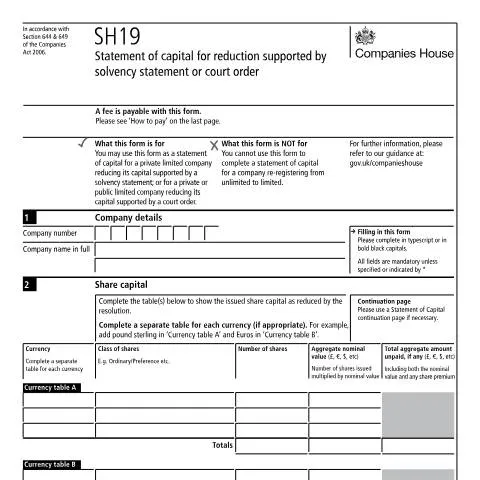
Understanding Capital Reduction Procedures Through the SH19 Statement
When a limited company in England, Wales, Scotland or Northern Ireland decides to reduce its share capital, the process involves complex legal procedures that must be carefully documented with Companies House. The SH19 Statement of capital for reduction supported by solvency statement or court order serves as the critical filing that formally records the company's reduced capital structure following completion of either a court-sanctioned reduction or a solvency statement-backed procedure under the Companies Act 2006.
Capital reduction represents one of the most significant corporate restructuring activities a company can undertake, potentially affecting creditor rights, shareholder interests, and the company's ability to make distributions. The SH19 form ensures that the public record accurately reflects the company's new capital position after this fundamental change has been legally completed.
Two Distinct Legal Pathways for Capital Reduction
The SH19 form accommodates two separate legal procedures for capital reduction, each governed by different sections of the Companies Act 2006. Understanding which pathway applies determines the specific requirements and timing for filing this statement.
Court-Sanctioned Reductions Under Section 645-648
The traditional court-sanctioned route requires companies to apply to the High Court for confirmation of the capital reduction. This procedure involves all types of limited companies - both private and public - and requires court approval before the reduction takes effect. The court examines whether the reduction unfairly prejudices creditors or shareholders, and may impose conditions or require creditor consent.
Under this pathway, the SH19 must be filed after the court order confirming the reduction has been made. The form records the capital structure as modified by the court's decision, which may differ from the company's original proposals if the court imposed variations or conditions.
Solvency Statement Route for Private Companies
Private limited companies may use the streamlined solvency statement procedure under sections 641-644, avoiding court involvement entirely. This process requires directors to make a statutory declaration that the company will remain solvent for twelve months following the reduction, taking into account all contingent and prospective liabilities.
The solvency statement must be made no more than 15 days before the resolution to reduce capital, and the reduction becomes effective when the special resolution is passed. The SH19 filing occurs after the resolution, documenting the reduced capital structure that results from this director-certified procedure.
Detailed Capital Structure Documentation Requirements
The core purpose of form SH19 lies in its comprehensive recording of the company's share capital following reduction. This documentation goes far beyond simple numerical changes, requiring detailed specification of share rights and characteristics across potentially multiple currencies.
Multi-Currency Capital Structures
Companies with share capital denominated in different currencies must complete separate tables for each currency used. Currency Table A typically records pound sterling shares, while Currency Table B accommodates euros, US dollars, or other foreign denominations. This separation ensures accurate calculation of aggregate values and prevents confusion in cross-currency arithmetic.
| Currency Table | Typical Use | Calculation Requirements |
|---|---|---|
| Table A | Pound sterling (£) denominated shares | Number of shares × nominal value = aggregate nominal value |
| Table B | Foreign currency shares (€, $, etc.) | Separate calculation maintaining original currency |
| Grand Total | Combined summary showing all currencies separately | No currency conversion - list each separately |
Share Class Specification and Rights Attachment
Each class of shares must be individually documented with its prescribed particulars clearly stated. The form requires specification of four mandatory categories of rights for each share class:
- Voting rights: Including conditional voting rights that arise only in specific circumstances, such as dividend arrears or winding-up scenarios
- Dividend participation rights: Detailed description of how each class participates in profit distributions, including preferential rights or cumulative provisions
- Capital distribution rights: Rights regarding capital distributions during the company's life and upon winding-up, including liquidation preferences
- Redemption characteristics: Whether shares are redeemable at the company's option, shareholder's option, or both, including any mandatory redemption provisions
This detailed rights specification becomes particularly critical following capital reduction, as the procedure may have altered the relative positions of different share classes or created new preferential arrangements.
Practical Completion Challenges and Technical Requirements
Filing the SH19 accurately requires careful attention to computational details and formatting requirements that reflect Companies House's emphasis on precision in capital documentation.
Unpaid Share Capital Calculations
The form requires careful calculation of any unpaid amounts on shares, representing the difference between nominal value and amounts actually paid up. Following capital reduction, these calculations become complex because:
- The reduction may have converted unpaid amounts to paid-up capital
- Share premium accounts may have been applied to write off unpaid capital
- Court orders may have imposed specific treatments for partly-paid shares
Companies must enter '0' or 'nil' explicitly if shares are fully paid, rather than leaving fields blank, which Companies House may interpret as incomplete filing.
Continuation Page Requirements
Complex capital structures often require additional Statement of Capital continuation pages beyond the standard SH19 form. This particularly applies to companies with:
- Multiple share classes with extensive rights variations
- Share capital in more than two currencies
- Detailed conditional voting or distribution rights requiring extensive description
Each continuation page must maintain the same level of detail and accuracy as the main form, with totals carefully carried forward to the grand total section.
Authentication and Filing Authority Framework
The SH19 requires authentication by specific categories of company officers, reflecting the significance of capital reduction as a fundamental corporate change requiring senior-level authorization.
Eligible Authenticating Parties
Authentication may be provided by directors, company secretaries, persons authorized under sections 270 or 274 of the Companies Act 2006, or Community Interest Company managers. For UK Societas companies, the authentication requirements adapt to reflect their distinct management organ structure rather than traditional director roles.
The authenticating person's name appears on the public record permanently, creating personal accountability for the accuracy of the capital statement. This public visibility serves as an important check against casual or inaccurate filings.
Timing Coordination with Related Filings
The SH19 filing must coordinate precisely with other Companies House submissions related to the capital reduction process. For solvency statement procedures, this includes ensuring the special resolution reducing capital has been properly filed before submitting the SH19. For court-sanctioned reductions, the court order must be registered before the capital statement can be accepted.
Regulatory Compliance and Public Record Implications
Filing form SH19 creates permanent public record entries with significant implications for the company's ongoing regulatory compliance and commercial relationships.
Creditor and Stakeholder Notification Effects
The public filing serves as formal notification to existing and potential creditors of the company's reduced capital base. This information directly affects:
- Credit assessments: Lenders and suppliers may reassess credit limits based on reduced capital cushions
- Covenant compliance: Existing loan agreements may contain minimum capital maintenance requirements
- Regulatory capital requirements: Regulated companies may need to demonstrate continued compliance with sector-specific capital adequacy rules
Distribution Capacity Calculations
The reduced capital structure documented in the SH19 directly impacts the company's legal capacity to make distributions to shareholders. Under the Companies Act 2006, distributions may only be made from accumulated, realized profits available for distribution, calculated after accounting for the capital reduction's effects.
Companies must carefully consider whether the capital reduction creates or eliminates distributable reserves, particularly where the reduction involves writing off accumulated losses or creating new reserves from share premium cancellation.
Fee Structure and Processing Practicalities
Companies House charges a £20 fee for processing the SH19, payable by cheque or postal order made out to 'Companies House'. This fee applies regardless of whether the capital reduction follows the court-sanctioned or solvency statement route.
The form may be submitted by post to the appropriate Companies House office or uploaded electronically where the company's filing systems support digital submission. Processing typically takes 5-7 working days for postal submissions, with electronic filings processed more rapidly.
Common Processing Delays and Rejection Reasons
Companies House frequently returns SH19 forms for correction due to:
- Arithmetic errors in share capital calculations, particularly in multi-currency scenarios
- Incomplete rights specifications for share classes, especially omitting conditional voting rights or redemption characteristics
- Mismatched company details where the company name or number differs from the public register
- Missing authentication or authentication by persons lacking proper authority
Rejected filings delay the completion of capital reduction procedures and may affect the company's ability to rely on the legal protections that proper filing provides against creditor challenges to the reduction.
Strategic Considerations for Complex Corporate Structures
The SH19 filing represents more than administrative compliance - it crystallizes fundamental changes to the company's financial architecture with lasting strategic implications.
Companies undertaking capital reduction often do so as part of broader corporate restructuring, whether to eliminate accumulated losses, return surplus capital to shareholders, or prepare for acquisition or merger activities. The precise documentation required by the SH19 ensures that these strategic objectives receive proper legal recognition and protection.
For companies with complex shareholding structures, including institutional investors, employee share schemes, or cross-border ownership, the detailed rights specification requirements serve to preserve existing contractual arrangements while accommodating the capital structure changes. This documentation becomes particularly valuable during subsequent corporate transactions where purchasers or advisers need clear understanding of each share class's characteristics and rights.
The permanent public record created by the SH19 filing also supports the company's ongoing corporate governance obligations, providing clear evidence of compliance with statutory procedures and proper authorization of fundamental changes to the company's constitution.
Timing and Coordination with Other Corporate Actions
The timing of your SH19 submission requires careful coordination with other corporate actions and regulatory requirements. You must file the form within 15 days of passing the resolution to reduce capital, but this deadline intersects with various other compliance obligations that demand strategic planning.
If your capital reduction coincides with a share buyback programme, you'll need to coordinate the SH19 filing with any required SH03 returns for share purchases. The statutory timelines don't automatically align—whilst SH19 has its 15-day window, share purchase returns follow different schedules depending on the nature and timing of the transactions.
Companies undertaking capital reductions as part of a broader restructuring often find themselves managing multiple Companies House filings simultaneously. A typical scenario might involve filing SH19 for the capital reduction, CS01 for director appointments if the restructuring includes board changes, and potentially PSC01-PSC09 forms if persons with significant control are affected. Each form has distinct deadlines, and late filing penalties apply independently to each submission.
The interaction with annual return cycles requires particular attention. If your capital reduction occurs close to your confirmation statement due date, ensure the reduced capital figures are accurately reflected in your next CS01 submission. Companies House systems don't automatically synchronise data between different form types, so discrepancies between your SH19 figures and subsequent confirmation statements can trigger compliance queries.
For companies with complex share structures, the timing becomes even more critical when dealing with multiple classes of shares. If your reduction affects different share classes sequentially rather than simultaneously, you may need separate resolutions and potentially multiple SH19 filings. Each reduction must be documented individually, with clear dating to establish the chronological sequence of capital changes.
International considerations add another layer of complexity. Companies with overseas subsidiaries or parent entities must consider how UK capital reductions affect their global reporting obligations. Some jurisdictions require advance notification of capital changes in subsidiary companies, potentially extending your planning timeline beyond the immediate UK requirements.
Impact on Creditor Rights and Protection Mechanisms
Capital reductions trigger specific creditor protection mechanisms under the Companies Act 2006, and your SH19 filing initiates formal processes that can significantly impact your business relationships and operational flexibility.
The court-approved reduction route requires you to demonstrate that creditor interests are adequately protected. This typically involves either obtaining creditor consent or providing security for debts. Your SH19 filing, whilst administrative, forms part of the public record that creditors and their advisers will scrutinise when evaluating their position. The level of detail you provide about the reduction's purpose and methodology can influence creditor reactions and potential objections.
Trade creditors often monitor Companies House filings systematically, particularly for companies in their supply chains. Your SH19 submission may trigger credit reviews, changes to payment terms, or requests for additional security. The timing of your filing relative to major supplier relationships, financing arrangements, or customer contracts requires careful consideration to minimise commercial disruption.
Banking relationships face particular scrutiny during capital reductions. Most commercial lending agreements include provisions requiring notification of material corporate actions, and capital reductions typically fall within these definitions. Your SH19 filing provides formal evidence of the reduction, but banks often require additional documentation and may invoke review clauses in existing facilities. Some lenders maintain automated monitoring of Companies House filings for their borrowers, meaning your submission could trigger immediate covenant compliance reviews.
The solvency statement requirement for private companies using the streamlined procedure places significant responsibility on directors. This statement, whilst not filed with the SH19 itself, must be made available to creditors and forms part of the statutory framework surrounding your capital reduction. Directors making solvency statements accept personal liability for their accuracy, and the interplay between the public SH19 filing and the private solvency statement creates a comprehensive record of the reduction's financial justification.
Pension scheme trustees represent a specific creditor category requiring particular attention. Companies with defined benefit pension schemes must consider the impact of capital reductions on scheme security and potential employer covenant strength. Trustees may have statutory consultation rights, and your SH19 filing often triggers formal reviews of employer support arrangements.
Regulatory Compliance Across Different Business Sectors
Sector-specific regulations create additional layers of compliance requirements that intersect with your SH19 filing obligations, particularly for companies operating in regulated industries where capital adequacy forms part of ongoing authorisation requirements.
Financial services companies face particularly complex requirements when reducing capital. Firms authorised by the Financial Conduct Authority (FCA) or Prudential Regulation Authority (PRA) must typically obtain regulatory approval before implementing capital reductions that could affect their regulatory capital ratios. Your SH19 filing should align with any regulatory permissions obtained, and discrepancies between approved reduction amounts and filed figures can trigger regulatory scrutiny. Insurance companies must consider Solvency II requirements, whilst investment firms need to evaluate compliance with prudential rules that may specify minimum capital thresholds.
Licensed operators in sectors such as telecommunications, energy, or transport often have licence conditions that reference share capital levels or financial resources. Ofcom, Ofgem, or other sector regulators may require notification of capital changes, and your SH19 filing provides evidence of compliance with any pre-notification requirements. Some licences include automatic review triggers when capital falls below specified levels, making accurate and timely SH19 submission critical for maintaining operational authorisations.
Companies holding government contracts or security clearances face additional considerations. Many public sector contracts include provisions requiring notification of material corporate changes, and capital reductions often fall within these definitions. Your SH19 filing creates a public record that contracting authorities can monitor, potentially affecting ongoing procurement evaluations or security vetting processes. Defence contractors, in particular, must consider how capital changes might affect their security clearance status or eligibility for classified work.
Professional service firms operating under regulatory oversight—such as law firms regulated by the Solicitors Regulation Authority or accountancy practices overseen by professional bodies—must ensure their capital reductions comply with professional rules. These bodies often have specific requirements about firm capitalisation, professional indemnity insurance coverage, or client money protection that could be affected by capital changes. Your SH19 filing should reflect reductions that maintain compliance with professional regulatory requirements.
Environmental and safety-regulated industries present unique challenges. Companies holding environmental permits or safety licences may find that capital reductions trigger review procedures with the Environment Agency, Health and Safety Executive, or other regulatory bodies. These reviews often focus on the company's continued ability to meet environmental bonds, decommissioning obligations, or safety performance standards that may be linked to financial capacity.