Understanding the Re-registration Process for Public Companies
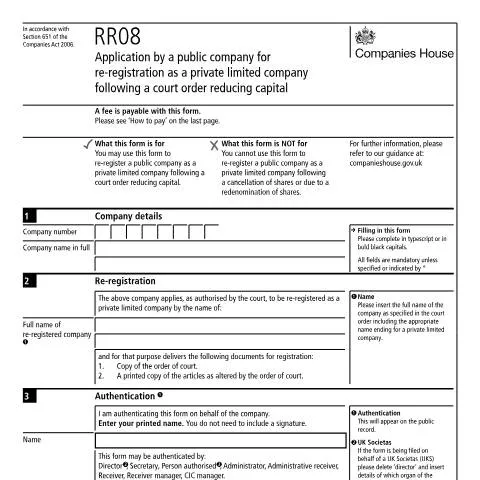
In the complex world of corporate governance, companies occasionally face the need to adapt their structures due to various circumstances, such as reducing capital following a court order. The re-registration of a public company as a private limited company is a critical process governed by UK law. Specifically, the RR08 form facilitates this transition, enabling companies to maintain operational integrity while complying with legal mandates. It’s essential to grasp the significance of this process, as it ensures that a company can effectively navigate regulatory requirements while optimizing its business structure.
The Significance of Court Orders in Company Re-registration
The ability to re-register as a private limited company is often triggered by a court order. Such orders typically arise in contexts where capital has to be reduced, necessitating a shift in company status. This action might stem from various scenarios such as financial restructuring, insolvency issues, or compliance with shareholder demands. It is crucial for directors and stakeholders to understand the implications of such orders, which can significantly influence a company's operational capacity.
For instance, a court might issue an order to reduce capital to protect creditors or to facilitate a smoother exit strategy for investors. Consequently, the re-registration through the RR08 form not only adheres to legal stipulations but also reflects a proactive approach by the management to safeguard the company’s interests.
Who Needs to File the RR08 Form?
The RR08 form is designed for public companies that have received a court order mandating a reduction in capital. The stakeholders involved in this process typically include:
- Directors: Responsible for initiating the re-registration process and ensuring that all legal documentation is in order.
- Company Secretaries: Often involved in the administrative aspects of filing the form and maintaining compliance.
- Registered Agents: May assist in submitting the form and managing the correspondence with Companies House.
It is worth noting that only public companies with a valid court order can utilize the RR08 form. Companies that aim to re-register due to reasons such as share cancellations or redenominations cannot use this form and should seek alternative routes.
Eligibility Criteria and Exceptions
While the RR08 form primarily serves public companies facing capital reductions, there are specifics to consider. For example:
- Companies with unresolved legal disputes or pending litigations may face restrictions on their ability to proceed with re-registration.
- Public companies considering re-registration should ensure compliance with Section 651 of the Companies Act 2006, which outlines the legal framework for such actions.
Additionally, it is essential to verify that the court order explicitly stipulates the need for re-registration, as the absence of such a directive may lead to complications during the submission process.
Navigating the RR08 Form: Step-by-Step Breakdown
Completing the RR08 form requires meticulous attention to detail. Each section of the form has specific requirements that, if overlooked, could lead to delays or rejections. Here’s a breakdown of the key sections:
Company Details
This section requires comprehensive information about the company, including its full name as specified in the court order and the company number. Ensure that this information matches the public register to avoid discrepancies.
- Company Name: Should reflect the full designation, including the change to a private limited company ('Ltd').
- Company Number: Must correspond with the unique identifier assigned by Companies House.
Court Order Documentation
Applicants must include a copy of the court order confirming the reduction of capital. This document is vital as it substantiates the request for re-registration.
Altered Articles of Association
Alongside the court order, a printed copy of the articles of association, as modified by the court, must be submitted. This document highlights the new governance structure and operational guidelines of the re-registered company.
Authentication of the Form
The RR08 must be authenticated by an authorized individual within the company, such as a director or secretary. Notably, this form does not require a signature but demands the printed name of the person authenticating it.
Financial Considerations: Fees and Payments
The re-registration process is not without its financial implications. A fee of £124 is applicable for submitting the RR08 form to Companies House. It’s crucial to understand the payment options available, as failure to include the required fee may result in the rejection of the application.
Payment Methods:
- Cheques: Must be made payable to 'Companies House'.
- Postal Orders: Also directed to 'Companies House'.
Implications of Non-Payment
Failing to include the appropriate fee or submitting an incorrect amount can significantly delay the re-registration process. Companies should ensure that all financial aspects are thoroughly checked before submission.
Post-Submission: What Happens Next?
Once the RR08 form is submitted along with all required documents and fees, Companies House will review the application. Understanding how to track the status of your submission can help alleviate anxiety during this period.
- Processing Time: The standard processing time can vary; however, Companies House typically aims to complete reviews within a few weeks.
- Confirmation: Upon successful re-registration, companies will receive confirmation along with an updated entry in the public register.
Tracking Your Application
While it is not mandatory to provide contact information within the RR08 form, doing so can significantly streamline communication with Companies House. If there are queries or requests for additional information, having a designated contact can be invaluable.
Potential Hurdles: What If Your Application Is Rejected?
Understanding the possible reasons for rejection is crucial for anyone involved in the re-registration process. Here are common pitfalls:
- Missing Documents: If any required documentation is absent, the application may be returned.
- Incorrect Company Information: Mismatches between the form and information on the public register can lead to delays.
- Failure to Authenticate: If the form is not authenticated correctly, it may be deemed invalid.
Steps to Take After Rejection
- Review Feedback: Carefully examine any feedback provided by Companies House to understand the rejection's basis.
- Address Issues: Correct the identified problems, whether they are documentation errors, missing fees, or authentication issues.
- Resubmit: Once all concerns have been addressed, promptly resubmit the RR08 form to avoid further delays.
The Role of Compliance in Re-registration
Re-registering a public company as a private limited entity has significant compliance implications. Companies must ensure that they adhere to the stipulations outlined in the Companies Act 2006, particularly sections relevant to re-registration procedures.
Consequences of Non-compliance
Non-compliance can lead to severe ramifications, including potential legal action against the company or its directors. Moreover, companies risk losing their operational licenses, which can have dire consequences on their ability to conduct business.
To mitigate these risks, companies should consider seeking legal counsel or professional advice during the re-registration process to ensure that all actions align with current legislation and best practices.
Conclusion: Ensuring a Smooth Transition
Successfully navigating the re-registration process from a public to a private limited company using the RR08 form requires diligence, attention to detail, and a robust understanding of the regulatory landscape. By comprehensively understanding the various elements involved—ranging from filling out the form correctly to submitting all necessary documentation—companies can facilitate a smooth transition.
Maintaining compliance with the Companies Act 2006 and addressing potential issues proactively will ensure that the re-registration process is completed efficiently. For businesses facing this critical transition, thorough preparation can make all the difference in achieving a successful outcome.
Understanding the Court Order Process for Capital Reduction
When re-registering a public company as a private limited company following a court order for capital reduction, it is crucial to understand the underlying legal framework. The process typically involves a court-sanctioned reduction of capital, which must comply with the Companies Act 2006. The court order will specify the terms of the capital reduction, ensuring that it adheres to the protections for creditors and the company’s obligations under the law.
Before initiating this process, the company must file a court application, usually under section 641 of the Companies Act, which allows for the reduction of share capital. The application must contain specific details, including the reason for the capital reduction and how it will benefit the company and its shareholders. The court will consider whether the proposed reduction will unfairly prejudice any creditors or shareholders, and whether the company’s solvency will be affected post-reduction.
Once the court grants the order, it's essential to ensure compliance with any conditions stipulated in the order. This may include publishing a notice in the official Gazette and informing any affected parties. Furthermore, it's advisable to consult with legal professionals to navigate the nuances of the court’s requirements, as failure to comply can result in significant legal repercussions and delay the re-registration process.
Implications of Re-registering from Public to Private Company Status
Re-registering from a public limited company (PLC) to a private limited company (Ltd) carries several implications that must be carefully considered. One of the most significant changes is the shift in reporting requirements. Private companies have less stringent reporting obligations compared to public companies. For instance, a private company is not required to hold annual general meetings (AGMs) or disclose as much financial information to the public, thereby reducing administrative burdens.
However, it's essential to note that transitioning to private status does not exempt the company from compliance with the Companies Act 2006. The company must continue to maintain accurate and up-to-date records, including registers of members, directors, and secretaries, and must file necessary documents with Companies House, such as annual confirmation statements and financial statements.
Another key consideration is the impact on shareholders. The re-registration process changes the nature of share capital, as private companies typically have fewer restrictions on the transfer of shares, which may alter the dynamics between existing shareholders. Furthermore, converting to private status can affect fundraising efforts, as private companies have different avenues for attracting investment compared to public ones. Engaging with stakeholders throughout the process can mitigate potential concerns and ensure a smoother transition.
Practical Steps After Re-registration: Adapting to Private Company Operations
Once a public company has successfully re-registered as a private limited company, there are several practical steps that management should undertake to adapt to the new corporate structure. One of the first tasks is to amend the company’s articles of association to reflect the change in status. The existing articles will likely contain provisions pertaining to the company’s public status, which need to be updated to comply with the requirements and regulations governing private companies.
Additionally, the company should review its internal governance structures. Since private companies are not subject to the same level of regulatory scrutiny as public companies, there may be opportunities to streamline decision-making processes and enhance operational efficiency. For instance, the company might consider adjusting its board composition or committee structures to better align with its new status.
Moreover, the company must communicate the change in status to its employees, suppliers, and other stakeholders. This transition may provide an opportunity to foster stronger relationships and build trust, given the typically closer-knit nature of private companies. Lastly, it’s wise to reassess the company’s strategic objectives in light of its new status, as the operational focus may shift towards long-term growth and stability rather than short-term market performance.