Understanding the MG06s Form: A Vital Tool for Scottish Companies
When a company registered in Scotland acquires property that is subject to a charge, the MG06s form serves as a crucial document for formal registration. This form is not just a bureaucratic requirement; it plays a key role in ensuring that the particulars of a charge are properly recorded and recognized by Companies House. Failure to file the MG06s can lead to significant legal and financial consequences for the company, affecting not merely internal governance but also external credibility and relationships with creditors.
The Importance of Registering a Charge
Registering particulars of a charge is essential for several reasons:
- Legal Recognition: Registering the charge provides legal recognition of the lender’s interests in the property, protecting their rights in case of default.
- Transparency: It ensures transparency, as the information becomes part of the public record, accessible to potential creditors and stakeholders.
- Priority of Claims: A registered charge may take precedence over unregistered ones, which is crucial in insolvency situations.
Companies must adhere to the rules under Section 880 of the Companies Act 2006 to safeguard their interests and maintain compliance with UK law. Failure to register such charges within the stipulated timeframe can severely compromise a company’s legal standing and financial health.
Chronological Path to Filing the MG06s: Step by Step
Filing the MG06s form involves several steps that must be followed meticulously to ensure successful registration. Here’s the timeline from acquisition to registration:
- Aquire Property: The company acquires property that is subject to a charge.
- Prepare Documentation: Gather all necessary documentation, including a verified copy of the charge instrument.
- Complete the MG06s: Fill out the MG06s form with accurate details.
- Pay the Fee: Ensure that the £13 fee is included with the submission.
- Submit to Companies House: Send the completed form and accompanying documents to the appropriate Companies House address.
- Await Confirmation: Wait for the registration to be processed and confirmation to be sent back.
Each of these steps is critical and must be performed with diligence. A misstep at any stage can result in delays, or worse, rejection by Companies House.
Decoding the MG06s Form: Each Section Explained
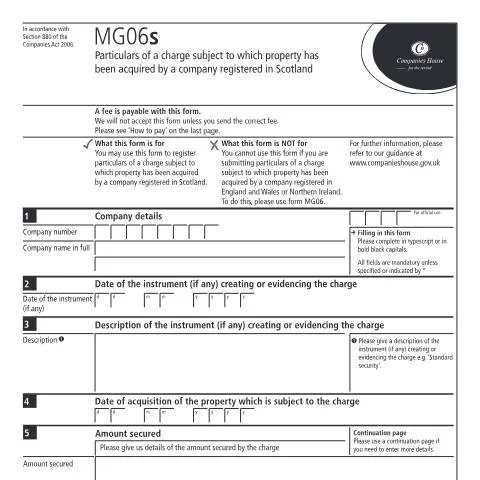
The MG06s form is divided into various sections, each serving a specific purpose. Here is a breakdown of the form:
| Field | Description | Common Pitfalls |
|---|---|---|
| 1 Company Details | Include the full company name and number. | Ensure the details match the public register to avoid rejections. |
| 2 Date of the Instrument | Enter the date when the instrument creating the charge was executed. | Inaccuracy can lead to complications in establishing priority. |
| 3 Description of the Instrument | Provide a brief description of the charge instrument, such as 'Standard security.' | Leaving this blank may lead to processing delays. |
| 5 Amount Secured | Detail the amount secured against the property. | Missing this information will invalidate your application. |
| 6 Mortgagee’s Details | List the names and addresses of mortgagees or those entitled to the charge. | Omitting details can create legal complications. |
| 7 Property Description | Provide a short description of the property that is charged. | Inadequate descriptions may lead to disputes or confusion. |
| 9 Signature | Sign the form to validate the submission. | Unsigned forms will be automatically returned. |
Each field on the MG06s form is mandatory unless specified otherwise. It's essential to double-check the entries for accuracy to avoid any delays or rejections.
What Happens After Submission? The Processing Phase
Once the MG06s form is submitted, Companies House processes the document. Typically, the timeframe for processing is relatively swift, but it may extend if there are issues with the application. Here’s what to expect:
- Verification: Companies House verifies the details against the official public register.
- Issuance of Certificate: Upon successful registration, a certificate confirming the charge will be issued.
- Notification of Issues: If there are any issues, the company will be notified, and corrective actions may be required.
It is prudent for companies to keep track of their submissions and maintain records of all correspondence with Companies House. This practice can provide valuable evidence in the event of disputes or queries regarding the charge.
Dealing with Rejections or Errors: Your Options
If the MG06s submission is rejected, it can be frustrating, but swift action can mitigate potential issues:
- Understand the Reason: Carefully review the feedback provided by Companies House to understand why the submission was rejected.
- Correct the Errors: Make the necessary amendments to the form or accompanying documents as indicated in the rejection notice.
- Resubmit Promptly: Once corrections are made, resubmit the MG06s form as soon as possible to comply with the 21-day deadline.
In cases where documents are missing or not properly verified, it is essential to address these issues immediately. Failure to do so could result in the company losing its charge registration altogether, which could have significant repercussions on financing and legal standing.
Unique Cases: Navigating Complex Situations
Some companies may find themselves in unique situations, such as having foreign entities involved or dealing with urgent timelines. In such cases:
- Foreign Acquisitions: If the property is located outside the UK, ensure compliance with both UK regulations and those in the jurisdiction where the property resides.
- Urgent Registrations: Should there be a need for expedited processing, contact Companies House directly to discuss options.
Companies with complex ownership structures or multiple stakeholders should consult legal professionals to ensure compliance with all applicable regulations and safeguards.
The MG06s Form in the Larger Context of Business Operations
The MG06s form is not an isolated document; it is part of a broader framework of corporate governance and regulatory compliance. It interacts with several other forms and requirements across the Companies House ecosystem:
- Financial Statements: Accurate financial records must align with registered charges to avoid discrepancies.
- Annual Returns: Registered charges may need to be reported in annual filings, highlighting the importance of maintaining accurate information.
- Compliance with HMRC Regulations: Ensure that property acquisitions are also compliant with tax regulations as laid out by HMRC.
Navigating the regulatory landscape requires diligence and an understanding of how various forms and documents interact, ultimately safeguarding a company’s interests during property acquisitions.
Final Thoughts on the MG06s Process
The process of completing and submitting the MG06s form may appear daunting at first glance, but with a clear understanding of each section and a meticulous approach, companies can navigate it successfully. Maintaining compliance with Companies House not only protects legal interests but also fosters trust and transparency with stakeholders. In an increasingly complex corporate environment, staying informed and prepared is the best strategy for safeguarding your company’s assets.
Understanding Charges and Their Importance in Business Operations
When it comes to securing loans or credit, businesses often use their assets as collateral. This is where charges come into play. A charge is a type of security interest that gives a lender a legal right over an asset of the borrower. In the context of a company registered in Scotland, understanding how to properly register these charges is essential for protecting the lender’s interests and ensuring that the company can manage its financial obligations effectively.
There are two main types of charges: fixed and floating. A fixed charge is attached to a specific asset, such as property or equipment, and remains in place until the debt is cleared. In contrast, a floating charge allows the company to use the asset in the ordinary course of business until a default occurs, at which point the charge 'crystallizes' and becomes a fixed charge. It's crucial to determine which type of charge best suits your financial situation and to ensure that this is accurately reflected in the MG06s form.
Steps to Register a Charge: A Comprehensive Guide
Registering a charge under the Companies Act 2006 requires careful attention to detail. Here is a step-by-step breakdown to assist you in completing the process accurately and efficiently, ensuring compliance with Scottish regulations:
- Gather Necessary Information: Before attempting to fill out the MG06s form, compile all relevant information regarding the charge. This includes the details of the borrower (the company), the lender, the type of charge, and a description of the property being charged. Additionally, gather any necessary legal documentation that supports the existence of the charge.
- Fill Out the MG06s Form: The MG06s form must include specific details such as the date of the creation of the charge, the amount secured (if applicable), and any terms related to the charge. Make sure to provide accurate descriptions of the properties involved and any rights or obligations that the charge entails.
- Submit the Form: Once the form is completed, submit it to Companies House within the stipulated time frame. In Scotland, you usually have 21 days from the date of creation of the charge to ensure proper registration. Failure to do so may result in the charge becoming void, which can have serious repercussions for the lender.
- Pay the Registration Fee: Ensure that you include the required fee with your submission. This fee varies, so it's best to check the latest information from Companies House to avoid delays in processing.
- Receive Confirmation: After submission, Companies House will process your application. Once approved, you will receive confirmation that the charge has been registered, along with a registration number. Keep this documentation for your records, as it may be required for future transactions.
Consequences of Not Registering a Charge
Failing to properly register a charge can have significant consequences for both the company and the lender. Without registration, the charge may be deemed void, meaning the lender has no legal claim over the asset in question. This can lead to considerable financial losses if the company defaults on its obligations.
Moreover, unregistered charges may complicate the company's relationships with other creditors. In the event of insolvency, unregistered charges typically rank lower in priority compared to registered ones, potentially leaving lenders with little to no recourse to recover their funds. In addition, the company may face legal consequences and reputational damage in the marketplace.
Therefore, it's crucial for both companies and lenders to understand the importance of registering charges and to adhere to all statutory requirements under the Companies Act 2006. Proper registration not only offers legal protection but also fosters trust and transparency in business operations.