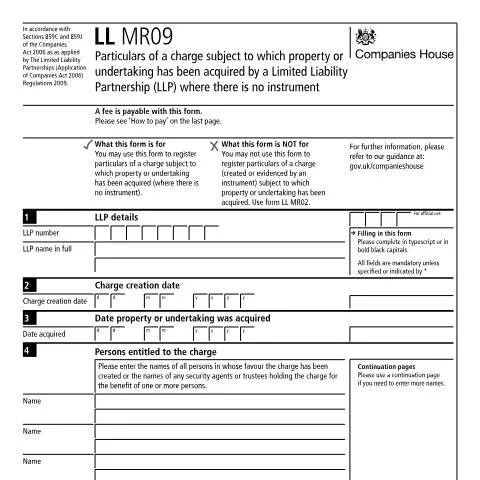
Understanding the LL MR09: A Crucial Registering Tool for Limited Liability Partnerships
For Limited Liability Partnerships (LLPs) in the UK, the LL MR09 form serves a vital purpose. This document, designed for registering particulars of a charge on property acquired by an LLP without an instrument, is essential for maintaining accurate records and ensuring compliance with the Companies Act 2006. While many may find the prospect of filling out official forms daunting, understanding the nuances of the LL MR09 can pave the way towards efficient completion and submission.
The Players Involved: Who’s Affected by the LL MR09?
While the primary users of the LL MR09 are limited liability partnerships, it’s important to recognize the associated parties who also play a role in the process:
- Members of the LLP: Individuals who hold interests in the partnership. They are directly impacted by the charges registered.
- Creditors: Entities or individuals who have financial interests in the LLP and must be informed of any charges against property acquired.
- Trustees: In cases where an LLP acts as a trustee for the property or undertaking, this role must be duly noted on the form.
Each of these groups has a stake in ensuring that the information documented on the LL MR09 is accurate and comprehensive. Missteps can lead to complications in ownership and financial liabilities, making diligence a necessity.
Regulatory Background: The Framework Behind the LL MR09
The historical context of the LL MR09 is grounded in the Companies Act 2006. This legislation governs how companies, including LLPs, must manage their financial affairs, including the registration of charges. Specifically, sections 859C and 859J outline the requirements for registering particulars of charges.
The introduction of the Limited Liability Partnerships (Application of Companies Act 2006) Regulations 2009 further clarifies the obligations of LLPs in relation to charges. These regulations ensure that LLPs operate transparently, allowing interested parties to understand the financial commitments associated with their property or undertaking.
Timelines and Deadlines: When to Act
Completing the LL MR09 isn’t just about filling out the form; timing is crucial. Understanding the calendar surrounding this process is vital for compliance:
- Charge Creation Date: This is the date when the charge was established. You must accurately reflect this date in your submission to avoid disputes.
- Date of Property Acquisition: This refers to when the LLP took ownership of the property or undertaking in question. Both dates are critical for the validity of the charge.
- Submission Deadline: The LL MR09 should be submitted promptly after the charge has been created. Delays may lead to penalties or complications in the LLP's financial standings.
Being aware of these dates and acting swiftly ensures that the LLP maintains its standing in the eyes of the law and its creditors.
Diving Deep into the Form: Filling Out the LL MR09
Completing the LL MR09 is a straightforward process, but attention to detail is essential. Each section of the document plays a distinct role:
LLP Details
At the top of the form, the LLP must provide its full name and registration number. Ensure that this information matches what is held on the public register; discrepancies can lead to rejections.
Charge and Property Details
- Nature of the Charge: This section requires a brief description of the charge itself. Be precise – vague language can confuse or mislead.
- Description of Property or Undertaking: Clearly outline what property is covered by the charge. This specificity helps all parties understand the implications of the charge.
Persons Entitled to the Charge
Here, you must list all individuals or entities entitled to the charge. If there are more names than space allows, use a continuation page. Failure to include all relevant parties can result in disputes later on.
Obligations Secured by the Charge
It is essential to provide details regarding obligations secured by this charge. This transparency aids in financial clarity and protects the interests of creditors.
Authentication of the Form
Finally, the LLP or an interested party must authenticate the form. While a signature isn’t necessary, entering a printed name is required. Ensure this is completed to avoid delays in processing.
Common Pitfalls to Avoid: Navigating the LL MR09
Even with clear guidelines, common errors frequently arise when completing the LL MR09:
- Data Mismatches: Ensure that the LLP name and number match the public register to prevent form rejection.
- Missing Dates: Both the charge creation date and property acquisition date are mandatory fields. Double-check that these are filled out correctly.
- Incomplete Information: Omitting the names of persons entitled to the charge can lead to significant complications.
By being vigilant and careful, these pitfalls can be avoided altogether.
Beyond the LL MR09: Understanding Related Documentation
The LL MR09 is often confused with other forms used in similar contexts. It’s crucial to differentiate between them to ensure that you’re using the correct documentation:
| Form | Purpose | When to Use |
|---|---|---|
| LL MR09 | To register particulars of a charge without an instrument | When property or undertaking is acquired |
| LL MR02 | To register particulars of a charge created by an instrument | When an instrument exists for the charge |
This differentiation ensures that the LLP meets all legal requirements without unnecessary complications.
Next Steps: What Happens After Submission?
Once the LL MR09 form is submitted, it enters a review process. Companies House may take some time to process and confirm the registration:
- Review Period: Companies House will review the submitted documentation for accuracy and completeness.
- Certificate Issuance: If everything is in order, a certificate confirming the registration will be sent to the presenter’s address.
- Public Record: All information provided on the LL MR09 will appear on the public record, ensuring transparency for interested parties.
Following these steps carefully will help ensure that the process runs smoothly.
Understanding Charges in Limited Liability Partnerships
When it comes to Limited Liability Partnerships (LLPs) in the UK, understanding the concept of 'charges' is crucial. A charge is a form of security interest over an asset, which can be an important tool when a business acquires property. For LLPs, registering a charge is not only a statutory requirement to ensure the interest is recognized against third parties but also serves to protect the rights of creditors. This process involves the creation of a legal claim over the property, ensuring that creditors have recourse to the asset if the LLP defaults on its obligations.
Charges can be fixed or floating. A fixed charge is attached to specific assets, such as property or machinery; these cannot be sold or disposed of without the creditor's consent. In contrast, a floating charge applies to a class of assets, allowing the LLP to use those assets in the ordinary course of business until a default occurs.
When an LLP registers a charge using the MR09 form, it must provide detailed information about the charge type, the properties involved, and any other relevant details. Failing to register a charge could lead to the charge being void against a liquidator, meaning that creditors may lose their security interest in the event of insolvency. Therefore, it is imperative for LLPs to ensure compliance with the registration process as stipulated by Companies House.
Step-by-Step Process for Completing the MR09 Form
Completing the MR09 form correctly is vital to ensure that the charge is registered without issues. Here’s a comprehensive guide to help you through the process:
- Download the Form: The MR09 form can be obtained from the Companies House website. Ensure you are using the most recent version to avoid any complications.
- Provide LLP Details: At the top of the form, include the name and registration number of your LLP. It's essential that this information matches what is on the Companies House register.
- Describe the Charge: Clearly state whether the charge is fixed or floating and provide a detailed description of the property secured by the charge. This could include the address of the property, the type of asset, and any distinguishing features.
- Debtor Information: If the LLP has multiple partners, make sure to list all relevant partners and their roles within the LLP. This helps in identifying who holds the authority concerning the charge.
- Specify Terms and Conditions: Include information about any terms and conditions associated with the charge. This might involve repayment terms or stipulations regarding default.
- Signatures: The form must be signed by a designated member of the LLP. Ensure that the signatory has the authority to represent the LLP in such matters to avoid any disputes later.
- Submit to Companies House: Once completed, submit the MR09 form along with any associated fees to Companies House. Keep a copy for your records.
It is recommended to consult legal experts when dealing with complex charges to avoid pitfalls that could arise from misunderstandings or misinterpretations of the form's requirements.
Implications of Failing to Register a Charge
The consequences of failing to register a charge cannot be overstated. In the event that an LLP does not register a charge within 21 days of its creation, the charge may be deemed void against a liquidator or administrator. This effectively means that creditors could find themselves unable to enforce their security rights over the assets, leading to potential losses.
In addition to the risk of losing priority, there are also reputational implications for the LLP. Non-compliance with the registration process may signal financial instability or disorganization, potentially impacting relationships with banks, suppliers, and investors. Moreover, unregistered charges can create disputes among creditors, particularly if multiple creditors claim rights over the same asset. In such cases, the order of priority becomes crucial and may leave certain creditors without recourse.
Another critical aspect to consider is the potential for legal action. If creditors feel that their interests have been compromised due to a failure to register, they may pursue legal channels to protect their rights. This could lead to costly litigation and further complications for the LLP.
Therefore, it’s essential for LLPs to prioritize the registration of charges promptly and accurately, protecting their interests and those of their creditors. Failure to do so could have significant ramifications for the business's overall health and operation.
Best Practices for Managing Charges within an LLP
Effectively managing charges within a Limited Liability Partnership is not just about compliance; it also plays a vital role in strategic financial management. Here are some best practices to consider:
- Maintain Accurate Records: Keeping detailed records of all charges, including their terms, conditions, and associated assets, is crucial. This not only aids in compliance but also helps in financial planning.
- Regular Review of Charges: Conducting periodic reviews of all registered charges can help assess their relevance and effectiveness. If certain properties or assets are no longer essential to the business, consider whether it's appropriate to release or restructure the charge.
- Consult with Legal and Financial Advisors: Regular interaction with legal and financial advisors ensures that your LLP remains compliant with changing regulations and that all charges are adequately managed. This can help mitigate risks and optimize the LLP’s financial performance.
- Educate Partners and Members: Ensuring that all members of the LLP are aware of the implications of charges and the importance of timely registration can foster a culture of compliance. Regular training sessions can help reinforce the significance of these practices.
- Consider Future Financing Needs: As your LLP grows, consider how emerging financial needs might impact the current charge structure. Being proactive about future financing options can help in devising a more robust charge strategy that aligns with business goals.
By applying these best practices, LLPs can effectively manage their charges, ensuring compliance while also positioning themselves for future financial stability and growth.