When Charge Modifications Trigger Mandatory Reporting Requirements
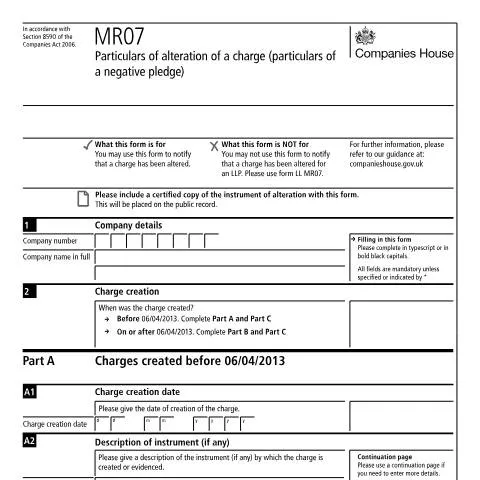
When a company's existing charge undergoes alteration—whether through variation of security terms, modification of charged assets, or changes to enforcement provisions—the MR07 form becomes the statutory vehicle for notifying Companies House. This registration requirement applies regardless of whether the alteration strengthens or weakens the charge holder's position, reflecting Parliament's intention that the public register remains current and comprehensive.
The form specifically addresses negative pledge scenarios, where companies commit not to create further charges ranking ahead of existing security. Such alterations frequently occur during refinancing arrangements, debt restructuring exercises, or when companies seek additional borrowing facilities that require modification of existing charge terms.
Unlike charge creation or satisfaction, alterations occupy a middle ground where the original security instrument remains valid but operates under modified terms. The MR07 ensures these changes become publicly searchable, maintaining transparency for potential creditors, investors, and other stakeholders who rely on charge register accuracy for commercial decisions.
Navigating the Pre-2013 and Post-2013 Charge Registration Divide
The form's structure reflects the fundamental changes introduced by the Companies Act 2006 amendments that took effect on 6 April 2013. This date creates a critical bifurcation in how charge alterations must be reported, with different completion requirements depending on when the original charge was created.
Charges Created Before 6 April 2013
For charges predating the 2013 reforms, companies must complete Part A alongside the universal Part C. This route requires detailed narrative descriptions because the pre-2013 system relied on textual particulars rather than standardised coding systems. Companies must provide:
- The exact charge creation date, formatted as DD/MM/YYYY
- A comprehensive description of the original instrument creating or evidencing the charge
- Short particulars of the property or undertaking charged, matching the original registration
The instrument description field demands particular attention, as it must accurately reflect the legal document type—whether mortgage, debenture, floating charge deed, or composite security instrument. Vague descriptions like "security document" or "charge agreement" risk rejection or delay.
Charges Created On or After 6 April 2013
Post-2013 charges benefit from the simplified Part B completion route, requiring only the unique charge code allocated by the registrar upon original registration. This alphanumeric identifier appears on the charge certificate and eliminates the need for lengthy textual descriptions.
However, companies must ensure they reference the correct charge code, particularly where multiple charges exist or where charges have been subsequently varied. The charge code system prevents ambiguity but demands precision—incorrect codes may result in alterations being registered against wrong charges, creating public record confusion.
Decoding the Instrument of Alteration Certification Requirement
Every MR07 submission must include a certified copy of the instrument effecting the charge alteration. This document becomes part of the permanent public record, meaning its contents will be searchable and downloadable by any member of the public.
The certification requirement serves multiple purposes: it provides evidence of the alteration's legal validity, enables Companies House to verify the form's accuracy, and ensures the public register contains sufficient detail for stakeholders to understand the modification's nature and scope.
Acceptable Certification Methods
Companies House accepts several certification approaches, each with specific requirements:
| Certification Type | Certifier Requirements | Typical Use Cases |
|---|---|---|
| Company Secretary | Must be appointed company secretary | Routine commercial alterations |
| Director | Must be registered company director | Where no company secretary appointed |
| Solicitor | Must hold current practising certificate | Complex restructuring arrangements |
| Licensed Conveyancer | Council for Licensed Conveyancers registration | Property-related charge modifications |
The certifier must confirm the copy's accuracy by signing and dating the certification statement, typically in the format: "I certify this to be a true copy of the original document" followed by signature, printed name, position, and date.
Understanding Signature Authority and Binding Commitments
Part C's signature requirement reflects the form's legal significance as a statutory declaration. The signature validates both the alteration's occurrence and the signatory's authority to bind the company in this registration.
The form permits signature by either the company that created the charge or the person taking the benefit of this or any affected charge. This dual option recognises that charge alterations may be initiated by either security holders seeking enhanced protection or companies requesting modified terms.
Company-Side Signature Authority
When the company signs, the signatory must possess actual authority to bind the company for statutory compliance purposes. This typically means:
- Directors acting within their general management authority
- Company secretaries exercising administrative functions
- Attorneys under powers of attorney specifically covering charge matters
- Authorised employees with delegated signing authority documented in board resolutions
Charge Holder Signature Scenarios
Charge holders may sign where they possess contractual or legal rights to effect alterations unilaterally. Common scenarios include:
- Banks exercising rights to convert floating charges to fixed charges upon default
- Trustees modifying trust deed terms affecting underlying security
- Administrators or receivers altering charges during insolvency proceedings
- Assignees of security interests updating registration following assignment
Timing Considerations and Registration Windows
Unlike charge creation, which operates under strict 21-day registration deadlines, charge alterations follow different timing rules reflecting their varied nature and triggering events. The Companies Act 2006 requires alteration registration "as soon as reasonably practicable" after the alteration takes effect.
This flexible standard accommodates the reality that alterations may result from complex negotiations, court orders, or operational changes requiring time to document properly. However, reasonably practicable generally means within days or weeks rather than months, particularly for straightforward commercial modifications.
Commercial Drivers for Prompt Registration
Beyond legal compliance, several commercial factors incentivise rapid MR07 filing:
- Credit facility drawdowns: Lenders may condition further advances on updated charge registration
- Due diligence processes: Potential investors or acquirers require current charge information
- Regulatory compliance: Listed companies may face disclosure obligations triggered by material charge modifications
- Inter-creditor arrangements: Multiple lenders may require visible registration of ranking modifications
Common Alteration Scenarios and Their Registration Implications
Charge alterations span a broad spectrum of commercial and legal circumstances, each presenting unique registration considerations that affect MR07 completion and supporting documentation requirements.
Asset Release and Substitution Arrangements
When companies seek to release specific assets from charge coverage—whether for disposal, refinancing, or operational restructuring—the alteration typically requires detailed asset identification and replacement security arrangements. The MR07 must capture these changes accurately to maintain register integrity.
Property releases present particular complexity where the original charge covered "all present and future property" or similar broad formulations. The alteration instrument must clearly specify released assets and any substitute security, with the MR07 reflecting these modifications precisely.
Negative Pledge Variations and Additional Borrowing Rights
The form's specific reference to negative pledge particulars acknowledges these provisions' commercial importance in modern lending arrangements. Companies frequently seek modifications to negative pledge clauses to accommodate:
- Working capital facilities with specific charge requirements
- Equipment financing arrangements over newly acquired assets
- Trade finance facilities requiring stock and debtor charges
- Development finance with progressive security release mechanisms
Such modifications often involve complex carve-outs, permitted encumbrance schedules, and priority arrangements requiring careful documentation and accurate MR07 completion.
Enforcement Right Modifications and Standstill Arrangements
Alterations affecting enforcement rights—whether temporary standstills, modified default definitions, or restructured payment terms—create registration obligations even where the underlying security remains unchanged. These modifications can significantly impact creditor priorities and enforcement capabilities, justifying their inclusion on the public register.
Submission Mechanics and Processing Expectations
Companies House processes MR07 forms through both electronic and postal channels, with each route offering distinct advantages depending on submission urgency and documentation complexity.
Electronic Filing Capabilities and Limitations
The electronic filing system accommodates MR07 submissions where supporting documentation can be uploaded in acceptable formats. PDF uploads must meet specific technical requirements:
- Maximum file size limitations per document
- Searchable text format preferred over scanned images
- Clear resolution enabling public record accessibility
- Appropriate file naming conventions for public searchability
However, complex alteration instruments with multiple schedules, plans, or technical drawings may exceed electronic system capabilities, necessitating postal submission with physical document bundles.
Processing Timescales and Query Resolution
Standard processing typically occurs within 8-10 working days for complete, accurate submissions. However, several factors can extend this timeframe:
Complex alteration instruments requiring detailed examination may trigger additional processing time, particularly where the modification affects multiple existing charges or involves novel security structures requiring registrar consideration.
Companies House may raise queries regarding form completion, supporting documentation, or apparent inconsistencies with existing charge registrations. Query resolution adds processing time but ensures register accuracy and legal compliance.
Upon successful processing, the alteration becomes immediately searchable on the public register, with the original instrument of alteration available for download. This transparency serves the legitimate interests of creditors, investors, and other stakeholders while fulfilling the statutory objective of maintaining comprehensive, current charge information for all registered companies.
Understanding the Legal Framework and Regulatory Context
The MR07 form operates within a complex regulatory framework governed by the Companies Act 2006, particularly sections 859A to 859Q which establish the comprehensive charge registration system. This legislative framework represents a significant evolution from earlier provisions, introducing enhanced disclosure requirements and streamlined procedures for charge modifications.
Under section 859F of the Companies Act 2006, any alteration to registered charge particulars must be notified to Companies House within prescribed timeframes. The legal definition of "alteration" encompasses modifications to security terms, changes in secured amounts, variations in property descriptions, and amendments to enforcement provisions. However, the Act distinguishes between material alterations requiring formal registration and administrative corrections that may follow simplified procedures.
The regulatory approach reflects the UK's commitment to maintaining comprehensive public records of corporate security interests. This transparency serves multiple stakeholders: creditors can assess a company's financial commitments, potential investors can evaluate security structures, and insolvency practitioners can identify secured assets during restructuring processes. The MR07 form serves as the primary vehicle for maintaining the accuracy and currency of these critical records.
Particular attention must be paid to the interaction between charge alterations and existing security documentation. Where debentures or security agreements contain specific amendment procedures, these contractual requirements must be satisfied before submitting the MR07 form. The registrar at Companies House does not verify compliance with underlying security documentation but relies on the accuracy of submitted information.
International considerations also influence the regulatory framework, particularly for charges over assets located outside England and Wales. While the MR07 process applies to charges created by companies registered in England and Wales, the interaction with foreign security interests requires careful consideration of conflict of law principles and potential dual registration requirements.
Practical Filing Strategies and Professional Considerations
Successful completion of the MR07 process requires strategic planning, particularly for complex commercial arrangements involving multiple charges or sophisticated security structures. Professional advisers typically develop filing strategies that consider timing, documentation requirements, and potential complications before initiating the alteration process.
For solicitors and company secretaries, establishing robust internal procedures becomes essential when handling frequent charge alterations. This includes maintaining comprehensive charge registers, tracking alteration deadlines, and coordinating with multiple parties involved in security arrangements. Many practitioners develop standardised checklists covering documentation requirements, fee calculations, and post-filing follow-up procedures.
The interaction between charge alterations and ongoing commercial relationships requires delicate handling. Where charges secure complex financing arrangements involving multiple lenders, the MR07 process must be coordinated with syndicate arrangements and intercreditor agreements. This often involves obtaining consents from various parties before proceeding with formal registration.
Timing considerations extend beyond statutory deadlines to encompass commercial factors such as refinancing schedules, audit requirements, and reporting obligations to regulatory bodies. For listed companies, charge alterations may trigger disclosure obligations under the Financial Conduct Authority's Listing Rules, requiring coordination between legal compliance and investor relations functions.
Professional indemnity considerations also influence filing strategies. Many law firms and corporate service providers maintain specific procedures for charge-related work, including enhanced file review processes and mandatory senior lawyer approval for material alterations. These internal safeguards reflect the significant potential liability associated with defective charge registrations.
The digitalisation of the filing process has introduced new efficiencies but also new risks. Electronic submission systems require careful attention to document formatting, file size limitations, and system compatibility issues. Professional users often maintain backup filing procedures to address potential technical difficulties, particularly for time-sensitive alterations approaching statutory deadlines.
Post-Filing Compliance and Ongoing Obligations
The completion of the MR07 filing process marks the beginning, rather than the end, of ongoing compliance obligations relating to altered charges. Companies and their advisers must maintain comprehensive records of all charge alterations and ensure consistency between Companies House records, internal registers, and underlying security documentation.
Directors' duties under the Companies Act 2006 include maintaining accurate statutory books and ensuring compliance with filing obligations. Following successful registration of charge alterations, companies must update their internal charge registers to reflect the modified terms. This internal record-keeping serves both compliance and commercial purposes, facilitating future transactions and due diligence processes.
The interaction between altered charges and financial reporting requirements demands ongoing attention. Under UK GAAP and International Financial Reporting Standards, changes to security arrangements may trigger disclosure obligations in annual accounts. Companies must ensure that charge alterations are properly reflected in financial statements and accompanying notes.
For companies subject to regulatory oversight, charge alterations may require notification to relevant authorities beyond Companies House. Financial services firms must consider Financial Conduct Authority requirements, while utilities and other regulated industries may have sector-specific obligations. The MR07 filing alone may not satisfy all regulatory requirements.
Ongoing monitoring of charge priorities becomes particularly important following alterations. Where multiple charges exist over the same assets, alterations to one charge may affect the priority ranking of others. This requires regular review of the overall security structure and potentially further filings if additional adjustments become necessary.
The Companies House digital records system provides ongoing access to filed MR07 forms and supporting documentation. However, companies should maintain their own comprehensive records including correspondence with secured parties, board resolutions authorising alterations, and evidence of compliance with underlying security documentation requirements. These records prove invaluable during future transactions, refinancing processes, or insolvency proceedings.
Professional advisers often establish post-filing review procedures to ensure that charge alterations have been properly implemented across all relevant systems and documentation. This includes updating legal opinions, revising security matrices, and communicating changes to all relevant parties including accountants, auditors, and other professional advisers involved in the company's affairs.