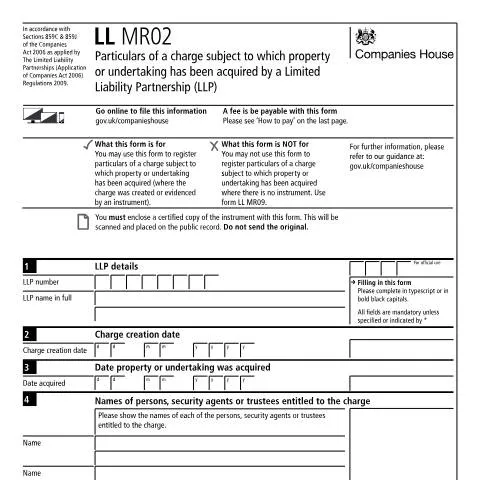
Understanding the Role of LL MR02 in Property Acquisition
In the world of limited liability partnerships (LLPs) in the UK, the document known as the LL MR02 plays a critical role. This form is essential when it comes to registering particulars of a charge against property or an undertaking that has been acquired by an LLP. When an LLP seeks financing or wishes to secure a debt through its assets, the registration of this charge through the LL MR02 ensures that the interests of the charge holders are officially recorded. This formal record is crucial, as it can dictate the order of priority if the LLP were to encounter financial difficulties.
The specifics of the charge—whether it’s a floating charge covering all property or a fixed charge on specific assets—must be accurately detailed in the LL MR02. The need for such precision stems from the legal implications of the Companies Act 2006, particularly sections 859C and 859J. By ensuring that all particulars are duly registered, the LLP safeguards its right to the property and provides transparency for lenders or other parties interested in the financial health of the business.
Before You Begin: Preparing for the LL MR02
Proper preparation is imperative before completing the LL MR02. Gathering the necessary documentation and information can streamline the process and reduce the likelihood of errors. Here’s a breakdown of the key preparatory steps:
- Identify the LLP Details: You need the name and registered number of the LLP. This information must match the records held at Companies House.
- Instrument of Charge: A certified copy of the instrument evidencing the charge is mandatory. This document should clearly outline the terms of the charge.
- Names of Charge Holders: Gather the names of all persons, security agents, or trustees who are entitled to the charge. If there are more than four, you only need to list four on the form and indicate that there are additional names.
- Charge Creation and Acquisition Dates: Ensure you have both the charge creation date and the date the property or undertaking was acquired, formatted accurately (dd/mm/yyyy).
- Financial Fees: Be prepared to pay a fee of £24 for the registration of the charge. This payment must accompany the form.
Step-by-Step Guide to Completing the LL MR02
Completing the LL MR02 requires careful attention to detail. To ensure you accurately fill out the form, follow this step-by-step breakdown:
1. LLP Identification
In the initial section, provide the full name of the LLP and its registered number. It is crucial that these details are consistent with what is recorded at Companies House.
2. Charge Creation Date
Input the charge creation date in the specified format (dd/mm/yyyy). This date signifies when the charge was formally established.
3. Acquisition Date
Similar to the charge creation date, provide the date on which the property or undertaking was acquired. This date is vital for establishing timelines.
4. Names of Charge Holders
List the names of individuals or entities entitled to the charge. If there are more than four, tick the appropriate box to indicate this fact and provide the names as required.
5. Details of Floating Charges
If applicable, indicate whether the charge is a floating charge and, if so, whether it covers all the property and undertaking of the LLP. This section is particularly important for clarifying the nature of the charge.
6. Description of Secured Property
Provide a brief description of the property or undertaking that is subject to the charge. If the charge includes multiple assets, a summary is sufficient, with a reference to the instrument for detailed descriptions.
7. Authentication of the Form
The form must be authenticated by a person with vested interests in the charge. Ensure that the name of the individual is printed clearly in the designated field. A signature is not required, but the authentication is essential for processing.
8. Submission Checklist
Before submitting the form, use the checklist provided on the LL MR02 to ensure that all required information is complete and accurate. Failing to do so may result in delays or rejection of your submission.
The Timeline for Submitting the LL MR02
Understanding the timeline associated with the LL MR02 is crucial for compliance. Once the charge is created, the LLP has a limited timeframe to register it. Here’s a typical timeline:
- Charge Creation: The process begins when a charge is created. This date is critical as it marks the starting point for registration.
- Registration Deadline: The LL MR02 must be submitted to Companies House within 21 days of the charge creation date. Late registrations can lead to complications, including the charge being deemed invalid.
- Processing Time: Once submitted, Companies House will review and process the application. If there are no issues, a certificate of registration will be issued.
- Public Record Update: After registration, the particulars of the charge will be made available on the public register, ensuring transparency for all stakeholders.
It’s essential to maintain this timeline to avoid any potential legal consequences and protect the interests of all parties involved in the transaction.
Diving Deeper: Sections of the LL MR02
Each section of the LL MR02 serves a specific purpose, and understanding them can significantly ease the completion of the form. Let’s dissect the critical sections:
Section 1: LLP Identification
This section is straightforward but crucial. The LLP name and number must match the records to prevent confusion and ensure accurate processing.
Section 4: Charge Holders
When entering the names of persons or entities entitled to the charge, detail is essential. Omitting names or providing incorrect information can lead to disputes in the future.
Section 5: Description of the Charge
Providing a concise yet comprehensive description of the charge’s nature is vital. If the charge includes various assets, ensure a clear statement is made regarding which assets are covered.
Section 7: Additional Restrictions
If there are terms within the charge that restrict the LLP from creating further security that could rank equally or ahead of the current charge, this must be clearly outlined. Clarity here can prevent future legal complications.
Section 9: Authentication
Authentication is a legal requirement that confirms the legitimacy of the information provided. Failure to properly authenticate can result in the rejection of the form.
Confusion often arises between the LL MR02 and other forms, particularly the LL MR09. Understanding these distinctions is crucial for the correct filing:
| Form |
Purpose |
When to Use |
| LL MR02 |
Register particulars of a charge for property or undertaking acquired. |
When a charge is created or evidenced by an instrument. |
| LL MR09 |
Register particulars of a charge not created by an instrument. |
When the acquisition does not involve an instrument. |
This table illustrates the distinctions between the two forms. Using the wrong form can lead to unnecessary complications and potential legal issues.
Final Steps: Submission and Follow-Up
Upon completion of the LL MR02, you have a few final steps to complete. If you plan to submit the form in person, visit the appropriate Companies House office. Alternatively, if you are sending it via post, ensure you send it to the correct address outlined on the Companies House website.
After submission, you should expect the following:
- Receipt Confirmation: Keep an eye out for confirmation of receipt, which you may receive via email or post, depending on your submission method.
- Certificate Issuance: Once processed, Companies House will issue a certificate confirming the registration of the charge, which should be kept as part of the LLP’s records.
- Public Record Availability: Note that the details you submitted will become part of the public register, making it accessible for scrutiny by creditors and other interested parties.
By following these steps and understanding the nuances of the LL MR02, you can ensure a smooth registration process for charges against your LLP’s property or undertaking.
Understanding the Charge Registration Process for Limited Liability Partnerships
When it comes to registering a charge for a Limited Liability Partnership (LLP) in the UK, the process is essential for protecting the interests of creditors and ensuring that the LLP complies with statutory requirements. A charge essentially gives a lender or creditor rights over an asset owned by the LLP, which could be property or other business undertakings. Understanding the nuances of this registration process is crucial for anyone involved in the management or financial oversight of an LLP.
The first step in registering a charge is to ensure that all necessary documentation is in order. This includes the LLP's registration with Companies House, where the LLP must have its unique registration number. The charge itself should be properly documented and may take various forms, such as a fixed charge on specific assets or a floating charge that covers assets that are subject to change over time. These distinctions are important because they affect the rights of the charge holder and the LLP's obligations.
Once the documentation is prepared, the LLP must file the necessary forms, specifically the LL MR02 form, with Companies House. This form requires detailed information about the charge, including the nature of the charge, the details of the assets involved, and the identity of the charge holder. Failure to file this form accurately can lead to complications, including the charge being deemed invalid.
The timeline for registration is also critical. Charges must be registered within 21 days of creation to ensure they are enforceable against third parties. If a charge is not registered within this timeframe, the charge holder risks losing priority over subsequent creditors. Therefore, prompt action is essential for an LLP to protect its interests and maintain a solid credit standing.
Exceptions and Special Circumstances in Charge Registration
While the charge registration process is straightforward, there are specific exceptions and special circumstances that can affect how an LLP manages this process. For instance, if the charge is created in favour of a connected person, such as a partner in the LLP, additional disclosures may be required to prevent potential conflicts of interest and ensure compliance with the relevant provisions of the Companies Act 2006.
Moreover, if an LLP defaults on its obligations under the charge, the charge holder may take various actions to enforce the charge. This could include taking possession of the charged asset, initiating legal proceedings, or entering into negotiations for repayment. However, the specific actions available depend on the nature of the charge and the terms outlined in the charge document.
There are also instances where a charge might be considered void due to non-compliance with legal requirements. For example, a charge created in contravention of a statutory prohibition or that fails to comply with the terms laid out in the LLP's governing documents may be rendered invalid. Therefore, it is advisable for LLPs to seek legal counsel when drafting charge agreements to ensure adherence to all relevant laws and regulations.
Consequences of Failing to Register a Charge Timely
The consequences of failing to register a charge in a timely manner can be significant for an LLP. As previously mentioned, the primary risk is losing priority over assets in favour of subsequent creditors. This means that if the LLP were to enter liquidation or face financial difficulties, creditors who registered their charges after the 21-day window could potentially recover their debts before the original charge holder.
Additionally, failure to register a charge may result in reputational damage to the LLP. Creditors and stakeholders may view delays in registration as a sign of poor management or financial instability, which could affect future funding opportunities or partnerships. Maintaining a good credit rating and a solid reputation in the business community are critical for the long-term success of an LLP.
To mitigate these risks, LLPs should implement robust administrative procedures to track the creation of charges and ensure timely registration. This includes setting reminders for the 21-day deadline and allocating responsibility for charge registration to a particular individual or team within the LLP. By doing so, LLPs can maintain compliance, protect their assets, and uphold their reputation in the marketplace.
In summary, understanding the intricacies of charge registration for Limited Liability Partnerships is crucial for effective financial management and legal compliance. The process may seem procedural, but the implications of proper or improper handling can significantly impact the LLP and its stakeholders in the long run. Ensuring timely registration, addressing exceptions or special circumstances, and recognizing the consequences of missed deadlines are essential components of responsible LLP administration.