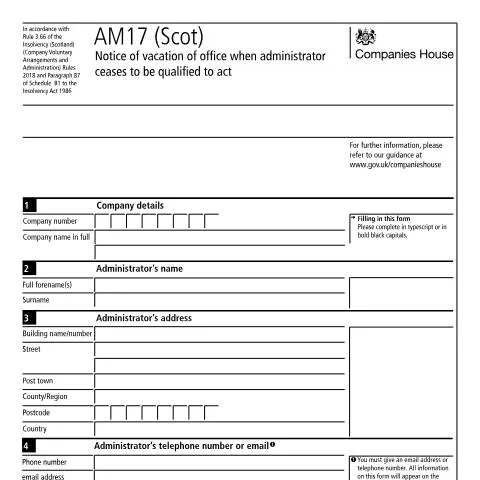
Understanding the AM17 (Scot) Notice: A Key Document for Scottish Administrators
The AM17 (Scot) form is a critical document that plays a vital role in the administrative landscape of Scottish companies. It provides a formal mechanism for notifying Companies House when an administrator ceases to be qualified to act. This situation may arise under various circumstances, necessitating a clear communication of the change to both the company and public records.
The Role of an Administrator in Scottish Companies
Administrators are appointed to manage a company when it faces insolvency, aiming to rescue the business or achieve a better outcome for creditors than would be likely if the company were wound up. An administrator must meet certain qualifications and standards. Should they fail to meet these standards, or if they choose to resign, the AM17 (Scot) notice must be filed to update Companies House.
Common Scenarios Leading to Filing the AM17 (Scot)
- Loss of Qualification: An administrator may lose their qualification due to various reasons, including failure to maintain professional standards or meeting regulatory requirements.
- Resignation: An administrator may decide to step down from their role for personal or professional reasons, necessitating formal notice.
- Completion of Duties: Upon fulfilling their responsibilities, an administrator needs to formally inform Companies House to ensure an accurate public record.
Critical Components of the AM17 (Scot) Notice
Filling out the AM17 (Scot) form requires accurate and detailed information. The following sections must be completed:
- Company Details: Include the full company name and number, ensuring they match the records held by Companies House.
- Administrator's Information: This includes the full name, address, and contact information of the administrator, which must be provided in bold black capitals.
- Date of Cessation: Clearly specify the date when the administrator ceased to be qualified to act.
- Signature: The administrator must sign and date the form, affirming the correctness of the information provided.
When is the AM17 (Scot) Notice Indispensable?
It is essential to file the AM17 (Scot) notice promptly after an administrator ceases to be qualified to act. Delays in filing can result in legal ramifications for the company and the administrator. The implications of failing to notify Companies House include:
- Potential Legal Issues: Without proper notification, the company may face penalties, and the administrator may retain liability for any actions taken while unqualified.
- Impact on Creditor Relations: Transparency regarding the administrator's status is crucial for building trust with creditors and stakeholders.
Articulating the AM17 (Scot) Notice with Other Documentation
The AM17 (Scot) form is one piece in the broader puzzle of insolvency procedures in Scotland. It’s often used in conjunction with other documentation, including:
- Insolvency Practitioner Reports: Detailed reports that accompany the AM17 (Scot) can provide context and justification for changes in administration.
- Declaration of Solvency: This document may be required to demonstrate that the company is proceeding with administration in compliance with legal obligations.
Comparison with Other Related Forms
| Form | Purpose | Timing |
|---|---|---|
| AM17 (Scot) | Notice of vacation of office for an administrator | When an administrator ceases to be qualified |
| AM2 (Scot) | Appointment of an administrator | At the beginning of the administration process |
| AM4 (Scot) | Notice of intention to appoint an administrator | Prior to the formal appointment |
Essential Terms and Concepts Related to the AM17 (Scot)
Understanding the terminology surrounding the AM17 (Scot) notice is crucial for effective navigation of the administrative process. Here are a few key terms:
- Insolvency: A financial state where a company cannot meet its obligations as debts fall due.
- Administrator: An individual appointed to manage an insolvent company's affairs, often tasked with restoring viability or liquidating the company.
- Companies House: The United Kingdom's official register of companies, responsible for incorporating and dissolving companies and registering company information.
Practical Steps for Submitting the AM17 (Scot) Notice
Submitting the AM17 (Scot) notice involves a few crucial steps to ensure compliance and accuracy:
- Check Company Records: Verify that the company name and number match the records at Companies House to avoid rejections.
- Complete the Form: Fill out the AM17 (Scot) in typescript or bold black capitals, ensuring clarity and legibility.
- Gather Supporting Documents: Collect any related documentation that may support the context of the administrator’s qualification status.
- Submit to Companies House: Send the completed form to an appropriate address for Companies House, with the advised address being Edinburgh Quay 2, 139 Fountainbridge, Edinburgh, EH3 9FF.
Legal Considerations and Data Protection
When dealing with the AM17 (Scot) notice, adherence to the Data Protection Act 2018 and UK GDPR is paramount. All information submitted via this form becomes part of the public record and must be handled with care:
- Personal Data Disclosure: Ensure that you only disclose personal information that is necessary and relevant.
- Public Records: Be aware that the details of the administrator will be accessible by the public, thus consider the implications of privacy.
Conclusion: The Importance of the AM17 (Scot) in Corporate Governance
The AM17 (Scot) notice is more than just a procedural form; it is a critical document that impacts the governance and operational integrity of companies operating in Scotland. Proper understanding and timely filing of this notice can safeguard the interests of all stakeholders involved, ensuring compliance with Scottish insolvency legislation.
Understanding the Process of Vacation of Office in Scottish Companies
Vacation of office, particularly in the context of a Scottish company, involves a structured process governed by the Companies Act 2006. It's essential to understand that this process not only affects the individual vacating their position but also impacts the company's governance and compliance obligations. The AM17 (Scot) form is a critical document in this process, and understanding when and how to use it is crucial for all parties involved.
When a company secretary, director, or other officer vacates their office, the company must notify Companies House to ensure that the public record accurately reflects the current leadership structure. This notification must be submitted using the AM17 (Scot) form, which specifically caters to Scottish companies under the jurisdiction of the Companies Act. The form requires details such as the individual’s name, position, and the effective date of the vacation.
Moreover, if the officer is leaving for reasons other than resignation, such as disqualification or removal by the shareholders, additional documentation may be required. Companies should ensure they maintain all related correspondence and decisions in their records to support any future inquiries from regulatory bodies such as HMRC or the Insolvency Service.
Consequences of Failing to Notify Companies House
Failing to submit the AM17 (Scot) form after an officer has vacated their position can lead to significant consequences for a company. Firstly, it compromises the accuracy of the public register, which can result in misinformation for stakeholders, including potential investors, creditors, and customers. This misinformation could potentially damage the company's reputation and credibility in the marketplace.
Additionally, companies may face regulatory scrutiny for failing to comply with their statutory obligations. The Companies Act stipulates that accurate records must be maintained, and failing to notify Companies House could lead to penalties. These can include fines or, in severe cases, disqualification from holding office for remaining directors or company secretaries.
Moreover, in the event of litigation or financial discrepancies, the absence of proper notifications can complicate matters. Courts or regulatory bodies may view the company unfavorably if it appears that the leadership structure was not transparently communicated, potentially affecting the outcomes of legal disputes or financial audits.
Best Practices for Managing Officer Vacancies
Managing officer vacancies effectively is essential for the smooth operation of a Scottish company. There are several best practices that companies should adopt to ensure compliance and maintain governance integrity. First, establish a clear internal policy regarding officer appointments and resignations. This policy should outline the necessary steps for notifying Companies House and other relevant authorities.
Secondly, it is prudent to have a designated individual or team responsible for monitoring officer positions and ensuring timely updates to the public register. This person should also be familiar with the deadlines for filing the AM17 (Scot) form and any additional paperwork that may be required.
Furthermore, maintaining accurate and up-to-date records is vital. Companies should keep track of all communications regarding officer appointments and resignations to provide transparency during audits or inspections. Regular internal reviews can help ensure that all records align with the current operational structure and that any changes are appropriately documented.
Lastly, it may be beneficial to consult with legal or compliance professionals when navigating the complexities of officer transitions. They can provide valuable insights into the legal implications of a vacation of office and help ensure that all necessary steps are taken to remain compliant with Scottish company regulations.