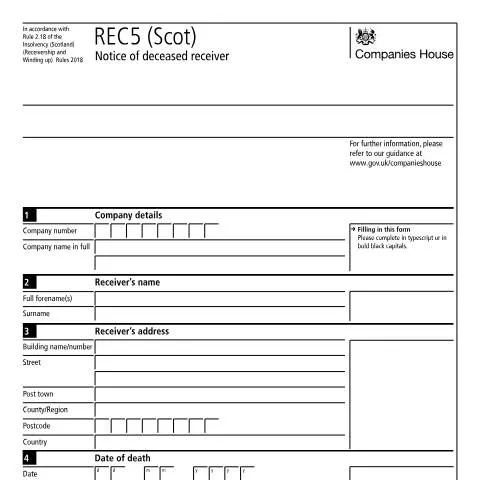
Understanding the Importance of the REC5 (Scot) Notice
In certain unfortunate circumstances, a receiver appointed to manage a Scottish company's affairs may pass away. This necessitates a formal communication to Companies House—the official register of companies in the UK—indicating the death of the receiver. This process is crucial as it ensures proper governance and transparency within the company’s operational and financial structures. The Notice of Deceased Receiver for a Scottish Company, or REC5 (Scot), serves this purpose and is an essential document in maintaining the integrity of corporate records.
Who Needs to File the REC5 (Scot) Notice?
The obligation to submit the REC5 (Scot) notice typically falls upon various parties connected to the deceased receiver. Understanding who is required to act in this situation is paramount:
- Surviving Joint Receiver: If multiple receivers were appointed, the surviving joint receiver is responsible for filing the notice.
- Personal Representative: This could be an executor or administrator of the deceased receiver’s estate.
- Firm Member: A member from the deceased receiver's firm may also take on this duty.
- Company Officer: An officer from the deceased receiver’s company may be required to submit the notice.
Each of these roles carries the responsibility to ensure the notification is completed accurately and submitted in a timely manner to prevent any disruptions in the company’s management.
Step-by-Step Guide to Submitting the REC5 (Scot)
Filing a notice can seem daunting, but a clear, systematic approach can simplify the process. Below is a step-by-step guide to help you navigate the requirements:
- Gather Necessary Information: Collect all relevant details about the deceased receiver, including their full name, address, date of death, and the company name and number.
- Complete the REC5 (Scot): Using a typewriter or bold black capital letters, fill out the form with the collected information. Ensure that the company name and number match the official records at Companies House.
- Sign the Notice: The individual submitting the notice must sign and date it, confirming the accuracy of the information provided.
- Submit the Form: Send the completed REC5 (Scot) to Companies House. While you can submit it to any of their addresses, sending it directly to the Edinburgh office is advisable for expediency.
By following these steps, you can ensure that the process is executed smoothly without unnecessary complications.
Key Considerations for Accurate Filing
To avoid common pitfalls that may delay the notification or cause it to be returned, there are several key considerations to keep in mind:
- Verification of Company Details: Double-check that the company name and number are accurately recorded. Any discrepancies can lead to significant delays.
- Completeness of Information: Ensure all fields of the REC5 (Scot) notice are filled out completely. Missing information can result in the form being returned.
- Signature Issues: The notice must be signed in the appropriate section by the filing party. An unsigned notice is invalid.
By adhering to these guidelines, the likelihood of errors can be significantly reduced, ensuring a smoother procedural experience.
Common Misinterpretations of the REC5 (Scot)
Understanding the nuances of legal documents is vital; misinterpretations can lead to serious consequences. Here are some common misunderstandings regarding the REC5 (Scot):
- Assuming Automatic Registration: Some might think that the death of a receiver will automatically be registered. However, it requires a formal notice to be submitted.
- Misunderstanding Responsibilities: It is essential to know who is legally obligated to submit the notice. Misplaced assumptions can lead to delays in reporting.
- Filing with Incomplete Information: A common error is filing the notice without complete information. This can lead to rejection; thus, all details must be meticulously confirmed before submission.
Awareness of these misinterpretations can help parties involved make informed decisions, preventing potential legal complications for the company.
The Interaction of the REC5 (Scot) with Other Required Documents
Filing the REC5 (Scot) is often part of a broader context involving other documents related to the company’s financial and administrative affairs. Understanding these interactions is crucial:
- Insolvency Proceedings: If the company is undergoing insolvency proceedings, additional procedures may need to be initiated. Consulting with a legal advisor is advisable in such cases.
- Other Notices: Depending on the company structure, other notices might be necessary, especially if there are multiple receivers or co-directors.
- Registration Updates: Any changes in company structure or directorship following the death of the receiver may also require updates to be submitted to Companies House.
Being aware of how the REC5 (Scot) fits within the larger framework of company documentation is essential for compliance and good governance.
Public Record and Privacy Considerations
Once filed, the information contained within the REC5 (Scot) notice becomes part of the public record. This raises important concerns regarding privacy:
- Transparency vs. Privacy: While transparency in corporate governance is essential, the personal details of the deceased receiver will be accessible to the public. Individuals should be informed and prepared for this visibility.
- Data Protection Compliance: It's crucial that the filing complies with the Data Protection Act 2018 and UK GDPR. Sensitive personal data should always be handled in line with these regulations.
- Implications for the Deceased’s Estate: The notice can have implications on how the deceased’s estate is managed and communicated to beneficiaries or creditors.
Understanding these aspects ensures that those involved act responsibly, respecting privacy while fulfilling legal obligations.
Resources for Further Assistance
If you find yourself in need of additional guidance, there are several resources available:
- Companies House Guidance: The official Companies House website offers comprehensive information regarding the REC5 (Scot) and related processes.
- Legal Advisors: Consulting with a legal advisor who specializes in corporate law can provide tailored assistance and clarity regarding responsibilities and options.
- Professional Bodies: Membership in professional organizations can yield access to tools and resources beneficial for navigating these situations.
Utilizing these resources can help ensure that the process is handled correctly and efficiently, providing peace of mind during a challenging time.
Understanding the Role of a Receiver in a Scottish Company
In the context of Scottish corporate law, a receiver plays a pivotal role in managing a company's affairs during financial distress. A receiver is typically appointed when the company is unable to meet its financial obligations, often at the behest of secured creditors who seek to recover outstanding debts. It is essential to understand the powers and responsibilities conferred upon a receiver, which can vary based on the terms outlined in the security agreement or debenture.
When a receiver is appointed, they are responsible for taking control of the company's assets and operations, ensuring that creditors are paid as per the priority established by law. The appointment of a receiver can have significant implications for the company and its shareholders, generally signalling a state of financial difficulty. For Scottish companies, it is crucial to adhere to the legal requirements and timelines surrounding the appointment and notification of a deceased receiver, such as filing the appropriate forms with the relevant authorities.
The Legal Process of Notifying Authorities about a Deceased Receiver
Notifying the relevant authorities about the death of a receiver for a Scottish company is not merely a formality; it involves a structured legal process that must be followed meticulously. Upon the unfortunate event of a receiver's passing, it is the responsibility of the company directors or any appointed representative to ensure that notification is provided to Companies House and any other pertinent regulatory bodies.
The process initiates with the completion of the REC5 (Scot) form, which serves to formally communicate the demise of the receiver to the authorities. Alongside this notification, supporting documentation such as the death certificate may be required to substantiate the claim. Timing is of the essence; it is advisable to submit the notification promptly to avoid any complications regarding the company's administration or the handling of its assets.
Upon receiving the REC5 (Scot) form and accompanying documentation, Companies House will update their public records to reflect the deceased receiver's status. It is crucial to ensure that the information is accurate and current, as discrepancies can lead to legal complications or delays in the company's restructuring process.
Considerations for Appointing a New Receiver Following the Death of a Receiver
Following the notification of a deceased receiver, the next step involves evaluating the necessity of appointing a new receiver to manage the company's affairs. This decision is not taken lightly and requires careful consideration of the company's financial status and objectives moving forward. If the company still faces significant financial challenges, appointing a new receiver may be essential to ensure the continuity of operations and the recovery of debts owed to creditors.
The process of appointing a new receiver is governed by similar legal frameworks as the original appointment. Typically, the secured creditor who initiated the appointment of the original receiver will hold the authority to appoint a new receiver. It is imperative that the new receipt is chosen with meticulous attention to their qualifications and experience, as they will be tasked with navigating the complex landscape of corporate recovery while ensuring compliance with all relevant legal obligations.
Once appointed, the new receiver must familiarize themselves with the existing financial arrangements and the company's operational status. Transparency and communication with creditors, shareholders, and other stakeholders are vital during this transition period to maintain trust and facilitate a smoother recovery process.