Understanding the AM16 (Scot): A Key Document for Company Administrators
The AM16 (Scot) document serves as a formal notice when an administrator is removed from their position in a Scottish company. This document is pivotal for ensuring that all changes in company administration are accurately recorded with Companies House, maintaining transparency in corporate governance. Understanding the nuances of this notice is essential for company directors, administrators, and legal representatives involved in the administration process.
The Role of the Administrator in Company Administration
Before delving into the specifics of the AM16 (Scot), it's crucial to outline the responsibilities of an administrator. An administrator is a professional who manages the affairs of a company facing potential insolvency. Their primary role is to rescue the company and create a viable strategy for its future or, if necessary, wind it down responsibly.
The appointment of an administrator usually arises from a court order or the consent of the company directors. However, there may be circumstances warranting the removal of an administrator, such as conflicts of interest, failure to act in the company's best interests, or the completion of the administrator's task.
Key Components of the AM16 (Scot) Document
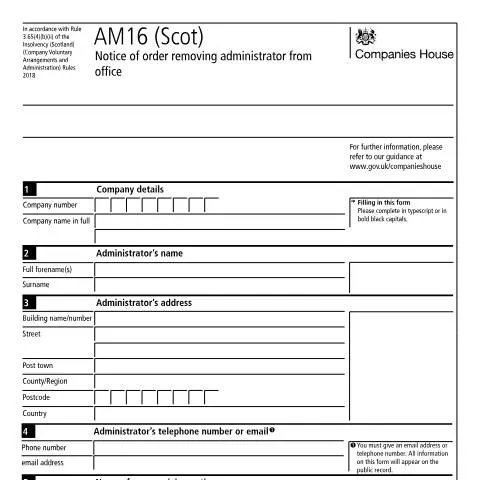
The AM16 (Scot) form is structured to encapsulate essential information concerning the removal of an administrator. Here's a breakdown of the key sections within this document:
- Company Details: This section requires the full name and registration number of the company to ensure accurate record-keeping.
- Administrator’s Information: This includes the administrator's full name, address, and contact information. Accurate details are crucial for the public record.
- Notice of Court Order: The document includes a field for the date of the court order that facilitates the administrator's removal. This date is fundamental as it establishes the timeline of the administrative changes.
- Signature and Verification: The form requires the signature of the individual giving notice and the date of signing, ensuring accountability and authenticity.
Contextualizing the Document within the Legal Framework
The AM16 (Scot) must be viewed in light of the Insolvency (Scotland) (Company Voluntary Arrangements and Administration) Rules 2018. According to Rule 3.65(4)(b)(ii), the submission of this notice is essential to formally communicate the change in administration to Companies House.
Failure to submit this document could lead to significant legal ramifications, including potential penalties for the company and its directors. Thus, understanding the legal context of the AM16 (Scot) is not merely an academic exercise; it is a critical component of corporate compliance in Scotland.
Step-by-Step Guide to Using the AM16 (Scot)
Although this guide does not instruct on how to fill out the form, it is important to consider the sequential steps following the decision to remove an administrator:
- Obtain a Court Order: Before filing the AM16 (Scot), it is imperative to secure a court order that allows for the removal of the administrator.
- Gather Necessary Information: Ensure that all required details regarding the company and the administrator are accurate and up-to-date.
- Complete the AM16 (Scot): While the filling-in process itself is not our focus, ensure that the document adheres to the guidelines, particularly in terms of legibility and completeness.
- Submit the Document: The AM16 (Scot) can be sent to any Companies House address; however, it is advisable to send it to the Edinburgh office for expediency.
The Implications of Public Disclosure
Upon submission, the information contained in the AM16 (Scot) will become part of the public record. This transparency is designed to protect stakeholders and maintain a level of accountability within corporate structures. Here are several implications of this disclosure:
- Stakeholder Awareness: Employees, creditors, and shareholders are privy to changes in management, which is crucial for maintaining trust.
- Reputational Impact: The visibility of administrator removals can significantly affect the company’s reputation. Stakeholders may interpret this as instability or mismanagement.
- Legal Accountability: The transparency provided by the AM16 (Scot) helps ensure that all parties involved in the administration process are held accountable for their actions.
Common Misinterpretations and Pitfalls
Misunderstandings surrounding the AM16 (Scot) may result in significant procedural issues. Here are some common pitfalls:
- Confusion with Other Forms: The AM16 (Scot) is often misidentified or confused with other documentation related to company administration. It is vital to confirm that the correct form is being used for the specific context.
- Omission of Required Information: Incomplete forms can lead to delays or rejections. Always double-check that all fields are filled out correctly.
- Neglecting to Attach the Court Order: This document is critical to validate the removal of the administrator. Without it, the submission may be deemed invalid.
Who Should Consider Filing the AM16 (Scot)?
The AM16 (Scot) is not for every company; its use is specific to situations involving the administration of a Scottish company. Here’s who should be involved:
- Company Directors: They play a crucial role in initiating the process leading to the removal of an administrator.
- Legal Representatives: Those advising the company on compliance matters should ensure that the AM16 (Scot) is correctly filed and submitted.
- Administrators: If they are to be removed, their cooperation and awareness of the process are essential.
Practical Considerations for Effective Submission
To facilitate a smooth submission process for the AM16 (Scot), consider the following practical tips:
- Follow Up: After submission, it could be useful to verify that the document has been processed correctly by Companies House. You may want to check the public record to confirm the administrator's removal.
- Maintain Records: Keep a copy of the submitted AM16 (Scot) and the accompanying court order for your files. These documents may be necessary for future reference.
- Stay Informed: Changes in legislation or Companies House processes could affect how the AM16 (Scot) is handled. Regularly consult the Companies House website or legal advisors for updates.
Final Thoughts on the Importance of the AM16 (Scot)
In conclusion, the AM16 (Scot) is more than a simple notice; it is a vital component in the governance of Scottish companies undergoing administrative changes. The proper use of this document ensures compliance with legal requirements and promotes transparency in corporate affairs. Understanding the implications, context, and procedure associated with the AM16 (Scot) is essential for any stakeholder involved in a company's administration.
Understanding the Role of Administrators in Scottish Companies
Before delving into the process of giving notice for the removal of an administrator, it's important to understand the role and responsibilities of administrators in Scottish companies. Administrators are appointed to manage a company in financial distress, with the primary objective of rescuing the enterprise or achieving a better result for creditors than an immediate winding-up. The appointment is typically made under the Insolvency Act 1986, and once in place, administrators have the authority to make significant decisions regarding the company’s operations.
In Scotland, the administrators must act in the best interests of creditors, which often involves restructuring the company, negotiating with stakeholders, and overseeing the financial recovery plan. Their role is critical; however, circumstances may arise where the interests of the company or its creditors are not being adequately served by the current administrator. This creates a need for processes to remove an administrator and appoint a new one if necessary.
Grounds and Procedure for Removal of Administrators
The removal of an administrator from office is not a decision to be taken lightly. Several grounds may justify such a move, including incompetence, conflicts of interest, or a failure to act in the best interests of creditors. It's crucial to document any evidence supporting these grounds to ensure a smooth transition and to stand up to any potential challenges that may arise during the process.
The procedure for removing an administrator in a Scottish company involves several steps, which must adhere to the requirements set forth in the Insolvency Act and relevant regulations. Initially, a meeting of creditors may be called to discuss the administrator's performance. The requisite notice period for such meetings is typically 14 days, which allows time for creditors to prepare their case and decide whether they support the removal of the administrator.
Furthermore, the proposal for removal can be initiated by a certain percentage of creditors or stakeholders, depending on the company's Articles of Association. If a majority at the meeting votes in favour of the removal, formal notice must then be given to both the administrator in question and Companies House using Form AM16 (Scot).
Impact of Removal on Company Operations and Stakeholders
Once notice is given for the removal of an administrator, various stakeholders may be affected, and it's vital to understand these implications. The removal can lead to a temporary vacuum in leadership and oversight, which might disrupt ongoing negotiations with creditors or other key parties. This could result in increased uncertainty for employees, suppliers, and customers, potentially affecting the business's operational stability.
It's essential to communicate transparently with all stakeholders throughout this process. Providing clear updates about the transition to a new administrator or the steps being taken to stabilize the company can mitigate concerns and maintain trust. Additionally, the new administrator must quickly assess the company’s position, strategize on next steps, and begin rebuilding relations with creditors to ensure that the company can move forward.
The impact of an administrator's removal can also extend to the company’s reputation in the market. If creditors perceive the removal as a sign of instability or mismanagement, it may affect future dealings and contractual relationships. Therefore, the entire process should be handled with care, adhering to best practices and maintaining compliance with legal obligations under the Companies Act and regulations set by the Insolvency Service.