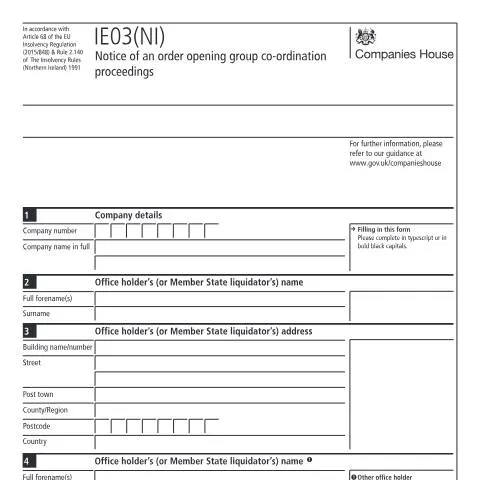
Navigating the IE03(NI): A Comprehensive Guide to Group Co-ordination Proceedings
In the intricate landscape of corporate governance in Northern Ireland, the notice of an order opening group co-ordination proceedings (document IE03(NI)) serves as a pivotal instrument for businesses facing insolvency. This guide delves into the nuances of the IE03(NI) document, elucidating its purpose, the scenarios necessitating its use, and the procedural considerations that accompany its submission.
Understanding the Purpose of the IE03(NI)
The IE03(NI) document is not merely a formality; it is a critical legal instrument that communicates to Companies House the commencement of group co-ordination proceedings. These proceedings emerge under the framework established by Article 68 of the EU Insolvency Regulation (2015/848) and the Insolvency Rules (Northern Ireland) 1991.
Group co-ordination proceedings allow for the simultaneous administration of multiple companies within a corporate group that may be undergoing individual insolvencies. This process is essential to manage the complexities of collective financial distress, ensuring that the interests of all creditors are adequately accounted for and that the procedure is efficient and streamlined.
Legal Framework and Key References
When dealing with the IE03(NI), it is vital to consider its grounding in existing legal frameworks:
- EU Insolvency Regulation (2015/848): Governs the jurisdiction and applicable law concerning insolvency proceedings across the EU, including Northern Ireland.
- Insolvency Rules (Northern Ireland) 1991: Provides detailed procedural guidelines for insolvency matters within Northern Ireland.
Understanding these legal references is crucial as they dictate the procedural requirements and the parameters within which the IE03(NI) operates.
When to Use the IE03(NI) Document
The use of the IE03(NI) document becomes indispensable under specific circumstances:
Situations Requiring IE03(NI) Notification
- Insolvency Proceedings Initiation: When a court order has been issued to commence group co-ordination proceedings for a group of companies.
- Multiple Entities in Distress: When two or more companies within the same group face insolvency, necessitating collective management.
- Liquidation Scenarios: If the group includes entities being liquidated, this notice is essential to outline the collective proceedings.
Failure to file the IE03(NI) in appropriate situations could lead to legal complications, including the inability to adequately protect creditors' interests or the mismanagement of the insolvency process.
Key Components of the IE03(NI) Document
The IE03(NI) document comprises several critical sections that need to be completed accurately to ensure its validity:
Essential Information Required
- Company Details: Full name and registration number of the company.
- Office Holder Information: The name and address of the appointed office holder or Member State liquidator must be clearly mentioned.
- Date of Court Order: This includes the date when the court order for opening group co-ordination proceedings was issued.
- Signature and Date: The document must be signed by the office holder, with the date of signing specified.
Each of these components plays a pivotal role in the overall submission, ensuring that Companies House has all the necessary information to register the group co-ordination proceedings properly.
Common Procedural Considerations
The process of submitting the IE03(NI) document is straightforward, yet there are several procedural considerations that stakeholders must be vigilant about:
Submission Guidelines
- Accurate Information: Ensure all company details match the public register entries to avoid rejection from Companies House.
- Attachments: A court order must accompany the IE03(NI) to substantiate the request for group co-ordination proceedings.
- Signature Requirements: The document must bear the signature of the office holder, confirming the authenticity of the submission.
Where to Send the IE03(NI)
Although the IE03(NI) can be sent to any Companies House address, it is advisable to submit it to:
The Registrar of Companies, Companies House, Second Floor, The Linenhall, 32-38 Linenhall Street, Belfast, Northern Ireland, BT2 8BG.For expediency, this specific address is recommended. Additionally, the document can be sent via the DX postal service (DX 481 N.R. Belfast 1).
Key Concepts in Group Co-ordination Proceedings
A firm grasp of certain concepts is essential for effective navigation through the group co-ordination proceedings:
Understanding Group Co-ordination
Group co-ordination refers to the method of managing multiple company insolvencies under a unified framework. This is particularly beneficial for corporate groups as it:
- Streamlines Communication: It facilitates communication among stakeholders, including creditors and court officials.
- Enhances Efficiency: By managing insolvency collectively, resources can be allocated more effectively.
- Protects Creditor Interests: Ensures that creditors across all companies in the group are treated equitably, reducing the risk of preferential treatment.
The Role of Office Holders
Office holders play a crucial role in these proceedings, acting as the appointed individuals responsible for overseeing the insolvency process. The responsibilities of office holders include:
- Managing Assets: Ensuring that the assets of the insolvent companies are managed and disposed of properly.
- Reporting to Creditors: Keeping creditors informed about the status of the proceedings and any developments.
- Facilitating Group Co-ordination: Ensuring that all companies within the group are managed cohesively during the insolvency process.
Potential Pitfalls in the Filing Process
While the IE03(NI) process is designed to be straightforward, several common pitfalls can hinder its effectiveness:
Misinterpretation of Requirements
One of the most significant issues arises from misunderstanding the requirements of the document. Companies must ensure they:
- Provide accurate and consistent company details.
- Attach all necessary documentation, particularly the court order.
- Adhere to deadlines associated with insolvency proceedings.
Incorrect Submission
Submitting the document to the wrong address or failing to include required signatures can result in delays. Such errors not only affect the timeline of proceedings but can also aggravate creditor relations.
Articulation with Other Documents
The IE03(NI) does not exist in isolation; it interacts with various other documents within the insolvency framework. Understanding these interactions can enhance the efficacy of the group co-ordination process.
Complementary Forms and Notices
- Form IE02: Used for reporting a liquidation summary that may accompany the IE03(NI) in certain scenarios.
- Form IE04: May be required if there are changes in the office holder during the proceedings.
By being aware of these supplementary documents, companies can ensure a smoother insolvency process, minimizing potential disruptions.
Final Thoughts on the IE03(NI) Document
The IE03(NI) notice plays a critical role in the landscape of corporate insolvency in Northern Ireland. By understanding its functions, procedural requirements, and common pitfalls, corporations can navigate the complexities of group co-ordination proceedings with greater confidence.
As the business environment continues to evolve, staying abreast of such administrative processes is vital for any corporate entity, especially those operating within a group structure facing insolvency. The implications of filing correctly and in a timely manner cannot be overstated — it is fundamental to securing the best possible outcome for all stakeholders involved.
For those involved in corporate governance, the IE03(NI) is not just a bureaucratic necessity; it is a pathway to managing the challenges of insolvency through structured co-ordination and collaboration.
Understanding Group Co-ordination Proceedings in the UK
Group co-ordination proceedings serve a crucial role in the UK legal framework, particularly within Northern Ireland, where the IE03(NI) form is utilized. This legal mechanism allows for the efficient and systematic management of cases involving multiple parties, particularly in situations where claims arise from similar circumstances, such as mass torts or consumer complaints. Understanding the nuances of this process is essential for individuals and businesses alike.
Group co-ordination proceedings are initiated when the court recognizes that several claims share common issues, thus permitting them to be handled together. This can significantly reduce the burden on the court system while providing all involved parties with a fair avenue for their grievances to be addressed simultaneously. The recent increase in litigation related to consumer rights, environmental issues, and product liability has made these proceedings increasingly relevant.
One critical aspect to consider is the distinction between group co-ordination proceedings and other forms of legal actions such as class actions. In the UK, class actions, particularly as seen in other jurisdictions like the United States, are not formally recognized. Instead, group co-ordination proceedings are more flexible and tailored to suit the specific needs of the cases at hand. This flexibility allows for various claims to be efficiently managed without necessitating a formal class structure.
When drafting a notice to open group co-ordination proceedings, it is important to ensure that all relevant details are included. This includes identifying the claimants, the nature of their claims, and how these claims intersect. Additionally, the notice must provide information on the proposed leadership of the group, which is typically one or more individuals representing the interests of the claimants. This selection should be made with consideration of experience, capability, and the potential to act in the best interest of the group as a whole.
Filing the IE03(NI) Form: Key Elements and Considerations
Filing the IE03(NI) form is a significant step in initiating group co-ordination proceedings and requires careful adherence to the prescribed guidelines. One of the first considerations is ensuring that the form is filled out accurately and completely. Incomplete or incorrect forms can lead to delays or even rejection of the proceedings. It is advisable to consult legal professionals with experience in civil litigation to ensure compliance with all legal requirements.
The IE03(NI) form requires specific details, including the title of the proceedings, names and addresses of the parties involved, and the claims being made. It may also necessitate a summary of the evidence that supports the claims, particularly how the claims share common facts or legal issues.
Moreover, when submitting the IE03(NI) form, it's crucial to consider the timing of the filing. Group co-ordination proceedings may have strategic timing implications, particularly concerning the limitation periods for the claims involved. Under UK law, certain claims must be filed within a specific timeframe; thus, understanding these deadlines can be vital in preserving rights for all claimants.
Another important aspect to include in your notice includes arrangements for the management of costs and how they will be shared among the group members. This transparency is crucial for maintaining trust among the claimants and ensuring that everyone understands their financial obligations as the proceedings progress. Addressing costs upfront can also alleviate potential disputes later in the proceedings.
Post-Filing: What to Expect After Submitting the IE03(NI) Form
Once the IE03(NI) form is submitted, the next steps are crucial for the progression of the group co-ordination proceedings. The court will review the notice to determine if it meets the necessary criteria for group co-ordination. If the court is satisfied with the submission, it will issue a direction on how the proceedings will move forward, including setting timelines for subsequent actions.
Following the court's approval, a notice of the proceedings will be served to all relevant parties, including those who may not have initially joined the group but could be affected by the outcome. This notification process is governed by the principles outlined in the Data Protection Act 2018 and UK GDPR, ensuring that all personal data is handled lawfully and sensitively.
During this phase, there may be court hearings to address procedural matters, such as the appointment of representatives for the group and discussions on how the claims will be heard. These preliminary hearings are essential for establishing the framework within which the group co-ordination proceedings will operate. It’s also an opportunity for claimants to voice any concerns and for the court to provide guidance on the expectations moving forward.
Additionally, parties involved should prepare for the possibility of settlement discussions that may take place during these early stages. The court may encourage mediation or other forms of alternative dispute resolution to facilitate a quicker resolution before the cases proceed to trial. Engaging in these discussions can often lead to favorable outcomes for claimants, minimizing the time and costs associated with prolonged litigation.
As the proceedings unfold, all claimants should stay informed and actively participate in the process. Keeping lines of communication open with legal representatives and among group members is vital for ensuring that everyone remains aligned and that their collective interests are consistently represented.