Identity Verification Obligations for Overseas Company Directors in the UK
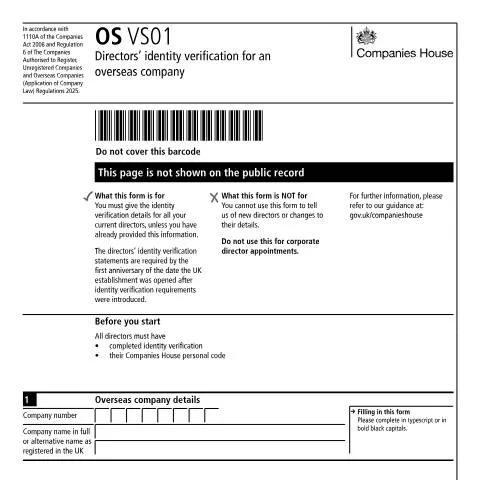
When an overseas company establishes a UK presence, its directors face a mandatory identity verification requirement that must be completed by the first anniversary of opening the UK establishment. The OS VS01 form serves as the crucial link between individual director verification and company compliance, ensuring Companies House maintains accurate records of who controls overseas entities operating on British soil.
This verification mandate stems from section 1110A of the Companies Act 2006 and the Companies Authorised to Register, Unregistered Companies and Overseas Companies (Application of Company Law) Regulations 2025. Unlike domestic UK companies where director verification occurs during incorporation, overseas companies must navigate this process separately, often months or years after establishing their UK foothold.
The timing requirement creates a specific compliance window: directors must complete personal identity verification with Companies House before the company can submit the OS VS01 form. This two-stage process distinguishes overseas company obligations from standard UK corporate filings, where verification and appointment typically occur simultaneously.
Decoding the Companies House Personal Code System
At the heart of the OS VS01 process lies the Companies House personal code – an 11-character identifier that proves a director has successfully completed identity verification. This alphanumeric code becomes the director's permanent identifier across all their UK corporate roles, whether as a director of domestic companies or overseas entities with UK establishments.
The personal code system represents a significant shift in UK corporate governance. Previously, directors could be appointed based solely on basic personal details. Now, each individual must undergo identity verification involving document checks and often in-person or video verification processes. The code serves as digital proof of this completed verification, streamlining future appointments while maintaining security standards.
For overseas company directors, obtaining this code requires particular attention to document requirements. UK identity verification typically expects British or EU documents, but Companies House accommodates international directors through alternative verification routes. The process may involve apostilled documents, certified translations, or embassy verification depending on the director's country of residence and nationality.
| Director Status | Verification Requirement | Timeline | Code Validity |
|---|---|---|---|
| New overseas director | Full identity verification | Before OS VS01 submission | Permanent across all roles |
| Existing UK director | Use existing code | Immediate | Already established |
| Recently verified director | Code from recent process | Within verification validity | Permanent once issued |
Navigating Name Variations and International Naming Conventions
One of the most complex aspects of the OS VS01 form involves reconciling director names across different legal systems and naming conventions. The form specifically asks whether the name provided matches the director's verified name, recognising that international directors may have legitimate reasons for name variations.
The form provides five specific categories for name discrepancies: legally changed name, preferred name, translation or different naming convention, prefer not to say, and error on the public register. Each category carries different implications for Companies House processing and potential follow-up requirements.
Translation issues prove particularly common for directors from non-English speaking countries. Chinese names, Arabic names, and names from languages using non-Latin scripts often undergo transliteration that may vary between official documents. Companies House acknowledges this reality but requires explanation to maintain audit trails and prevent fraudulent submissions.
Legally changed names present another frequent scenario, especially for directors who have undergone marriage, divorce, or legal name changes in jurisdictions with different requirements from UK law. The form accommodates these situations while ensuring the personal code remains linked to the correct individual across all their potential name variations.
Documentation Strategies for Complex Naming Situations
When name variations exist, directors should prepare supporting documentation even though the OS VS01 form itself doesn't require attachment of evidence. Companies House may request clarification, and having documents readily available expedites any follow-up process. Marriage certificates, divorce decrees, deed polls, or official translation certificates can substantiate legitimate name variations.
For directors using preferred names professionally while maintaining different legal names, the distinction becomes crucial for ongoing compliance. The verified identity must match official documents used in the verification process, while the company register may reflect the professional name under which the director operates in business contexts.
Authentication Requirements and Authorised Signatories
The OS VS01 form requires authentication by specific authorised individuals, reflecting Companies House's approach to maintaining accountability in overseas company filings. Unlike many standard forms that accept electronic signatures or simple declarations, this form demands authentication by someone with direct authority over the company's UK operations.
Three categories of individuals can authenticate the form: directors of the overseas company, company secretaries, or permanent representatives under sections 270 or 274 of the Companies Act 2006. This limitation ensures that only individuals with genuine authority over the company's affairs can submit identity verification statements for directors.
The permanent representative option proves particularly relevant for overseas companies, as many establish UK operations through appointed representatives rather than having directors physically present in Britain. These representatives carry specific legal responsibilities under UK company law and their authority to authenticate identity verification forms reflects their broader accountability for UK compliance.
Authentication involves printed name entry rather than traditional signatures, aligning with Companies House's digital transformation while maintaining personal accountability. The authenticating individual takes responsibility for the accuracy of all director information provided, creating potential liability for false or misleading statements.
Timing Constraints and Anniversary Date Calculations
The first anniversary deadline for OS VS01 submission creates a firm compliance boundary that overseas companies must navigate carefully. This deadline runs from the date the UK establishment opened, not from when identity verification requirements were introduced, creating potential confusion for companies established before the current regulations took effect.
Companies House calculates anniversary dates based on the official registration date of the UK establishment, which may differ from when the company began actual operations in Britain. The establishment date appears on official Companies House records and determines the specific deadline for identity verification compliance.
For companies established before identity verification requirements became mandatory, the anniversary calculation may involve transitional provisions. These companies received extended deadlines to complete verification for existing directors, but new director appointments after the requirement introduction must complete verification immediately.
Managing Multiple Director Timelines
Overseas companies with multiple directors face the complexity of coordinating individual verification timelines with the collective OS VS01 submission deadline. Each director must complete personal identity verification independently, potentially involving different processing times based on their documentation, location, and verification method chosen.
The form allows submission for all current directors simultaneously, regardless of when each individual completed their verification. This approach enables companies to meet the anniversary deadline even if some directors completed verification months earlier while others finished just before the submission deadline.
Distinguishing OS VS01 from Related Overseas Company Forms
The OS VS01 form serves a highly specific purpose within the broader ecosystem of overseas company filings, and understanding its limitations prevents common submission errors. The form explicitly cannot be used for appointing new directors or changing existing director details – functions handled by separate overseas company forms.
This limitation creates a clear distinction between identity verification compliance and ongoing director administration. Companies requiring director changes must use appropriate appointment or resignation forms before or after submitting OS VS01, but cannot combine these functions in a single submission.
Corporate director appointments also fall outside OS VS01 scope, as corporate entities cannot complete personal identity verification. Overseas companies with corporate directors must handle these appointments through standard corporate director procedures, while using OS VS01 only for individual human directors.
| Form Purpose | OS VS01 Capability | Alternative Required |
|---|---|---|
| Identity verification compliance | ✓ Primary function | N/A |
| New director appointment | ✗ Not permitted | Separate appointment form |
| Director detail changes | ✗ Not permitted | Change of details form |
| Corporate director matters | ✗ Not applicable | Corporate director procedures |
Submission Pathways and Processing Considerations
Companies House offers multiple submission routes for the OS VS01 form, reflecting the organisation's digital transformation while maintaining traditional postal options. Electronic submission through Companies House online services provides faster processing and immediate confirmation, while postal submission remains available for companies preferring traditional methods or facing technical constraints.
Electronic submission requires careful attention to file formats and size limitations, particularly if supporting documentation becomes necessary during processing. The online system provides immediate validation of basic form completeness but cannot verify the accuracy of personal codes or name matching until human review occurs.
Postal submissions must be sent to the correct Companies House office, with addresses varying based on company type and specific circumstances. The form includes guidance directing users to the Companies House website for current postal addresses, reflecting occasional changes in processing arrangements.
Processing Timeline Expectations
Processing timelines for OS VS01 forms typically range from 5 to 15 working days for straightforward submissions with matching names and valid personal codes. However, submissions requiring name verification clarification or personal code validation may extend processing times significantly, particularly during peak submission periods around common anniversary dates.
Companies House may contact the presenter or authenticating individual for clarification during processing, making accurate contact information valuable despite being optional. Providing presenter details enables faster resolution of queries and prevents processing delays that could impact compliance deadlines.
Consequences of Non-Compliance and Remedial Actions
Failure to submit OS VS01 by the required anniversary deadline triggers specific penalties under UK company law, including potential restrictions on the overseas company's UK establishment status. Companies House maintains enforcement procedures for overseas companies similar to those applied to domestic UK companies, including late filing penalties and potential prosecution for persistent non-compliance.
The verification requirement forms part of broader UK efforts to enhance corporate transparency and prevent money laundering through anonymous company ownership. Non-compliance therefore carries implications beyond simple administrative penalties, potentially affecting the company's ability to conduct business through its UK establishment.
Remedial submission after deadline remains possible but incurs penalties and may trigger additional scrutiny of the company's compliance procedures. Companies House expects overseas entities to maintain the same standards as domestic companies, despite the additional complexity of international operations and verification requirements.
For companies discovering compliance issues before the deadline, immediate action to complete director verification and submit OS VS01 forms can prevent penalties. The form's design accommodates directors who complete verification close to the deadline, provided the company submits within the anniversary window.
Common Verification Challenges and Solutions
Directors often encounter specific hurdles when completing OS VS01 verification, particularly when their documentation doesn't align with UK administrative expectations. Understanding these challenges beforehand can prevent delays and rejection of your application.
Name variations across documents frequently cause complications. If your passport shows "Maria-Elena Rodriguez Santos" but your driving licence displays "M Rodriguez", Companies House may flag this discrepancy. The verification process requires consistent identity presentation across all submitted documents. Where variations exist, you'll need to provide additional evidence linking the different name formats—such as marriage certificates, deed polls, or official name change documentation from your home country's authorities.
Translated documents present another layer of complexity. While Companies House accepts documents in languages other than English, any foreign-language identification must be accompanied by certified translations. The translator must be professionally qualified and include their credentials with the translation. Simple online translation tools or informal translations by bilingual friends won't satisfy the requirements. Some countries' authorities provide official English translations directly—check whether your local passport office or national identity card issuer offers this service before seeking private translation.
Address verification complications arise when directors live in countries with different addressing conventions. Rural addresses without formal postal codes, or regions where street numbering follows non-Western systems, can create verification difficulties. In such cases, provide the most detailed address possible in the format closest to UK conventions, and include supplementary documentation like utility bills or bank statements showing the same address in the local format.
Digital document submission quality significantly impacts verification success. Scanned documents must be clear, with all text legible and security features visible where applicable. Mobile phone photographs rarely meet the required standards—use a proper scanner or high-quality document camera. Ensure the entire document appears within the scan boundaries, including any official seals or watermarks that authenticate the document's validity.
Timing considerations become critical when documents have limited validity periods. Some national identity cards expire frequently, and passport validity requirements vary between countries. Submit your OS VS01 verification well before any identity documents approach their expiry dates, as Companies House may reject applications where documents expire during the processing period.
Ongoing Compliance and Record-Keeping Requirements
Successful OS VS01 verification marks the beginning, not the end, of your compliance obligations as a director of an overseas company operating in the UK. Understanding ongoing requirements ensures you maintain good standing with Companies House and other regulatory bodies.
Annual confirmation statements must be filed regardless of your verification status, but verified directors face additional scrutiny during the filing process. Companies House may request updated identity verification if significant time has elapsed since your initial OS VS01 submission, particularly if you've changed addresses or renewed identity documents in the interim. Keep digital copies of your verification documents easily accessible for potential future requests.
Directors' residential addresses require particular attention under UK disclosure rules. While service addresses can be used for official correspondence, your actual residential address must be maintained on the Companies House register. Any changes to your residential address trigger a requirement to notify Companies House within 14 days, and significant changes may necessitate fresh identity verification through the OS VS01 process.
Cross-border tax implications often intersect with your verification status. HMRC may reference your Companies House verification when assessing your UK tax obligations, particularly regarding Corporation Tax registration and PAYE responsibilities if your company employs UK-based staff. Maintain clear records linking your director verification to any subsequent tax registrations to avoid administrative complications.
Enhanced due diligence requirements under anti-money laundering regulations mean that banks, accountants, and other professional service providers will likely request copies of your OS VS01 verification when establishing business relationships. Keep certified copies available, as these professional advisers cannot accept simple photocopies for their own compliance obligations.
Regulatory reporting extends beyond Companies House to include potential obligations with sector-specific regulators. If your overseas company operates in regulated industries such as financial services, telecommunications, or healthcare, your director verification status may be referenced during licence applications or compliance reviews. The Financial Conduct Authority, Ofcom, and Care Quality Commission all maintain director fitness and propriety requirements that may draw upon your Companies House verification.
Document retention becomes crucial for long-term compliance. While Companies House maintains records of your verification, you should retain your own copies of all submitted documents for at least six years after ceasing to be a director. This retention period aligns with general UK business record-keeping requirements and ensures you can respond to any retrospective queries from regulators or professional advisers.
Integration with UK Banking and Professional Services
Your OS VS01 verification status significantly influences your ability to establish and maintain business relationships within the UK financial and professional services ecosystem. Understanding these connections helps you navigate the practical implications of director verification beyond simple regulatory compliance.
Corporate banking relationships rely heavily on director verification when overseas companies seek to open UK bank accounts. Major UK banks including Barclays, HSBC, and Lloyds require directors to demonstrate verified status with Companies House before progressing corporate account applications. Your OS VS01 completion provides banks with confidence in your identity verification, but they'll typically require additional documentation including proof of address, source of funds declarations, and detailed business activity explanations.
The verification process creates a documented trail that banks use for their own anti-money laundering compliance. When your company later applies for credit facilities, trade finance, or foreign exchange services, banks reference your initial verification to streamline enhanced due diligence processes. However, don't assume that Companies House verification automatically satisfies all banking requirements—each institution maintains its own risk assessment procedures.
Professional service provider relationships become more straightforward once your director verification is complete. Accountancy firms, legal practices, and corporate service providers can more easily accept your company as a client when they can verify your identity through official Companies House records. This verification reduces their own compliance burden and typically accelerates the onboarding process for services such as audit, tax advice, and legal representation.
Insurance providers, particularly for directors' and officers' liability coverage, increasingly reference director verification status when assessing policy applications. Verified directors may qualify for more favourable terms or streamlined underwriting processes, as insurers view official identity verification as reducing fraud risk and enhancing corporate governance standards.
Supply chain integration benefits from director verification when establishing trade relationships with UK-based suppliers or customers. Large corporations and government contractors often require verified director status from their overseas business partners as part of their own supply chain compliance programmes. Your OS VS01 completion can therefore open doors to business opportunities that might otherwise remain inaccessible.
Professional qualification recognition becomes relevant if you hold professional certifications from your home country and wish to practice in the UK. Bodies such as the Institute of Chartered Accountants in England and Wales, the Law Society, or professional engineering institutions may reference your director verification when assessing applications for membership or qualification recognition.
Property and asset acquisition processes often require director verification when overseas companies purchase UK real estate or other significant assets. Conveyancing solicitors, asset managers, and investment platforms use your verified status to satisfy their anti-money laundering obligations and expedite transaction completion.
The verification creates a foundation of trust that extends across multiple business relationships, reducing the administrative burden of repeatedly proving your identity to different UK-based organisations. However, each relationship may still require additional documentation specific to their sector or risk assessment requirements—your OS VS01 verification provides a starting point rather than a comprehensive solution for all UK business interactions.