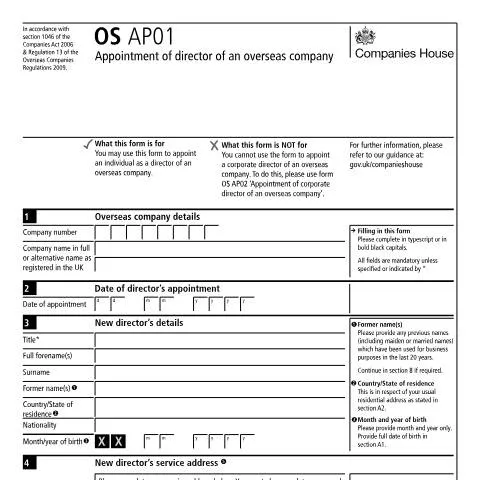
Understanding the OS AP01: When Overseas Companies Need Individual Directors in the UK
When an overseas company establishes a presence in the United Kingdom, the appointment of directors becomes a critical compliance requirement under the Companies Act 2006 and the Overseas Companies Regulations 2009. The OS AP01 form serves as the official mechanism for registering individual directors with Companies House, ensuring that foreign entities operating within UK jurisdiction maintain proper governance structures and transparency standards.
This process extends beyond simple paperwork—it represents a fundamental aspect of corporate accountability for international businesses. Whether you're a multinational corporation expanding operations or a smaller overseas entity seeking UK market access, understanding the intricacies of director appointment through OS AP01 can determine your compliance success and operational legitimacy.
Navigating the Individual vs Corporate Director Distinction
The OS AP01 form exclusively handles appointments of individual persons as directors, creating a clear boundary in Companies House's administrative framework. This distinction carries significant implications for overseas companies planning their UK governance structure.
If your overseas company requires a corporate director—another company or legal entity serving in a directorial capacity—the OS AP01 becomes irrelevant. Instead, you must utilise form OS AP02 for corporate director appointments. This separation reflects the different disclosure requirements and regulatory considerations between natural persons and corporate entities in directorial roles.
Understanding this distinction early in your planning process prevents administrative delays and ensures you're following the correct procedural pathway. Many overseas companies initially assume a single form covers all director types, leading to submission rejections and extended compliance timelines.
Timing Considerations for Different Director Types
Individual directors appointed through OS AP01 face different verification requirements compared to corporate appointees. The form now incorporates identity verification provisions under section 1110A of the Companies Act 2006, requiring directors to complete identity checks before or concurrent with their appointment.
Corporate directors, conversely, undergo different verification processes focused on corporate legitimacy rather than personal identity. This procedural divergence affects appointment timing and preparation requirements for overseas companies planning mixed governance structures.
Decoding the Form's Essential Components and Hidden Requirements
The OS AP01 form's structure reveals several layers of information requirements, each serving distinct regulatory purposes. Beyond basic personal details, the form captures elements that directly impact the director's public profile and legal standing within UK corporate governance.
Service Address Strategy and Public Disclosure
Section 4 of the OS AP01 addresses the service address—the address appearing on public records. This creates a strategic decision point for overseas directors concerned about privacy or security. The service address need not match the director's usual residential address, allowing for professional addresses or registered office locations.
However, directors must still provide their usual residential address in section A2, though this information remains protected from public disclosure. This dual-address system balances transparency requirements with personal privacy protections, particularly relevant for international directors operating across multiple jurisdictions.
The Identity Verification Imperative
Sections A4 and A5 introduce the identity verification framework, representing one of the most significant recent changes to UK corporate governance requirements. Directors must obtain a Companies House personal code—an 11-character identifier confirming verified identity status.
| Verification Element | Requirement | Impact on Appointment |
|---|---|---|
| Companies House personal code | 11-character code from identity verification | Mandatory for appointment processing |
| Name matching | Verified name must align with form details | Discrepancies trigger additional scrutiny |
| Identity verification statement | Confirmation tick box required | Cannot proceed without acknowledgment |
Name discrepancies between verified identity and form submissions require explanation through specific categories: legally changed names, preferred names, translation issues, or declining to specify. Each category carries different implications for processing and ongoing compliance.
Authority Specifications and Joint Action Requirements
Section 5 of the OS AP01 addresses the extent of authority granted to the appointed director, creating binding parameters for their decision-making capacity. This section often receives insufficient attention from overseas companies, yet it fundamentally shapes the director's operational scope.
Limited vs Unlimited Authority Frameworks
Directors may receive limited or unlimited authority, with limited authority requiring detailed descriptions of permitted actions. These descriptions become part of the public record, creating transparency about directorial constraints while potentially revealing strategic information about company operations.
Unlimited authority grants full directorial powers within legal boundaries, but overseas companies should consider whether such broad empowerment aligns with their governance objectives and risk management strategies. The choice impacts both internal control systems and external stakeholder perceptions.
Joint Action Mechanisms
When directors are authorised to act jointly rather than alone, section 5 requires identification of co-decision makers. This creates formal constraints on directorial independence while establishing accountability frameworks for significant decisions.
Joint action requirements particularly affect overseas companies with distributed management structures or those requiring dual-signature authorities for UK operations. The named joint actors must be identifiable individuals, creating ongoing compliance obligations if personnel changes occur.
Multi-Establishment Coordination and Administrative Efficiency
Section 6 addresses UK establishments, recognising that overseas companies often operate multiple UK locations. The form permits consolidated reporting for companies with several UK establishments, provided they complete the establishment details table comprehensively.
This consolidation mechanism reduces administrative burden while maintaining regulatory oversight across all UK operations. However, it requires careful coordination to ensure all establishments are properly represented and that subsequent changes are uniformly reported.
Registration Number Management
Each UK establishment carries its own registration number, creating a tracking system for Companies House oversight. These numbers become critical references for ongoing compliance activities, including annual returns and change notifications.
Overseas companies must maintain accurate records of all establishment registration numbers, as errors in this section can lead to compliance gaps affecting individual establishments rather than the entire UK operation.
Processing Pathways and Higher Protection Protocols
The OS AP01 form incorporates provisions for directors requiring higher protection under Regulation 25 of the Overseas Companies Regulations 2009. This protection shields directors' usual residential addresses from disclosure to credit reference agencies, addressing security concerns for high-profile or at-risk individuals.
Alternative Submission Routes
Directors applying for or holding higher protection must submit their OS AP01 forms through a separate postal address: The Registrar of Companies, PO Box 4082, Cardiff, CF14 3WE. This alternative pathway ensures enhanced confidentiality during processing while maintaining regulatory compliance.
The higher protection application and OS AP01 form must be submitted together when seeking protection concurrent with director appointment. This timing requirement prevents disclosure gaps that might compromise the protection's effectiveness.
Barcode Integrity and Processing Reliability
Multiple sections of the OS AP01 feature barcode coverage warnings, highlighting the form's automated processing capabilities. These barcodes enable efficient data capture and reduce manual processing errors, but they require careful handling during completion and submission.
Covering or damaging barcodes can delay processing or require manual intervention, potentially extending appointment timelines. This consideration becomes particularly relevant for overseas companies operating under tight compliance deadlines or time-sensitive operational requirements.
Authentication Requirements and Authorised Signatories
Section 7 specifies the authentication framework for OS AP01 submissions, limiting form authentication to specific roles: directors, secretaries, or permanent representatives. This restriction ensures appropriate authority levels for director appointments while maintaining accountability chains.
The authentication requirement creates practical considerations for overseas companies, particularly regarding signatory availability and authority verification. Companies must ensure their chosen authenticator possesses the necessary authority and understands their responsibility for the appointment's accuracy and completeness.
Cross-Border Signature Coordination
For overseas companies with distributed management structures, coordinating authentication across jurisdictions can present logistical challenges. The authenticator must be readily identifiable and accessible for potential Companies House inquiries, creating ongoing availability requirements.
Electronic submission options may offer advantages for authentication coordination, though companies must ensure their chosen submission method aligns with their authentication capacity and internal approval processes.
Ongoing Compliance and Change Management Through OS AP01
Director appointment through OS AP01 establishes ongoing compliance obligations extending beyond the initial submission. Changes to director details, authority levels, or circumstances require prompt notification to Companies House, often through additional forms or updated submissions.
Overseas companies must establish systems for monitoring director status changes, including residential address updates, authority modifications, or identity verification renewals. These ongoing requirements integrate with broader UK compliance frameworks, including annual return obligations and statutory disclosure requirements.
Integration with Broader Regulatory Frameworks
OS AP01 submissions connect with multiple regulatory systems beyond Companies House, including HMRC obligations for director tax responsibilities and potential UK Visas and Immigration requirements for non-UK resident directors. Understanding these interconnections helps overseas companies maintain comprehensive compliance.
The appointed director's details become reference points for various UK regulatory interactions, making accuracy and currency essential for smooth operational compliance. Regular review of director information ensures continued regulatory alignment across all relevant UK authorities.
The OS AP01 form represents more than administrative compliance—it establishes the foundation for overseas companies' UK governance structures and ongoing regulatory relationships. Success requires attention to detail, understanding of interconnected requirements, and proactive management of changing circumstances.
Disclosure Requirements and Transparency Obligations
When appointing a director through OS AP01, companies must navigate comprehensive disclosure requirements that extend beyond the basic appointment details. The People with Significant Control (PSC) regime intersects with director appointments, particularly when the new director holds shares or voting rights that trigger PSC thresholds.
Companies must assess whether the appointed director controls more than 25% of shares or voting rights, directly or indirectly. This assessment becomes complex when the director represents nominee arrangements or acts on behalf of overseas entities. If PSC obligations apply, separate filings with Companies House become necessary within the standard 14-day period.
The appointment may also trigger beneficial ownership disclosure requirements under the Economic Crime (Transparency and Enforcement) Act 2022. Overseas companies with UK property interests face additional scrutiny, requiring detailed disclosure of the director's beneficial ownership chain. This particularly affects companies registered in jurisdictions with limited transparency requirements.
Directors appointed to companies engaged in regulated activities must consider sector-specific disclosure obligations. Financial services companies report to the Financial Conduct Authority (FCA) or Prudential Regulation Authority (PRA), whilst companies in other regulated sectors face industry-specific notification requirements that operate alongside Companies House filings.
The Corporate Insolvency and Governance Act 2020 introduced enhanced disclosure requirements for companies experiencing financial difficulties. Directors appointed during restructuring periods must ensure their appointment doesn't breach moratorium conditions or compromise ongoing insolvency procedures. This creates additional complexity when overseas companies undergo parallel proceedings in multiple jurisdictions.
Anti-money laundering (AML) regulations impose disclosure obligations on companies in designated sectors. The appointed director's background, particularly regarding sanctions screening and politically exposed person (PEP) status, requires careful documentation. Companies must maintain enhanced due diligence records, especially when appointing directors from high-risk jurisdictions as defined by the Financial Action Task Force (FATF).
Cross-Border Compliance Challenges and Jurisdiction-Specific Considerations
Overseas companies appointing directors through OS AP01 face intricate cross-border compliance challenges that vary significantly depending on the company's jurisdiction of incorporation. Companies incorporated in EU member states must navigate post-Brexit arrangements, including potential impacts on director qualification requirements and ongoing compliance obligations.
The Withdrawal Agreement affects companies incorporated before 31 December 2020, creating grandfathering provisions for existing directors whilst imposing new requirements for subsequent appointments. Directors appointed after this date may face enhanced scrutiny regarding their right to act for companies with UK operations or assets.
Companies incorporated in common law jurisdictions often benefit from alignment with UK corporate governance principles, simplifying the appointment process. However, civil law jurisdictions may impose conflicting requirements regarding director duties, creating potential conflicts that require careful legal analysis before proceeding with appointments.
Tax residence implications vary dramatically based on the director's individual circumstances and the company's operational structure. Newly appointed directors may inadvertently trigger UK tax residence for the overseas company if their activities constitute management and control from the UK. This particularly affects companies with significant UK operations or customer bases.
Double taxation treaty provisions influence the appointment decision, especially for companies operating across multiple jurisdictions. Directors must understand how their appointment affects treaty benefits and whether additional tax compliance obligations arise in either the UK or the company's jurisdiction of incorporation.
Sanctions compliance presents ongoing challenges for overseas companies, particularly those with operations in jurisdictions subject to UK sanctions regimes. The appointed director's background requires thorough screening against HM Treasury's sanctions lists, with ongoing monitoring obligations throughout their tenure.
Data protection compliance becomes complex when personal information crosses international borders. The UK GDPR and Data Protection Act 2018 impose specific requirements for international data transfers, affecting how director information is shared between the overseas company and its UK operations or advisors.
Practical Implementation Strategies and Best Practice Frameworks
Successful implementation of director appointments through OS AP01 requires structured approaches that address both immediate compliance requirements and long-term governance considerations. Companies benefit from establishing clear appointment protocols that ensure consistency across multiple jurisdictions whilst accommodating local variations in corporate law requirements.
Pre-appointment due diligence should encompass comprehensive background checks extending beyond basic qualification verification. This includes sanctions screening, adverse media searches, and verification of professional qualifications relevant to the director's proposed role. Companies operating in regulated sectors require enhanced due diligence procedures that align with regulatory expectations.
Documentation strategies must accommodate both UK requirements and the overseas company's jurisdiction of incorporation. This often requires parallel documentation sets, with careful attention to potential conflicts between different legal systems' requirements. Companies should maintain comprehensive records of the appointment process, including board resolutions, consent forms, and verification documentation.
Integration with existing governance frameworks requires careful consideration of how the new director fits within established reporting structures and decision-making processes. Companies with complex group structures must ensure the appointment doesn't create unintended conflicts or compromise existing governance arrangements.
Communication strategies should address all relevant stakeholders, including existing directors, shareholders, employees, and regulatory bodies. This becomes particularly important for companies with public profiles or those operating in sectors with high public interest, where director appointments may attract media attention.
Ongoing compliance monitoring requires systems that track regulatory obligations across multiple jurisdictions. This includes annual confirmation statement requirements with Companies House, tax compliance obligations, and sector-specific regulatory reporting requirements that may arise from the director's appointment.
Risk management frameworks should incorporate specific considerations for overseas directors, including political risk assessments for directors from jurisdictions with unstable regulatory environments. Companies should establish contingency procedures for situations where directors become unable to fulfil their duties due to travel restrictions or political developments.
Training and induction programmes for newly appointed directors should address UK corporate governance expectations, even when the director primarily operates from overseas. This includes understanding of UK company law requirements, regulatory frameworks affecting the company's operations, and cultural considerations that may affect board dynamics.
Technology solutions can streamline compliance processes, particularly for companies managing multiple director appointments across different jurisdictions. However, companies must ensure these solutions comply with data protection requirements and maintain appropriate security standards for sensitive personal information.