When Corporate Governance Meets International Waters: Understanding OS TM01 Requirements
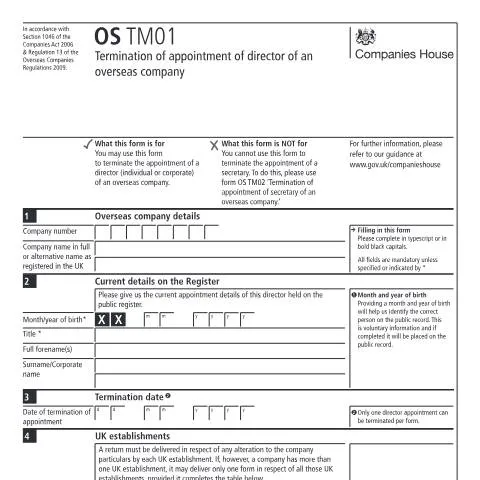
The departure of a director from an overseas company registered in the UK triggers a cascade of administrative obligations that many businesses underestimate. Form OS TM01 sits at the heart of this process, serving as the formal mechanism through which overseas companies notify Companies House of directorial terminations. Unlike domestic company procedures, overseas entities face unique compliance challenges that stem from their cross-border nature and the specific regulatory framework governing their UK presence.
This termination process carries significant weight beyond mere paperwork. Each director departure affects the company's legal standing, its ability to conduct business through UK establishments, and its ongoing compliance with the Companies Act 2006. The form itself reflects the government's commitment to maintaining accurate public records whilst accommodating the complex structures typical of international business operations.
Deciphering the Overseas Company Landscape: Who Must File OS TM01
The scope of OS TM01 application extends to any overseas company that has established a UK presence and subsequently experiences changes in its directorial composition. This encompasses a remarkably diverse range of entities, from multinational corporations with substantial UK operations to smaller foreign companies maintaining minimal but legally significant presences.
Primary candidates for OS TM01 filing include:
- Foreign companies operating through UK branches or subsidiaries
- International holding companies with UK-registered establishments
- Overseas entities conducting business activities that require UK registration
- Foreign companies owning UK property or assets
- International firms providing services that necessitate UK regulatory compliance
The distinction between different types of overseas presence proves crucial. Companies with multiple UK establishments face particular considerations, as the form accommodates situations where a single filing can address multiple locations. This efficiency measure recognises the administrative burden that would otherwise fall on large international operations with extensive UK footprints.
Corporate directors present their own complexities. When the departing director is itself a company rather than an individual, the form requires careful attention to corporate naming conventions and registration details. This scenario often arises in sophisticated corporate structures where holding companies or management entities serve in directorial capacities.
Timing Sensitivities and Regulatory Windows
The regulatory framework surrounding OS TM01 submission operates within strict temporal boundaries that companies ignore at their peril. The form must reflect actual termination dates accurately, as these determine the company's legal obligations and the departing director's ongoing responsibilities. Companies House maintains rigorous records that cross-reference against other filings, making accuracy essential for avoiding regulatory scrutiny.
Seasonal variations in filing patterns often emerge around year-end periods when companies undertake governance restructuring. Understanding these patterns helps companies anticipate processing delays and plan accordingly for time-sensitive transactions that depend on updated directorial records.
Navigating the Form's Architecture: Section-by-Section Breakdown
Form OS TM01's structure reflects careful consideration of the information hierarchy necessary for accurate record-keeping. Each section builds upon previous entries, creating a comprehensive picture of the termination event and its implications for the company's UK presence.
Company Identification Protocols
Section 1 demands precise alignment between the company's registered UK details and its actual operational identity. The company name field requires the exact registered name as it appears on Companies House records, not trading names or abbreviated versions that might be used in daily business operations. This precision requirement extends to alternative names where applicable, reflecting the reality that many overseas companies operate under different identities in various jurisdictions.
The company number serves as the definitive identifier, linking the form to the correct entity within Companies House databases. This alphanumeric code, typically prefixed with letters indicating the company's registration category, must match exactly with existing records to ensure proper processing.
Director Identification and Verification Challenges
Section 2's current details requirements create a verification checkpoint that often reveals discrepancies between Companies House records and company understanding of directorial appointments. The form demands details as they appear on the public register, not as they might exist in company records or contracts.
| Detail Type | Requirement | Common Issues |
|---|---|---|
| Full forenames | Complete given names as registered | Abbreviations or preferred names used instead |
| Surname/Corporate name | Exact match with public record | Marriage name changes not yet updated |
| Title | Optional but must match if provided | Professional titles confused with courtesy titles |
| Month/year of birth | Voluntary identification aid | Privacy concerns vs. accuracy benefits |
The month and year of birth field presents a strategic choice for companies. Whilst voluntary, providing this information significantly aids Companies House in distinguishing between individuals with similar names. The data becomes part of the public record, creating a permanent identification marker that enhances record accuracy but raises privacy considerations for some directors.
Termination Date Precision and Legal Implications
Section 3's termination date field carries legal weight that extends beyond administrative convenience. This date determines when the director's authority ceased, affecting everything from signature validity to liability exposure. Companies must ensure the date reflects the actual termination as defined by the company's articles of association or relevant corporate law, not merely when the paperwork was completed.
The date format follows UK conventions (dd/mm/yyyy), and Companies House systems validate entries against reasonable parameters. Future dates are generally rejected unless they fall within narrow acceptable windows for pre-planned departures, whilst historical dates undergo scrutiny for compliance with filing deadlines.
Multiple Establishments: Coordinating Complex Corporate Structures
Section 4 addresses one of the most sophisticated aspects of overseas company compliance: managing multiple UK establishments through coordinated filings. This provision recognises that large international companies often operate through numerous UK locations, each technically requiring separate notification of corporate changes.
The consolidation option allows companies to file a single OS TM01 covering all UK establishments, provided each establishment is properly identified through registration numbers and names. This efficiency measure requires careful coordination between different establishment managers and central compliance functions, as errors in any establishment details can invalidate the entire filing.
Strategic considerations for multi-establishment filings include:
- Ensuring all establishment registration numbers are current and accurate
- Verifying that establishment names match Companies House records exactly
- Coordinating timing across different operational units
- Maintaining audit trails for compliance verification
- Planning for potential establishment-specific complications
Companies with extensive UK operations often develop internal protocols for managing these coordinated filings, including designation of lead contacts and establishment of verification procedures that prevent errors from propagating across multiple locations.
Authentication and Authority: The Signature Imperative
Section 5's signature requirements embody the form's legal authority and create binding commitments on behalf of the overseas company. The signature panel restricts signing authority to specific roles: directors, secretaries, and permanent representatives, reflecting the regulatory focus on ensuring proper corporate authority for significant governance changes.
The authentication process extends beyond mere signature provision. The signatory must possess current authority to act on behalf of the company, creating potential complications when directorial changes occur in rapid succession or during periods of corporate restructuring. Companies must verify that the signing party retains valid authority at the time of submission, not merely when the form was prepared.
Electronic vs. Physical Submission Pathways
Whilst the form permits various submission methods, each pathway carries distinct requirements for authentication and processing. Electronic submissions through Companies House systems require digital authentication that links to verified company accounts, whilst postal submissions depend on physical signature verification and document handling protocols.
The choice of submission method affects processing timelines, with electronic filings typically achieving faster integration into public records. However, complex cases or those requiring additional documentation may benefit from postal submission pathways that accommodate supporting materials more readily.
Integration with Broader Compliance Frameworks
OS TM01 submission represents one component of a broader compliance ecosystem that governs overseas company operations in the UK. The form's data integrates with various regulatory databases and triggers cross-referencing activities that can reveal inconsistencies across different aspects of company compliance.
The relationship between OS TM01 and other Companies House filings creates opportunities for coordinated compliance strategies. Companies planning multiple governance changes can sequence their filings to minimise administrative burden whilst maintaining regulatory compliance throughout transition periods.
Data protection considerations add another layer of complexity, as the form's public record status means that all submitted information becomes accessible through Companies House search facilities. This transparency serves legitimate business and regulatory purposes but requires careful consideration of sensitive information handling, particularly regarding personal details of departing directors.
Cross-Border Regulatory Coordination
International companies must navigate the intersection between UK requirements and home jurisdiction obligations. OS TM01 submission often forms part of larger corporate reorganisation processes that span multiple countries, requiring coordination between different legal systems and regulatory requirements.
The timing of UK filings relative to home jurisdiction procedures can affect everything from tax obligations to regulatory approvals. Companies benefit from understanding these interdependencies and planning their compliance activities accordingly, ensuring that UK requirements align with broader international obligations.
Processing Dynamics and Post-Submission Management
Once submitted, OS TM01 enters Companies House processing systems that operate according to established protocols and quality assurance procedures. Understanding these internal processes helps companies anticipate potential queries and prepare appropriate responses to processing challenges.
Companies House employs automated validation systems that check form completeness and consistency before human review. Common validation failures include mismatched company details, invalid director information, or incomplete establishment data. These automated checks provide rapid feedback but require companies to address technical compliance issues before substantive review begins.
The human review process focuses on accuracy verification and cross-referencing against existing records. Reviewers may identify discrepancies that require clarification or additional documentation, leading to queries that can extend processing timelines. Companies can minimise query likelihood through careful preparation and accuracy verification before submission.
Public Record Integration and Accessibility
Successful OS TM01 processing results in updated public records that reflect the directorial termination across all relevant company filings. These updates appear in company profiles accessible through Companies House search facilities, creating transparency that serves various stakeholder interests whilst maintaining regulatory oversight.
The public record update process follows established timelines that companies can monitor through online tracking systems. Understanding these timelines helps companies plan subsequent activities that depend on updated directorial records, such as banking changes or contract modifications that require current governance information.
Stakeholder notification strategies often incorporate public record timing, ensuring that interested parties receive appropriate communication about governance changes whilst respecting regulatory requirements and commercial sensitivities. The balance between transparency and commercial discretion requires careful consideration of timing and communication methods.
Common Scenarios Requiring OS TM01 Filing
Understanding when to file an OS TM01 form requires careful consideration of various business circumstances that trigger director appointment terminations. The most straightforward scenario involves voluntary resignation, where a director chooses to step down from their position. This might occur due to career changes, retirement, or strategic restructuring within the overseas company's operations.
Corporate restructuring presents another frequent trigger for OS TM01 submissions. When overseas companies undergo mergers, acquisitions, or significant operational changes, director appointments often require termination and replacement. In such cases, timing becomes crucial—the form must reflect the actual termination date rather than when the restructuring was announced or planned.
Death of a director creates an immediate filing obligation that executors or remaining directors must address promptly. The termination date recorded should be the actual date of death, and supporting documentation may include death certificates or probate documents. Companies House typically requires this information within the standard 14-day filing window, though compassionate circumstances may allow for reasonable delays.
Removal by resolution represents a more complex scenario where shareholders or the board formally votes to terminate a director's appointment. The OS TM01 must accurately reflect the resolution date and circumstances, particularly if the removal was contested or involved legal proceedings. Companies should ensure proper documentation of the removal process exists before filing.
Disqualification orders issued by UK courts create mandatory termination obligations. When a director becomes subject to a disqualification order under the Company Directors Disqualification Act 1986, their appointment automatically terminates. The OS TM01 filing becomes a compliance requirement rather than a voluntary administrative action.
Breach of service agreements or employment contracts may also necessitate director termination. However, companies must distinguish between termination of employment and termination of directorship—these are separate legal positions that may not occur simultaneously. The OS TM01 addresses only the directorship termination.
Cross-border complications arise when overseas companies face regulatory changes in their home jurisdiction that affect UK director appointments. For instance, new local laws might prohibit certain individuals from holding director positions, creating automatic termination obligations that must be reflected in UK filings.
Detailed Form Completion Guidelines and Common Pitfalls
Accurate completion of form OS TM01 requires meticulous attention to specific data fields and formatting requirements that Companies House systems process automatically. The company number field must contain the exact eight-character code assigned during overseas company registration, typically beginning with 'OC' followed by six digits. Any variation in this number will result in system rejection and filing delays.
Director identification presents particular challenges when dealing with overseas individuals who may not possess standard UK identification documents. The form requires full legal names as they appear on official documents, not shortened versions or commonly used names. Middle names should be included where they form part of the legal identity, and any name changes since appointment must be clearly documented.
Date formatting follows strict UK conventions using DD/MM/YYYY format throughout the form. The termination date represents the actual cessation of director duties, not when the decision was made or when paperwork was signed. This distinction becomes crucial in legal disputes or regulatory investigations where precise timing matters.
Residential address requirements create complexity for overseas directors who may have changed location since appointment. The form requires the current residential address, not necessarily the address held during their directorship. However, if the director cannot be contacted to confirm current details, companies may use the last known address with appropriate notation.
Service address modifications often accompany director terminations, particularly when the departing director previously used the company's registered office as their service address. Companies must ensure alternative service addresses are established for ongoing legal correspondence, especially if disputes or claims might arise post-termination.
Electronic signature requirements have evolved significantly, with Companies House accepting various digital authentication methods. However, the person signing must have proper authority to make the filing—typically the company secretary, remaining director, or authorised representative. Unauthorised signatures can invalidate the entire filing and create legal complications.
Supporting documentation, while not always mandatory, should be retained for potential future reference. This includes board resolutions, resignation letters, or legal notices that triggered the termination. Companies House may request such documentation during compliance reviews or investigations.
Common filing errors include incomplete termination details, incorrect date sequences, and mismatched director identification information. The system automatically cross-references submitted data against existing company records, rejecting forms containing inconsistencies. Careful verification before submission prevents costly resubmission delays.
Multiple director terminations require separate OS TM01 forms for each individual, though these can be submitted simultaneously. Bulk terminations during company restructuring should maintain consistent termination dates and reasoning to avoid regulatory scrutiny about the circumstances surrounding multiple departures.
Post-Filing Compliance and Ongoing Obligations
Successful OS TM01 submission triggers several automatic processes within Companies House systems that affect the overseas company's ongoing compliance obligations. The updated director information becomes immediately available on the public register, potentially affecting the company's ability to enter contracts or conduct business where director authority verification is required.
Notification obligations extend beyond Companies House filing to include various government departments and regulatory bodies. HMRC requires notification when directors with tax obligations terminate their appointments, particularly if they were responsible for PAYE operations or VAT compliance. The timing of such notifications can affect the company's tax status and compliance ratings.
Banking relationships often require immediate notification of director changes, especially when terminated directors held signing authorities or were designated as beneficial owners for anti-money laundering purposes. Financial institutions may freeze accounts or impose restrictions until updated authorisation documentation is provided, creating potential cash flow disruptions.
Insurance policies frequently include director coverage that requires adjustment following termination. Directors' and officers' insurance may need modification to reflect changed risk profiles, while professional indemnity coverage might require extension to protect the departed director from claims arising from their period of service.
Contractual obligations review becomes essential when terminated directors were signatories to significant agreements. Third parties may require confirmation that replacement authorised representatives have been appointed, particularly for ongoing contracts, property leases, or employment agreements where director authority was specifically referenced.
Regulatory compliance across various sectors may be affected by director terminations. Companies operating in regulated industries like financial services, healthcare, or construction must notify relevant authorities when key personnel changes occur. Failure to provide timely notifications can result in licence suspensions or regulatory sanctions.
Data protection obligations under UK GDPR require careful handling of terminated director information. While Companies House filings become public record, companies must ensure that internal records containing personal data about former directors are processed lawfully and retained only as long as necessary for legitimate business purposes.
Intellectual property considerations arise when terminated directors were inventors, authors, or creators of company assets. Employment agreements and service contracts should be reviewed to ensure proper assignment of rights and to prevent disputes over ownership of developments created during their tenure.
Succession planning becomes immediately relevant following director termination, particularly if the departed individual held unique knowledge or relationships critical to business operations. Companies should ensure proper handover procedures and knowledge transfer to prevent operational disruptions that could affect regulatory compliance or business continuity.
Ongoing monitoring of terminated directors may be necessary in certain circumstances, particularly if they join competitor organisations or establish competing businesses. Non-compete clauses and confidentiality agreements require active monitoring to ensure compliance and protect company interests in the post-termination period.