When Overseas Companies Need to Update Their Director Information
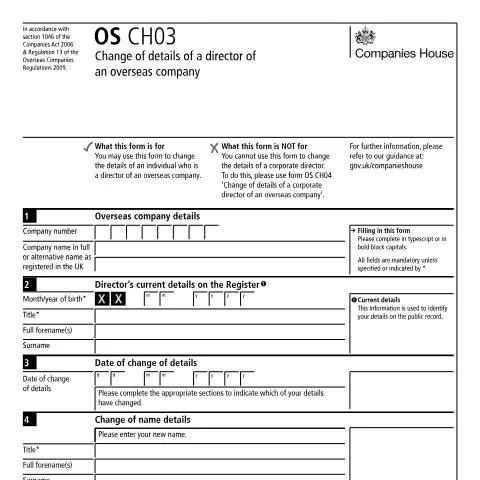
Directors of overseas companies registered in the UK face a continuous obligation to maintain accurate records with Companies House. When personal circumstances change—whether it's a new address, altered name, or shifted authority—these updates must be formally recorded through the OS CH03 form. This document serves as the official gateway for individual directors to amend their registered details, ensuring the public record reflects current information whilst maintaining compliance with the Companies Act 2006 and the Overseas Companies Regulations 2009.
The form addresses a specific scenario: overseas companies that have established UK operations but need to update individual director information on the public register. Unlike domestic companies, overseas entities face additional complexities around jurisdiction, authority structures, and multiple establishment reporting requirements.
Distinguishing Individual from Corporate Director Changes
Companies House maintains a clear distinction between individual and corporate director modifications. The OS CH03 form exclusively handles changes for individual persons serving as directors. If your overseas company needs to update details for a corporate director—another company acting in a directorial capacity—you must instead use form OS CH04.
This separation reflects fundamental differences in how personal versus corporate information is managed. Individual directors have residential address protections, nationality considerations, and personal authority structures that don't apply to corporate entities. The form's design acknowledges these nuances through specific sections for residential addresses that remain confidential and detailed authority descriptions.
Scope of Individual Director Updates
The OS CH03 form accommodates several categories of change:
- Name changes: Including title modifications, surname alterations, or forename updates
- Service address updates: The publicly visible business contact address
- Residential address changes: Protected information not shown on public records
- Nationality modifications: Reflecting citizenship changes or corrections
- Country of residence updates: When directors relocate between jurisdictions
- Authority alterations: Changes in directorial powers or joint acting requirements
Navigating the Authority Framework for Overseas Directors
Section 7 of the OS CH03 form addresses a critical aspect unique to overseas company structures: the extent and nature of directorial authority. Directors must specify whether their authority is limited or unlimited, and whether they can act alone or must act jointly with other individuals.
Limited authority requires a detailed description of the specific constraints or scope of the director's powers. This might include restrictions to particular business areas, geographic limitations, or financial thresholds. The form provides space for this explanation, recognising that overseas companies often implement complex governance structures that don't conform to standard UK patterns.
Joint Authority Requirements
When directors must act jointly rather than independently, the form captures the names of all individuals with whom joint action is required. This arrangement is particularly common in overseas companies where parent jurisdiction regulations mandate collective decision-making or where UK operations require oversight from multiple jurisdictions.
| Authority Type | Documentation Required | Public Record Impact |
|---|---|---|
| Unlimited | Simple selection on form | Full directorial status displayed |
| Limited | Detailed description of limitations | Specific constraints shown publicly |
| Joint action required | Names of all joint actors | Collective authority structure visible |
Managing Multiple UK Establishments Through Consolidated Filing
Overseas companies frequently operate through multiple UK establishments, each requiring separate registration with Companies House. Section 8 of the OS CH03 form addresses this complexity by allowing consolidated reporting. Rather than submitting separate forms for each establishment, companies can file a single OS CH03 covering all UK operations, provided they complete the establishment details table.
This consolidated approach streamlines compliance whilst ensuring each establishment's records remain accurate. The form captures both the establishment name and registration number, creating clear links between the director change and all affected UK operations.
Establishment-Specific Considerations
Each UK establishment must receive notification of director changes, but the consolidated filing mechanism prevents duplicate paperwork. Companies must carefully verify that all establishment details are current and correctly referenced. Errors in establishment information can delay processing or require additional correspondence with Companies House.
Address Confidentiality and Public Record Management
The OS CH03 form implements a two-tier address system recognising directors' privacy needs whilst maintaining public transparency. The service address appears on public records and serves as the official contact point for business correspondence. The usual residential address remains confidential, protected from public searches but available to Companies House for official purposes.
Directors can designate their residential address as their service address if they choose, but this decision makes their home address publicly searchable. Many directors prefer to use business premises, registered office addresses, or professional service providers for their public service address.
Residential Address Restrictions
Section 5a specifically prohibits certain address formats for residential addresses:
- PO Box numbers: Not acceptable as standalone residential addresses
- DX addresses: Document exchange addresses don't constitute residential locations
- LP numbers: Legal Post addresses in Scotland aren't residential addresses
These restrictions ensure that Companies House maintains genuine contact information for directors whilst respecting legitimate privacy concerns.
Timing Requirements and Effective Date Management
Section 3 of the OS CH03 form captures the crucial date of change of details, which determines when modifications take effect on the public record. This date should reflect when the change actually occurred, not when the form is submitted to Companies House. Accurate dating ensures compliance with statutory requirements and prevents confusion in the public record timeline.
The form follows UK date conventions (day/month/year format) and requires complete dates rather than approximate timeframes. Companies must maintain internal records supporting the declared change dates, as Companies House may request verification during processing.
Processing Timeline Expectations
While Companies House doesn't guarantee specific processing times on the form itself, overseas company filings typically require additional verification compared to domestic company submissions. The authentication requirements and establishment cross-referencing can extend processing periods, particularly during peak filing periods around financial year-ends.
Authentication and Submission Requirements
The OS CH03 form requires authentication from authorised individuals within the overseas company structure. Section 9 specifies that authentication may come from a director, secretary, or permanent representative of the company. This flexibility accommodates various overseas company governance structures whilst ensuring appropriate authorisation.
Authentication requires only a printed name—no physical signature is necessary. This approach reflects Companies House's modernisation efforts whilst maintaining security through identity verification processes.
Presenter Information Options
The form includes optional presenter information sections allowing companies to provide contact details for queries. While not mandatory, completing these sections can expedite resolution of any processing questions. However, presenter information becomes part of the public record, so companies should consider privacy implications when providing contact details.
The checklist provided with the form serves as a final verification tool, highlighting common submission errors that could delay processing. Key verification points include matching company names and numbers with existing registrations, ensuring physical addresses rather than postal services, and confirming all mandatory sections are complete.
Integration with Broader Compliance Frameworks
The OS CH03 form operates within the wider context of overseas company compliance obligations in the UK. Director changes often trigger related requirements, such as updating registered office details, modifying establishment registrations, or filing annual returns with amended director information.
Companies should coordinate OS CH03 submissions with their broader compliance calendar to ensure consistency across all filings. Discrepancies between director information on different forms can trigger Companies House queries and potentially delay other submissions.
Data Protection Considerations
The form's handling of personal information aligns with the Data Protection Act 2018 and UK GDPR requirements. While certain director information becomes publicly available, the legislation provides specific exemptions for company registration purposes. The confidential treatment of residential addresses reflects these privacy protections whilst maintaining necessary transparency for business operations.
Directors concerned about public information disclosure should review Companies House guidance on address confidentiality and consider whether additional privacy measures are appropriate for their circumstances. The distinction between service and residential addresses provides the primary mechanism for balancing transparency with privacy protection.
Notification Requirements for Significant Changes
Beyond the standard details covered in form OS CH03, certain types of directorial changes trigger additional notification requirements that overseas companies must carefully navigate. Understanding these cascading obligations prevents inadvertent compliance failures that could result in penalties or administrative complications.
When a director change involves someone who holds multiple roles within the company structure, the ripple effects extend beyond the basic appointment or resignation. For instance, if the departing or incoming director also serves as a company secretary, authorised signatory, or holds power of attorney for UK operations, these related positions must be addressed separately through appropriate forms and notifications.
Person with significant control (PSC) implications represent another critical consideration. If the director being appointed or removed also qualifies as a PSC under the Companies Act 2006 criteria—typically holding more than 25% of shares or voting rights, or exercising significant influence or control—the company must file additional PSC notifications within the prescribed timeframes. This dual reporting requirement often catches overseas companies off-guard, particularly when beneficial ownership structures span multiple jurisdictions.
The timing of notifications becomes particularly complex when directorial changes coincide with other corporate events. If a director appointment occurs simultaneously with share transfers, registered office changes, or amendments to constitutional documents, Companies House requires careful sequencing of filings to maintain accurate records. Some changes may need to be filed in a specific order to avoid rejection or processing delays.
For overseas companies with UK establishment branches, directorial changes often necessitate parallel notifications to different regulatory bodies. HMRC may require separate notification if the director has responsibilities for UK tax affairs, whilst sector-specific regulators—such as the Financial Conduct Authority for financial services firms—impose their own reporting timelines that may differ from Companies House requirements.
Documentation standards for supporting evidence vary significantly depending on the nature of the change. Routine appointments typically require minimal supporting documents, but changes involving directors from high-risk jurisdictions, politically exposed persons, or individuals with complex corporate structures may trigger enhanced due diligence requirements. Companies House may request additional verification documents, certified translations, or apostilled certificates depending on the circumstances.
The concept of "shadow directors" presents particular challenges for overseas companies. UK law recognises shadow directors—persons who aren't formally appointed but whose instructions the appointed directors regularly follow—and these individuals may need to be disclosed even if they don't appear on the company's own constitutional documents. This provision often catches multinational groups where parent company executives exercise de facto control over UK subsidiary operations without formal appointments.
Cross-Border Compliance and Regulatory Coordination
Managing directorial changes for overseas companies requires sophisticated coordination between UK requirements and home jurisdiction obligations. This multi-jurisdictional complexity demands careful attention to conflicting timelines, varying disclosure standards, and potential regulatory tensions that could impact the company's operations across different territories.
Tax residence implications often emerge as the most immediate concern following directorial changes. When a UK resident becomes a director of an overseas company, or conversely when a non-UK resident joins the board of a company with UK operations, the tax obligations can shift substantially. HMRC's statutory residence test may be triggered, potentially affecting both personal tax liabilities and corporate tax obligations depending on the director's role and time spent in the UK.
The interaction between UK disclosure requirements and home jurisdiction confidentiality laws creates recurring challenges. Some countries impose strict confidentiality obligations on corporate information that may conflict with UK transparency requirements. Companies must navigate these tensions carefully, potentially requiring legal opinions or regulatory clearances from home jurisdiction authorities before making UK filings.
Double taxation treaty provisions can significantly influence the practical implications of directorial changes. When directors trigger tax residence changes, the availability of treaty relief, the allocation of taxing rights between jurisdictions, and the application of tie-breaker rules become critical considerations. These factors may influence the timing of directorial changes or the structuring of director roles and responsibilities.
Banking and financial services compliance adds another layer of complexity. UK banks increasingly scrutinise overseas company accounts, and directorial changes—particularly involving individuals from sanctioned countries or high-risk jurisdictions—may trigger account reviews, enhanced due diligence requirements, or in extreme cases, account closures. Proactive communication with banking partners before filing directorial changes can prevent operational disruptions.
Regulatory coordination extends to sector-specific requirements that may not be immediately apparent. For example, overseas companies involved in UK property transactions, import/export activities, or professional services may need to notify additional regulatory bodies beyond Companies House. The timing and content of these notifications must be carefully coordinated to ensure consistent information across all regulatory touchpoints.
Data protection considerations under UK GDPR add complexity when directorial information crosses borders. The lawful basis for processing personal data, international transfer mechanisms, and retention periods must comply with both UK and home jurisdiction requirements. This is particularly relevant when directorial information is shared between group companies or when home jurisdiction authorities request copies of UK filings.
Corporate governance implications vary significantly between common law and civil law jurisdictions. What constitutes proper board authority for directorial appointments, the validity of resolutions passed in different jurisdictions, and the recognition of corporate actions across borders all require careful consideration. Companies House may reject filings if the underlying corporate authority is questionable under UK law principles, regardless of home jurisdiction validity.
Remedial Actions and Compliance Recovery
When overseas companies discover compliance gaps or filing errors related to directorial changes, the path to remediation requires strategic thinking and prompt action. Companies House provides various mechanisms for correcting errors, but the approach depends heavily on the nature of the mistake, the time elapsed, and the potential consequences of the error.
Late filing penalties represent the most immediate consequence of missed deadlines. The penalty structure for form OS CH03 follows a escalating scale, but overseas companies may qualify for reasonable excuse defences in certain circumstances. Acceptable reasons typically include postal delays from overseas jurisdictions, translation difficulties, or genuine misunderstandings about filing requirements. However, Companies House scrutinises these defences carefully and requires compelling evidence to support penalty appeals.
Voluntary error correction through amended filings demonstrates good faith compliance efforts and may influence penalty decisions. When companies discover errors—such as incorrect appointment dates, misspelled names, or wrong addresses—prompt correction through supplementary filings often receives more favourable treatment than corrections made only after regulatory inquiry or investigation.
The doctrine of substantial compliance sometimes applies when technical errors don't materially affect the accuracy or utility of the filed information. For instance, minor formatting inconsistencies, abbreviation variations, or non-material address differences may not invalidate an otherwise compliant filing. However, overseas companies should not rely on this principle for significant errors or omissions.
Regulatory engagement strategies become crucial when compliance issues escalate beyond routine error correction. Companies House investigators may initiate formal inquiries when patterns of non-compliance emerge or when directorial changes appear suspicious or incomplete. Early, proactive engagement with investigators—supported by comprehensive documentation and clear explanations—often produces more favourable outcomes than defensive or evasive responses.
The intersection between Companies House enforcement and other regulatory actions requires careful consideration. Directorial filing errors may trigger scrutiny from HMRC, sector-specific regulators, or law enforcement agencies. Companies must assess whether voluntary disclosure to other agencies is appropriate and coordinate their responses to avoid inconsistent statements or conflicting positions across different proceedings.
Professional indemnity considerations often arise when compliance failures result from professional adviser errors or omissions. Overseas companies may have recourse against UK solicitors, accountants, or company formation agents whose mistakes contributed to filing failures. However, pursuing such claims requires careful documentation of the advisory relationship and clear evidence of professional negligence or breach of duty.
Prevention strategies for future compliance focus on robust internal processes and clear accountability structures. Effective systems typically include automated reminder systems for filing deadlines, standardised procedures for collecting and verifying directorial information, and regular compliance audits to identify potential gaps before they become violations. Many overseas companies benefit from establishing UK-based compliance contacts who understand local requirements and can respond quickly to regulatory communications.
The cost-benefit analysis of different remediation approaches varies significantly depending on company circumstances. Simple error corrections may cost relatively little, whilst complex regulatory investigations can consume substantial resources with uncertain outcomes. Companies must weigh the costs of different approaches against the risks of ongoing non-compliance, considering both direct financial penalties and broader reputational or operational consequences.