Understanding the Official Form 106Sum: A Guide for Bankruptcy Filers
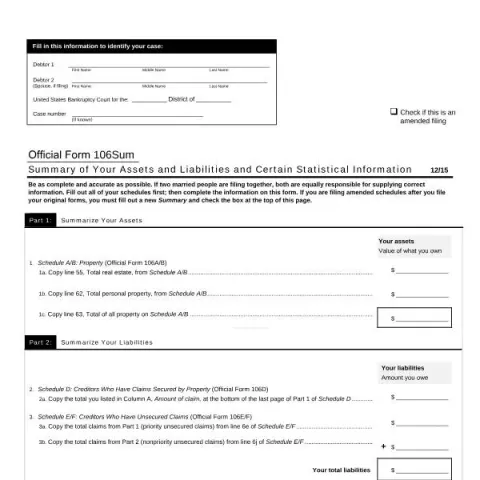
If you are considering filing for bankruptcy in the United States, one of the essential documents you will encounter is the Official Form 106Sum, titled Summary of Your Assets and Liabilities and Certain Statistical Information. This form serves as a comprehensive snapshot of your financial situation, providing the bankruptcy court with a clear overview of your assets, liabilities, income, and expenses. Properly completing this form is crucial for a smooth bankruptcy process.
The Purpose and Importance of Form 106Sum
Form 106Sum is designed to compile key financial data from your other bankruptcy schedules into a summarized format. It helps the court and creditors quickly assess your overall financial health, which influences decisions regarding the bankruptcy case, such as eligibility and repayment plans. The form is used in cases filed under Chapters 7, 11, or 13, and must be filled out accurately and completely.
Both debtors—whether single or married filing jointly—are responsible for providing precise information. If you are filing jointly with a spouse, both parties must ensure the data is correct, as the form reflects shared financial obligations and assets.
Preparing Your Form 106Sum
Gathering Necessary Information
Before filling out the form, gather your financial records, including:
- Schedules of real estate and personal property (Schedule A/B)
- Details of secured claims (Schedule D)
- Unsecured claims (Schedule E/F)
- Income sources (Schedule I)
- Monthly expenses (Schedule J)
Having these documents on hand will streamline the process and ensure accuracy.
Completing the Form
Form 106Sum is divided into four main parts:
- Part 1: Assets — Summarize your real estate, personal property, and total assets based on Schedule A/B.
- Part 2: Liabilities — List your secured claims from Schedule D and unsecured claims from Schedule E/F, calculating your total liabilities.
- Part 3: Income and Expenses — Enter your monthly income and expenses from Schedules I and J.
- Part 4: Additional Data — Provide answers regarding the type of bankruptcy filed and specific categories of debts, such as taxes or student loans, for statistical and administrative purposes.
Ensure that all figures are copied accurately from your detailed schedules. If you are filing an amended case, you must complete a new Form 106Sum and check the appropriate box at the top of the form.
Filing and Submission Procedures
The completed Form 106Sum must be submitted along with your other bankruptcy schedules and petitions to the United States Bankruptcy Court. Depending on your jurisdiction, filing can often be done electronically via the court’s electronic filing system or physically in person or by mail.
It is essential to adhere to the court’s deadlines—typically, the form should be filed within the same timeframe as your other bankruptcy documents. Failure to submit accurate and complete information can delay your case or result in dismissal.
Fill in your form directly online
No printing: type your details into the boxes of the official form, tick, then download the PDF ready to send.
- 1Type into the form boxes
- 2Tick in one click
- 3Save and download the PDF
Post-Filing Considerations and Follow-Up
After submission, the court reviews your Form 106Sum as part of your overall bankruptcy case. If discrepancies or omissions are identified, you may be asked to provide clarification or correction. Maintaining organized records of your financial documentation will facilitate any follow-up requests.
For any questions during the process, you can consult the court’s clerk or legal counsel experienced in bankruptcy procedures. Additionally, official resources and guidance are available through the United States Courts website.
Final Tips for Completing Form 106Sum
- Be thorough and precise; double-check figures against your schedules.
- Complete all relevant parts, especially if filing jointly with a spouse.
- Use official court forms and follow the latest version and instructions.
- Seek legal advice if you encounter complex financial situations or uncertainties.
Filling out the Official Form 106Sum accurately is a vital step in your bankruptcy journey. It ensures transparency, facilitates the court’s review, and helps you move forward with your financial fresh start.